


More news on this day
New cross-border train fleets for the Brenner corridor between Austria and Italy are moving from design offices to factory floors, as ÖBB and regional partners advance a generation of regional and long-distance trainsets intended to reshape passenger services over the high-traffic Alpine route.
Get the latest news straight to your inbox!
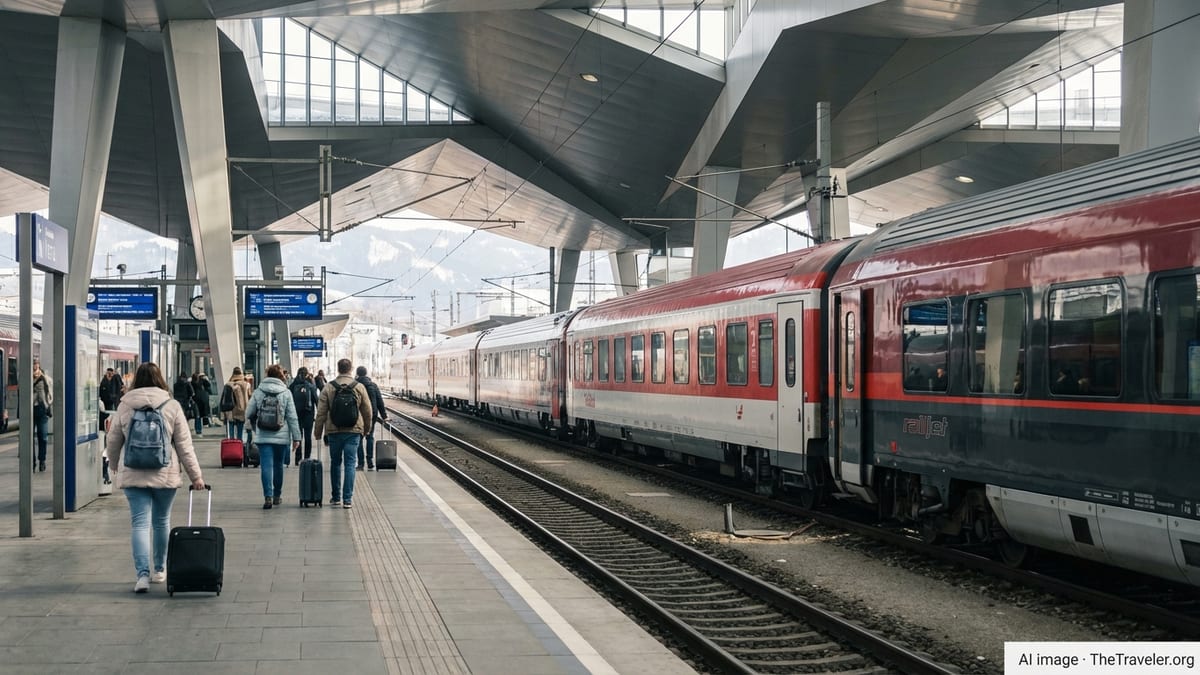
From concept to hardware on the Brenner corridor
Publicly available project information indicates that the Brenner axis is a central focus of Austria’s current rolling stock and infrastructure investment program, with new trains planned to complement the future Brenner Base Tunnel as well as upgrades on the existing mountain line. The Brenner railway links Innsbruck with the border at Brenner/Brennero and onward into Italy, and has long been constrained by steep gradients, tight curves and heavy mixed traffic.
Austria’s 2024 infrastructure and corporate reporting points to sustained growth in passenger numbers and a push for more capacity, comfort and accessibility on key domestic and cross-border routes. This includes the Brenner corridor, which is being upgraded as part of a wider program of northern approach works and station enhancements in Tyrol. These efforts aim to create room for more regional and long-distance services while freight traffic is expected to shift into the future base tunnel.
Within this context, new regional trainsets for cross-border operation over Brenner are beginning to take shape alongside the latest generation of long-distance Railjet formations. While infrastructure schemes will unfold over the rest of the decade, rolling stock orders placed in recent years are now entering detailed engineering and manufacturing phases at Stadler and other European plants.
The Brenner line’s importance as a gateway between Austria, Italy and wider European markets means that regional trains must meet both domestic and international requirements, including multi-system operation, language-neutral passenger information and compliance with differing platform and accessibility standards on each side of the border.
Tyrol–South Tyrol regional fleets set for cross-border duty
In parallel with ÖBB’s national fleet renewal, regional authorities in the Italian province of South Tyrol have ordered new electric trainsets designed explicitly for cross-border operation into Tyrol. According to regional tender and project summaries, these units are from the Alstom Coradia Stream family and are being procured for services that will run north from South Tyrol over Brenner into Austrian territory.
Reports from rail industry observers note that test runs of South Tyrolean regional trains have already taken place on Austrian tracks, indicating that the cross-border concept is moving beyond planning and into on-network validation. These trains are being designed to work in close coordination with ÖBB’s own regional fleets, with harmonised boarding heights, multi-language passenger information and bicycle and luggage areas configured for both daily commuters and leisure traffic.
The cross-border regional concept is intended to deliver through services between Tyrol and South Tyrol, replacing the need for passengers to change at the frontier station of Brenner/Brennero. Travel planners expect that eliminating these transfers, combined with higher capacity rolling stock, will make rail more competitive against road traffic on the pass, particularly during the busy tourist seasons.
The new regional trainsets are being dimensioned for steep-gradient operation and frequent stops, reflecting the mix of local, regional and cross-border flows on the Brenner route. Their deployment is planned to align with progressive electrification and capacity enhancements on connecting lines in northern Italy and western Austria.
Stadler platforms underpin ÖBB’s next-generation fleets
While cross-border regional services over Brenner rely partly on Italian-ordered stock, ÖBB is reshaping its own fleet around Stadler’s double-deck KISS platform and related multiple-unit families. Recent media releases and technical summaries show that ÖBB has placed framework orders for up to 186 KISS-based electric multiple units in four, five and six car formations, with maximum operating speeds of 160 or 200 km/h depending on configuration.
These trains are being delivered in several variants: Cityjet-branded regional and S-Bahn sets, Railjet-branded long-distance formations and units dedicated to Vienna’s City Airport Train. While the bulk of the initial order is earmarked for the eastern region around Vienna and for main line services between Vienna, Linz and Salzburg, published coverage indicates that the same platform will also underpin long-distance services traversing the Brenner axis.
Stadler has concentrated double-deck multiple unit production at its site in St. Margrethen, close to the Austrian border, which has been developed as a competence centre for KISS trains. Engineering hubs in Austria support adaptation of the type to national rules, route clearances and passenger expectations, including interior layouts that balance commuter needs with regional and intercity comfort.
For Brenner, the KISS-based Railjet generation is expected to offer higher capacity in a similar train length to existing locomotive hauled formations, while improving acceleration on steep gradients and through frequent stops. The platform’s modularity simplifies tailoring of door positions, seating densities and on-board amenities to the specific demands of cross-border services.
Preparing operations around construction and the Brenner Base Tunnel
Infrastructure development on the Brenner axis is advancing in parallel with rolling stock work. ÖBB’s recent infrastructure reports highlight preparatory works for the northern approach to the Brenner Base Tunnel, with new junctions, passing tracks and capacity enhancements being rolled out in the Tyrolean Unterland region. Stations such as Fritzens-Wattens and Schwaz are being reconfigured to handle more trains, including longer and heavier formations.
Timetable and construction notices for 2026 already indicate periods when regional services between Innsbruck and Brenner will be partially or fully replaced by buses to allow intensive works on the existing line. These interruptions are scheduled to be temporary, with the objective of delivering a more resilient corridor that can host both the emerging generation of regional fleets and long-distance Railjet services while base tunnel construction continues.
The Brenner Base Tunnel itself is conceived as the future backbone for long-distance and freight flows between Austria and Italy, with a new high-capacity line connecting to Verona in the south and to upgraded approaches in the north. Once operational, the base tunnel is expected to divert a significant share of long-distance traffic away from the current mountain line, freeing up the historic route for denser regional and cross-border stopping services.
In this scenario, the combination of new regional multiple units from South Tyrol, modernised ÖBB regional fleets and KISS-based Railjet sets would allow operators to segment traffic more efficiently. Fast trains could use the low gradient base tunnel alignment, while frequent local and regional trains provide improved connectivity for communities along the traditional Brenner railway.
Passenger-focused features for a changing Alpine corridor
Design documentation and manufacturer materials for the latest KISS and Coradia Stream generations place strong emphasis on accessibility, digital connectivity and multi-purpose spaces. Low-floor entrance areas, step-free boarding where platform heights permit, and barrier-free toilets are standard features across most of the new fleets being readied for Brenner-related services.
On-board layouts are being configured with dedicated areas for bicycles, ski equipment and bulky luggage to reflect the route’s mix of daily commuters, students and tourists. Information systems are planned to operate in multiple languages, reflecting the bilingual environment of South Tyrol and the international character of the Brenner corridor, while modern climate control and LED lighting are intended to improve comfort in both summer heat and winter conditions at altitude.
Digital systems are another focus area, with preparations for reliable Wi-Fi, high-capacity power outlets and real-time passenger information across national borders. These features support ÖBB’s broader strategy of presenting long-distance trains as an alternative to short-haul flights and regional services as a credible substitute for car travel over the pass.
As the various workstreams on infrastructure, fleet acquisition and cross-border coordination converge, the Brenner corridor is set to see a phased transformation over the next several years. The regional and long-distance trainsets now taking shape in factories across Europe will play a central role in how passengers experience one of the continent’s most important Alpine rail links.