


Orlando International Airport is one of the busiest gateways in the United States for theme park and cruise visitors, and for many of them a rental car is the easiest way to get from the terminal to Disney, Universal and beyond. Yet between three terminals, on-airport and off-airport rental desks, toll roads, and dense resort traffic, it is easy for first-time visitors to feel overwhelmed. This guide breaks down exactly how rental cars work at Orlando International Airport today, from where to pick up the keys in Terminals A, B and C to how to handle tolls and decide whether you really need a car for your trip.
Get the latest updates straight to your inbox!
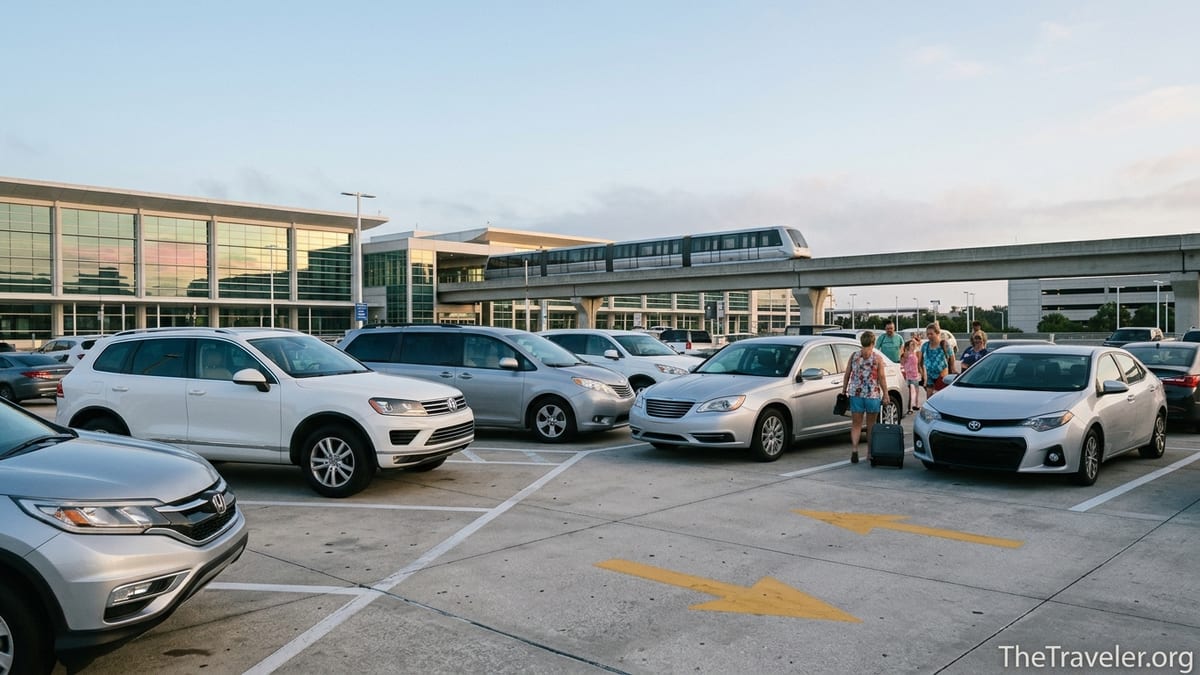
How Orlando International Airport Is Laid Out for Rental Cars
Orlando International Airport (airport code MCO) is split into a main terminal complex, which houses Terminals A and B, and a separate South Terminal complex for Terminal C. A short people-mover train called Terminal Link connects Terminal C to the main A/B complex in a few minutes. For rental car customers, this matters because the counters and garages for the big on-airport brands are inside these buildings rather than at a remote consolidated facility, so you will walk from baggage claim to your car instead of taking a long shuttle ride.
In practical terms, most arriving domestic passengers will land at an airside concourse, ride a short tram to either the A/B main terminal or the C terminal building, collect their bags, then follow signs to “Ground Transportation” and “Rental Cars.” Rental car counters serving Terminals A and B sit on Level 1, the ground transportation level of the main terminal, while Terminal C rental desks are located on Level 4 in its main building. The vehicles themselves are stored in the parking garages attached to each complex, a short walk via tunnels or bridges from the counters, so pickup is generally fast once you reach the right level.
Because the airport has grown in phases, some companies operate in more than one terminal. For example, large brands like Hertz, Avis, Budget, Enterprise, Alamo, National and Sixt have counters at both the A/B complex and Terminal C, giving you multiple pickup options if you arrive early, late or need to switch sides. Smaller regional and value brands are more likely to be off-airport, accessed by shuttle from designated pickup spaces outside each terminal.
Lines and congestion can vary by time of day and season. Summer school holidays, spring break, and major events such as theme park festivals often bring long queues at the counters, especially when several international flights arrive close together in Terminal C. If your flight is landing late at night during a busy period and you have a choice when booking, it can be worth checking typical reviews and recent customer feedback for the specific terminal location of your preferred rental company, as some travelers report shorter lines in the A/B complex compared with Terminal C during peak international arrival waves.
On-Airport Rental Desks and Where to Find Your Car
Orlando is unusual in that many of the biggest rental brands are inside the terminal buildings themselves. At Terminals A and B, the on-airport counters sit on Level 1 of the main terminal, one level below baggage claim. As you exit the baggage carousel area, you will see overhead signs pointing toward “Rental Cars A-Side” and “Rental Cars B-Side.” Both sides host major brands such as Alamo, National, Enterprise, Hertz, Dollar, Thrifty, Avis, Budget and others, so in most cases you simply follow the side indicated on your confirmation email, present your ID and credit card, then proceed through the tunnel to the attached garage where your car is parked.
Vehicle pickup for the A/B complex is typically in the lower levels of Garages A and B, directly across from the terminal building and connected via enclosed walkways. For example, a Hertz or Avis reservation at the main terminal usually means you check in at Level 1 and walk to the assigned row in the garage, with car classes such as full-size sedans, midsize SUVs or minivans grouped together. Some loyalty programs allow you to bypass the counter completely: members of National’s Emerald Club or Hertz Gold Plus Rewards, for instance, may go directly to a designated aisle in the garage, choose any car in their category, and exit through the gate with their license and reservation details.
At Terminal C, which handles many JetBlue, foreign airline and some domestic flights, on-airport rental desks are located on Level 4 of the terminal building. After baggage claim, you take escalators or elevators up, following “Car Rental” signs. Brands including Enterprise, Alamo, National, Hertz and Sixt operate rental facilities linked to the adjacent Garage C, where their cars are stored on specific levels marked with color-coded signage. Feedback from recent travelers suggests that while Terminal C’s rental area is modern and well signed, queues can occasionally be long during afternoon and evening banks of international flights, so mobile check-in or loyalty status can save time.
If your itinerary is flexible and you are staying overnight at an airport hotel like the Hyatt Regency Orlando International located over the A/B terminal, you can also choose to pick up your car the following morning from the A/B complex instead of Terminal C. Some travelers deliberately take the Terminal Link people-mover from C to A/B the next day to access larger vehicle selections or specific loyalty aisles. The airport layout allows this sort of flexibility, but it requires paying close attention to the pickup terminal listed on your reservation so you arrive at the right desk.
Off-Airport Rental Companies and Shuttle Pickup Areas
Not every rental brand operates counters inside the terminals. A substantial number of budget and independent car rental companies are located along nearby roads such as McCoy Road and Semoran Boulevard, typically within a 10 to 15 minute drive of the airport. Names you might encounter online include Ace, Fox, Green Motion, Easirent, Economy, Nu, York and several local operators. These firms usually advertise lower daily base rates, especially on compact and midsize cars, but rely on free shuttle buses from the airport to move customers to and from their lots.
If you book one of these off-airport companies, your confirmation should state “shuttle” or “off-airport” and give instructions for where to meet the van. At Terminals A and B, the standard pickup zone for off-airport rental car shuttles is on Level 1, Ground Transportation, in designated spaces typically labeled A11 to A13 on the A side and B11 to B13 on the B side. At Terminal C, the equivalent off-airport shuttle area is on Level 1 Ground Transportation in marked spaces in the C2xx range. Airport wayfinding signs directing you to “Off-Airport Rental Car Shuttles” or “Rental Car Shuttle Buses” are posted in the arrival halls and at the curb.
In real terms, this means that after collecting your bags you proceed to Ground Transportation, cross to the curbside, and wait at the numbered bay for your company’s shuttle, which usually runs every 10 to 30 minutes depending on the hour. For example, a traveler with a reservation at a McCoy Road value brand might be instructed to wait at space A12, watch for a shuttle labeled with the company’s name, and then ride 8 minutes to a low-rise office and fenced lot. It is common for these companies to cluster along the same stretches of road, so your shuttle may share a route with other brands or make multiple stops.
Off-airport locations can be a good value for longer trips, but they introduce a few tradeoffs. Pickup and drop-off typically take longer because you must wait for the shuttle and allow for traffic on access roads. Per-day rates may be lower but additional fees for toll programs, insurance or fuel can be higher than at major brands. Before committing to a deep discount, it is worth reading recent reviews for your chosen company, checking their operating hours if you arrive late at night, and verifying that their shuttle runs to your terminal even during schedule disruptions or weather delays.
Driving Out of the Airport, Toll Roads and SunPass Options
Once you exit the garage or rental lot at Orlando International, you will immediately encounter a network of toll roads that serve the region’s resorts and suburbs. The most common routes for visitors are State Road 528 (the Beachline Expressway) west toward International Drive and Universal Orlando, State Road 417 (Central Florida GreeneWay) toward the Lake Nona area and Disney’s eastern entrances, and State Road 408 toward downtown Orlando. Many of these toll roads use electronic collection via E-PASS or SunPass, with some mainline plazas also accepting cash in attended lanes, though exact cash coverage has been reduced in recent years.
Most major rental car companies in Orlando equip their vehicles with built-in toll transponders integrated into the windshield or interior mirror area. Programs go by different names but work in a similar way: if you drive through an electronic toll without paying cash, the transponder is activated, and the rental company later charges your card for the tolls plus a service fee. For instance, a typical plan might charge the actual toll amounts plus a convenience fee of around 4 to 6 dollars per day the system is used, sometimes capped at a weekly maximum. That means one short tolled trip from the airport to a resort could trigger several days of fees if you are not careful about opting in or avoiding toll roads.
To manage costs, ask at the counter exactly how tolls are billed and choose the option that fits your itinerary. If you plan a single day trip to Kennedy Space Center via State Road 528 and 407, using the rental company’s built-in transponder may be worth the modest surcharge compared with the hassle of finding cash or avoiding tolls. If you expect to drive tolled routes daily between a villa in Kissimmee and Universal, the per-day fees can add up quickly and you might prefer a visitor toll product. Orlando’s expressway authorities promote a Visitor Toll Pass, a hangtag that offers native SunPass rates and is typically picked up and returned at kiosks in the airport parking garages; this can be a cost-effective alternative for families staying a week or more and repeatedly driving on toll roads.
If you prefer to avoid tolls entirely, your navigation app can be set to “avoid tolls,” routing you along US 17/92 or local roads. However, these non-toll alternatives are often slower and involve more traffic lights, particularly around resort corridors. In peak periods such as Friday afternoons on International Drive or around Disney Springs in the early evening, avoiding toll roads can double your travel time. For many visitors heading straight to theme parks with tired children and luggage, using toll expressways for at least the first airport-to-hotel leg is often the most practical choice, even if it adds a few dollars to the final bill.
Insurance, Fees and What to Expect at the Counter
Insurance and extras are where Orlando rental costs can rise quickly if you are not prepared. At the counter, the agent will usually offer a collision damage waiver (CDW or LDW), supplemental liability coverage, roadside assistance packages, and sometimes prepaid fuel, toll plans and GPS devices. For a standard midsize SUV, a CDW alone can add 20 to 35 dollars per day, while supplemental liability might add another 10 to 15 dollars. Roadside assistance, which may include lost key coverage or jump-start service, often appears as a smaller line item but is rarely essential if you already have similar coverage through a roadside membership or your personal auto policy.
If you own a car in the United States, your existing auto insurance may extend collision and liability coverage to a rental car for personal use, though deductibles and limits still apply. Many major credit cards, especially those with travel rewards, also include secondary or primary collision damage coverage when you pay the entire rental cost with that card and decline the rental company’s CDW. For example, a traveler using a mid-tier travel rewards Visa or Mastercard might rely on their personal auto policy for liability and the card’s collision benefit for damage to the rental vehicle, saving 25 dollars per day in fees. Before traveling, it is wise to call your insurer and card issuer to confirm exactly what is covered in Florida and whether any vehicle types, such as large SUVs or vans, are excluded.
International visitors who do not have US auto insurance or a credit card with robust rental coverage may find it safer to accept at least the rental company’s collision damage waiver, especially when driving heavily trafficked routes around the parks. Orlando sees millions of tourists each year, many unfamiliar with local driving norms or distracted by unfamiliar surroundings, and minor fender-benders in hotel parking lots are not uncommon. A CDW that limits or removes your financial responsibility for damage to the rental car can provide peace of mind, though you should still inspect the vehicle thoroughly before leaving the garage and photograph any existing scratches, dents or curb rash on wheels.
Other fees to watch for include additional driver charges, under-25 surcharges, and one-way fees if you plan to drop the car at another Florida airport such as Tampa or Miami. A typical additional driver fee can be around 10 to 15 dollars per day, though many companies waive it for spouses or domestic partners and for members of certain loyalty programs. Drivers under 25 often pay extra per day, and some specialty vehicles such as convertibles or large SUVs may not be available to younger renters. At pickup, review the contract on the screen or paper before signing, and do not hesitate to ask the agent to remove any optional extras you did not request, such as roadside assistance or added insurance that was pre-selected.
Is a Rental Car Worth It for Orlando Theme Park Trips?
Whether you truly need a rental car in Orlando depends heavily on where you are staying and how you plan to spend your time. For a family staying at a Walt Disney World resort and focusing almost exclusively on Disney parks, Disney Springs and hotel pools, a car is often optional. Disney operates extensive internal buses, boats and a monorail system between its hotels and parks, and ride-share services such as Uber and Lyft are widely available. In that case, you might save hundreds of dollars in rental, fuel and parking costs over a week by skipping the car and using airport transfers plus occasional ride-shares.
By contrast, if your itinerary spans multiple destinations, such as spending three days at Walt Disney World, two days at Universal Orlando, a day at Kennedy Space Center and an outlet shopping run near International Drive, a rental car becomes far more useful. While it is technically possible to string together ride-shares for each leg, a one-way ride between Disney’s Pop Century Resort and Universal’s CityWalk entrance can cost roughly the same as one or two days of an inexpensive compact rental car, especially during high-demand periods. For a group of four or five people traveling with strollers or sports gear, the convenience of packing everything into a minivan in the hotel garage and driving on your own schedule is often worth the incremental cost.
Parking fees are another key factor. Disney World theme parks charge a daily parking fee for guests staying off-site, while on-site Disney hotel guests are currently exempt from theme park parking charges. Universal Orlando charges daily parking at its garages, and many off-site hotels along International Drive add nightly resort or parking fees as well. If your hotel offers free parking and you frequently drive out for meals, grocery runs or side trips to places like Lake Eola Park downtown or the airboat wetlands tours south of Orlando, a rental car can quickly pay off in convenience. If your chosen hotel charges high parking fees and you plan to remain mostly on property, however, it can be more economical to rely on shuttles and ride-shares.
For visitors planning nature or beach day trips, a car is almost essential. Public transportation from Orlando’s resort corridor to places like Cocoa Beach, New Smyrna Beach or Wekiwa Springs State Park is limited and slow, and organized tours may not operate on your preferred dates. A modest compact or midsize rental makes it easy to leave early, stop at a supermarket for picnic supplies, and detour to a viewpoint without worrying about schedules. When you factor in the ability to drive to a nearby supermarket such as Publix or Target to stock a vacation rental kitchen or buy inexpensive ponchos and snacks instead of paying theme park prices, the value of a rental car becomes clearer for many families staying more than a few days.
Practical Tips for a Smooth MCO Rental Experience
A bit of planning before you land can dramatically improve the rental process at Orlando International. First, verify which terminal your airline uses and which terminal is listed on your rental confirmation. If your airline arrives in Terminal C but your preferred company’s loyalty aisle and vehicle selection are stronger in the A/B complex, you can ride the Terminal Link people-mover and follow signs to the appropriate side. Just allow extra time and be sure your reservation does not specify a separate off-airport or city location, which would require a shuttle or taxi.
Second, consider your luggage and group size when choosing a vehicle category. Many Orlando visitors are families traveling with large suitcases, strollers and sometimes collapsible coolers or souvenirs. A midsize SUV or minivan may cost a bit more per day than a compact sedan but can save headaches when loading for an early-morning rope drop at Magic Kingdom or a late evening return from Universal’s nighttime shows. At the garage, take a moment to test how easily the stroller or wheelchair folds and fits behind the third row before you leave, and adjust seating so everyone has sufficient space for long drives to attractions like Kennedy Space Center or the Gulf Coast beaches.
Third, program your navigation before exiting the garage. Cellular coverage inside concrete parking structures can be patchy, so a practical trick is to sit in the car while still parked, connect your phone to the vehicle’s CarPlay or Android Auto if available, and pre-load directions to your hotel, villa or theme park. When you pull out, watch for overhead signs on the airport loop road directing you to “South Exit / 417 / 528” or similar. A typical route to Disney-area hotels from the A/B garages involves following the south exit signs to State Road 417 or 528, then transferring to World Drive or Interstate 4; from Terminal C, you will see similar signage guiding you directly to the expressways.
Finally, plan your return strategy. Morning peak hours on airport access roads and tollways can be busy, especially on weekends when cruise ships dock at Port Canaveral or during school holidays. If you are returning a car to the A/B garages before an early flight, allow at least 30 extra minutes to refuel at a station near the airport, navigate to the correct garage entrance, unload bags, and walk to the terminal. From a Disney or Universal area hotel, many renters find that leaving 2.5 to 3 hours before a domestic flight gives comfortable margin: roughly 30 to 45 minutes drive plus fuel stop, 30 minutes for vehicle return and terminal walk, and the remainder for check-in and security.
FAQ
Q1. Where exactly are the rental car counters at Orlando International Airport?
Rental car counters for most major brands are on Level 1 of the main A/B terminal and on Level 4 of Terminal C. After baggage claim, follow signs for “Ground Transportation” or “Car Rental” to reach the desks, then walk to the adjacent parking garages where vehicles are parked.
Q2. Can I pick up my rental car in one MCO terminal and drop it at another?
Within Orlando International, you typically return the car to the same terminal complex where it was picked up, because each complex has its own garage and return lanes. However, some brands that operate in all terminals may accept returns at a different MCO terminal if arranged in advance. Confirm this with your rental company before changing return plans.
Q3. How long does it usually take to pick up a rental car at MCO?
Outside peak periods, many travelers report being in their car within 30 to 45 minutes of landing, including baggage claim time. During busy times such as summer holidays or Saturday afternoons at Terminal C, counter queues can add 30 minutes or more, especially with off-airport shuttles. Using loyalty programs that allow counter bypass and ensuring your reservation details are complete can significantly reduce wait times.
Q4. Do I really need a car for a Disney World vacation?
If you are staying at a Disney resort and plan to spend almost all your time on Disney property, you can usually manage without a car by relying on Disney transportation and ride-shares. If you plan to visit Universal Orlando, SeaWorld, outlet malls or beaches, a rental car becomes much more practical. The decision often comes down to how frequently you will leave your main resort area and how comfortable you are relying on app-based rides.
Q5. What is the best way to handle tolls in an Orlando rental car?
Most rental cars come equipped with toll transponders that charge actual tolls plus a daily service fee when used. This is convenient for occasional tolled trips. For frequent toll use over a week or longer, a visitor toll product that charges native SunPass or E-PASS rates can be more economical. If you prefer to avoid extra fees, set your navigation to avoid tolls, but be prepared for slower routes and more traffic lights.
Q6. Are off-airport rental companies around MCO a good deal?
Off-airport companies often advertise lower daily rates, particularly on compact cars, and can be a good value for longer rentals if you are price sensitive and flexible. However, you must factor in shuttle time, more limited operating hours, and the potential for extra fees on insurance and tolls. Reading recent reviews and confirming shuttle pickup instructions from your arrival terminal is essential before choosing a deep-discount provider.
Q7. Is driving in Orlando difficult for visitors who are not used to US roads?
Most visitors adapt quickly, as major routes to the parks are multi-lane highways with clear signage. The main challenges are heavy traffic around resort exits, frequent lane changes on Interstate 4, and aggressive merging during peak times. Using navigation, planning exits in advance, and allowing extra time help reduce stress. For drivers unused to right-hand traffic, starting with a daylight airport-to-hotel drive via toll expressways can make the adjustment easier.
Q8. What size of rental car is best for a family visiting Orlando?
For a family of four with large suitcases and a stroller, a midsize SUV is often a good balance of space and cost. Larger families or groups of five or more frequently choose minivans for their sliding doors and luggage capacity. Couples or solo travelers focused on city and theme park driving can usually manage with a compact or midsize sedan, provided they pack light.
Q9. How early should I return my rental car before a flight from MCO?
For domestic flights, many travelers aim to be at the rental return area about two hours before departure, or earlier during peak seasons. From hotel zones near Disney or Universal, leaving 2.5 to 3 hours before your scheduled departure typically allows for drive time, a quick refueling stop, car return, and terminal check-in. International flights or travel during major holidays may warrant even more buffer.
Q10. Are there alternatives to traditional rental car companies at Orlando Airport?
Yes. Peer-to-peer car-sharing platforms operate at Orlando, with hosts arranging vehicle pickup in designated airport parking areas or nearby lots. These options can sometimes offer unique vehicles or flexible pickup times, but policies vary by host and platform, and you should carefully review instructions on exactly where to meet the car, how to handle tolls, and what insurance coverage is included.