


More news on this day
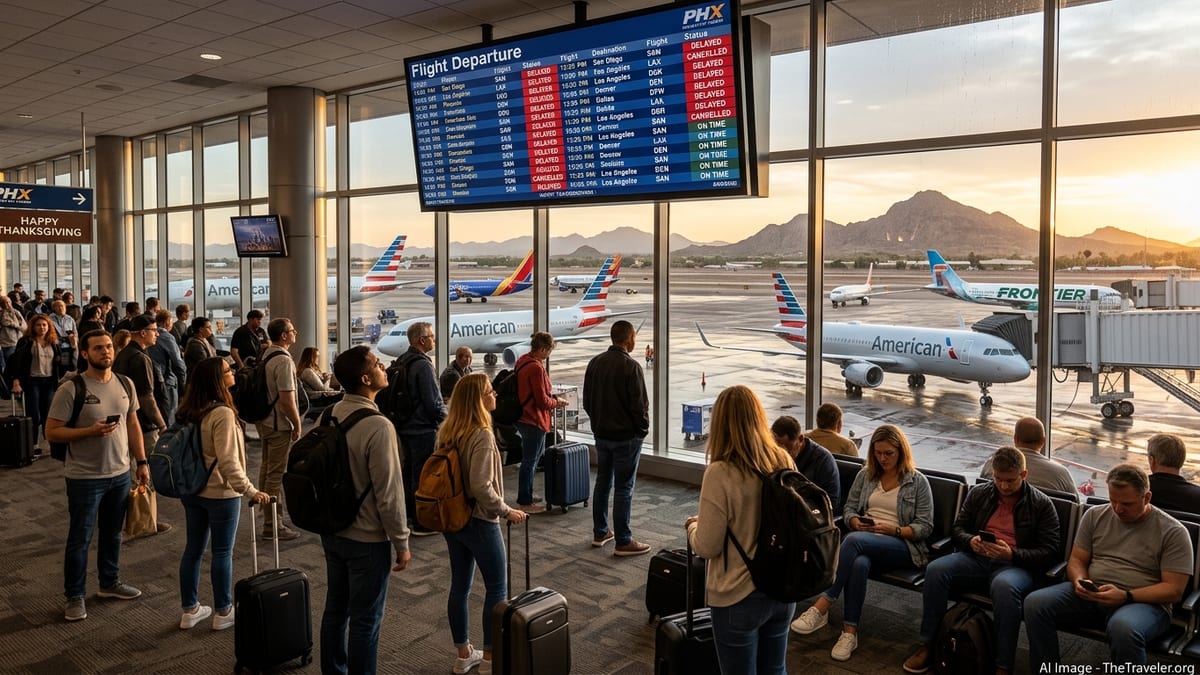
Phoenix Sky Harbor International Airport entered the 2026 Thanksgiving travel period with more than 100 delayed flights on Wednesday, November 25, as heavy holiday demand and congestion at other Western U.S. hubs combined to slow departures and arrivals for one of the airport’s busiest weeks of the year.
Get the latest news straight to your inbox!
How the delays built up as the holiday rush began
According to airport and flight-tracking data, Phoenix Sky Harbor saw over 100 delayed flights on Wednesday, November 25, 2026, as the main outbound Thanksgiving travel wave gathered speed. The disruption coincided with what local and federal authorities had already warned would be an exceptionally busy stretch for the airport, which serves as a major hub for American Airlines and a large base for Southwest and Frontier.
A report published late Wednesday noted that Sky Harbor’s delays were not primarily caused by local weather problems. Instead, many flights were affected by congestion and traffic management measures elsewhere in the network, including a Federal Aviation Administration ground delay program at San Diego International Airport triggered by above-normal traffic volumes. Aircraft and crews arriving late from other airports fed into knock-on delays in Phoenix, particularly for afternoon and evening operations.
Real-time departure boards on Thursday, November 26, show that operations at Sky Harbor have largely normalized, with most flights listed as on time or only modestly delayed and a smaller number canceled outright. However, airlines are still working through residual schedule pressures from the previous day’s disruptions and from a series of earlier national and carrier-specific issues that have strained the system in the run-up to Thanksgiving.
Recent system strains: from ground stop to airline glitches
The midweek delay spike at Phoenix followed several days of wider stress across the U.S. air travel network. On Friday, November 13, 2026, the FAA imposed a nationwide ground stop that temporarily halted departures across the country, including at Sky Harbor. American Airlines later described the stop as lasting several hours, and local media reported that passengers at Phoenix faced long waits and missed connections as the backlog of flights was slowly cleared in the days that followed.
More recently, Delta Air Lines experienced an outage affecting its baggage system on Sunday, November 22, leading to widespread delays for the carrier. Phoenix was among the airports where Delta flights ran late as the airline recovered its operation. Local television coverage from Phoenix showed Delta passengers preparing for Thanksgiving trips reporting late departures and longer-than-expected times waiting at gates as aircraft and baggage were repositioned.
These events have contributed to a fragile operating environment heading into what is typically one of the busiest travel weeks of the year. Industry and government data indicate that many major U.S. airports have been running with higher-than-usual delay rates in November, and that problems in one part of the network can quickly ripple outward even when conditions at a particular airport appear favorable.
Passenger volumes and what to expect at Sky Harbor this week
Even before the midweek spike in delays, officials had been preparing travelers for a crowded Thanksgiving period at Phoenix Sky Harbor. The Transportation Security Administration’s local office said this week it was fully staffed for the holiday and expected heavy passenger traffic, in line with national forecasts that roughly 81.5 million people would travel at least 50 miles from home between Tuesday, November 24, and Monday, November 30. Within that total, several million are projected to fly, with Phoenix ranked among the nation’s larger origin-and-destination airports.
Recent City of Phoenix and airport guidance notes that the Thanksgiving holiday is observed on Thursday, November 26, and Friday, November 27, 2026, and advises travelers that airport roadways, parking facilities and security checkpoints are likely to be busy for several consecutive days. Phoenix Sky Harbor’s own tools show that checkpoint wait times fluctuate significantly across the day, with the early morning and late afternoon windows historically among the most crowded during holiday peaks.
Monthly statistics from the airport indicate that Sky Harbor served more than 44 million passengers in the most recent full year, placing it among the busier U.S. airports by passenger traffic. Local reports ahead of the holiday suggested that the 2026 Thanksgiving period could include some of the airport’s single busiest days of the year, even as overall national travel demand is expected to edge slightly lower compared with last year.
Causes of Wednesday’s disruption and limits of current information
The specific tally of “over 100” delays for Wednesday, November 25, is based on counts from airport dashboards and flight-status services that aggregate departures and arrivals into delayed and on-time categories. These figures typically define a delay as a departure or arrival operating at least 15 minutes behind schedule. Because they draw on near-real-time operational data, the exact number can change as additional flights push back or land later than planned.
Information published Wednesday indicates that Sky Harbor’s disruption was aggravated by an FAA ground delay program at San Diego International Airport, which restricted the rate at which flights could depart and arrive there because of the volume of traffic. Phoenix, which has frequent services to and from San Diego on multiple carriers, was among the airports affected as aircraft scheduled to arrive from Southern California were held or slowed, in turn pushing back later legs of the same aircraft or crews.
There is no indication from current official sources that Phoenix experienced a local ground stop, runway closure or major weather event on Wednesday that would have independently generated such a large spike in delays. Instead, the picture that emerges from FAA advisories, airline statements and airport messaging is of a system strained by exceptionally high demand, lingering operational aftereffects from earlier national issues and localized air-traffic constraints at other West Coast airports. As of Thursday morning, no authority has reported a significant infrastructure failure or safety incident at Sky Harbor related to the Wednesday delays.
Practical advice for travelers using Phoenix Sky Harbor
For travelers flying into or out of Phoenix across the Thanksgiving period, airport and airline guidance remains consistent: check flight status frequently before leaving home, build extra time into itineraries and be prepared for occasional longer waits at check-in, security or the gate. Phoenix Sky Harbor’s website and airline apps provide real-time departure and arrival information, and the airport also publishes current security checkpoint wait estimates to help passengers choose the quickest screening point when possible.
Parking and curbside access are particular pressure points during the holiday week. The City of Phoenix and airport officials have recommended that passengers consider reserving parking in advance where options exist, or using public transport and ride-hailing services to reduce congestion on terminal roadways. Construction and lane restrictions near some terminal approaches, highlighted in recent local coverage, may lengthen the time it takes to reach drop-off points during peak hours.
Looking ahead to the rest of the Thanksgiving period, the key operational dates are expected to be Sunday, November 29, and Monday, November 30, when many travelers return home. Airlines will be working to keep schedules stable following Wednesday’s disruption, but given the broader national picture of intermittent delays, passengers should continue to monitor conditions closely. Travel plans for later in the week, particularly for tight connections or last flights of the day, may benefit from added flexibility, such as allowing longer connection windows or considering earlier departures when available.