


More news on this day
A FedEx Express MD-11 cargo jet arriving from Memphis overran a runway at Miami International Airport on the evening of November 25, 2026, prompting a temporary ground stop for incoming flights and causing delays for passengers on one of the busiest nights of the Thanksgiving travel period.
Get the latest news straight to your inbox!
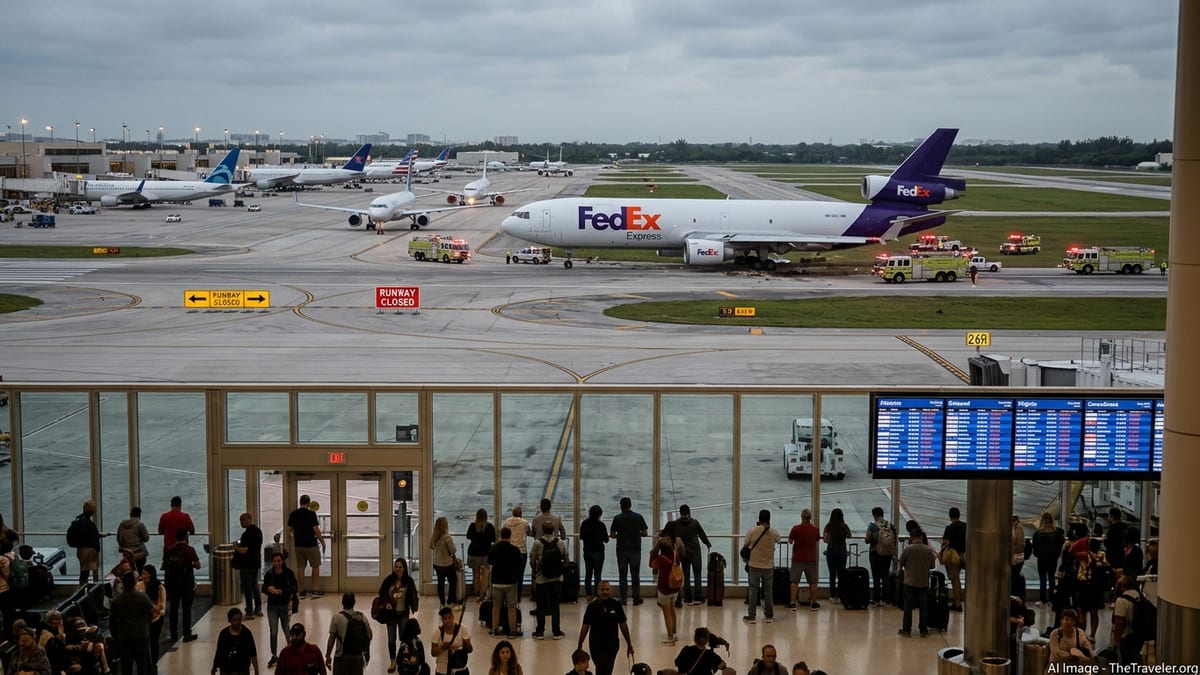
What happened to the FedEx flight at Miami International Airport
According to statements from Miami International Airport and initial reports from the Federal Aviation Administration, the incident occurred at approximately 8:40 p.m. Eastern Time on Wednesday, November 25, 2026. The aircraft, a FedEx Express McDonnell Douglas MD-11 operating as Flight 910 from Memphis to Miami, overran Runway 26R while landing and came to a stop beyond the paved surface near the west end of the airfield.
Local authorities and airport officials said there were no reported injuries among the flight crew, and no injuries were reported on the ground. Fire-rescue and airport emergency teams responded to the scene, surrounding the aircraft and inspecting it for damage and possible fuel leaks before beginning the process of securing and eventually removing the jet from its position off the runway.
Preliminary descriptions from officials and contemporaneous flight-tracking data indicate that the aircraft remained largely intact and upright after the overrun. Although photographs and video circulating online show the FedEx jet resting off the paved runway area, there have been no official indications of fire or structural breakup. As of the morning of November 26, investigators had not publicly identified a cause or contributing factors, and no determinations have been made regarding weather, mechanical issues, pilot actions or runway conditions.
Immediate operational impact at Miami International Airport
The disabled aircraft on Runway 26R prompted significant, though temporary, operational restrictions at Miami International Airport on an evening when holiday passenger and cargo traffic was already heavy. The Federal Aviation Administration issued a ground stop for flights bound for Miami on Wednesday night, temporarily halting many inbound departures from other airports while local controllers managed limited runway availability and coordinated emergency response.
Airport officials said that all but one runway were initially closed while emergency responders worked at the scene and airfield inspections were carried out, sharply reducing arrival and departure capacity. Miami International, which normally relies on several intersecting runways to handle a dense mix of domestic, international and cargo operations, had to funnel traffic through remaining usable infrastructure, compounding delays that were already possible due to seasonal weather systems across parts of the eastern United States.
Data from federal forecasts and holiday travel projections indicate that the broader U.S. air network was under strain even before the Miami incident, with Thanksgiving-week flight volumes at multi-year highs and weather advisories in effect for parts of the country. Against that backdrop, the runway overrun at a major hub airport created pockets of extended waits for passengers on outbound Miami flights and for travelers connecting through other cities whose aircraft were scheduled to arrive from South Florida but instead faced holds on the ground or in the air.
How the disruption affected Thanksgiving week travelers
The incident came during the peak of the Thanksgiving travel window, with the evening of November 25 expected to be one of the busiest periods for both passenger and cargo operations. While the FedEx aircraft itself was a freighter and carried no paying passengers, its presence off the runway had a knock-on effect on the broader schedule at Miami International Airport and across the network of airlines serving the region.
In the hours after the runway overrun, airlines serving Miami reported delays to a range of domestic and international departures as ground crews and controllers adjusted to the loss of a primary landing runway. Some flights already en route to Miami entered holding patterns or diverted while the ground stop was in effect, and others departing from distant airports were held at their origin until the FAA allowed more arrivals into the Miami airspace. For travelers, this translated into later departure times, missed connections and, in some cases, curtailed evening itineraries that would have otherwise brought them to holiday gatherings on schedule.
Because the incident involved a cargo aircraft, there is no direct manifest of disrupted passenger bookings for the FedEx flight itself. However, the timing of the event has implications for both travelers and shippers. For air passengers, the reduced runway capacity at Miami and the temporary ground stop primarily affected scheduled commercial flights on the Wednesday evening peak and into the early hours of Thanksgiving Day on Thursday, November 26. For shippers, the unplanned interruption came as parcel carriers and freight operators were moving high volumes of time-sensitive goods linked to the holiday period and early end-of-year commerce, potentially necessitating rerouting of some consignments or minor delays in cargo transfer at Miami’s freight facilities.
Safety context and ongoing investigation
Runway overruns and excursions, where an aircraft departs the end or side of a runway, are relatively uncommon but are treated as serious incidents by aviation authorities because of the risk to passengers, crew, ground personnel and people near the airport. The FedEx MD-11 overrun at Miami on November 25 follows another high-profile cargo overrun at the same airport in early September 2026, when a Boeing 767 freighter operating on behalf of an e-commerce carrier overshot another runway and collided with vehicles beyond airport property, resulting in fatalities on the ground. The proximity in time and location between the two events is drawing particular attention from regulators and safety investigators.
As with other significant U.S. aviation incidents, the National Transportation Safety Board is expected to lead an independent safety investigation, in coordination with the Federal Aviation Administration and local authorities. Early steps typically include securing the aircraft and its flight recorders, preserving relevant data such as cockpit voice communications and flight parameters, interviewing crew and witnesses, and examining weather, runway friction measurements, approach paths and aircraft systems performance. At this stage, no preliminary report on the Miami FedEx overrun has been released, and officials have not publicly singled out any suspected cause.
The MD-11, a three-engine widebody jet derived from the earlier DC-10, has been widely used in cargo operations for decades, including by FedEx Express. Like other legacy aircraft types, it is subject to regular oversight, maintenance and operational requirements set by regulators and the operator’s internal safety programs. It remains too early in the Miami inquiry to know whether factors specific to the aircraft model, pilot training, operational decisions, or external conditions such as wind or runway surface contamination played any role. Until investigators publish verified findings, any attempt to connect the Miami FedEx overrun to previous MD-11 incidents elsewhere would be speculative.
What travelers using Miami should know in the coming days
By Thanksgiving Day on November 26, authorities were working to restore normal operations at Miami International Airport, including the complex task of removing the disabled FedEx aircraft and inspecting the affected runway and adjacent areas. The timeline for fully reopening the specific runway involved has not been publicly detailed, but major airports are accustomed to operating with modified runway configurations during maintenance or after incidents, and they typically adjust arrival and departure rates accordingly.
For passengers with flights into or out of Miami over the remainder of the Thanksgiving weekend, the main practical advice is to allow extra time for potential knock-on disruptions and to monitor flight status closely through airline channels. Even after an immediate ground stop is lifted, residual delays can persist as airlines reposition aircraft, crews reach duty-time limits and connections ripple through the network. Some carriers may opt to swap aircraft types or consolidate lightly booked services in order to keep as much of the schedule moving as possible while runway capacity and gate availability are slightly constrained.
Travelers connecting through Miami should pay particular attention to minimum connection times over the next couple of days, as even modest delays on inbound legs could compress already tight transfers in a busy terminal environment. For those whose holiday plans are flexible, checking for alternative routings through other hubs in Florida or the southeastern United States may offer more options if Miami experiences any further congestion. Shippers and customers awaiting urgent parcels routed through Miami’s cargo facilities may likewise wish to track shipments through carrier systems and be prepared for minor timing adjustments while airport operations continue to normalize following the FedEx runway overrun.