


More news on this day
With a powerful coastal storm forecast to bring heavy rain and strong winds up the Eastern Seaboard on Thanksgiving Day, the four largest U.S. airlines have issued temporary weather waivers that let many travelers reroute or change Thursday flights at major East Coast hubs without paying standard change fees or, in some cases, fare differences.
Get the latest news straight to your inbox!
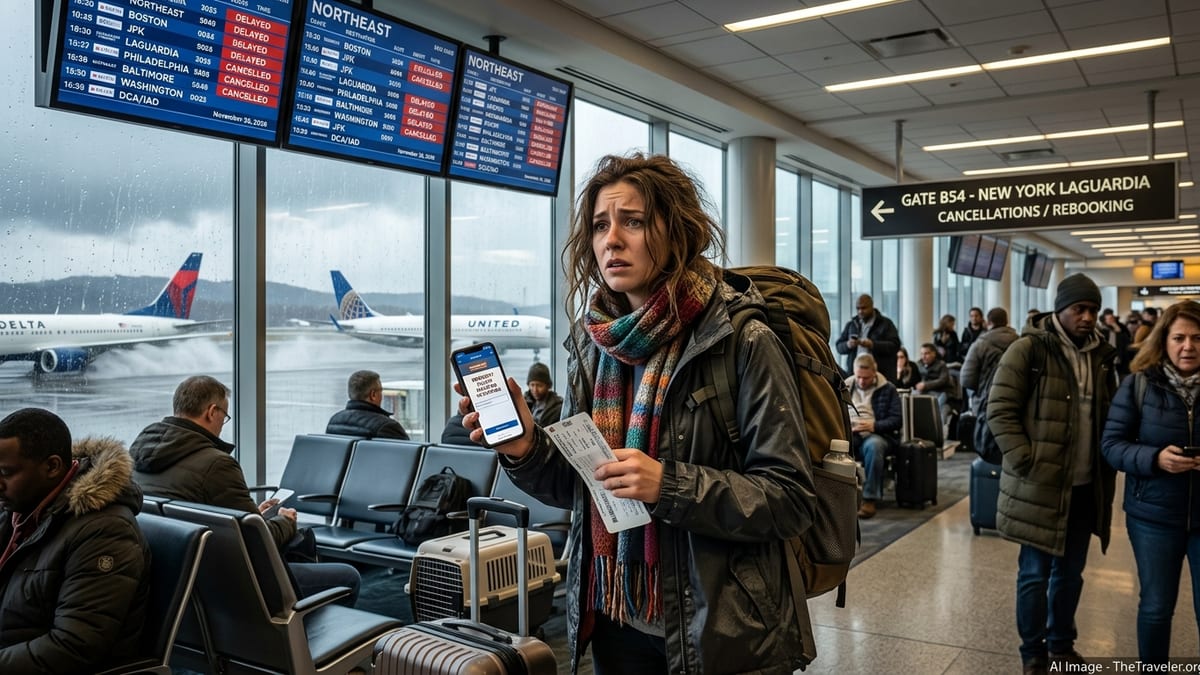
Who is covered and where the waivers apply
The waivers are targeted at passengers scheduled to travel on Thursday, November 26, 2026, through a band of East Coast airports expected to see the worst weather and the greatest risk of delays and cancellations. Delta Air Lines has posted a “Northeast Weather Flexibility” advisory covering travel to, from or through nine airports: Baltimore/Washington International, Boston Logan, New York John F. Kennedy, New York LaGuardia, Newark Liberty, Philadelphia, Washington Dulles, Washington Reagan National and White Plains, New York. United Airlines has issued a separate “Northeast Coastal Storm” waiver that applies at least to Boston, Baltimore/Washington International, Washington Reagan National, Newark, Washington Dulles, LaGuardia and Philadelphia, with the carrier allowing rebooking within a limited window around the storm period.
American Airlines has added a travel alert on its website that includes parts of the Northeast, giving customers traveling around the storm dates flexibility to change plans without the usual penalty fees. The precise list of covered airports is broader than a single corridor and includes key hubs where knock-on disruption is considered likely. Southwest Airlines, the largest U.S. domestic carrier by passengers, is also allowing customers to adjust itineraries for a group of East Coast airports on November 26 if their flights are affected by weather-related delays or cancellations. Together, the waivers mean that travelers booked on the country’s four biggest airlines who are passing through airports such as Boston, New York, Philadelphia, Baltimore or Washington on Thanksgiving Day have more options than usual to shift their trips when forecasts look unfavorable.
In most cases, the waivers apply both to origin and destination flights and to itineraries that merely connect through the affected airports. That makes them particularly relevant for travelers on cross-country or international journeys that include an East Coast layover. However, the exact combination of dates, airports and eligible tickets differs by airline, so passengers cannot assume that a waiver at one carrier will match the terms at another. Each airline is directing customers to its travel advisory page or mobile app to verify eligibility before they attempt to rebook.
Key terms: fees, fare differences and rebooking windows
While all four carriers are relaxing their normal rules in response to the storm, they are not identical in what they offer. Delta’s advisory states that customers booked to fly on November 26 to, from or through the nine listed airports can make a one-time change and, if they keep the same origin, destination and cabin, both change fees and fare differences will be waived as long as they rebook and complete travel on or before Saturday, November 28, 2026. If a traveler prefers a new flight outside that rebooking window, standard fare differences apply even though the change fee is waived, which may increase the cost for those trying to move trips into early next week.
United’s Northeast weather waiver allows customers scheduled to travel between November 25 and November 28 on affected routes to switch to other United or United Express flights in the same cabin between the same cities, generally without change fees or fare differences if the new trip departs by November 28. Travelers who postpone beyond that date typically still avoid change fees but may be required to pay any fare difference between the old and new tickets. American and Southwest follow the same basic structure, but with their own date ranges and conditions: American’s alert lists a multi-day window in which passengers can adjust plans, provided they rebook within a defined replacement travel period, while Southwest permits changes to available flights serving the same origin and destination at no additional fare for a set number of days around November 26.
Across all four airlines, the waivers generally apply only to tickets issued directly by the carrier or by an authorized agent and only to flights operated by that airline and its regional affiliates. Codeshare flights operated by a partner but sold under a U.S. airline’s code may not qualify under the same terms, and basic economy tickets can carry extra restrictions even when a waiver is in place. Travelers who bought through online travel agencies or package providers may need to contact those companies rather than the airline to make changes, although the same underlying waiver usually governs what is possible.
Storm forecast and likely impact on Thanksgiving operations
The National Weather Service forecast updated on Wednesday, November 25, describes a storm system currently off the Southeast coast that is expected to intensify and move northward, tracking up the Eastern Seaboard through Thanksgiving Day. Meteorologists warn of coastal flooding, strong onshore winds and heavy rain affecting portions of the Carolinas, the mid-Atlantic and New England during the peak of the holiday rush. Gusts of 50 miles per hour or higher are possible along parts of the coast on Thursday, a combination that can trigger low cloud ceilings, wind shear and crosswinds that slow airport operations even if runways remain open.
For aviation, the greatest operational risk lies in reduced arrival and departure rates at congested hubs like New York, Philadelphia, Baltimore and Washington during periods of intense rain and high winds. Air traffic controllers can respond to deteriorating conditions by spacing aircraft further apart and imposing ground delay programs, which quickly create queues of delayed flights upstream. In the most severe conditions, such as strong crosswinds or low visibility below airport landing minima, airports can temporarily suspend some or all operations. The current Thanksgiving forecast does not guarantee such shutdowns, but federal and airline planners are factoring in the possibility of significant slowdowns from Thursday morning into early Friday in parts of the Northeast corridor.
This week’s storm arrives after a challenging run-up to Thanksgiving that has already tested airline resilience. Within the past fortnight, U.S. carriers experienced major technology disruptions, including a nationwide ground stop on November 13 that halted departures for several hours. While those earlier events were not weather-related, they left some airlines with planes and crews out of position and raised concern among travelers about the potential for cascading problems if bad weather overlaps with high holiday demand. By activating targeted weather waivers a day before the worst of the storm is expected, airlines are attempting to reduce the number of passengers who are on packed Thursday flights that may be most vulnerable to delay or cancellation.
What travelers can and cannot do under the waivers
For passengers, the practical effect of the waivers is the opportunity to move a trip earlier or later, or to reroute away from specific airports, without the usual financial penalties, but within strict limits. A traveler booked from Atlanta to Boston on Delta mid-afternoon Thursday, for example, may be able to switch at no additional cost to a Wednesday evening departure, or to a Thursday morning flight on the same route that the airline considers less exposed to the storm, so long as the new flight departs by November 28. Someone with a cross-country itinerary from Los Angeles to New York connecting at one of the covered hubs could reroute through a different city if seats are available, again keeping origin and destination unchanged and traveling inside the allowed window.
However, the waivers do not automatically entitle passengers to refunds for flights that still operate. In general, if a traveler voluntarily changes plans based on the forecast using a weather waiver, the airline will provide a credit in the form of a ticket change without fee rather than cash. A cash refund is usually available only when the airline cancels a flight outright or makes a significant schedule change and the customer decides not to travel. That distinction matters for Thanksgiving travelers who are deciding whether to cancel a trip entirely, since those who no longer wish to travel but whose flights remain scheduled may be offered credits rather than refunds depending on each carrier’s contract of carriage and any specific language in the current travel alerts.
Travelers who booked ancillary services such as seat assignments, extra legroom or checked baggage in advance should also be aware that those options do not automatically transfer if they switch flights. Many airlines will attempt to honor paid seat selections on a new itinerary, but this is not guaranteed, particularly if a rerouting changes the aircraft type. Similarly, hotels, vacation rentals, cruises or ground transport booked separately are not covered by airline weather waivers, so passengers who adjust flights may need to renegotiate or rebook those elements directly with providers. The waivers reduce the risk of extra airline fees, but they do not insulate travelers from all the knock-on effects of a storm-disrupted itinerary.
How to check your options and what to watch for next
Airlines are steering customers first to digital channels, where waiver eligibility and rebooking options are being updated as the forecast evolves. Delta, United, American and Southwest all list the Northeast storm advisories under travel alerts or advisories on their websites, and the same information is usually reflected in their mobile apps. Passengers typically need their confirmation number and surname to view current bookings and determine whether a waiver applies. Where a waiver is active, online tools may present alternative flights that qualify without extra fees, while other options that fall outside the waiver window are shown with a quoted fare difference.
For those with complex itineraries, group bookings or tickets involving partner airlines, phone support may still be required, but hold times can lengthen significantly around major holidays and weather events. Many airlines prioritize elite frequent flyers or premium-cabin passengers in phone queues, which can leave occasional travelers waiting longer. In some cases, airport ticket counters and chat functions within airline apps offer alternative ways to request changes under the waiver terms. Because capacity on earlier or later flights is limited, travelers considering a proactive change are generally better off acting as soon as they see a waiver that applies to their route and dates rather than waiting until day-of-travel disruptions begin.
Looking ahead, the key unknown is how closely actual conditions on Thursday and Friday will track the current forecast. If the storm shifts offshore or weakens more quickly than expected, airlines may be able to operate closer to normal, leaving some passengers who changed plans facing crowded alternative flights that did not strictly need to be moved. If the storm strengthens or lingers, carriers could widen existing waivers to cover additional dates or airports, or issue new advisories for secondary markets beyond the major hubs already named. Travelers scheduled to fly on November 26 through the Northeast should keep monitoring both the National Weather Service outlook and their airline’s alerts through the holiday period, checking repeatedly in the hours before departure to confirm their gate, departure time and, where applicable, the continuing availability and terms of the storm-related waivers.