


More news on this day
Stormy weather across multiple U.S. regions is slowing the pre‑Thanksgiving travel rush on Wednesday, November 25, with more than a thousand flights delayed nationwide by mid-morning and South Florida airports warning of mounting disruptions as heavy rain and flooding coincide with one of the busiest travel days of the year.
Get the latest news straight to your inbox!
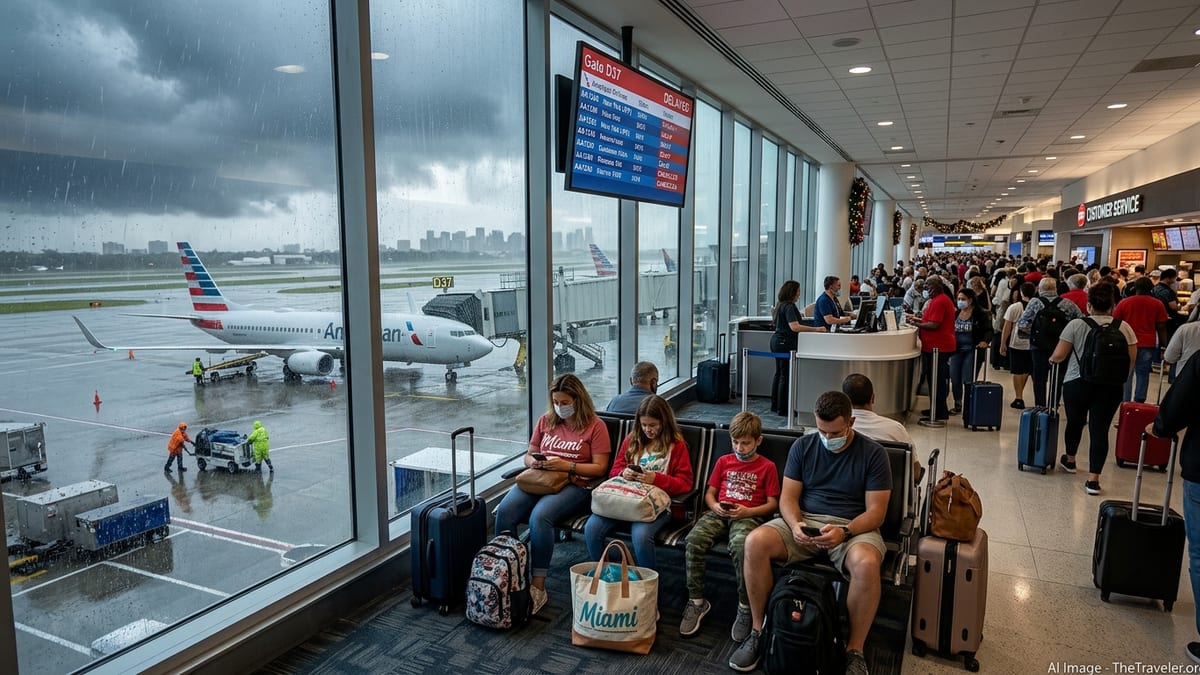
Stormy holiday getaway as delays climb across the U.S.
Flight-tracking data on Wednesday morning showed more than 1,100 U.S. flights departing or arriving late, along with several dozen cancellations, as airlines and airports handled a surge of Thanksgiving passengers amid unsettled weather in several regions. Those national figures continued to climb through the day as afternoon and evening bank departures met deteriorating conditions along the East Coast and in parts of the Midwest.
The Federal Aviation Administration reported weather-related delays at a number of major hubs, including Miami International Airport, where rain and low clouds slowed operations, and San Francisco International Airport, where a low cloud ceiling led to flow-control measures. Forecasters warned that an intensifying coastal storm along the Eastern Seaboard could further disrupt flights later Wednesday and into Thanksgiving Day, particularly at congested airports from the Carolinas to New England.
Travelers have also been dealing with knock-on effects from earlier issues in the week. A brief Federal Aviation Administration ground stop affecting flights bound for Hartsfield-Jackson Atlanta International Airport on Sunday, caused by a problem with an automated weight-and-balance system, led to significant delays at Delta Air Lines’ largest hub and ripple effects across the domestic network even after operations were restored.
Heavy rain and long lines at Miami and Fort Lauderdale
South Florida has emerged as one of the focal points of Wednesday’s disruption. A quick-moving storm system brought bands of heavy rain over areas already affected by earlier November flash flooding, prompting flood advisories from state and local authorities and raising the risk of runway and access-road ponding around Miami and Fort Lauderdale. Emergency management guidance for November 24 and 25 highlighted a potential for 2 to 3 inches of additional rainfall in Southeast Florida on Wednesday, enough to slow ground operations and traffic flows into the airports.
By around midday Eastern Time, data compiled by FlightAware and local media indicated that Miami International Airport had recorded close to 200 delays and at least one cancellation, while Fort Lauderdale-Hollywood International Airport reported more than 140 delays and several cancellations. The heaviest impact at Miami was on American Airlines, the airport’s largest carrier, while at Fort Lauderdale low-cost and leisure-focused airlines, including JetBlue, saw dozens of late departures amid the storms.
On top of the weather-related slowdowns, Miami International reported very busy checkpoints. Transportation Security Administration (TSA) data cited by local outlets showed maximum wait times earlier on Wednesday reaching roughly 80 minutes at some security checkpoints, well above typical weekday levels. TSA also reported waits of around 40 minutes at certain times on Wednesday morning at Newark Liberty International in New Jersey and Portland International Airport in Oregon, reflecting broader volume-driven pressure on screening operations as the holiday period gets under way.
Severe weather risks stretch from Florida to the Northeast
The current wave of disruption is rooted in a multi-part weather pattern affecting several major travel corridors just as passenger volumes spike. In South Florida, repeated rounds of heavy rain and embedded thunderstorms are moving across the region, with saturated ground raising the likelihood of localized flooding on access roads to Miami International and Fort Lauderdale-Hollywood airports. Airport operators in the region have urged departing passengers to check flight status frequently, allow extra time to reach terminals and expect potential delays and gate changes as airlines adjust schedules to the evolving conditions.
Farther west, portions of California have been facing a different set of challenges. Coastal areas and higher elevations have seen strong onshore winds, heavy surf, and pockets of coastal flooding, along with rain that can trigger low-visibility approaches and minor ground delays at airports such as San Francisco and Los Angeles. While these effects have generally been more modest than those in Florida so far, any capacity reductions at major West Coast hubs can still feed into the national delay picture, particularly on transcontinental routes.
Along the Eastern Seaboard, forecasters expect a strengthening storm to move northward into Thanksgiving Day, bringing bands of heavy rain, gusty winds and the risk of coastal flooding from the Carolinas through the Mid-Atlantic and into the Northeast. Some higher-elevation areas inland may see accumulating snow, and strong crosswinds could periodically affect operations at airports near the coast. Even travelers flying in regions where the weather remains relatively calm are likely to feel the impact if their itineraries connect through these constrained hubs or rely on aircraft arriving from affected areas.
Record-near Thanksgiving volumes despite slight dip from 2025
Despite the unsettled forecast, overall Thanksgiving travel remains close to record levels. AAA’s national holiday forecast, released on November 16, projects that 81.5 million Americans will travel at least 50 miles from home between Tuesday, November 24 and Monday, November 30. That total is only marginally below the 81.6 million estimated to have traveled over Thanksgiving 2025 and ends a three-year streak of record Thanksgiving volumes, but still reflects very robust demand for holiday trips.
Air travel is expected to account for a significant share of those journeys. AAA anticipates that about 5.96 million people will take domestic flights for Thanksgiving this year, a small, 0.2 percent decrease from last year’s already high figure. According to AAA, that still means roughly 7 percent of all Thanksgiving travelers will be flying, while the overwhelming majority, nearly 90 percent, will travel by car. A further 2.6 million people are projected to travel by bus, train or cruise, a segment forecast to grow more than 4 percent compared with 2025.
Prices reflect the strong demand environment. AAA’s analysis indicates that average domestic round-trip airfares for Thanksgiving departures are around 17 percent higher than last year, at about 800 dollars for itineraries booked through its channels. While actual fares vary considerably by route and booking date, the increase helps explain the modest pullback in air passenger numbers even as overall travel holds near historic highs.
TSA screening surge and what travelers should expect next
The TSA is preparing for some of its busiest days of the year. In guidance issued ahead of the holiday, the agency said it expects to screen about 17.6 million passengers nationwide between Tuesday, November 24 and Monday, November 30. Officials anticipate that Sunday, November 29, the traditional peak return day, could see more than 3 million passengers screened in a single day for the first time this year, depending on final travel patterns and weather-driven schedule changes.
To manage the influx, TSA has highlighted steps it is taking, including deploying additional officers to high-volume airports during peak periods, expanding the use of computed tomography scanners at checkpoints for faster bag screening, and encouraging travelers who are eligible to enroll in programs such as TSA PreCheck to reduce processing times. Even so, the agency is urging all passengers, particularly at large hubs and in weather-affected regions, to arrive at the airport earlier than they might under normal conditions.
For travelers still due to depart over the Thanksgiving period, the most immediate concern remains the evolving weather pattern. In South Florida, continued showers and the possibility of further flooding could sustain delays into Wednesday evening and potentially early Thursday, particularly during the busiest departure banks. Along the East Coast, the northward-moving storm is expected to bring its strongest winds and heaviest rain into several major metropolitan areas between Wednesday night and Thanksgiving Day, which could trigger additional ground delay programs or, in more severe cases, temporary suspensions of certain operations for safety reasons.
Passengers are advised to verify their flight status directly with their airline before leaving for the airport, to sign up for carrier and airport alerts, and to allow additional time for security and check-in, particularly at Miami, Fort Lauderdale and other major hubs identified by airlines and the FAA as weather-sensitive during this period. Those with flexible plans may wish to discuss rebooking options or travel waivers with their airlines, especially if their itineraries involve tight connections through regions forecast to experience the worst of the storm over the Thanksgiving holiday.