


More news on this day
San Francisco International Airport recorded some of the longest flight delays in the United States on Tuesday evening, November 24, as strong winds reduced arrival capacity and led the Federal Aviation Administration to impose a brief ground stop followed by a multi-hour ground delay program just as Thanksgiving travel peaked.
Get the latest news straight to your inbox!
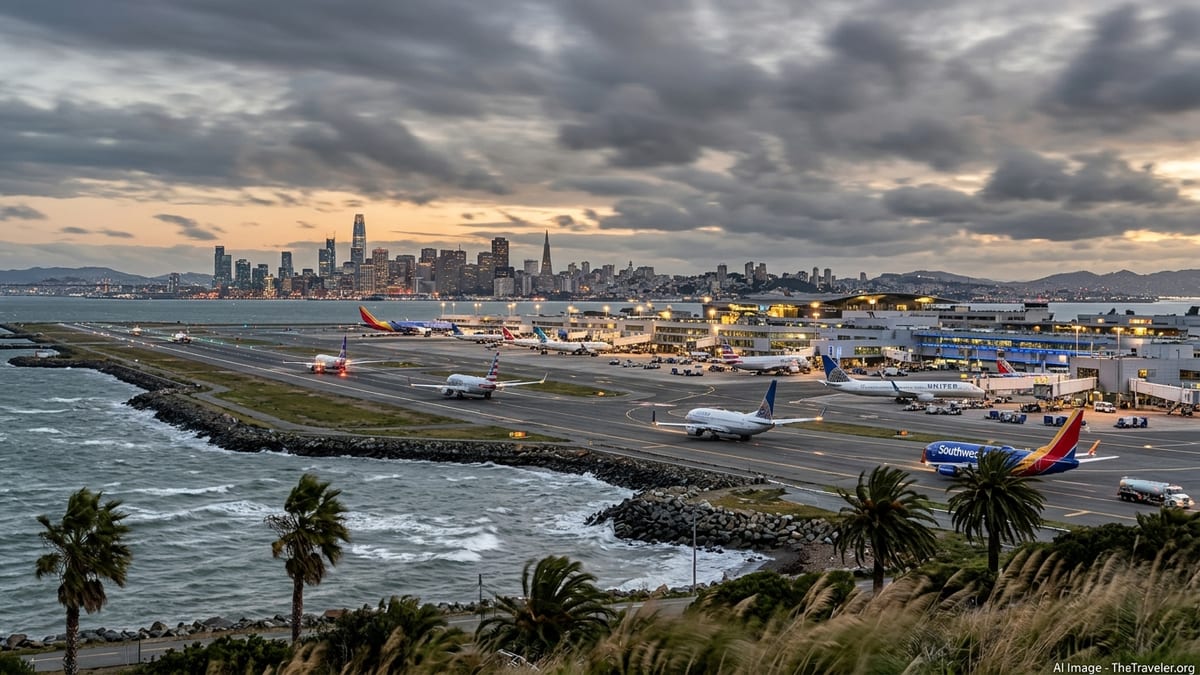
Ground Stop and Delay Program Cut SFO Arrival Capacity
According to data compiled from the FAA’s air traffic control system command center advisories and multiple delay-tracking services, the FAA issued a short ground stop for San Francisco International Airport on Tuesday evening, November 24, local time, before switching to a formal ground delay program that lasted for several hours into the early hours of November 25.
Publicly accessible disruption logs indicate that the ground delay program at SFO was initiated at about 6:20 p.m. Pacific Time on November 24 and remained in effect for roughly five and a half hours. During this period, average assigned delays climbed to around 124 minutes, with some departures to San Francisco experiencing holding delays of up to approximately 200 minutes as the FAA throttled the rate of arrivals into the Bay Area hub.
FAA summaries for the Thanksgiving travel period cited strong or gusty winds in the vicinity of San Francisco as the primary operational constraint. With winds limiting which runways and approach configurations could be used, the airport’s arrival acceptance rate fell below the volume of scheduled inbound traffic, leading air traffic managers to meter flights bound for SFO rather than allowing them to depart and accumulate airborne holding.
Why Wind, Not Flooding, Drove Tuesday Night’s Disruptions
The delay program on November 24 followed several days of public concern that an incoming Pacific storm, coinciding with seasonal king tides, might cause coastal flooding at SFO and surrounding low-lying areas of the Bay shoreline. Local and federal forecasts highlighted the potential for minor to moderate coastal inundation on some roads and transit corridors, and city officials had warned residents to keep a close watch on updated advisories.
In the end, however, the FAA’s traffic management measures on Tuesday evening were attributed to wind rather than water. Operational summaries and delay statistics for the night list strong winds as the relevant constraint for SFO, while contemporaneous airport communications and traveler reports did not show significant closures of runways or terminals due to flooding. Some surface routes and public transport links across the Bay Area did experience ponding and localized disruption, but these did not emerge as the primary factor behind the flight metering into the airport itself.
For travelers, this distinction matters because the type of weather driving a delay can affect how quickly conditions improve. Wind-related acceptance-rate reductions at SFO tend to ease as soon as gusts moderate or shift direction sufficiently to reopen preferred approach paths, whereas flooding that affects airport infrastructure or access roads can require longer clean-up and inspection times before normal operations resume.
Nationwide Impact: Which Flights and Regions Were Affected
The ground delay program applied to aircraft departing for San Francisco from airports across the contiguous United States and selected Canadian gateways. Flight-planning tools and disruption trackers show that departures from major hubs and regional airports alike received controlled departure times if they were destined for SFO, meaning delays were widely distributed throughout the domestic network rather than concentrated solely on the West Coast.
Among the affected international points, at least Vancouver, Calgary and Edmonton were listed in the FAA’s scope for the SFO ground delay program. Flights from these Canadian cities to San Francisco received new departure slots designed to match the reduced arrival rate that controllers could safely accommodate in the Bay Area under the prevailing wind conditions.
Because the constraint was on arrivals into San Francisco, knock-on effects extended to outbound departures from SFO as well. Aircraft arriving late into the airport turned around later for subsequent flights, which in some cases propagated delays into late-night and early-morning departures on November 25. However, by mid-morning on Wednesday, delay-monitoring sites were no longer showing an active ground stop or delay program for San Francisco, indicating that the most severe restrictions had been lifted.
Airline Waivers and Passenger Options Around November 25
Anticipating further weather-related disruption around the Thanksgiving holiday, several airlines serving San Francisco announced flexible rebooking measures for customers with travel scheduled on Wednesday, November 25. United Airlines, American Airlines and Southwest Airlines each published waivers enabling eligible passengers to change their itineraries without standard change fees, provided they kept to specified date ranges and city pairs.
United’s travel waiver for the San Francisco area, issued ahead of the storm’s arrival, covered tickets to, from or through SFO for travel on November 25, with rebooking options extending over multiple days as long as customers retained United or United Express flights and operated between the original origin and destination. Separately, Southwest listed “San Francisco Inclement Weather” as a travel advisory for November 25, allowing customers booked via the city on that date to rebook within about two weeks of the original travel date without paying additional fare differences, subject to availability.
American Airlines similarly encouraged customers to verify their flight status and make adjustments through digital channels, reflecting both the potential for continued weather delays in the West and the broader strains on the national air system following an earlier, unrelated nationwide ground stop earlier in November. Collectively, these waivers gave travelers leeway to depart a day earlier or later, shift to different flight times, or in some cases reroute via alternative West Coast hubs to avoid the peak of the San Francisco constraints.
What Travelers Should Check Next
Although the formal ground delay program that hit San Francisco on the evening of November 24 has ended, the FAA’s ongoing operational outlook around the Thanksgiving period continues to flag SFO as an airport where additional flow-control measures remain possible when low clouds or renewed wind gusts materialize. The national air traffic report for the days surrounding Thanksgiving highlights Northern California as an area where intermittent weather could trigger new metering programs, particularly during early-morning and evening peaks.
Travelers headed to or through San Francisco over the holiday period should therefore monitor three types of information in parallel: the FAA’s current status for SFO, their airline’s latest travel advisories or change-fee waivers, and airport-specific updates on access roads, parking and public transport. The FAA status feeds provide the clearest indication of whether a new ground stop or delay program is in place, while airline alerts determine whether customers can adjust itineraries without incurring extra costs.
Given that Tuesday night’s severe delays were driven by wind rather than the coastal flooding many residents had feared, passengers should also pay close attention to short-term wind and ceiling forecasts for the Bay Area rather than focusing solely on tide projections. In practice, that means rechecking conditions and flight status on the day of travel, allowing extra time at the airport in case of queues created by earlier delays, and considering earlier departures or alternative routings where a carrier offers them under an active waiver. With millions of passengers passing through US airports for Thanksgiving, relatively modest changes in SFO’s arrival rate can translate quickly into widespread delays across the network, making up-to-the-minute information critical for anyone connecting through San Francisco in the days ahead.