


More news on this day
Florida’s busiest airports are reporting significant pre‑Thanksgiving delays driven by thunderstorms, a runway overrun that briefly restricted operations at Miami International Airport, and the nationwide holiday travel surge, leaving many travelers facing longer queues and late departures on one of the year’s peak flying days.
Get the latest news straight to your inbox!
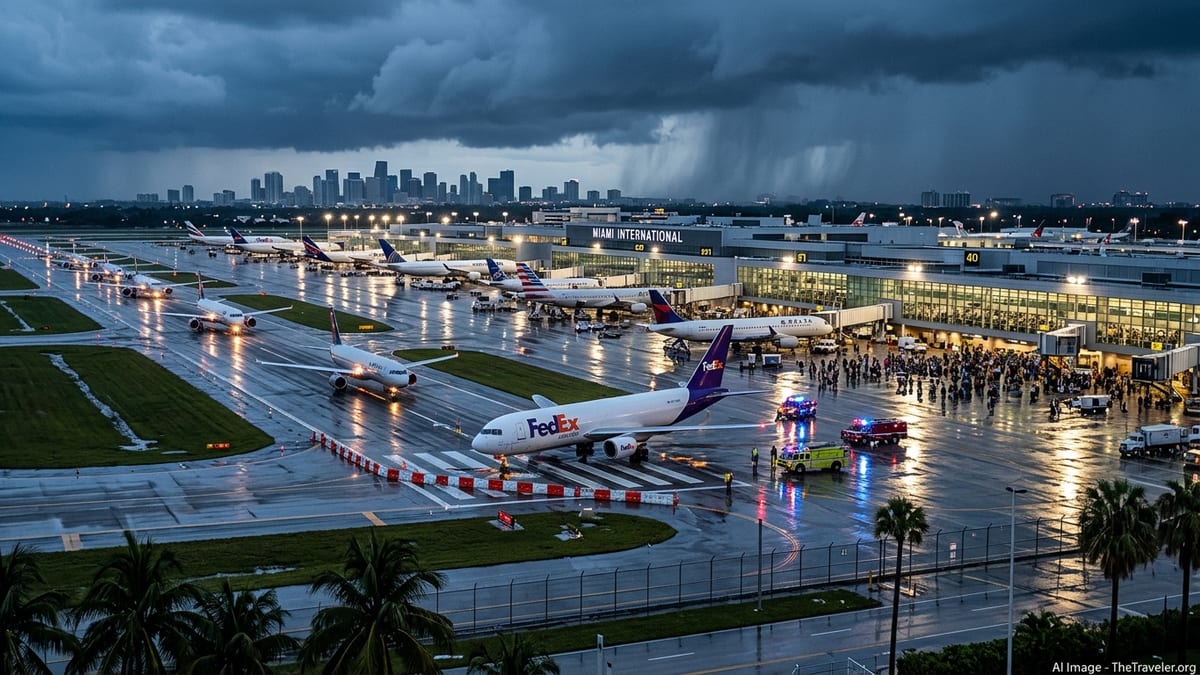
Miami hit by runway incident and weather‑related ground delays
Miami International Airport has experienced the most severe pre‑Thanksgiving disruption in Florida after a FedEx cargo aircraft overran a runway on the evening of Wednesday 25 November 2026. The incident temporarily closed all but one runway while emergency teams responded, just as thunderstorms were already limiting operations and traffic volumes were building for Thanksgiving travel.
According to a Federal Aviation Administration advisory for Thursday 26 November, arrivals into Miami were subject to delays of up to 60 minutes during parts of Wednesday’s peak due to storms in the Miami airspace, with a formal arrival delay program in effect from mid‑morning to mid‑afternoon. Separate ground‑delay measures and a short ground stop for Miami‑bound flights were initiated around 01:35 UTC on 26 November, holding some departures at their origin airports and contributing to knock‑on delays across the network.
Data compiled from FAA status feeds show that by early Wednesday afternoon, Miami International had one of the highest disruption levels among major U.S. hubs, with more than 200 delayed flights and a low single‑digit percentage of same‑day cancellations. Local media outlets, citing FlightAware figures, reported 269 delayed flights and three cancellations around 13:50 Eastern time on Wednesday, underscoring how even a relatively small number of cancellations can translate into lengthy queues and missed connections during a compressed holiday travel window.
Fort Lauderdale and Orlando report moderate but widespread delays
Fort Lauderdale–Hollywood International Airport, which serves as a key alternative to Miami for both domestic and international services, is also experiencing notable schedule pressure ahead of Thanksgiving, though without a comparable incident to Miami’s runway overrun. Midday data on Wednesday indicated more than 200 delayed flights and a handful of cancellations, with most disruptions clustered in the afternoon and evening when storm cells and peak travel demand overlapped.
Further north, Orlando International Airport, Florida’s busiest by passenger volume, has so far avoided major, airport‑wide ground stops. FAA condition reports as of late Wednesday indicated that Orlando did not have an active airport‑level delay program, although third‑party monitoring services flagged the airport at “amber” status earlier in the day because a combination of heavy traffic and passing showers was pushing some arrivals and departures behind schedule. Travelers reported scattered delays, but no systemic cancellations on the scale seen during earlier nationwide disruptions in mid‑November.
While Orlando’s airport operations remain relatively stable compared with South Florida, travelers should still anticipate longer security and check‑in lines than on a typical weekday. Thanksgiving week typically ranks among the highest for throughput at Orlando’s security checkpoints, and this year’s national projections indicate that the Transportation Security Administration expects record or near‑record passenger screening numbers across the holiday period.
Stormy weather and record travel volumes compound holiday strain
The timing of this week’s storms has heightened the impact on Florida’s major airports. A developing coastal low and associated frontal system have brought bands of heavy rain, gusty winds and thunderstorms to parts of Florida and the Southeast in the two days leading up to Thanksgiving. Forecasts issued on Monday 23 November anticipated that weather impacts would reach Florida and the Carolinas on Wednesday and then move up the East Coast into Thanksgiving Day, a pattern that is largely playing out and affecting flight operations in several states.
Weather‑related traffic management initiatives, such as metered arrival flows and tactical ground stops, are common during intense storm activity, but they have a particularly strong effect during holiday peaks when schedules are already compressed. When airports slow the rate at which they can safely accept arrivals or departures, the resulting queue can quickly translate into broader delays as aircraft and crews finish each segment of their rotation later than scheduled.
These constraints are interacting with unusually high travel demand. AAA has projected that about 81.5 million people in the United States will travel at least 50 miles from home between Tuesday and the Monday after Thanksgiving in 2026, including nearly 6 million air travelers. Transportation Security Administration updates this week suggest that daily checkpoint volumes at U.S. airports are tracking close to or above 2025 levels, reinforcing expectations that Wednesday, Saturday and Sunday would be the busiest days for air travel during the holiday period.
Nationwide operational context and what travelers are seeing on the ground
The pre‑Thanksgiving delays in Florida come less than two weeks after a nationwide Federal Aviation Administration ground stop related to communication system issues, which disrupted flights across several major carriers and hubs, including in Florida. Airlines have largely recovered from that earlier event, but some travelers are still reporting occasional residual schedule adjustments and equipment changes, particularly on complex multi‑segment itineraries that touch crowded hubs.
Over the past week, separate from the current storms, Miami International has already seen substantial weather‑driven disruption. Local broadcasters reported as many as several hundred delays in a single day over the preceding weekend when severe thunderstorms affected operations. That recent experience likely contributed to the airport’s decision to emphasize early arrival and to urge passengers to check with their airlines for real‑time information once Wednesday’s thunderstorms and the FedEx runway incident developed.
On the concourses, travelers are encountering a mix of long queues and largely functional operations. At peak times on Wednesday, security wait times at Miami reportedly approached or exceeded an hour in some checkpoints, particularly for standard screening. Meanwhile, anecdotal reports from Orlando and Fort Lauderdale passengers describe crowded but orderly terminals, with some flights leaving close to on time and others delayed 30 to 90 minutes depending on aircraft routing and crew availability.
What travelers flying through Florida should verify next
Given the combination of lingering thunderstorms, constrained runway capacity in Miami following the cargo aircraft overrun, and sustained holiday demand, conditions at Florida airports are likely to remain dynamic through at least Thursday 26 November and into the weekend. Weather systems moving up the East Coast could introduce additional delays on connecting flights from or to the Northeast, even if local skies over Florida have begun to improve.
Passengers traveling through Miami, Fort Lauderdale or Orlando over the next several days should monitor flight status directly with their airlines rather than relying only on generalized delay statistics. The airline’s mobile app or website typically reflects operational changes such as equipment swaps, gate moves and rebookings before those adjustments show up on airport summary boards or in third‑party trackers. Travelers with tight connections may want to explore earlier departures or longer layovers where possible, particularly if their route involves multiple weather‑sensitive hubs.
For those yet to depart, arriving at the airport earlier than usual is advisable during this period, especially at Miami where the combination of security queues and occasional gate changes can add time to the journey from curb to boarding door. Parking facilities at several Florida airports are expected to be near capacity through the end of the holiday weekend, so travelers should confirm lot availability in advance and consider off‑site parking or public transport if available. With further FAA advisories and localized delay programs possible as the weather pattern evolves, checking conditions on the morning of travel will remain essential for any itinerary touching Florida’s major airports in the days immediately following Thanksgiving.