


More news on this day
An overnight American Airlines flight from San Diego to Chicago was forced to divert to Phoenix early on November 25, 2026, after a disruptive passenger allegedly left his seat, moved to the front of the aircraft and tried to manipulate an aircraft door, prompting crew and fellow travelers to restrain him until the plane could land safely.
Get the latest news straight to your inbox!
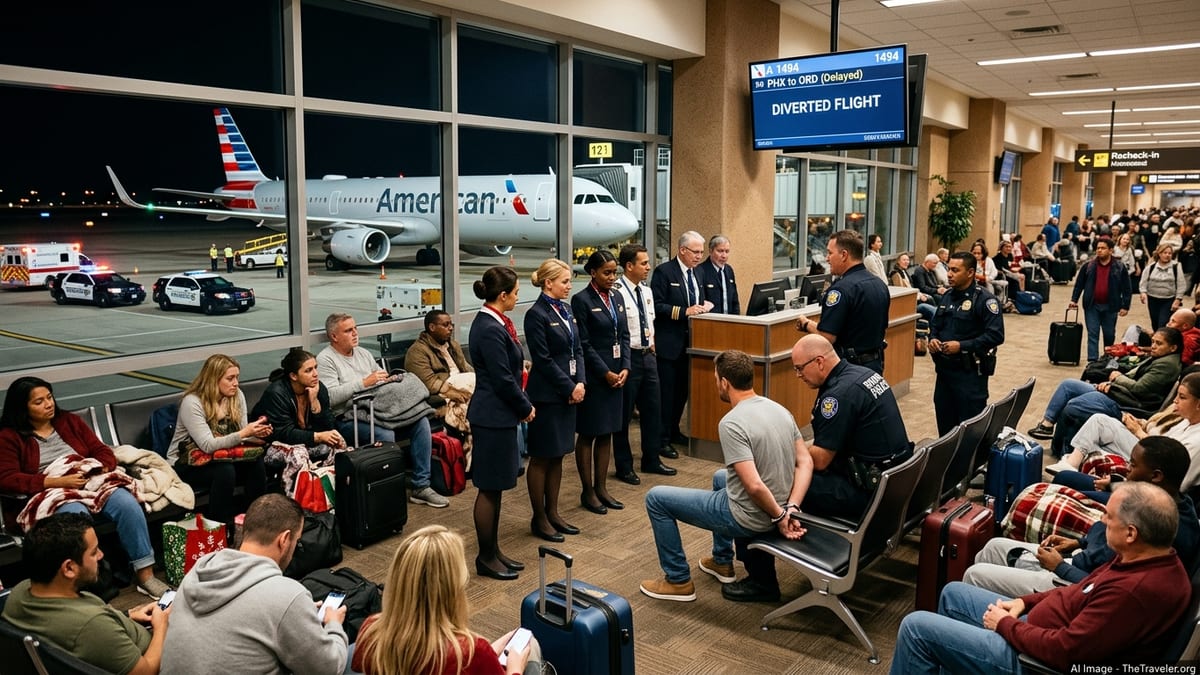
Diverted red-eye lands safely amid holiday rush
American Airlines flight 1494 departed San Diego International Airport late on Tuesday, November 24, operating a scheduled red-eye service to Chicago O’Hare International Airport. According to American Airlines and the Federal Aviation Administration (FAA), the aircraft diverted to Phoenix Sky Harbor International Airport after the crew reported a passenger disturbance in flight.
The FAA said the A321 landed safely at Phoenix around 1 a.m. local time on Wednesday, November 25, after the incident occurred while the aircraft was cruising near the California–Arizona border. Phoenix police said the crew requested that law enforcement meet the flight on arrival because of the seriousness of the disturbance.
American Airlines confirmed that law enforcement officers met the aircraft at the gate in Phoenix, removed the passenger involved and that the flight later continued on to its original destination of Chicago O’Hare. The airline reiterated that the safety and security of customers and crew remain its top priority and thanked passengers who assisted cabin staff during the diversion.
What police and regulators say happened on board
Phoenix police said in a written statement that the male passenger at the center of the incident left his assigned seat and moved toward the front of the aircraft. Officers said he repeatedly refused instructions from the cabin crew to sit back down before allegedly attempting to manipulate a cabin door while the flight was in the air.
According to police, crew members, assisted by several passengers, physically restrained the man and kept him under control until the aircraft landed at Sky Harbor. Authorities said the passenger sustained a minor injury during the struggle but that no other passengers or crew members were reported injured.
The FAA categorized the case as an unruly passenger incident and said it has received more than 1,500 such reports from U.S. airlines so far in 2026. The agency treats attempts to interfere with a door or exit as a serious safety concern, even though modern jet doors are designed so they cannot be opened in normal pressurized flight conditions at cruising altitude.
Potential penalties under the FAA’s “zero tolerance” approach
The FAA has continued its strict enforcement posture toward disruptive behavior first formalized in its so-called zero-tolerance policy, introduced in early 2021. Under current rules, passengers who assault, threaten, intimidate or interfere with crew members can face civil penalties of up to $43,658 per violation, and a single in-flight disturbance can result in multiple violations.
In addition to civil fines, serious cases are frequently referred to federal prosecutors or local authorities for possible criminal charges. Phoenix police said their investigation into the American flight diversion is ongoing, and as of November 26 no charging documents had been made public. Until formal charges are filed, it remains unclear which specific offenses the passenger could face.
Regulators have repeatedly emphasized that any attempt to interfere with doors, exits or cockpit access is treated as particularly grave. FAA enforcement guidance lists efforts to open an exit door in flight as an example of conduct that poses an imminent threat to the safety of the aircraft and can justify substantial penalties, permanent records of violation and, in the most serious cases, imprisonment if a criminal conviction follows.
Unruly passenger incidents in a busy Thanksgiving travel period
The diversion of flight 1494 occurred in the critical run-up to the U.S. Thanksgiving holiday, traditionally one of the busiest travel periods of the year for American airports. Federal officials have said they expect 2026 Thanksgiving air travel volumes to approach or exceed pre-pandemic highs, putting additional pressure on airlines, airports and air traffic control.
While the overall rate of unruly passenger reports has fallen from its pandemic-era peak, FAA data and recent federal presentations show that disruptive behavior in the cabin remains a persistent concern. Over the past five years, the FAA has logged more than 14,000 reports of unruly passengers, and regulators have warned that alcohol misuse, refusals to follow crew instructions and disputes over seating remain common triggers.
International airline groups have echoed those concerns. A June 2026 briefing from the International Air Transport Association highlighted that, although the frequency of incidents per flight improved between 2024 and 2025, airlines worldwide are still reporting thousands of cases each year that require some form of intervention by cabin crew, ground security teams or police.
What this means for travelers on U.S. flights
For passengers, the American Airlines diversion illustrates how a single person’s behavior can disrupt an entire overnight service, particularly during peak holiday travel periods. When a disturbance rises to the level that crew classify it as a security or safety issue, diversions are a standard tool available to pilots. That can mean unplanned landings, missed connections and extended travel times for everyone on board.
Airlines and regulators consistently advise travelers to follow all crew instructions, remain seated when directed, and avoid behavior that could be interpreted as threatening or obstructive. Under federal regulations, ignoring those instructions can itself form the basis for enforcement action, even if a situation does not escalate to physical restraint or a diversion.
For those with upcoming flights, particularly around Thanksgiving and the winter holidays, officials recommend allowing generous buffers for connections, monitoring flight status closely and being prepared for potential delays, whether caused by weather, air-traffic constraints or unexpected incidents such as disruptive passengers. If a serious disturbance does occur, passengers are generally urged to follow crew directions and avoid intervening unless explicitly requested, so that trained staff can manage the situation as safely as possible.