


Palancar Caves is one of those Cozumel sites that experienced divers talk about for years afterward. Part of the famous Palancar Reef system on the island’s southwest coast, it offers towering coral buttresses, dramatic canyons, and a maze of wide swim-throughs that feel adventurous without requiring true cave training. For divers visiting Cozumel, it is often a bucket-list wall dive, but it is not the right first dive for everyone. This guide breaks down the real conditions at Palancar Caves, the depth and current you can expect, what certification and comfort level you should have, and how to decide whether this iconic site is a good match for your experience.
Get the latest updates straight to your inbox!
Where Palancar Caves Fits in the Palancar Reef System
Palancar Reef is a large coral reef running along the southwest side of Cozumel within the Arrecifes de Cozumel National Park. The reef is divided into several well-known sections, including Palancar Gardens, Palancar Caves, Palancar Bricks, and Palancar Horseshoe. Palancar Caves sits between Gardens and Bricks, roughly a 45 to 60 minute boat ride from the main marinas in San Miguel, depending on the speed of your boat and sea conditions. Local dive centers frequently pair Palancar Caves as the first, deeper morning dive followed by a shallower second tank at sites such as Colombia Shallows or Tormentos.
Unlike many pure wall dives, Palancar Caves combines a sloping reef that leads to a wall with intricate coral formations, overhangs, and canyons. Multiple guides and diver reports describe the area as a network of large coral buttresses forming tunnels and passages with plenty of ambient light and clear exits rather than a tight cave environment. In practice, you will spend much of the dive drifting along the wall and ducking in and out of these swim-throughs, often emerging onto open blue water with the reef dropping off below.
The site lies fully inside Cozumel’s national marine park, which means divers must visit with a licensed operator that holds marine park permits. Most reputable shops in Cozumel, such as Dive Palancar and Cozumel Dive School, schedule Palancar Caves regularly but will confirm conditions and the experience level of the group before committing to the site on a given day. It is common for divemasters to adjust the exact route on the reef depending on current, visibility, and how comfortable the group looks on the descent.
Because Palancar Caves is so well known, it can attract multiple boats at peak times. Many operators, especially smaller six-pack boats, try to time their arrival to avoid the biggest crowds. When several groups do arrive together, experienced guides often alter the route or choose alternate swim-throughs to keep divers out of conga-line traffic inside the reef.
Depth Profile, Swim-Throughs, and Reef Formations
Typical depth profiles for Palancar Caves run from about 50 to 90 feet, with many operators aiming for a maximum depth between 70 and 80 feet for recreational groups. Divers commonly log their deepest points on this site around 80 to 85 feet, then work gradually shallower as the dive progresses along the wall and into shallower coral ridges. The actual maximum depth depends on the exact section of the reef the captain drops you on and how conservative your guide wants to be with no-decompression limits and air consumption.
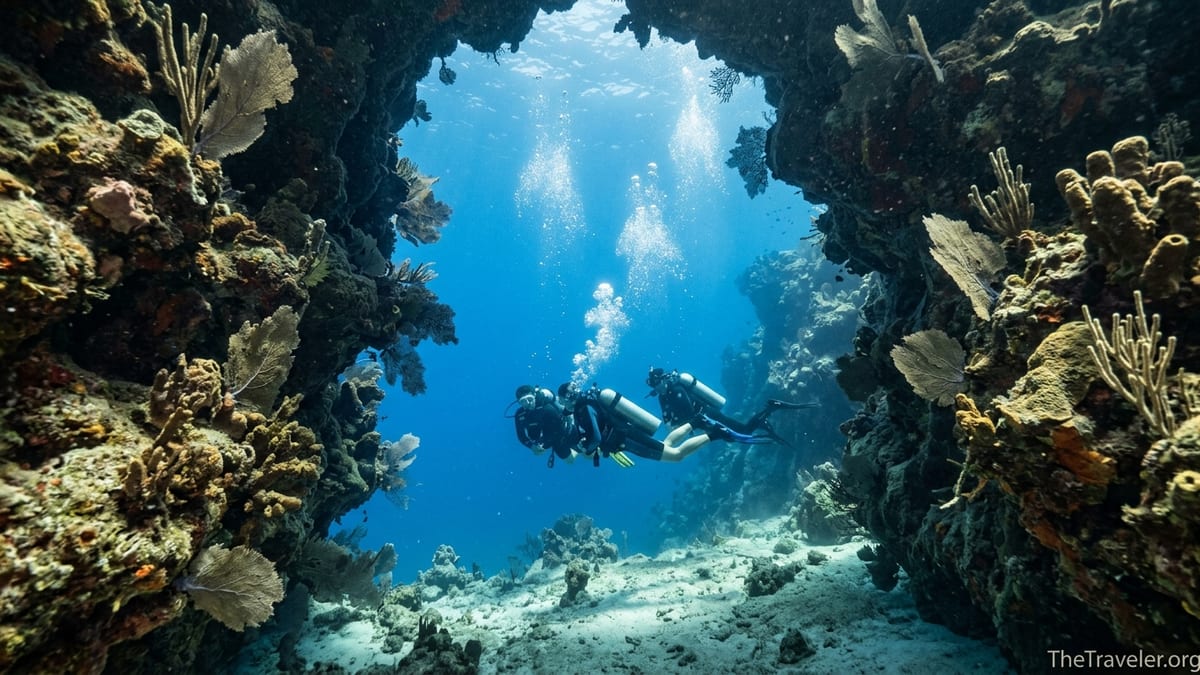
The swim-throughs are the defining feature of this site. Rather than being rock caverns, they are large tunnels and archways formed by living coral towers and buttresses. In many passages you can see blue water and light at both ends, and there are often vertical openings above that would allow a diver to ascend into open water in an emergency. These are not overhead environments in the strict cave-diving sense, but they do create short periods when there is a ceiling above you, so good trim, buoyancy, and situational awareness are important.
Inside the swim-throughs, ambient light is typically strong enough that you can navigate easily without a dedicated primary light, although carrying a small torch is useful for checking cracks for lobsters, crabs, and moray eels. The sand and limestone floors between coral ridges can sit at 70 to 90 feet while the tops of the coral towers may rise to 45 or 50 feet, creating dramatic vertical relief. Out along the wall edge, the reef lip can slope steeply into the blue, giving that classic Cozumel wall-diving sensation where the seafloor disappears beneath you.
For photographers, this topography offers opportunities to frame divers silhouetted in swim-through entrances or drifting along corridors of coral. Many divers use mid-range lenses on action cameras, such as a GoPro with a wide but not ultra-fisheye setting, to capture both the diver and the structural scale of the reef. Visibility often exceeds 80 to 100 feet, so wide scenic shots at 60 to 70 feet depth are common, especially in the dry season from roughly December through April.
Current, Visibility, and Seasonal Conditions
Cozumel is famous for drift diving, and Palancar Caves is no exception. Operators often describe the site as having moderate to sometimes strong current. On relaxed days, the current may carry you gently along the reef, allowing plenty of time to peek into side canyons and pause behind coral heads. On more energetic days, you may move faster, which can make the dive feel like an underwater flight over coral ridges and walls.
Because of the current, most dives are conducted as drifts from a live boat. You descend together as a group, follow the guide along the reef at the prevailing depth, and then ascend into open water for the safety stop. Surface support boats in Cozumel are very practiced at following the group’s bubbles and picking divers up where they surface, rather than from a fixed mooring line. Newer drift divers should be prepared for the sensation of the reef moving past them and for the possibility that current will shift in strength or direction as they pass around coral structures.
Visibility at Palancar Caves is typically excellent, often reported as 80 to 100 feet or more in dry-season conditions. Even in the rainy season, visibility frequently remains better than many other Caribbean destinations because Cozumel’s west coast benefits from oceanic water rather than river runoff. Water temperatures usually range from about 78 to 82 degrees Fahrenheit in winter to 82 to 86 degrees in late summer and early fall, meaning most divers are comfortable in a 3 mm full wetsuit, although those prone to getting cold may use a 5 mm suit for longer second dives.
Weather and sea state influence boat rides more than the underwater experience. Nortes, or seasonal north fronts, can bring wind and chop in winter, occasionally leading to port closures that pause diving for a day or two. When winds are moderate, operators may choose more sheltered reef sections instead of Palancar Caves, so if this site is on your must-do list, plan a multi-day dive trip rather than relying on a single morning when conditions might not cooperate.
Certification, Experience, and Comfort Level
Most Cozumel operators list Palancar sites, including Caves, as suitable for certified Open Water divers or higher, provided they are comfortable with drift diving and depths in the 60 to 80 foot range. However, there is an important difference between the minimum certification required by an operator and what is realistically appropriate for a given diver’s personal experience and comfort.
If you earned your Open Water certification recently and have logged only a handful of dives, you may find Palancar Caves to be a significant step up in complexity compared with a sheltered training site or a shallow reef. The combination of current, variable depth, and occasional overhead-style swim-throughs means you should already feel relaxed managing your buoyancy, equalizing smoothly on descent, and staying with a group in mild current before attempting this dive. As a rule of thumb, divers with at least 15 to 20 post-certification dives in a variety of conditions tend to enjoy Palancar Caves more and spend less mental energy simply keeping up.
Another factor is comfort at depth. Some newer divers complete their certification without spending much time deeper than 40 to 50 feet. Dropping to 70 or 80 feet where the reef wall drops into blue water can feel psychologically different, even if you are still well within recreational limits. Before signing up for Palancar Caves, consider doing one or two shallower drift dives around 40 to 60 feet on sites like Paradise, Chankanaab, or Colombia Shallows. Many Cozumel shops will schedule these for newer divers on their first day, then move to deeper Palancar sections once the crew has seen everyone in the water.
Finally, think honestly about overhead environments. While Palancar Caves is not a true cavern or cave site, you will likely spend short stretches under coral archways or inside broad tunnels. If the idea of any ceiling, even with clear exits and ambient light, makes you anxious, talk to your dive center. Guides can choose a route that minimizes time inside swim-throughs or skip them entirely, letting you enjoy the outer wall and coral formations instead.
Guide Requirements, Group Size, and Safety Practices
Diving at Palancar Caves takes place inside a federally protected national marine park, so you must dive with a licensed guide through an authorized operator. Independent unguided diving is not allowed. Marine park rules also limit group sizes and set expectations for environmental protection, such as no touching or collecting marine life and no feeding fish. Many operators keep groups to six to eight divers per guide, and some boutique boats limit groups even further to four or five divers for more attentive supervision.
On the practical side, most two-tank dive trips to Palancar Caves are priced in the range of about 100 to 150 US dollars per person for certified divers, depending on the operator, boat size, and what is included. Some shops include rental gear, marine park fees, and snacks, while others charge separately for equipment or the daily park bracelet, which is often around the equivalent of 10 to 15 US dollars. When booking, ask whether the marine park fee, tanks, weights, and dive computer are part of the package so there are no surprises at the dock.
A thorough briefing on the boat is a key safety step before diving Palancar Caves. You can expect your guide to cover the planned maximum depth, expected current direction, hand signals for swim-throughs, and what to do if you are separated from the group or blown slightly off the reef. On drift dives in Cozumel, standard practice is that if you lose visual contact with your group, you search for one minute while turning slowly and then ascend to your safety stop and surface where the boat can see you. Guides typically carry a surface marker buoy and may ask divers to carry their own SMBs as well.
Good operators will also pay attention to certification levels and dive histories when forming groups. For example, if a boat has both experienced divers with hundreds of dives and newer divers who just finished their Open Water course, the captain may split them into two groups with different guides. The more advanced group might explore deeper sections and more complex swim-throughs, while the newer group follows a shallower route with fewer overhead segments. When booking, share your recent dive experience honestly so the shop can place you in the right group.
Managing Risk: Buoyancy, Air, and Navigation in Swim-Throughs
Good buoyancy control is the single most important individual skill for enjoying Palancar Caves safely. Inside swim-throughs, you want to maintain a steady depth, avoid kicking the ceiling or walls with your fins, and prevent stirring up sediment that could reduce visibility for divers behind you. Before traveling, practice hovering in place and fine-tuning your position with slow, controlled fin kicks and lung volume rather than constant inflating or deflating of your BCD.
Air management is another key safety consideration. Because parts of the dive reach 70 to 80 feet, your gas consumption will be higher than on a 30 to 40 foot reef. Most guides will plan the route so the deepest portion of the dive comes early, then work shallower as the group’s no-decompression time and air reserves decline. You should check your pressure gauge more frequently than on shallower dives and let your guide know when you reach predetermined milestones such as half a tank or 700 psi. If one diver in the group runs low sooner, it is common for the guide to send that diver and their buddy shallower or to the safety stop while the rest of the group finishes a bit deeper.
Inside the swim-throughs, always maintain visual contact with the diver in front of you and, if possible, the diver behind you. If you are uncomfortable following a long tunnel, you can signal the guide and stay on the outside of the formation. Most routes have parallel paths along the reef wall that allow you to meet the group at the exit of the swim-through, so you never have to feel pressured into entering a space that feels too tight or unfamiliar.
Navigation is primarily the guide’s responsibility on a drift dive, but you can contribute to group safety by staying at roughly the same depth and distance from the reef as the leader. Because current can vary around large coral towers, if you drift wider into the blue or tuck too far behind structures, you might end up in a slightly different current stream and separate from the group. Focus on keeping the guide within a comfortable distance, using gentle kicks to adjust rather than fighting the current.
Is Palancar Caves Suitable for Newer Divers?
Whether Palancar Caves is a good match for a newer diver depends less on the number of logged dives and more on comfort with three factors: drift, depth, and overhead features. Many divers within their first 25 dives have an excellent experience at this site, particularly if they have already done several Cozumel drift dives earlier in the trip and if conditions are on the calmer side that day.
If you are newer, consider starting your trip with shallow reefs like Paradise, Chankanaab Shallows, or Colombia Shallows, where depths range around 30 to 50 feet and current is usually more forgiving. After a day or two getting used to Cozumel’s style of drifting, you can talk with your guide about stepping up to Palancar Caves or Palancar Gardens. It is completely acceptable to tell the operator you prefer to stay shallower than 70 feet or that you want to avoid long swim-throughs; good guides will respect those boundaries and tailor the dive accordingly.
For divers who feel nervous about overheads, Palancar Gardens can be a gentler introduction to the Palancar system. It offers beautiful coral formations with fewer and shorter swim-throughs, often at slightly shallower depths, while still showcasing the structure and marine life the area is known for. Another option is to do Palancar Caves but follow the outer route, skipping tunnels while the rest of the group goes inside for brief periods, then rejoining as they exit.
Conversely, if you are a more advanced diver who enjoys overhead environments but does not hold cave or technical certifications, Palancar Caves can provide enough challenge and visual drama to stay interesting across multiple dives. You can ask for routes that emphasize longer corridors or that push closer to the wall’s deeper edge while still comfortably within recreational limits and the group’s gas and no-decompression constraints.
The Takeaway
Palancar Caves has earned its reputation among Cozumel’s signature dives by offering soaring coral architecture, long lines of sight, and playful swim-throughs that feel adventurous yet accessible for well-prepared recreational divers. Positioned within the broader Palancar Reef system, it combines classic wall diving with canyons, arches, and tunnels that showcase how living coral can sculpt a truly three-dimensional underwater landscape.
At the same time, this is not a beginner training site. Depths frequently approach 70 to 80 feet, current can be moderate to strong, and the presence of short overhead segments demands solid buoyancy, situational awareness, and comfort in the water. With the guidance of a licensed local divemaster, thoughtful dive planning, and honest self-assessment of your skills, Palancar Caves can be a highlight of a Cozumel trip rather than a stressful challenge.
For newer divers, a sensible progression from shallow reefs to intermediate drift dives before tackling Palancar Caves will help build confidence and make the experience more rewarding. For experienced recreational divers, choosing a reputable operator, keeping group sizes small, and communicating your preferences about depth and swim-throughs will unlock everything this site has to offer. In either case, approaching Palancar Caves with respect for the reef, the marine park rules, and your own limits ensures you leave with vivid memories rather than near-miss stories.
FAQ
Q1. How deep is Palancar Caves and what is the usual maximum depth on a guided dive?
Most recreational dives at Palancar Caves run between about 50 and 80 feet, with many guides planning a maximum depth around 70 to 80 feet before working shallower.
Q2. Are the “caves” at Palancar true caves that require special training?
No. The “caves” are really large coral swim-throughs and tunnels with ambient light and visible exits. They are not true caves, but they do create brief overhead environments.
Q3. What certification level should I have before diving Palancar Caves?
An Open Water certification is usually accepted by local operators, but divers are expected to be comfortable with drift diving, good buoyancy, and depths in the 60 to 80 foot range.
Q4. Is Palancar Caves suitable for brand-new divers with only a few logged dives?
It can be, but only if conditions are mild and the diver has already done easier Cozumel drift dives first. Many new divers are better off starting on shallower reefs before moving up to Palancar Caves.
Q5. How strong is the current at Palancar Caves?
Current is typically moderate but can range from gentle to strong depending on the day. All dives are done as drifts, so you go with the flow rather than trying to swim against it.
Q6. Do I have to go into the swim-throughs, or can I stay outside on the wall?
You never have to enter a swim-through if you do not want to. You can signal your guide and stay on the outer wall, meeting the group again where the tunnel exits.
Q7. Are dive guides mandatory at Palancar Caves?
Yes. Palancar Caves lies inside Cozumel’s national marine park, and you must dive with a licensed guide through an authorized operator. Independent unguided diving is not permitted.
Q8. What kind of exposure protection is recommended for Palancar Caves?
Most divers are comfortable in a 3 mm full wetsuit, as typical water temperatures range from the high 70s to mid 80s Fahrenheit, but colder-sensitive divers may prefer a 5 mm suit.
Q9. How much does a two-tank trip that includes Palancar Caves usually cost?
As of 2026, many Cozumel operators charge roughly 100 to 150 US dollars for a two-tank boat trip, with variations depending on gear rental, marine park fees, and boat size.
Q10. What safety gear should I bring for a Palancar Caves dive?
A dive computer, audible signaling device, and surface marker buoy are highly recommended, along with a small dive light for looking into crevices and improving visibility in swim-throughs.