


More news on this day
Travellers heading through Paris this summer are being advised to build in extra time and backup plans, as new data and forecasts point to mounting flight delays and disruption at both Charles de Gaulle and Orly airports.
Get the latest news straight to your inbox!
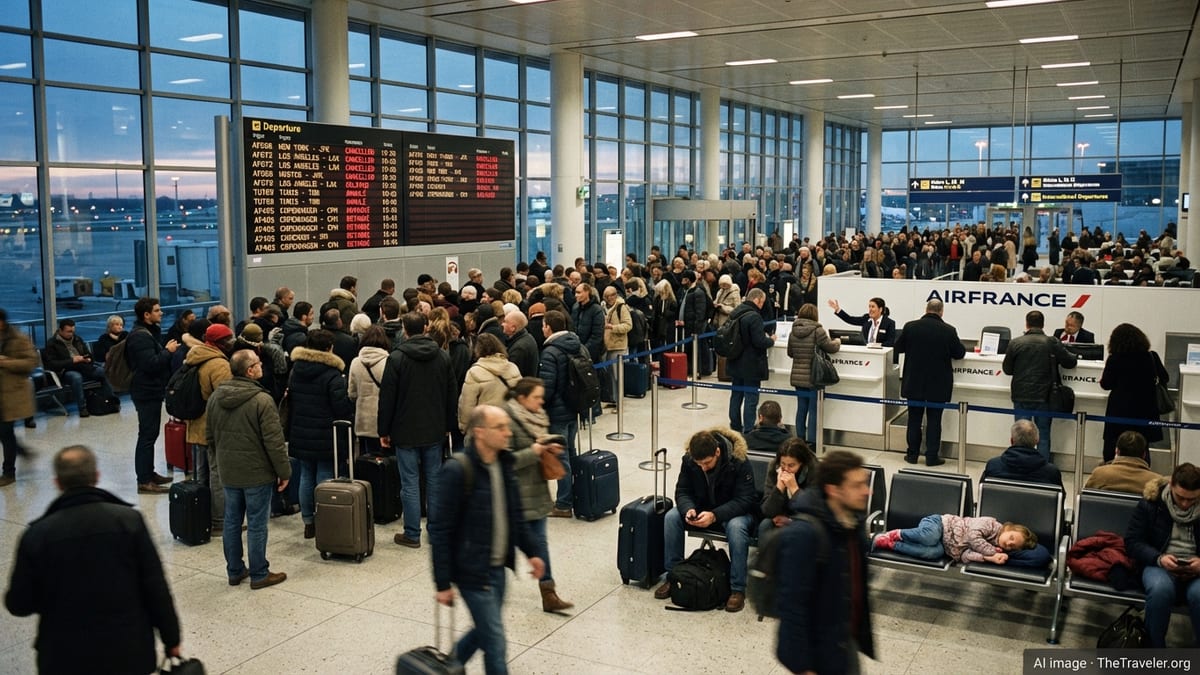
Rising Delay Pressure at France’s Busiest Hub
Paris Charles de Gaulle (CDG), the main international gateway for the French capital, is entering the 2026 peak season under intensified pressure from surging traffic and a tight airspace network. Recent punctuality snapshots from European air traffic monitoring bodies show that delays across major hubs worsened in early 2026 compared with the previous year, with CDG frequently listed among the airports facing higher arrival and departure hold-ups.
Industry analysis of airport performance ranks CDG among the European hubs with elevated delay risk this year, citing its role as a major transfer point and its exposure to en route congestion over France. For long-haul and connecting passengers, that means even modest schedule disruptions can cascade into missed onward flights and extended rebooking queues.
Airport traffic figures published by Groupe ADP, which operates the Paris airports, confirm that passenger numbers have continued to grow into 2026, adding extra strain to terminal operations, security screening and ground handling. While infrastructure upgrades and operational adjustments are underway, these changes have not fully offset the effect of higher demand and increasingly complex flight patterns over Western Europe.
Travel analysts note that CDG’s challenge is not just the volume of flights but the concentration of movements during morning and evening peaks. With tight turnaround times and limited slack built into many schedules, any disruption, from storms to minor equipment issues, can quickly translate into knock-on delays across the day.
Orly Adjusts to Airline Shake-Up but Faces Airspace Risks
Paris Orly (ORY), historically the city’s second airport and a key base for domestic and leisure services, is undergoing a period of transition that is reshaping delay patterns. Air France has moved to end its remaining scheduled operations at Orly in 2026, consolidating flights at Charles de Gaulle and shifting many domestic routes to its low-cost subsidiary. Publicly available information indicates this step is part of a broader network simplification aimed at improving efficiency.
On paper, the redistribution of traffic away from Orly could ease some congestion. However, Orly remains a busy hub for low-cost and leisure carriers, with strong seasonal peaks to Mediterranean and overseas destinations. These flights are particularly sensitive to disruptions in French airspace, where any capacity reduction can prompt regulators to cut schedules and prioritize certain routes.
Past episodes show how quickly disruption can escalate. Earlier French air traffic control stoppages led to widespread cancellations at Orly and CDG, and guidance from passenger-rights platforms indicates that Orly-based flights are consistently among those hardest hit when airspace capacity is reduced. Even when no strike is in effect, flow-management restrictions over central France can slow arrivals and departures, lengthening taxi times and holding patterns.
For travellers, the practical effect is that Orly can swing from operating smoothly to experiencing long queues and rolling delays within a few hours, particularly on peak holiday dates. Travel planners recommend monitoring flight status closely and considering earlier departures when connecting to time-sensitive events or cruises.
Strikes and Industrial Action Keep Disruption Threat High
Although there is no nationwide air traffic control walkout underway in France as of early June 2026, recent history and new announcements underline how quickly the situation can change. A three-day strike by French controllers in mid-May caused substantial disruption, with thousands of flights across the country affected or cancelled, including many to and from Paris. Travel advisory services reported that the action coincided with a busy public holiday period, amplifying its impact on holidaymakers.
Looking ahead, union notices point to further industrial action risks later in the year. One major controllers’ union has already signalled plans for a four-day national strike in October, with estimates from corporate travel risk consultancies suggesting that up to 1,800 flights could be cancelled across France and on overflights using French airspace. Even if some actions are scaled back or called off, the pattern of repeated strike threats is adding a layer of uncertainty for anyone planning trips via Paris.
Beyond national strikes, targeted work stoppages and staffing issues at specific control centres can slow traffic flows through French airspace without fully closing it. Network operations reports from European aviation authorities highlight France as a recurrent source of en route air traffic flow management delays, which can extend flight times and cause aircraft to be held on the ground at origin airports.
For passengers, that means disruption at Paris airports is not only driven by local problems at CDG or Orly. Flights inbound from elsewhere in Europe, North Africa or the Atlantic may already be delayed before they reach French airspace, compounding congestion during busy arrival banks and leading to further schedule slippage.
Summer 2026 Travel: Long Queues and Missed Connections
Across Europe, summer 2026 is shaping up as another challenging season for air travel, and Paris sits squarely at the intersection of several pressure points. Travel industry reporting notes that many major European airports are already seeing security and border-control queues stretching to two or three hours at peak times, as new border systems and staffing constraints collide with robust demand.
Paris travellers are likely to encounter similar conditions, especially on mornings and evenings when multiple long-haul arrivals and short-haul departures overlap. Aviation data providers warn that longer processing times at passport control and security can cause knock-on effects at the gate, forcing aircraft to wait for late passengers and pushing back departure slots.
Delay-mapping guides produced for summer 2026 rank CDG among the hubs with notable disruption risk, pointing to French air traffic control congestion, high transfer volumes and constrained airport capacity. Orly, while smaller, is highlighted as vulnerable to schedule volatility on heavily seasonal leisure routes, where aircraft and crews are tightly utilized and recovery options are limited when something goes wrong.
For connection-heavy itineraries, these patterns translate into a higher risk of missed onward flights, especially when travellers have self-booked separate tickets or tight transfers. Travel advisers increasingly recommend building in a wider buffer between flights at CDG, and avoiding last departures of the day on crucial connections where possible.
What Passengers Can Expect on the Ground
The growing likelihood of delays does not mean that trips through Paris airports are unmanageable, but it does change what travellers should expect. Publicly available guidance from airlines and passenger-rights organizations emphasises the importance of real-time monitoring, encouraging passengers to use carrier apps and airport information screens to track any developing disruption.
When delays do occur, European Union rules on passenger rights still provide a framework of care and, in many cases, financial compensation, although policymakers in Brussels are debating changes that could eventually reduce some payouts. For now, travellers departing from Paris can generally expect assistance such as meals, refreshments and accommodation once delays reach certain thresholds, along with compensation for long delays and cancellations that are not caused by extraordinary circumstances.
In practice, access to that support often depends on how quickly passengers contact their airline and document the disruption. Consumer advocates advise keeping boarding passes, written delay notices and photos of flight information displays, which can help substantiate later claims. At busy airports like CDG and Orly, where customer-service desks may be overwhelmed during major disruption, digital channels can sometimes yield faster responses.
With air traffic demand still rising and the structural constraints on French airspace unlikely to ease in the short term, aviation analysts expect delays at Paris airports to remain a recurring feature of the travel landscape. For now, the most realistic strategy for passengers is to factor that reality into their plans: arrive earlier, allow more time between flights and stay flexible when the schedule shifts.