


More news on this day
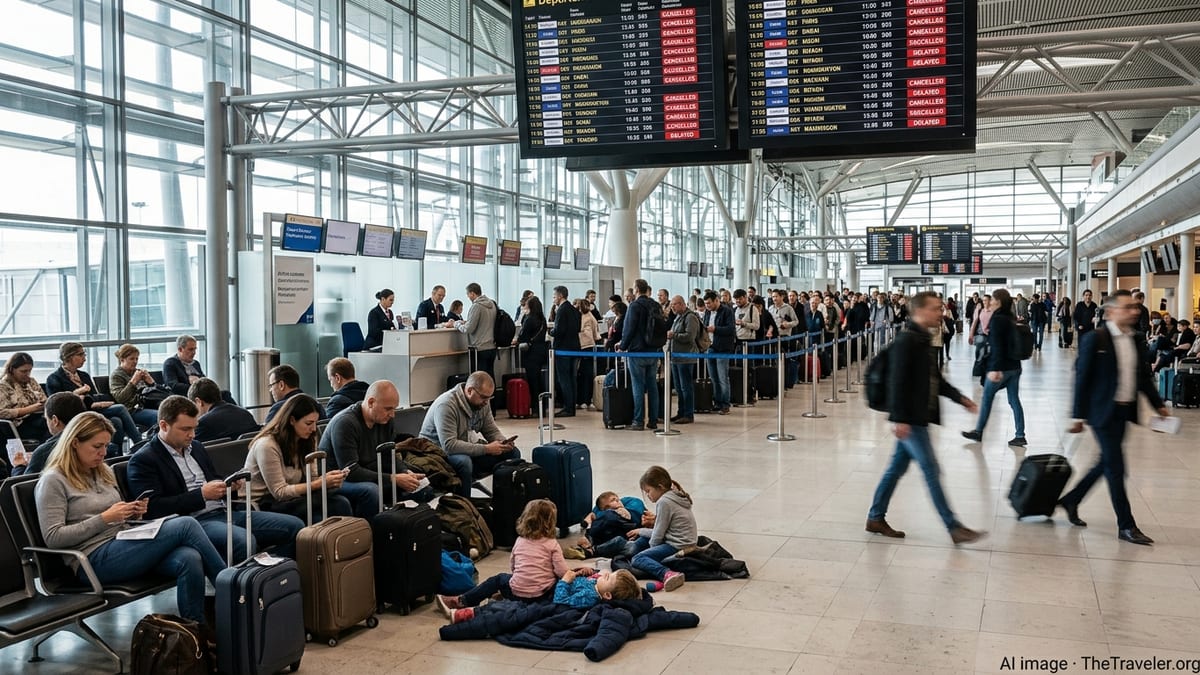
Paris-bound passengers flying with Air France and United Airlines have faced a turbulent weekend, as a combination of ground-side disruption, system issues and wider European congestion triggered growing delays and scattered cancellations at the French capital’s airports.
Get the latest news straight to your inbox!
Delays Mount Across Paris Airports
Recent operational data and traveler reports indicate mounting disruption at Paris Charles de Gaulle and Orly, with late-running departures and arrivals rippling across short and long haul networks. Aviation monitoring services tracking Saturday and Sunday movements show numerous flights into the capital arriving behind schedule, including several Air France services into Charles de Gaulle that landed more than 20 minutes late despite largely clear weather.
At the same time, broader European traffic patterns are amplifying the strain. Eurocontrol’s latest weekly overview highlights that air traffic control capacity issues in France remain a leading driver of air traffic flow management delays, adding minutes to flights even when local airport conditions appear normal. That pressure is feeding through to major hubs such as Paris, where tight turnaround schedules leave little margin before late flights begin to stack up.
For travelers, the picture is uneven. Some flights are operating close to schedule, while others encounter rolling delays at check in, security and boarding. Real time tracking tools show a mix of minor lateness and more significant hold ups on key European routes into Paris, underlining how fragile the timetable has become at the outset of the busy summer travel period.
Separate disruption tracking suggests that Paris Orly, traditionally a stronghold for domestic and leisure routes, is also feeling the strain, with more than one hundred delayed services recorded on Sunday. Those knock-on effects are complicating connections for passengers who rely on cross-town transfers between Orly and Charles de Gaulle or onward rail links from central Paris.
Air France Faces Patchwork of Cancellations and Late Arrivals
Publicly available flight status information shows that Air France has been grappling with a patchwork of delays and cancellations involving Paris flights. On Friday and Saturday, several services into Charles de Gaulle operated with moderate lateness, including inbound flights from African and European gateways that arrived more than 20 minutes behind schedule after late departures and congestion en route.
Consumer-rights platforms tracking cancellations list at least one Air France domestic service between Paris Charles de Gaulle and Toulouse as canceled in the early hours of Saturday morning, signaling that operational pressures are occasionally severe enough to push the airline to trim its schedule. In most cases, however, flights have departed and arrived, albeit off timetable, pointing to a network under stress rather than in full-scale shutdown.
Despite the disruption, outage-monitoring sites report no widespread failure of Air France’s core digital systems, suggesting that current problems are driven more by operational bottlenecks and air traffic constraints than by a major information-technology collapse. Even so, scattered customer complaints over booking and check in difficulties hint at localized technology friction adding to a sense of chaos on the ground.
Advisories from partner carriers stress the importance of real time alerts for passengers booked on Air France and affiliated services, especially for itineraries to or from Paris that involve onward connections. Travelers are being encouraged to monitor flight status closely and remain flexible on rerouting options when delays threaten to strand them in the hub.
United Passengers Caught in Network Turbulence
Transatlantic passengers on United Airlines routes into and out of Paris have not escaped the turbulence. While no single, headline-grabbing failure has emerged in recent days, United’s Paris services are operating against the backdrop of a strained global network, with weather waivers on the United States East Coast and operational snags elsewhere forcing schedule changes that can cascade onto European flights.
Community travel forums tracking United’s waivers show the airline has been managing multiple disruption windows this month, including storm-related flexibility for East Coast departures that overlap with transatlantic travel dates. When those waivers kick in, large numbers of passengers rebook or re-route, which can leave Paris flights crowded, reshuffled or, in some cases, subject to last-minute aircraft swaps.
Archived traveler accounts from earlier Paris disruptions also illustrate how fragile United’s Charles de Gaulle operations can become when the carrier’s technology or scheduling tools misfire. In one widely shared case from a previous summer season, a Paris to Newark service appeared canceled in booking systems while still operating, causing confusion at the airport and highlighting the risk of relying on inconsistent status updates during busy travel periods.
While current reports do not point to a repeat of that specific glitch, they underline why United passengers heading to or from Paris this week are being advised by travel forums and consumer groups to double check their flight number and operating carrier, particularly when codeshares, retimed services or replacement flights in the 3000-series range appear in their itineraries.
Strikes and Structural Bottlenecks Set the Stage
The latest wave of disruption is unfolding against a wider backdrop of structural strain at Paris airports. Ground staff unions have called a 24 hour strike for June 18 covering Charles de Gaulle, Orly and Le Bourget, with walkouts expected among baggage handlers, ramp agents, check in teams and other badge-holding ground workers. Passenger advocacy groups warn that this industrial action is likely to trigger long queues, slower baggage delivery and potential same day cancellations across multiple airlines.
Because the strike targets airport staff rather than specific carriers, analysts expect Air France, United and a broad mix of European, Gulf and transatlantic airlines to experience turbulence in their Paris operations on that date. Consumer information sites note that while compensation rules may be limited when strikes involve airport employees, airlines remain responsible for offering rerouting or refunds in the event of cancellations and for providing care such as meals and accommodation during extended delays.
Separately, European air traffic management data shows that France has emerged as one of the continent’s hotspots for air traffic control staffing and capacity delays, which have become a chronic feature of the network since early June. Those en route hold ups can quickly translate into missed slots and ground congestion at Paris hubs, even when local staffing and weather appear adequate.
Industry observers argue that the combination of structural capacity issues, mounting summer demand and upcoming industrial action leaves little slack in the system. For airlines like Air France with dense Paris hub operations, and for United, which depends on smooth transatlantic flows to feed its U.S. network, any fresh shock has the potential to produce another round of high profile delays and cancellations.
What Travelers Can Do If Their Paris Flight Is Hit
Travel organizations and passenger rights groups recommend that anyone flying into or out of Paris with Air France, United or partner carriers over the coming days adopt a defensive travel strategy. That includes enrolling in airline notification tools, checking flight status frequently, and keeping a close eye on both airport specific disruptions and broader air traffic control alerts that may affect France.
In the event of a delay or cancellation, publicly available guidance emphasizes documenting the situation with screenshots of flight status, boarding passes and any communication from the airline. This information can prove useful later when seeking refunds, rerouting or, where applicable, compensation under European passenger protection rules.
Passengers are also being encouraged to think ahead about alternatives. For those on United, that may mean looking at rebooking options via other European hubs if Paris becomes gridlocked, while Air France travelers could explore retiming to less crowded off peak departures or requesting re-routing through partner hubs where spare capacity exists.
With a major ground staff strike scheduled and European airspace already congested, aviation analysts caution that the current Paris flight chaos may persist beyond the weekend. For now, traveler preparedness, flexibility and vigilance remain the best defenses against an unpredictable summer at one of Europe’s busiest gateways.