


The Pembrokeshire Coast combines a designated coastal national park with pastel harbour towns, sweeping sandy bays, cliff edge walking and wildlife rich islands. For visitors weighing up different Welsh coasts or wondering where to base themselves in West Wales, it offers a compact but varied stretch of shoreline where you can switch from family friendly beaches to wild headlands and tiny cathedral city lanes in the space of a short drive or bus ride.
Get the latest updates straight to your inbox!
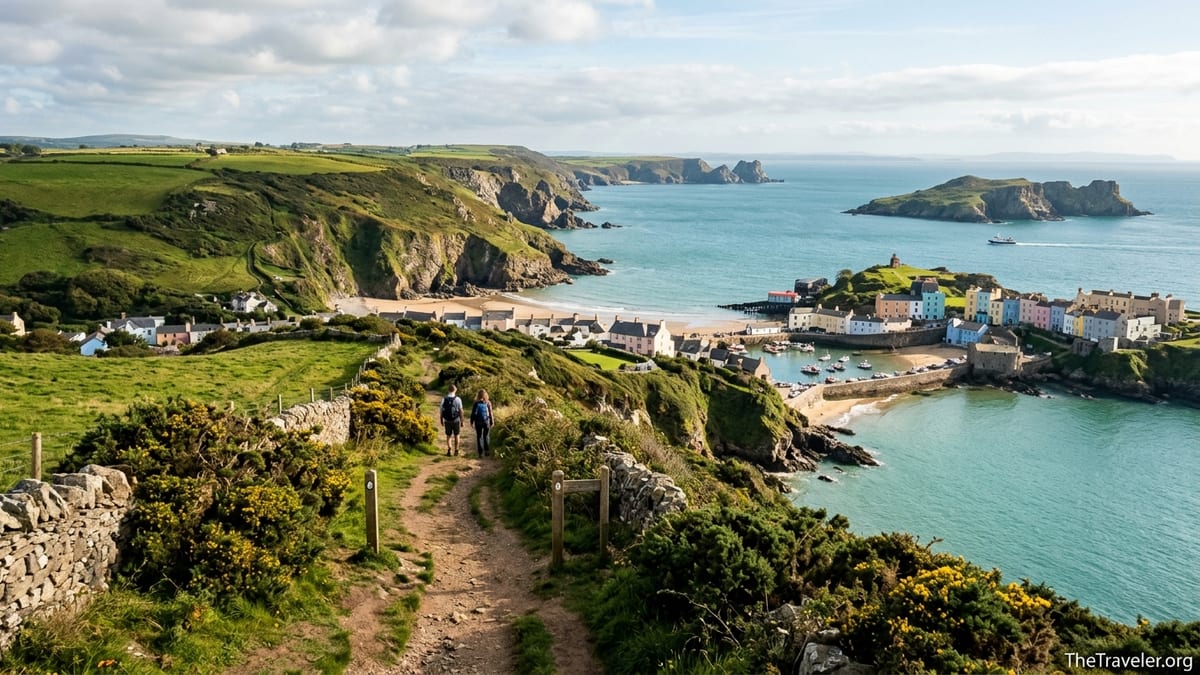
What Makes the Pembrokeshire Coast Distinct
Pembrokeshire Coast National Park protects almost all of the county’s shoreline, including high sea cliffs, dune backed bays and estuaries, making it one of the United Kingdom’s few coastal national parks. The protected area wraps around much of the peninsula, taking in St Brides Bay, the rugged northwest near Fishguard and Newport, and much of the south coast near Tenby and Manorbier. Some inland market towns and transport hubs such as Haverfordwest sit just outside the park boundary but still function as useful gateways.
Running along this protected shoreline is the Pembrokeshire Coast Path, a 186 mile National Trail that also forms part of the longer Wales Coast Path. Official information emphasises its constant ascent and descent as it follows the natural folds of the cliffs, so even short day sections can feel strenuous in places, although well waymarked tracks and regular access points make it manageable for most reasonably fit walkers who take their time.
The human side of the coast is just as appealing. Colourful harbour towns like Tenby and Saundersfoot have long catered for traditional seaside holidays with Victorian terraces, ice cream kiosks and busy summer beaches, while St Davids offers a quieter, small city atmosphere focused on its medieval cathedral and arts scene. Smaller communities such as Solva, Newport and the twin ports of Fishguard and Goodwick retain a more village like feel and make relaxed bases for walking focused trips.
Out to sea, islands such as Skomer and Ramsey are recognised for internationally important seabird colonies and rich marine life. Visitor numbers are carefully managed through bookable boat trips, which means experiences are intimate but require advance planning, especially in peak season when sailings can sell out. Together with safe, gently shelving beaches, coastal castles and pretty lanes, this mix of natural drama and small scale development is what sets Pembrokeshire apart from more heavily built up seaside stretches elsewhere in Wales.
Choosing Your Base: Key Towns and Villages
Tenby lies on the south coast within the national park boundary and is the county’s best known resort. The historic walled town overlooks three main sandy beaches and a small harbour, with frequent boat trips to Caldey Island in season. In summer it is lively and sometimes crowded, with a broad choice of guesthouses, small hotels, apartments and budget friendly bed and breakfasts that suit families and first time visitors. Without a car you can still enjoy cliff top walks towards Saundersfoot and Manorbier, reach beaches on foot and use regular trains and local buses for day trips.
Saundersfoot, a few kilometres east of Tenby, also lies inside the national park and grew up around a compact harbour and wide sandy bay. It feels smaller and slightly quieter than Tenby but still offers a good range of accommodation, restaurants and easy beach access. Its rail station is about a mile inland, close to the line that continues to Tenby and beyond, and the village connects directly to the Pembrokeshire Coast Path, making it attractive for walkers who want a gentler resort atmosphere but do not wish to drive every day.
On the north western coast, St Davids sits within the national park and is widely known as Britain’s smallest city. In practice it functions as a large village with a cathedral at its heart, a scattering of eateries and galleries, and a relaxed, slightly arty feel. Nearby Whitesands Bay and St Davids Head provide dramatic coast path walking and one of the area’s best surfing and bodyboarding beaches. St Davids works well for visitors prioritising coastal walking, boat trips to Ramsey Island and cultural sights over traditional resort amusements, although public transport options are more limited than in the south.
Fishguard and Goodwick, twin settlements facing Fishguard Bay, lie partly within the park boundary and serve as a quieter northern base. Goodwick hosts the rail terminus and ferry port, while Fishguard itself climbs the hillside with views across the harbour and an old town clustered around a smaller quay. The coast path runs directly through the area and local buses link out to villages along Cardigan Bay and back towards St Davids, so car free walkers can piece together day routes, although timetables need to be checked in advance and often vary by season.
Smaller options include Solva, a picturesque harbour village on the St Brides Bay coast within the park, and Newport, a compact settlement near the mouth of the River Nevern that also lies inside the protected area. Both offer guesthouses, smaller self catering properties and access to sections of the coast path that feel quieter than those near the big resorts. They suit travellers who value scenery and walking above nightlife and shopping, and are particularly attractive to repeat visitors who already know Tenby or St Davids and want a more low key base.
How Long to Stay and Whether You Need a Car
A stay of two or three nights allows time for a snapshot of the Pembrokeshire Coast, with one full day on the beach or islands and another on a short stretch of the coast path. Many visitors, especially families in summer or walkers in spring and autumn, find four to seven nights more rewarding, as this allows them to combine different parts of the coastline. A week based in one town such as Tenby or St Davids can work well if you are happy to focus on one area, while a week split between the south and the St Davids or Newport area shows off more variety.
Having a car gives the most flexibility, particularly if you want to reach more remote coves, quiet headlands or early morning boat departures. Road access follows a mix of main routes and minor lanes, and some final approaches to beaches are along single track roads with passing places where careful, patient driving is essential. Popular car parks at sites such as Broad Haven South, Barafundle access points or Whitesands can fill quickly on fine summer days, and the national park authority advises arriving early or having a back up plan.
Travel without a car is entirely possible but requires more planning. Rail services run to Tenby, Saundersfoot, Haverfordwest and Fishguard and Goodwick, usually with connections from Cardiff and Swansea, and from these hubs local buses reach several coastal villages. Some rural services are infrequent, may not run on Sundays and can change in school holidays, so visitors should check current timetables close to their travel date. In addition, seasonal coastal buses, often branded with coastal or country themes, operate on certain routes in walking season to help hikers link sections of the path, but they also vary year to year and should be confirmed through official park or council channels.
For walkers planning multi day routes on the Pembrokeshire Coast Path, a mix of public transport, taxi transfers and baggage transfer services works well. Many companies that operate along the Wales Coast Path offer pre bookable luggage transport between accommodations, allowing you to walk each section with a daypack. Coastal villages with pubs or small shops can then serve as overnight stops, while rail connected towns like Fishguard and Haverfordwest provide convenient start or end points when connecting back to national services.
Reaching the Coast: Rail, Bus and Driving
The main rail routes into Pembrokeshire are part of the West Wales lines, operated by Transport for Wales. Trains from Swansea and Cardiff run west to Carmarthen, then divide to serve branches to Pembroke Dock via Tenby and Saundersfoot, and to Milford Haven and Fishguard and Goodwick via Haverfordwest. These stations act as practical railheads for coastal stays, with Tenby and Saundersfoot inside the national park, and Haverfordwest and Fishguard and Goodwick just outside or straddling its boundary but well placed for onward travel.
From these stations, local buses provide connections to resort towns, smaller villages and some coast path trailheads. Services exist along both the south and north coasts and include routes linking Fishguard and Goodwick with St Davids and Haverfordwest, and buses between Tenby, Saundersfoot and other south coast communities. However, official information and local reports stress that rural bus frequencies can be modest, especially outside school times and in winter, so visitors should not assume turn up and go service and should always consult current journey planners or operator information.
For walkers, seasonal coastal bus services have historically operated to link popular sections of the Pembrokeshire Coast Path, allowing linear day walks and one way itineraries. The national park promotes these when they are running, often with branded names and clear maps, but availability, routes and timetables can change with funding and demand. Anyone relying on these services should check the latest national park leaflets or visitor centre information for the specific year of travel and be prepared with taxi contacts as a backup in more remote stretches.
Drivers approaching Pembrokeshire usually arrive via the M4 and A48 from England and South Wales, continuing on the A40 to Haverfordwest before branching south to Tenby and Pembroke or north to Fishguard and Cardigan. Once on the coast, roads quickly narrow into minor routes and single track lanes, particularly near beaches such as Barafundle, Marloes Sands and some coves around St Davids Head. Many larger beaches and viewpoints have pay and display car parks managed by the national park or local authorities, often with daily or hourly charges and occasionally height barriers. Payment methods and tariffs are subject to change, so visitors should check signs on arrival.
Beaches and Classic Coastal Walks
Pembrokeshire’s beaches range from broad family strands to hidden coves. Tenby’s North and South Beaches offer gently shelving golden sand, lifeguard cover in the main summer season and easy access from town, making them ideal for families and visitors without a car. Saundersfoot’s bay offers similar facilities with a more village like feel. Local councils publish current information on lifeguard patrol dates, bathing water quality and any dog restrictions, which often vary between main summer months and the rest of the year.
For something more dramatic, beaches along St Brides Bay and the northwest coast combine surf, cliffs and wilder surroundings. Whitesands Bay, a short drive or bus ride from St Davids, is a long sandy beach backed by low dunes and a car park that can fill early on fine days. It provides an excellent starting point for coast path walks around St Davids Head, where the trail climbs above rocky inlets and offers wide views across Ramsey Sound. Some sections are exposed near unfenced cliff edges, so families with younger children should supervise carefully and consider shorter there and back strolls rather than longer circuits.
Rugged coves such as those near Solva or between Little Haven and Broad Haven feel quieter again, with narrower access roads and limited parking. Here, short but steep paths often link the village to the main coast path, which then undulates over headlands and past rock stacks. Beach safety services are more limited or absent at these smaller coves, so visitors should be cautious with swimming, check tide times locally and follow any safety notices. Walking in these areas rewards with a sense of remoteness within relatively short distances of accommodation.
Along the north coast near Newport and Fishguard, the coast path follows higher cliffs and more remote stretches, with fewer large sandy beaches but superb headland walking and views across Cardigan Bay. Access points such as Newport’s estuary and Parrog, or the minor road heads west of Fishguard, give options for out and back walks or one way routes using buses or taxis. As elsewhere, official path managers monitor for erosion or landslips and may impose temporary diversions, so checking current Wales Coast Path and national park notices before long outings is sensible.
The Pembrokeshire Coast Path and the Wales Coast Path
The Pembrokeshire Coast Path is one of Wales’s official National Trails and runs for roughly 186 miles around the county’s coastline. It forms a substantial section of the all Wales Coast Path, which creates a continuous walking route around the country’s shore. Waymarking in Pembrokeshire typically combines the National Trail acorn symbol with the Wales Coast Path’s distinctive shell style logo, making it straightforward to follow for visitors used to British long distance paths.
Most visitors experience the coast path through day walks rather than the full trail. From bases such as Tenby, Saundersfoot, St Davids, Solva, Newport or Fishguard, it is easy to step straight onto the path from town or after a short bus or taxi ride. Common patterns include walking one way for a few hours and then returning by the same route, or linking two villages or access points and using public transport or pre arranged taxi transfers. This flexible approach suits mixed ability groups and families, since individuals can turn back earlier while others continue further.
For keen walkers, multi day itineraries along the Pembrokeshire Coast Path are a highlight. Guideline information from official sources suggests planning modest daily distances, because cumulative ascent and descent often exceeds what the map alone might suggest. Accommodation is available in towns and villages spaced along the route, including youth hostels, campsites, guesthouses and small hotels. Several specialist companies offer baggage transfer services, moving luggage between overnight stops so that walkers carry only daypacks. Before committing to a long hike, travellers should check official trail resources for up to date details of any path closures, diversions and graded difficulty for particular sections.
Given the path’s proximity to unfenced cliff edges and occasional livestock, sensible precautions apply. Good footwear, awareness of weather and visibility, and caution near exposed sections are all recommended. Families should supervise children closely near cliffs and avoid climbing on unstable edges. Dogs are usually welcome but may be required to be on leads in sections with grazing animals or near wildlife sensitive areas; local signage and national park guidance should be followed at all times.
Offshore Islands: Skomer, Ramsey and Marine Wildlife
Off the south western coast, Skomer Island is one of the United Kingdom’s most renowned seabird sites, known especially for its puffin colony in late spring and early summer, as well as manx shearwaters, guillemots and other species. The surrounding waters form a marine conservation zone home to seals and varied marine life. Visitor numbers to Skomer are strictly controlled through a system of bookable boat landings and around island cruises run by licensed operators from the mainland. Sailings are weather dependent and often sell out well in advance in peak months, so pre booking through official channels is strongly advised.
To the west of St Davids, Ramsey Island offers another island experience with towering cliffs, seabirds and frequent seal sightings. Boats typically depart from the St Justinians area near St Davids, again on small vessels with limited capacity and schedules shaped by tides and sea conditions. Trips range from shorter wildlife watching excursions that circle the island to longer landings where permitted. Operators work in partnership with conservation bodies, and visitors are asked to follow strict codes of conduct, including sticking to marked paths and keeping appropriate distances from wildlife.
In both cases, practical arrangements change from season to season. Operating periods usually focus on spring through early autumn, with more frequent sailings in high summer, but exact start and end dates, ticket prices and booking systems can vary. Prospective visitors should consult the latest information from the national park and official boat operators rather than relying on older guidebooks or third party sites. It is also sensible to build flexibility into your wider itinerary in case weather forces last minute cancellations or timetable changes.
Even if you do not land on an island, coastal boat trips from Tenby, St Davids area harbours and other points along the coast offer an alternative way to experience Pembrokeshire’s cliffs and marine life. Shorter cruises can be more suitable for families with younger children or travellers prone to seasickness, although sea conditions can still be lively. Warm layers, waterproofs and secure footwear are advisable even on clear days, as Atlantic weather can change quickly.
Seasons, Weather and When to Visit
Summer, particularly July and August, brings the warmest sea temperatures, longer daylight and the most reliable conditions for beach going and island boat trips, but also the largest crowds and highest accommodation prices. Resorts such as Tenby and Saundersfoot feel lively and may be busy at peak times of day, and popular car parks at beaches and coastal viewpoints can fill up by late morning on fine days. Families tied to school holidays often accept this trade off in exchange for easier swimming and a full programme of visitor services.
Spring and early summer, broadly from April into June, can offer a good balance of milder weather, longer days for walking and abundant wildlife. This is typically the best period for seeing puffins on Skomer and seabirds along cliffs more generally, and coastal slopes may be carpeted with wildflowers. Some seasonal buses and tourist facilities start up around Easter, although exact dates depend on the year. Sea temperatures remain cool, so many visitors opt for wetsuits when swimming or focus on walking and boating.
Autumn, especially September and early October, brings quieter paths and beaches while sea temperatures are often at their warmest after summer. Weather can be more changeable, with a greater chance of Atlantic storms interspersed with clear days. This period suits experienced walkers and those focusing on photography or slower paced stays rather than guaranteed beach weather. Some boat services and coastal buses may reduce frequency or stop entirely as the season winds down, making forward planning even more important.
Winter on the Pembrokeshire Coast is generally mild by British standards but can be very windy and wet, with short daylight hours. Many visitor facing businesses reduce opening hours or close, and public transport options thin out, although core rail services continue. Coastal walking can still be rewarding on clear days, with dramatic seas and empty paths, but care is needed around slippery sections and high cliffs. Travellers at this time of year should plan conservatively, carry appropriate clothing and equipment, and remain flexible in case weather alters their plans.
Which Base Is Best For You: Sample Trip Ideas
For a family beach long weekend, basing in Tenby or Saundersfoot works well. You can arrive by train from Cardiff or Swansea, walk to main beaches without a car and enjoy classic seaside activities. One full day might be spent on Tenby’s North or South Beach with time exploring the walled town, and another on a short section of the coast path towards Saundersfoot or Manorbier, returning by bus or train. If sea conditions and schedules allow, a half day boat trip from Tenby to Caldey Island adds variety without demanding complex logistics.
Walkers with four or five days could base in St Davids or split time between Newport and St Davids. Using local buses and taxis, they might walk sections of the coast path such as Newport to Fishguard, Solva to St Davids, and circuits from Whitesands around St Davids Head. On a rest day or in mixed weather, a visit to St Davids Cathedral and its surrounding lanes offers a cultural change of pace. Depending on season and availability, a day reserved for a Ramsey Island or other wildlife boat trip fits naturally into this kind of itinerary.
For a coast and culture week that showcases different sides of Pembrokeshire, consider three or four nights in Tenby followed by three or four in the St Davids or Solva area. The southern base allows for beach time, castle visits in nearby Pembroke and relaxed evenings in a lively resort setting. Moving north brings a shift to wilder scenery, quieter nights and island or headland walks. Travelling between the two by bus or car takes a relatively short time, yet the contrast in landscapes and atmosphere feels marked, giving a sense of having explored more than one destination within a single county.
Whichever base you choose, the key to a rewarding Pembrokeshire Coast trip is matching your expectations and logistics to the area’s character. Decide whether you value busy resort facilities or quieter villages, plan how you will reach and move around the coast, and build in some flexibility to adapt to weather and transport realities. With that groundwork in place, the combination of cliff top paths, wide sandy bays and wildlife rich islands makes this corner of West Wales one of the most satisfying stretches of the Welsh coast for a short break or longer holiday.