


More news on this day
United Airlines has expanded the use of generative AI to craft detailed delay explanations and embed live weather radar maps directly into passenger notifications, and the carrier now says customer satisfaction scores on some weather‑delayed flights rival or even exceed those of typical on‑time services, underscoring how clearer information can alter how travelers experience disruptions even when schedules themselves do not improve.
Get the latest news straight to your inbox!
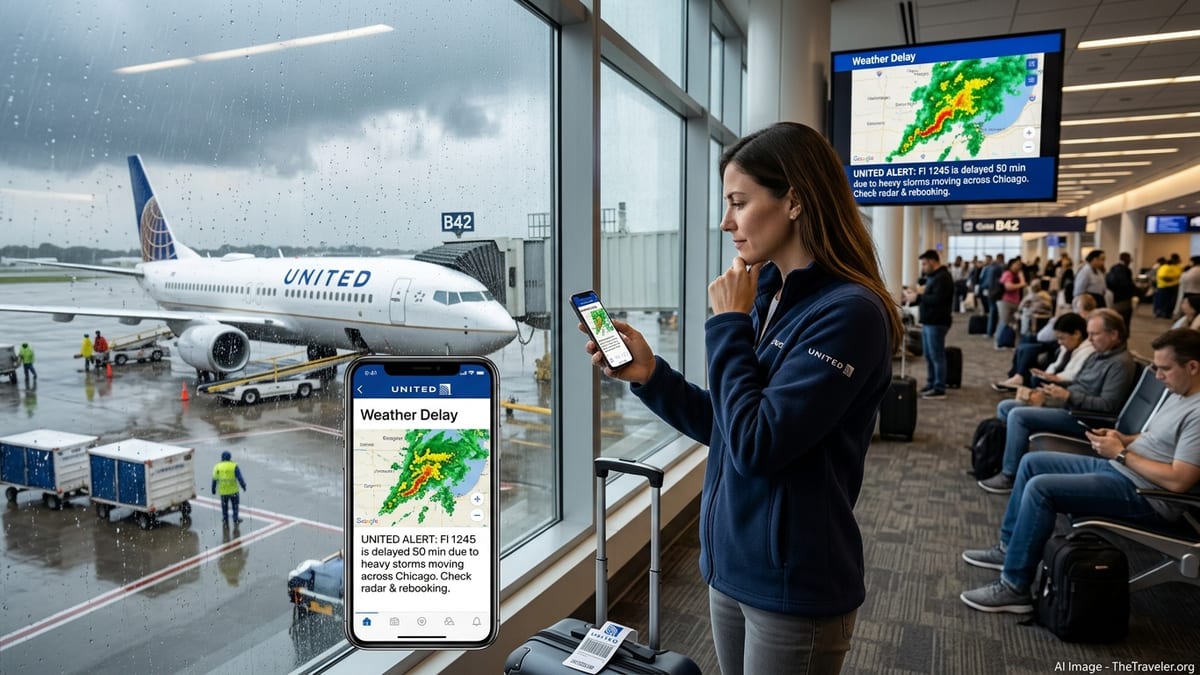
What United’s AI weather delay system actually does
United began sending customers links to local, live radar maps during weather‑related delays in mid‑2024, describing the feature publicly in early July that year as part of a broader effort to make operational decisions more transparent to passengers. The radar links appear in push alerts and text messages, alongside delay explanations that are now drafted with the help of generative AI tools and then reviewed by staff before being sent to customers. ([reddit.com](https://www.reddit.com/r/unitedairlines/comments/1duczsi?utm_source=openai))
Those explanations draw on operational data already consolidated inside United’s technology stack. The airline has spent several years building a central data hub and machine‑learning layer to ingest flight status, aircraft routing, crew assignments, airport constraints and multiple weather feeds. Generative models sit on top of that infrastructure and propose plain‑language narratives that explain why a flight is delayed, what operational teams are doing about it and what customers can expect in the next phase of the disruption. ([cio.com](https://www.cio.com/article/3969476/united-airlines-ai-strategy-the-airline-that-makes-decisions-fastest-wins.html?utm_source=openai))
Specialized customer service “storyteller” teams based in United’s network operations center then review each AI‑drafted message, adjust wording for clarity and tone, and release it through the United mobile app and SMS channels. For weather events, those messages are often paired with a zoomable radar map centered on the relevant airport or storm system. At some hubs, the same radar imagery can also be shown on gate‑area screens so travelers with limited mobile connectivity can still see the conditions affecting their flight. ([imagine.ai](https://imagine.ai/research/united-airlines?utm_source=openai))
How much satisfaction actually improves, and what the numbers mean
United’s leadership has repeatedly argued that information quality, more than small changes in block times, is the most powerful lever the airline controls in disruption scenarios. In recent interviews and conference appearances, CEO Scott Kirby has pointed to internal Net Promoter Score experiments in which delayed flights receiving only a generic “due to weather” message scored sharply lower than otherwise comparable flights where passengers were sent a radar image and detailed explanation. ([finance.yahoo.com](https://finance.yahoo.com/video/high-fuel-costs-starlink-and-the-beauty-of-ai-alerts-united-airlines-ceo-154733220.html?.tsrc=rss&utm_source=openai))
Kirby has described one internal trial at Chicago where United split delayed flights into two groups. According to his account, services that received a standard, brief weather notice recorded an NPS of roughly minus 60 for delays of about an hour, while flights whose customers were sent a radar snapshot of the storm line and a narrative about air traffic control restrictions scored around plus 60, a level he said is higher than a typical on‑time flight. These figures come from United’s own measurements rather than an independent study, and the airline has not released a full data series or route‑level breakdowns, but they explain why the carrier has continued to invest in the approach. ([finance.yahoo.com](https://finance.yahoo.com/video/high-fuel-costs-starlink-and-the-beauty-of-ai-alerts-united-airlines-ceo-154733220.html?.tsrc=rss&utm_source=openai))
Company filings in 2026 highlight “embedded live weather maps directly into customer messages” as one of the technology milestones that management believes contributed to higher app engagement and improved sentiment scores in irregular operations. However, the filings and public comments also make clear that the AI tools do not shorten weather delays themselves; rather, they appear to influence perceptions of fairness and control during events driven by storms, airspace congestion and ground‑handling limits. ([ir.united.com](https://ir.united.com/static-files/4465ec94-3c73-45ff-841a-eac498655855?_sp=89a54c1d-ba60-4749-a698-db0613876aad&utm_source=openai))
Inside the tech stack powering United’s delay “stories”
The radar‑linked updates are built on top of United’s broader AI and data modernization program, which the airline has discussed in technology case studies and industry presentations over the last two years. At the core is a data platform that aggregates live operational feeds, including aircraft telemetry, maintenance status logs, crew scheduling systems, airport throughput metrics and multiple weather products, from high‑level terminal forecasts to convective radar and lightning data. ([cio.com](https://www.cio.com/article/3969476/united-airlines-ai-strategy-the-airline-that-makes-decisions-fastest-wins.html?utm_source=openai))
When an irregular operation is detected, the system assembles a snapshot of relevant factors: for example, whether the inbound aircraft is held in a ground stop, whether crew duty‑time limits are approaching, and whether air traffic control has imposed flow restrictions along the route. A generative AI model running on this platform reads the structured flight facts, operations and gate chat threads, and current weather information, and drafts a narrative in everyday language aimed at customers rather than specialists. Internal governance rules require that a human agent review and approve each message, and in many cases edit it, before it reaches passengers. ([case-studies.ai](https://case-studies.ai/use-cases/customer-engagement/CE-099-flight-delay-messages-united-airlines/?utm_source=openai))
Because the system is driven by live feeds, it can send sequential updates as conditions shift. If a thunderstorm line dissipates more quickly than forecast and a ground delay program is relaxed, a follow‑up message can explain the change, provide a revised estimated departure time and, when appropriate, include an updated radar image that shows the storm field clearing along the planned departure corridor. Conversely, if convective activity strengthens or spreads, later messages can describe why air traffic control has extended restrictions and why the flight cannot simply “go around” storms that may look narrow but are too intense or widespread to avoid while maintaining safe separation. ([cbsnews.com](https://www.cbsnews.com/news/united-text-real-time-radar-maps-weather-delays/?utm_source=openai))
What this means for passengers during real weather disruptions
For travelers, the most visible change is the specificity of the information they receive when a flight is held for weather. Instead of a single, vague “your flight is delayed due to weather” alert, United’s customers increasingly see a series of messages that might describe a ground stop issued by the Federal Aviation Administration, lower arrival rates at a busy hub due to low cloud ceilings, or thunderstorms closing departure paths to the east. The live radar link allows passengers to verify that storms are present and, in some cases, see how bad weather in another region is rippling into their own itinerary. ([reddit.com](https://www.reddit.com/r/unitedairlines/comments/1duczsi?utm_source=openai))
These explanations are integrated with self‑service tools in the United app. During weather disruptions, many customers can view and accept alternative flights, join standby lists, adjust same‑day travel or check on through‑checked baggage without waiting for a customer service agent. United has highlighted in multiple product announcements that rebooking options, meal and hotel vouchers when eligible, and airport‑specific information are now surfaced automatically for many disrupted travelers, which reduces pressure on airport service desks during severe storms at large hubs such as Denver, Houston or Newark. ([ruaea.org](https://www.ruaea.org/newsletter/479C76727847/RUAEA-Newsletter-August-2024-D.pdf?utm_source=openai))
Early public feedback suggests that experiences still vary. Some flyers praise the additional detail and say that seeing radar and receiving clear causal explanations makes it easier to accept lengthy holds, particularly when skies at their specific gate look clear. Others report cases where messages appear generic or lag behind information on airport departure boards, especially during large‑scale system disruptions involving both weather and technology issues. Those anecdotal reports are consistent with United’s description of the project as a continuing rollout rather than a fully uniform, system‑wide capability. ([reddit.com](https://www.reddit.com/r/unitedairlines/comments/1m52vir?utm_source=openai))
Regulatory context, limitations and how far AI can go
United’s AI‑drafted weather messages operate inside existing U.S. aviation rules and do not alter the criteria for when flights can depart, how close aircraft can be spaced during poor visibility, or when crews must stop flying for duty‑time reasons. Air traffic control centers and local airport operations, not airline apps, determine ground stops, flow programs and runway configurations. The radar maps and delay narratives can explain those constraints but cannot guarantee a specific departure time or connection protection outcome. ([uscode.house.gov](https://uscode.house.gov/us/usc/t49/subtitleVII.html?utm_source=openai))
Under current U.S. regulations, airlines must provide accurate information about delays and cancellations but are generally not required to compensate passengers for weather‑related disruptions on domestic itineraries. The Department of Transportation’s online customer service dashboard summarizes what each major carrier voluntarily promises in events it deems controllable, such as mechanical issues, but it treats weather as outside airline control. DOT has nonetheless stressed that it expects timely and responsive communication in all disruption scenarios, which is one reason airlines have invested in higher‑quality messaging tools even where their financial obligations remain unchanged. ([transportation.gov](https://www.transportation.gov/airconsumer/airline-cancellation-delay-dashboard?utm_source=openai))
For travelers, the practical implication is that United’s AI‑assisted updates should be treated as a detailed information source rather than as an authority on compensation eligibility. When disruption messages mention multiple causes, such as an initial mechanical problem followed by weather‑driven airspace restrictions, passengers who believe they may qualify for vouchers or other assistance should still confirm entitlements against United’s contract of carriage and, where applicable, specific jurisdictional rules for international segments. The AI tools summarize operational reality in real time but do not adjudicate passenger rights. ([transportation.gov](https://www.transportation.gov/sites/dot.gov/files/2024-07/14%20CFR-200%20ro%201199_01012023.pdf?utm_source=openai))
How this fits into airlines’ broader AI push and what to watch next
The live radar and delay‑storytelling system is one of several AI‑enabled tools United has deployed across its operation, alongside products such as ConnectionSaver, which uses machine learning to decide when to hold flights for connecting passengers, and internal “United GPT” tools that let employees query operational data with natural‑language questions. Company reports and technology interviews describe customer messaging as the first major generative AI use case to reach large‑scale production, in part because it sits directly on top of the data platform United has been building since before the pandemic. ([imagine.ai](https://imagine.ai/research/united-airlines?utm_source=openai))
Other large U.S. carriers are testing or rolling out similar concepts, including richer delay explanations and expanded app‑based self‑service options, but available public information suggests they are at different stages of implementation and use a variety of technical approaches. United executives contend that the airline remains ahead in terms of how deeply generative AI is embedded into day‑to‑day operations and customer communications, though such claims are difficult to verify externally because competitors disclose limited detail. For now, United appears to be the only U.S. carrier explicitly stating that it routinely sends live radar links generated with assistance from generative AI tools as part of its mainstream product. ([au.linkedin.com](https://au.linkedin.com/in/belindacondon?utm_source=openai))
Looking ahead, United has signaled that future phases will extend conversational AI to more customer touchpoints, including richer chat support in the app, voice‑based assistance and summarized operational briefings for frontline staff. For travelers, the immediate, practical advice is more basic: ensure the United app is installed and notifications are enabled before heading to the airport; treat AI‑assisted messages and radar images as one input alongside departure boards and official weather channels; and double‑check any rebooking, minimum connection times and overnight arrangements in the app or with an agent before making time‑sensitive decisions during major storms. As the technology matures, United’s delay messages are likely to become more consistent and personalized, but the underlying operational constraints of weather and airspace will remain.