


More news on this day
Three Delta Air Lines first officers declared themselves too fatigued to fly during separate domestic operations on November 23, 2026, forcing last-minute crew substitutions at the carrier’s Atlanta and Minneapolis hubs just one day after a major outage in its automated weight-and-balance system had already delayed hundreds of flights across the network.
Get the latest news straight to your inbox!
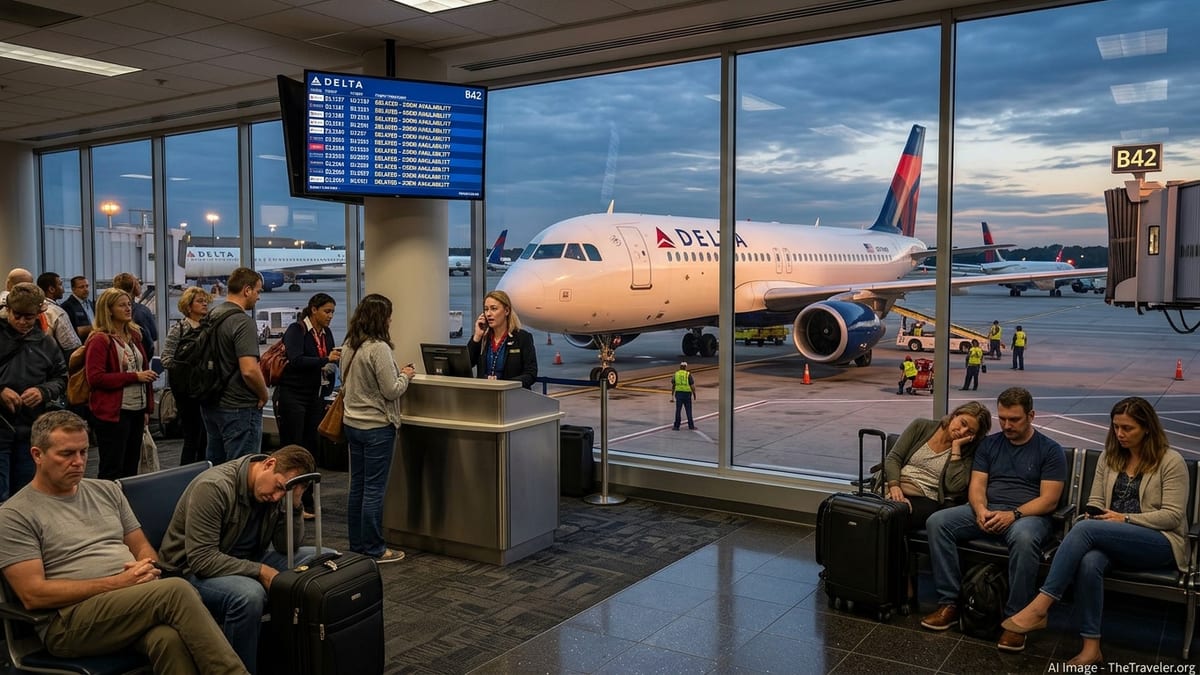
What happened on Delta flights DL1137, DL1241 and DL2654
According to operational data and reports from aviation specialist outlets, the three fatigue declarations occurred within roughly four hours on Monday, November 23, 2026, during otherwise routine domestic Airbus narrowbody services. All flights landed safely and there were no in-flight irregularities reported, but each case required Delta’s crew scheduling teams to adjust rosters at short notice.
On flight DL1137, operated by an Airbus A320 registered N374NW, the aircraft arrived at Hartsfield–Jackson Atlanta International Airport at about 3:40 p.m. Eastern time. After the aircraft parked at the gate, the first officer informed company dispatch that they were too fatigued to continue with their remaining scheduled sectors and withdrew from duty. Delta then arranged a replacement first officer from its reserve pool for subsequent flying on that rotation.
A short time later in Atlanta, a separate crew on flight DL1241, another Airbus A320 registered N359NW, reported a similar issue. In this case the first officer notified the airline before departure that they were fatigued and unfit to fly. The aircraft remained on the ground while Delta’s crew scheduling team located and positioned a legally rested replacement first officer. DL1241 eventually departed at about 4:10 p.m. Eastern time, after a delay attributed to crew availability.
The third incident was recorded that evening in Minneapolis. Flight DL2654, operated by an Airbus A321 registered N350DN, arrived at Minneapolis–Saint Paul International Airport at approximately 7:05 p.m. Central time. After arrival, the first officer declared fatigue and removed themselves from any further assignments scheduled for that duty period. As in the Atlanta cases, the declaration took place after the aircraft was safely parked at the gate, and there was no indication of in-flight safety issues.
Delta has not issued a detailed public explanation of the individual circumstances behind the three fatigue calls, and there is no indication that regulators have opened a formal investigation specific to these events. Available details instead come from operational databases and specialist aviation reporting, which corroborate the timings, aircraft registrations and basic sequence of crew substitutions.
Link to Delta’s November 22 weight-and-balance disruption
The clustered fatigue reports came just one day after Delta experienced a separate network-wide technology disruption involving its automated weight-and-balance calculation system on Sunday, November 22, 2026. Delta confirmed that the outage affected automation used to generate load instructions and weight-and-balance figures for departing aircraft, prompting an FAA-approved ground stop for some Atlanta-bound flights and widespread delays as airport and operations staff reverted to manual workarounds.
Multiple news outlets and aviation tracking services reported that the November 22 outage led to more than 1,000 delayed Delta flights nationwide, with some tallies placing the number of affected departures higher as the day progressed. The problem originated in the software used at Delta’s operations center in Atlanta to produce weight-and-balance instructions for each aircraft, a step that must be completed before pushback. While safety was maintained through manual procedures, the reduced processing speed and need for extra verification extended turnaround times at many airports.
Delta said on November 22 that the automation issue had been resolved and that its weight-and-balance system was back online, although passengers continued to experience knock-on delays into November 23 as displaced aircraft and crews filtered back into position. There is currently no confirmed evidence that the system outage directly caused the three fatigue declarations on November 23, and neither Delta nor the Federal Aviation Administration has publicly linked the events. However, the proximity in timing means the fatigue calls occurred against a backdrop of recent network disruption, irregular duty days for some crews and increased operational complexity at key hubs as Thanksgiving-week travel was ramping up.
For travelers, the combination of a major technology outage followed by isolated fatigue-related crew changes illustrates how knock-on effects can extend beyond the day of the original disruption. Even after an airline restores its core systems, aircraft and pilots may still be out of place, duty periods may be close to regulatory limits and reserve crews may be more heavily utilized than usual, increasing the likelihood of delays when additional issues arise.
How U.S. fatigue rules give pilots the final say
Under U.S. law, commercial airline pilots are required to decline or discontinue flight duties if fatigue could compromise their alertness or performance, regardless of whether they are technically within their maximum duty or flight-time limits. These requirements are set out in Title 14 of the Code of Federal Regulations, Part 117, which has applied to passenger-carrying Part 121 operators such as Delta since 2014.
Part 117 defines “fatigue” as a state of reduced mental or physical performance caused by lack of sleep or increased activity that can diminish a pilot’s ability to safely operate an aircraft or carry out safety-related tasks. It pairs that definition with tables specifying maximum daily flight time, allowable flight duty periods and cumulative limits over 7- and 28-day windows, along with minimum rest requirements between duty periods. The permitted duty length depends on factors such as the time of day the flight duty period starts, the number of segments scheduled and whether the crew is acclimated to the local time zone.
Crucially for events such as those at Delta on November 23, the regulation makes fitness for duty a shared legal responsibility between airlines and individual pilots. Airlines may not assign, and pilots may not accept, any flight duty period if they know or should know that fatigue is likely to prevent safe operation, even if the schedule appears legal on paper. As part of preflight procedures, each pilot must make an affirmative statement that they are fit for duty before a flight can be dispatched. If a pilot subsequently recognizes that their alertness has deteriorated to an unsafe level, they are expected to remove themselves from the operation, and the operator must honor that decision.
Part 117 also allows airlines to apply for an FAA-approved Fatigue Risk Management System, or FRMS, which uses operational data, scientific modeling and safety reports to identify and mitigate fatigue risks. An approved FRMS can permit limited flexibility around prescriptive duty limits in specific circumstances, provided the airline demonstrates an equivalent or higher level of safety. Even without a formal FRMS authorization, many U.S. carriers apply fatigue risk principles in their scheduling, rest and training policies and maintain structured processes for pilots to report fatigue without fear of punishment.
Delta’s fatigue reporting framework and union role
At Delta Air Lines, fatigue reporting sits inside a broader Safety Management System and is reinforced by contractual provisions negotiated with the Air Line Pilots Association, International, which represents Delta’s pilots. The airline and union jointly support a Fatigue Risk Management Team or similar committee that reviews fatigue reports and analyzes scheduling patterns, with the aim of identifying operational scenarios that routinely leave crews feeling excessively tired.
When a Delta pilot declares fatigue and is unable to complete an assigned duty period, they are typically required to file a report describing the circumstances. While specific internal forms are not public, union and safety presentations indicate that these reports commonly include details such as preceding duty schedules, time-zone transitions, rest opportunities, hotel conditions on layovers, commuting patterns, unexpected delays, and any cumulative workload or disruption that may have contributed to reduced alertness.
Delta and ALPA both state in training and safety materials that fatigue reporting is intended to be non-punitive and confidential at the individual level. The airline may review reports to understand what happened and to verify that pilots are using the system responsibly, but the focus of the joint fatigue committee is on aggregated data rather than individual cases. This structure is designed to encourage pilots to speak up when they feel unfit to fly, rather than attempting to push through tiredness due to fear of disciplinary action or loss of pay.
Over time, findings from the joint fatigue process can lead to practical schedule changes that are directly relevant to travelers. For example, safety teams may recommend altering certain multi-day pairings that repeatedly generate high fatigue reports, adjusting particularly tight early-morning sequences, lengthening specific layovers to allow more recovery time or bolstering reserve coverage at times and locations where fatigue-related removals are common. While Delta does not usually publicize these micro-level adjustments, they play a role in how the carrier structures its internal schedules and staffing around published timetables.
Operational impacts for hubs, connections and travelers
From an operational perspective, replacing a pilot who declares fatigue at short notice can be challenging, especially at busy hubs during peak travel periods. Delta maintains pools of reserve pilots at major crew bases such as Atlanta and Minneapolis–Saint Paul to cover unplanned absences, including illness, last-minute personal emergencies, disruptions that push crews beyond regulatory duty limits and fatigue declarations of the kind reported on November 23.
Even when a reserve pilot is available, bringing them onto a flight involves more than simply walking to the gate. They must receive and review the flight release, confirm weather and NOTAMs, complete any required briefings with the captain and cabin crew, and carry out standard preflight cockpit setup and checks. This process can add 30 minutes or more to a departure, and longer if the replacement pilot must be transported from another concourse or airport facility. When no suitably qualified and legally rested pilot can be found in time, the airline may have to cancel or reroute the flight.
Events like Delta’s weight-and-balance outage on November 22 illustrate how quickly reserve resources can be strained. When a system failure delays hundreds or thousands of flights in one day, knock-on effects can leave some pilots approaching or exceeding their maximum duty or cumulative limits, while others and their aircraft are displaced from their planned positions. On the following day, the network may still be operating with thinner margins, so that additional disruptions such as illness, weather or fatigue declarations have more pronounced impacts on schedules.
For passengers transiting through large hubs such as Atlanta and Minneapolis in these circumstances, the most immediate effects are longer ground times, missed connections and occasional cancellations. Airlines rarely specify “pilot fatigue” in public-facing delay explanations, both to protect crew privacy and because system codes typically group several crew-related causes together. In practice, travelers might see reasons such as “crew availability,” “crew rest” or “operational disruption” on airport screens or in mobile apps when a replacement pilot is being arranged.
What travelers should watch for after fatigue-related disruptions
The three November 23 fatigue declarations at Delta appear to have been handled within existing regulatory and company procedures, with no long-term changes to the airline’s published schedules announced as a result. However, the timing during the busy U.S. Thanksgiving travel period and the fact that the events followed a technology outage mean similar patterns of disruption are possible whenever major system issues coincide with tight holiday schedules.
Travelers connecting through Delta hubs in the coming weeks should be aware that residual schedule imbalances can persist for a day or more after an outage or severe weather system, potentially affecting aircraft rotations and crew availability. Choosing slightly longer connection times, particularly at peak airports such as Atlanta, can reduce the chance of misconnecting if a flight is held at the gate while the airline sources a replacement pilot or completes additional manual processes.
Passengers are generally advised to monitor their bookings through Delta’s mobile app or website on the day of travel, since these tools usually display gate changes, revised departure times and rebooking options before information appears on terminal displays. If a delay is recorded as crew-related or linked to earlier operational problems, affected travelers may be eligible for meal vouchers, hotel accommodation or alternative routing under Delta’s customer service policies, although specific entitlements depend on route, fare rules and the cause of the disruption as recorded by the airline.
Looking ahead, any substantive changes to U.S. pilot fatigue rules or to Delta’s scheduling and fatigue management processes would normally be communicated through formal FAA publications, union bulletins and company operational notices rather than through ad hoc responses to individual events. For now, the three November 23 declarations primarily underline that, when pilots judge themselves too tired to fly safely, established safety protocols allow and require them to step aside, even when that decision disrupts the day’s flight plan for some travelers.