


For April 2027, Portugal offers a classic spring trade off. If you want the best chance of mild sunshine with manageable crowds, look first to Lisbon, nearby coastal towns such as Cascais, and the central regions of Coimbra and Évora. The Algarve usually brings warmer and drier conditions than the north, but Atlantic water temperatures remain cool for relaxed swimming. Porto and the Douro Valley can be wonderfully atmospheric for wine, river scenery and culture, but they are more exposed to spring rain. April in Portugal is ideal for city sightseeing, road trips and vineyard visits, less so for a guaranteed beach holiday.
Get the latest updates straight to your inbox!
Weather in April 2027: What to Expect Region by Region
Official long term climate normals from Portugal’s meteorological institute show that April brings a genuine spring pattern across the country. Over the 30 year reference period, Lisbon has April daytime highs around the high teens to low 20s Celsius, often near 19 to 21 °C, with nights mostly in the low teens. Porto, on the Atlantic in the north, trends a few degrees cooler and wetter, while Faro in the Algarve records warmer maximums, often around the low 20s Celsius on average in April. These figures describe long term means rather than any specific forecast for April 2027.
Rainfall contrasts are significant. Historical data indicate that Porto can see around twice as much April rain as Faro, with more frequent passing fronts from the Atlantic. Lisbon sits in the middle: some showers and occasional wet days, but also long sunny spells. Sunshine hours are relatively generous by European standards, with southern Portugal typically enjoying more bright days than the north as spring advances.
Wind and sea conditions matter if you are eyeing time by the coast. In April, breezes along the Atlantic shore can make evenings feel a little cooler than the air temperature suggests, especially in exposed spots like Guincho near Cascais or on Porto’s Foz do Douro seafront. Coastal and offshore water temperatures respond slowly to the strengthening sun. Historical series for the Algarve show April sea temperatures often around 16 to 17 °C. This is noticeably milder than the waters off Porto but still cold enough that many visitors find only short dips or wetsuit supported activities comfortable.
For April 2027 itself, only medium range and seasonal outlooks are available at the time of writing rather than precise daily forecasts. These suggest conditions broadly in line with the long term pattern: increasing sunshine, lingering risk of showers, and a north south divide where the Algarve and Alentejo interior are warmer and drier than Porto and the Douro. Travellers should still check updated short range forecasts in late March 2027 for details such as specific rainy spells or unseasonable heat.
City Comparisons: Lisbon, Sintra, Porto, Coimbra and Évora
Lisbon is the most reliable all round choice for April 2027. Temperatures are usually mild enough for outdoor sightseeing in light layers, and showers tend to be short. The historic neighbourhoods of Alfama, Bairro Alto and Belém reward long walks, and when clouds gather you can duck into the Gulbenkian Museum or the MAAT contemporary art museum, both of which maintain regular opening hours through spring. Tram 28, Miradouro da Senhora do Monte and the riverside promenade at Cais do Sodré are all appealing in the softer spring light.
Sintra, reachable from Lisbon by frequent suburban trains from Rossio Station in about 40 minutes, is cooler and mistier. The microclimate around the Serra de Sintra means that April days can feel several degrees cooler than downtown Lisbon, with the palaces of Pena and Monserrate often wrapped in low cloud after rain. This adds atmosphere to palace interiors and gardens but makes it less suited to those seeking consistent blue skies. Paths in the wooded hills can be slippery after showers, so footwear with good grip is sensible for anyone hiking up to the Moorish Castle or exploring forest trails.
Porto in April offers characterful weather to match its granite architecture. Expect changeable days with passing showers, strong light for photography after rain, and fresh evenings along the riverfront in Vila Nova de Gaia. The city works well in mixed weather because many of its signature experiences are indoors: port wine lodge tastings, the azulejo tiled São Bento station, the Palácio da Bolsa and churches like Igreja de São Francisco. Compared with Lisbon, plan an extra indoor backup option each day in case of heavier rain.
In the centre of the country, Coimbra and Évora offer slightly different spring experiences. Coimbra, straddling the Mondego River between Lisbon and Porto, has a mild April climate broadly similar to Lisbon but with a bit more rain. The university courtyard, Joanina Library and riverside parklands can all be enjoyed in a single day, with cafés along Rua Ferreira Borges providing shelter during showers. Évora, in the Alentejo interior, tends to be drier and a touch warmer than Coimbra in April, with clearer skies and a more continental feel. Its compact historic core around the Roman Temple, Cathedral and Chapel of Bones makes it ideal for a day or two of cultural sightseeing when you want warmth without committing to the coast.
Porto, the Douro Valley and Spring Vineyard Conditions
The Douro Valley in April is primarily about landscapes, wine and river travel rather than beach style heat. Vineyards are emerging from winter dormancy, with budburst typically occurring between late March and mid April depending on altitude and exposure. Hillsides around Régua and Pinhão shift from brown to light green through the month, and working quintas begin spring tasks such as pruning correction, soil work and trellis adjustments. It is not harvest season, so you will not see grape picking, but you do witness the valley waking up after winter.
Regular regional trains operate all year along the Douro line from Porto São Bento and Campanhã stations through Régua and Pinhão to Pocinho. Timetables published for recent seasons show multiple daily services in April, making it entirely realistic for April 2027 travellers to use rail for day trips or multi day stays in the valley. Journey times from Porto to Pinhão are typically around two and a half to three hours depending on the train.
Dedicated tourist products in the Douro also run in April. International river cruise companies schedule 7 night itineraries from Porto along the Douro for much of April 2027, which confirms that navigation conditions and dock facilities are active at that time of year. Shorter daily cruises from Porto’s Ribeira district, from Régua or from Pinhão are also commonly advertised from early spring through autumn. Travellers should, however, expect more variability in departure days and times than in high summer, with some small operators concentrating departures at weekends or on days with stronger bookings.
On land, many quintas open for tastings and tours by April, but some smaller estates still require advance reservations, especially early in the month. Spring showers can make steep vineyard paths damp and occasionally muddy, so moderate walking shoes are advisable. If a planned boat trip is cancelled due to river conditions or low demand, alternative indoor activities in the region include winery cellar visits, the Douro Museum in Peso da Régua and extended tastings with food pairings that turn a rainy afternoon into a slow, convivial experience.
Algarve Coast: Weather, Sea Temperatures and Boat Tours
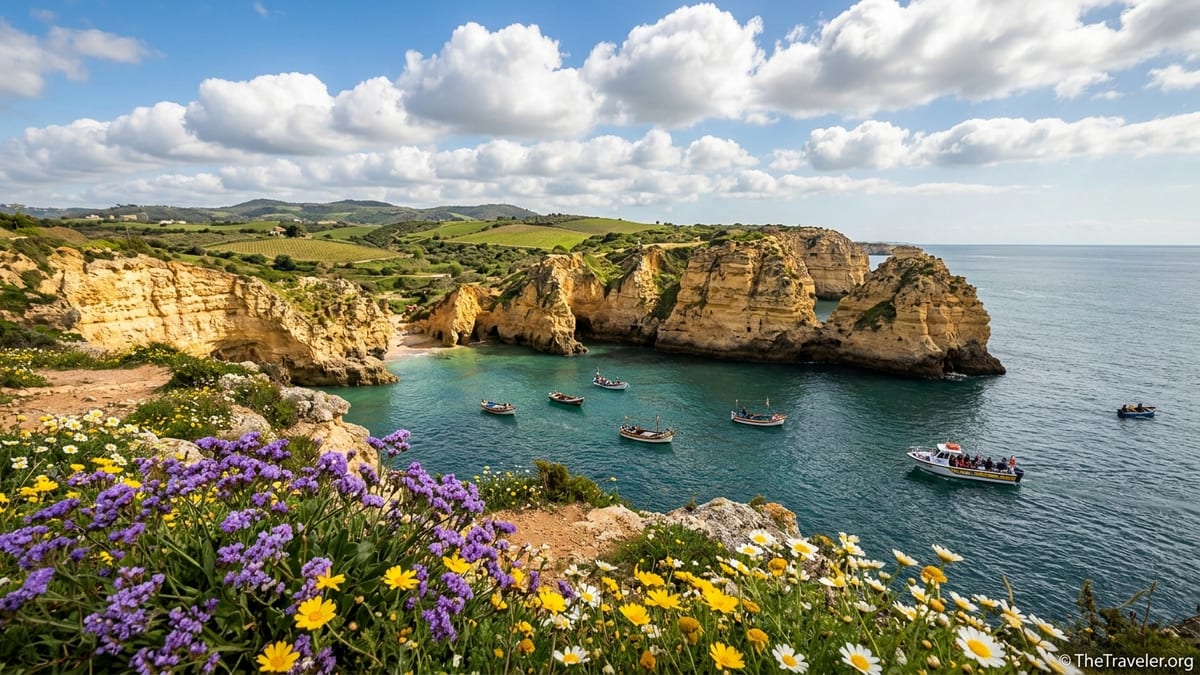
Compared with Lisbon and Porto, the Algarve offers a markedly milder and drier April, which is why many northern Europeans treat it as an early season escape. Historical climate data from coastal Algarve cities show average daytime highs in April often in the low 20s Celsius, with an appreciably lower chance of prolonged rain than in the north. Lagos, Faro and Tavira all enjoy generous sunshine, particularly from mid month onwards, and sheltered south facing beaches can feel briefly summery in the early afternoon.
The critical limitation is the Atlantic. While the air turns warm, the sea is still recovering from winter. Long term records place April sea temperatures along much of the Algarve around the mid teens Celsius. This is noticeably warmer than off Porto or Peniche yet still brisk for unacclimatised swimmers. Calm days in coves such as Praia do Camilo near Lagos or Ilha de Tavira off Tavira can tempt hardy travellers into the water for short swims, but many visitors find April better suited to beach walks, terrace cafés and coastal hikes than to extended bathing without a wetsuit.
Boat tours in the Algarve generally begin their main season by March and run steadily through April. From Lagos, operators take visitors to the Ponta da Piedade grottoes, sometimes combining coastal caves with dolphin watching in the open ocean. Faro based companies run Ria Formosa lagoon trips out to sandbank islands, while Tavira marinas support ferries and small tour boats to beaches like Praia do Barril and the long sandspit of Tavira Island. In April 2027, expect a good spread of departures, though schedules remain more limited than in July and August and can be adjusted at short notice for wind and swell.
For an April 2027 traveller combining Lisbon and the Algarve, Lagos, Faro and Tavira each offer distinct atmospheres. Lagos mixes a young, international vibe with dramatic cliffs; Faro pairs a compact walled old town with the Ria Formosa islands; Tavira provides a quieter, small town feel with whitewashed houses and a church dotted skyline. All three are linked by regular regional trains and buses, and by April accommodation and restaurant infrastructure are operating at near full capacity without high summer congestion.
Accommodation Costs, Easter Timing and Freedom Day
Because Easter Sunday falls on 28 March in 2027, the usual spike in Portuguese accommodation prices linked to Holy Week will mostly affect late March rather than April. For April 2027 itself, the key date is the national Freedom Day holiday on 25 April, which often brings domestic long weekend trips, especially when it aligns conveniently with weekends. This can raise prices and reduce availability in popular spots such as Lisbon, Porto and parts of the Algarve for the nights around 24 to 25 April.
Recent booking data for April in Lisbon and Porto show that early April nights commonly cost less than late April for comparable properties, especially where April overlaps with school holidays in major European markets. In practice, a budget traveller willing to book simple guesthouses or hostels and stay slightly outside the historic cores can often secure beds in Lisbon or Porto in early April for a noticeably lower nightly rate than in late April. By the final week of the month, central double rooms in midrange hotels and apartments in both cities tend to command higher nightly rates due to a combination of better weather expectations and increased demand.
In the Algarve, price seasonality is even more pronounced. Early April sits on the shoulder between winter long stay visitors and the start of summer rates. Many hotels in Lagos or Albufeira offer comparatively attractive prices in the first half of the month, with promotional rates rising as you approach May Day holidays. Faro and Tavira, which attract a mix of urban and nature oriented visitors, can stay slightly more stable, although waterfront properties and boutique guesthouses closest to the Ria Formosa and island ferries still see noticeable rate increases by late April.
For planning purposes, travellers should consider early April 2027 from about 1 to 10 April as the value sweet spot, balancing moderate prices with increasingly pleasant weather. Mid April from around 11 to 20 April often sees a gradual firming of rates, while the period from roughly 21 April through the end of the month brings Freedom Day related demand and the first hints of pre summer pricing, especially in coastal destinations.
Getting Around: Public Transport, Rental Cars, Tolls and Parking
Portugal’s public transport network makes April 2027 travel between Lisbon, Porto, Coimbra, Évora and the Algarve quite practical without a car. Intercity trains operated by Comboios de Portugal connect Lisbon with Porto in about three hours on faster services, with multiple departures daily. Coimbra lies on the same north south main line, allowing straightforward connections. Évora is linked to Lisbon by regional trains and buses, and the Algarve line connects Lagos, Portimão, Albufeira, Faro and Tavira. Bus companies supplement rail connections between secondary towns and tourist areas, particularly in the Algarve hinterland and between Faro Airport and coastal resorts.
For the Douro Valley, regional trains from Porto along the Douro line provide scenic access to Régua, Pinhão and Pocinho. Schedules in recent years show several daily departures in each direction, which is enough to support day trips and one or two night stays. However, public transport within the valley to specific quintas on the hillsides is limited, often requiring taxis or prearranged winery transfers from station towns. Travellers focusing on winery hopping or remote viewpoints may therefore prefer a rental car for part of their trip.
Driving adds flexibility, especially for combining Lisbon, Évora and Algarve villages or for exploring smaller beaches between Lagos and Sagres. Portugal’s main motorways operate with electronic tolls. Foreign drivers can register their rental’s licence plate at service points or use toll devices supplied by major rental agencies, with charges later applied to a credit card. Tolls between Lisbon and Porto or Lisbon and the central Algarve add a noticeable but manageable cost to a week long itinerary. Parking is the main constraint in older city centres: historic cores of Lisbon, Porto and Sintra have tight streets and paid zones, and several areas restrict non resident traffic. Hotels that include parking or are located near public car parks can significantly reduce hassle for drivers.
One way rental fees between Lisbon and Faro or Lisbon and Porto are another point to check. Some international rental brands waive modest one way fees during shoulder seasons, while smaller local agencies may charge more substantial drop costs. If prices for cross country one way rentals are high for April 2027, a practical compromise is to use trains between Lisbon and Porto or Lisbon and the Algarve, then rent a car locally for a few specific days of regional exploring.
Sample Itineraries for April 2027
A four day Lisbon city break in April might begin with arrival and orientation in Baixa and Alfama, including a visit to São Jorge Castle and evening dinner in a traditional restaurant. Day two could cover Belém’s Jerónimos Monastery and Belém Tower plus the riverside cultural centres, with a fallback plan of the Maritime Museum and modern art collections if showers move in. Day three is ideal for Sintra, using the train from Rossio to visit Pena Palace and the Moorish Castle, then descending through the historic centre for coffee before returning to Lisbon. Day four allows time for the Gulbenkian Museum, Parque Eduardo VII viewpoints and last minute shopping in Chiado before departure.
A seven day Porto and Douro holiday can balance city culture with river landscapes. Spend two to three nights in Porto, exploring the Ribeira quarter, crossing the Dom Luís I bridge on foot, visiting port wine cellars in Vila Nova de Gaia and taking in indoor highlights such as Livraria Lello and the Bolsa Palace. Then move upriver by train to a base in Peso da Régua or Pinhão for three or four nights. Here you can mix a half day river cruise, one or two organized vineyard visits with tastings, and walks through nearby village lanes on dry days. Keep one indoor heavy day in Porto or Régua as a weather buffer for wine lodge tours, museum visits and long lunches if river excursions are curtailed by rain or wind.
A week combining Lisbon with the Algarve suits travellers seeking both culture and milder coastal weather. Allocate three nights to Lisbon at the start, following the city break outline, then travel by train or bus to Lagos, Faro or Tavira for the remaining four nights. In the Algarve leg, plan at least one boat outing, such as a Ponta da Piedade grotto trip from Lagos or a Ria Formosa island tour from Faro, but schedule them with flexibility to move between days depending on marine forecasts. Use other days for cliff walks on the coastal path west of Lagos, birdwatching in the Ria Formosa wetlands or wandering Tavira’s old town and island beaches. Even if the sea is too cool for long swims, café terraces by the water and golden hour views over the Atlantic can deliver a strong sense of early summer.
Across all three itineraries, build in indoor cultural options for each location so that spring showers do not derail plans. In Lisbon, that might mean reserving time for the National Tile Museum; in Porto, extra port lodge visits or a theatre performance; in the Algarve, visiting regional museums in Faro or Silves Castle inland. April rewards travellers who treat the sun as a welcome bonus rather than a guarantee.
Daily Budgets and Practical Spring Considerations
For April 2027, reasonable daily budgets excluding flights can be estimated in broad bands. Budget travellers staying in hostel dorms or simple guesthouses, eating at casual cafés and using public transport can often structure days in Lisbon, Porto or the Algarve in the range of modest double digit euro amounts per person, with slightly higher totals when paying for river cruises, boat tours or multiple museum entries. Midrange travellers choosing centrally located three star hotels or quality apartments, restaurant dinners most nights and occasional taxis should allow a meaningfully higher per day figure. Comfortable travellers opting for boutique hotels, frequent guided excursions and regular sit down restaurant meals will need larger daily allocations again, particularly in popular areas such as central Lisbon, Porto’s riverside districts and scenic Algarve towns.
Spring specific costs and considerations also merit attention. In April, some attractions and tours operate on shorter schedules than in high summer. Museum hours for major institutions such as Lisbon’s Gulbenkian remain stable through the year, but smaller regional museums and some coastal restaurants may still run reduced days early in the month, especially outside Easter and Freedom Day periods. It is wise to confirm opening days and to book key experiences, such as Douro river day cruises or popular Sintra palace time slots, several weeks ahead.
Weather related disruptions are another factor. Spring showers can make cobbled streets and coastal paths surprisingly slippery, particularly in older neighbourhoods like Lisbon’s Alfama or Porto’s Ribeira and on cliff top trails near Lagos and along the Vicentina Coast. Good footwear reduces the risk of slips. Boat tours in the Douro or along the Algarve coast may be cancelled or shortened when wind, swell or river conditions are not favourable. Travellers should avoid building irreplaceable experiences into a single unmovable time slot and instead keep some flexibility within each destination stay.
On the positive side, April’s softer light and moderate temperatures make city sightseeing far more comfortable than in the peak summer heat. Queues at major monuments are typically shorter than in July and August, and restaurant reservations are easier to secure, particularly on weekdays. Combined with the lower early April prices away from major holiday dates, these advantages make April 2027 an appealing target month for travellers who value culture, scenery and manageable conditions more than guaranteed beach weather.
Who Should Go Where in April 2027
Couples looking for a blend of atmosphere, food and gentle exploring will be happiest dividing time between Lisbon and either Porto or the Douro Valley. Lisbon provides viewpoints, riverfront sunsets and a wide restaurant scene, while Porto adds a more intimate scale and wine focused experiences. A night or two in the Douro, timed with a river cruise or vineyard lunch, creates a memorable contrast without relying on perfect weather.
Families may prefer a combination of Lisbon and the Algarve. Lisbon offers child friendly trams, the large aquarium at Parque das Nações and accessible castle and monastery visits. Moving on to Lagos, Faro or Tavira gives space for beach play, island ferries and dolphin or grotto boat trips, even if the water is too cold for long swims. Choosing accommodation with some indoor space, such as apartments or aparthotels, helps families ride out any rainy spells more comfortably.
Hikers and active travellers will appreciate the Algarve’s cliff paths and the Alentejo and central regions in April’s moderate temperatures. Sections of the Fishermen’s Trail west of Lagos and routes around Sagres offer striking Atlantic scenery without midsummer heat stress, though they are exposed to wind and require attention to footing after rain. The hills near Sintra also provide good half day hiking among forests and palaces, best tackled on days with stable forecasts to avoid heavy fog or persistent drizzle.
Wine focused travellers should target Porto and the Douro, optionally adding Évora and the surrounding Alentejo wine country. April is too early for harvest, but cellar tours, structured tastings and vineyard views are all rewarding, and accommodation in wine regions is generally more available than in autumn. Those primarily seeking an early season beach holiday with regular swimming should temper expectations. The Algarve offers the best shot at sunbathing and short dips in April 2027, particularly in the second half of the month, but anyone wanting reliably warm sea water may prefer to reserve Portugal’s beaches for a later trip in late summer or early autumn.