


More news on this day
Portugal’s main airports handled more than 72 million passengers in 2025, setting a new traffic record for the ANA network as airlines add capacity to island gateways such as Madeira, Porto Santo and the Azores, a shift that gives international travelers more options beyond Lisbon and Porto for both city breaks and Atlantic archipelago escapes.
Get the latest news straight to your inbox!
Record Passenger Volumes Confirm Portugal’s Airport Momentum
ANA, the Portuguese airport operator owned by Vinci Airports, reports that its network handled about 72.5 million passengers in 2025, up roughly 4 to 5 percent on 2024 and around 17 percent above pre pandemic 2019 levels. Vinci’s consolidated traffic tables for 2024 already showed 69.2 million passengers through Portuguese airports, and the 2025 earnings update indicates continued expansion, confirming that the new 2025 figure represents an all time high for the system.
Lisbon Airport remains the largest gateway, accounting for just over half of ANA’s total passengers in 2024 and surpassing 35 million travelers for the first time that year, according to ANA’s latest management report. Porto, Faro and the Madeira and Azores airports together make up the other half of movements, with Vinci data showing that by the end of 2024 these airports collectively were significantly above their 2019 volumes, helped by point to point low cost growth and more island connectivity.
Within the network, ANA and Vinci highlight particularly strong growth in leisure focused regions. Traffic at Madeira and Porto Santo exceeded 5 million passengers in 2024, about 50 percent higher than in 2019, while the Azores also recorded gains of more than 30 percent versus pre pandemic levels. This combination of rising volumes on the mainland and outsized growth on the islands underpins the overall record set in 2025.
Airlines Add Aircraft and Routes to Portuguese Islands
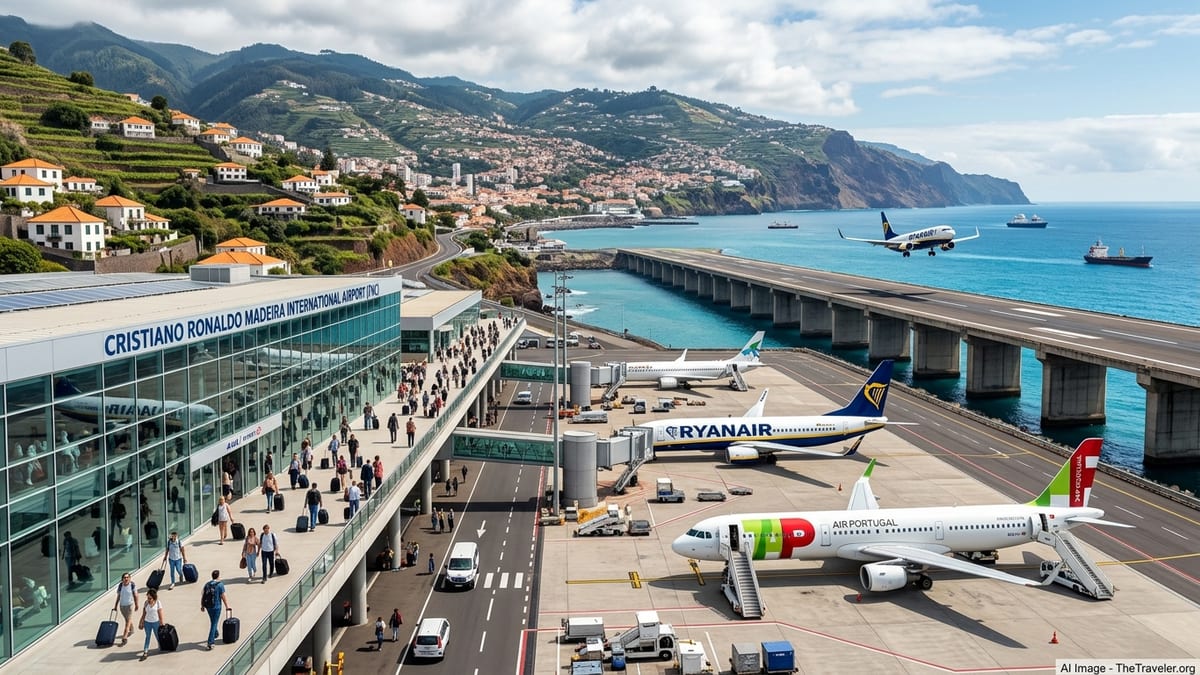
The passenger record is being supported by concrete airline capacity decisions, especially toward Portugal’s islands. Ryanair, which describes itself as Portugal’s largest carrier by passenger numbers, announced in February 2025 that it will base two additional Boeing 737 “Gamechanger” aircraft in Portugal for summer 2025, one in Madeira and one in Faro. The airline’s Portugal wide program for that season covers 169 routes, including four new routes, three of which directly involve Madeira, linking the island with Milan, Shannon and Edinburgh.
ANA’s most recent investor reporting notes that Ryanair’s enlarged presence at Madeira in 2025 translates into three more routes than in 2024 and around 708,000 passengers handled by the airline there, an increase of about 188,000 travelers or more than 36 percent year on year. For an airport system that processed just over 5 million passengers in Madeira and Porto Santo combined in 2024, that single carrier’s incremental growth represents a noticeable share of the island market.
Transatlantic capacity is also expanding to the islands. TAP Air Portugal has introduced a seasonal route from San Francisco to Terceira in the Azores, alongside its existing services linking North America with Lisbon and Porto. The airline’s 2024 summer plan already increased weekly frequencies between Portugal and both the United States and Canada compared with 2023, and one weekly North America flight now includes a stop in Funchal on either the outbound or return leg, giving Madeira an additional long haul connection without passengers needing to change planes in Lisbon.
Mainland Gateways Spread Traffic Beyond Lisbon
While Lisbon remains constrained by infrastructure and operating near capacity, Vinci’s 2024 traffic breakdown shows that Porto, Faro and the island airports are capturing a growing share of international demand. In 2024, Porto handled just under 16 million passengers and Faro roughly 9.8 million, both ahead of 2019 levels. Growth rates of about 5 percent at Porto and 2 percent at Faro compared with 2023, combined with nearly 10 percent annual growth at the Madeira airports, indicate that new services are increasingly being scheduled outside the capital.
Low cost carriers are central to this shift. Ryanair’s dedicated summer 2025 schedule for Porto comprises 72 routes, including a new link to Rome Fiumicino, while its Faro schedule offers 47 routes and more than 270 weekly flights in peak season. These additions provide alternatives to flying through Lisbon, especially for European travelers from cities such as Berlin, Dublin, London and Vienna who can now reach Portugal’s secondary gateways directly.
For ANA and Vinci, this pattern aligns with a stated objective of distributing traffic more evenly across the network. Company statements accompanying 2024 traffic releases describe Portugal as a reference aviation hub in Europe and point to the island and regional airports’ growth as evidence of diversified demand. Although decisions on major new infrastructure, such as a replacement or supplementary airport for Lisbon, remain subject to government processes, the operational reality for 2025 is that more travelers are entering Portugal through a wider set of gateways than a decade ago.
What This Means for International Travelers
For travelers planning trips from North America or other long haul markets, the main practical change is a broader set of one stop or non stop options into Portugal’s regions. A passenger flying from Boston or Los Angeles can connect via TAP’s Lisbon hub into Porto, Faro, Madeira, Porto Santo or several Azores islands on a single ticket, while the growing number of direct European low cost flights into Porto, Faro, Funchal and Ponta Delgada creates additional ways to combine a mainland city stay with an island holiday.
Island focused travelers may find it easier to avoid backtracking through Lisbon at busy times. Ryanair’s new 2025 routes from Milan, Shannon and Edinburgh into Madeira, and its expanded base there, give residents of Italy, Ireland and the United Kingdom more direct choices for week long or long weekend breaks. The additional aircraft based in Madeira also provide some buffer capacity, though schedules remain strongly seasonal and seats on school holiday departures can still sell out early.
Prices are influenced by broader fuel and demand conditions, so the new capacity does not guarantee cheaper fares. However, more overlapping routes on popular city pairs, such as multiple airlines now linking northern European cities with Faro or Funchal, typically give travelers more opportunity to compare timings, connections and ancillary fees. The main near term benefit of the 2025 shifts is therefore greater route choice and scheduling flexibility rather than an automatic drop in ticket costs.
Key Limitations and What to Watch Next
Despite the record traffic figures, ANA’s own reports stress that several Portuguese airports, particularly Lisbon, continue to face capacity constraints at peak times, which can mean longer queues and limited slots for further growth. The expansion of services into Porto, Faro and the islands eases some of that pressure but does not resolve infrastructure bottlenecks in the capital, and no new airport has yet been approved or opened that would materially change that situation for travelers in the immediate future.
Most of the new routes highlighted for 2025 are summer seasonal rather than year round operations. Travelers looking at spring or autumn trips should check carefully whether a particular island flight operates on their intended dates, and whether it runs only on certain weekdays. Schedules published by airlines and airports remain the definitive guide, and as with all announced plans, individual flights can still be adjusted or canceled before or during the season based on demand or operational needs.
Looking ahead, the main developments to watch are future traffic releases from Vinci and ANA that will show whether the 2025 record is sustained or surpassed, and any formal government decisions on new airport capacity around Lisbon. For now, the confirmed facts for travelers are that Portugal’s airports collectively reached their highest ever passenger volumes in 2025, and that airlines have already scheduled additional aircraft and routes, especially to Madeira and the Azores, that open up more city and island combinations for upcoming trips.