


Renting a car at Queen Beatrix International Airport in Aruba can be the difference between staying in the resort bubble and freely exploring the island’s beaches, coves and local restaurants. This guide walks you through how airport and off-site car rentals work at AUA, what to know about insurance and deposits, what driving is really like, and how beach parking works at popular spots such as Eagle Beach and Arashi, so you can decide if renting is worth it for your trip.
Get the latest updates straight to your inbox!
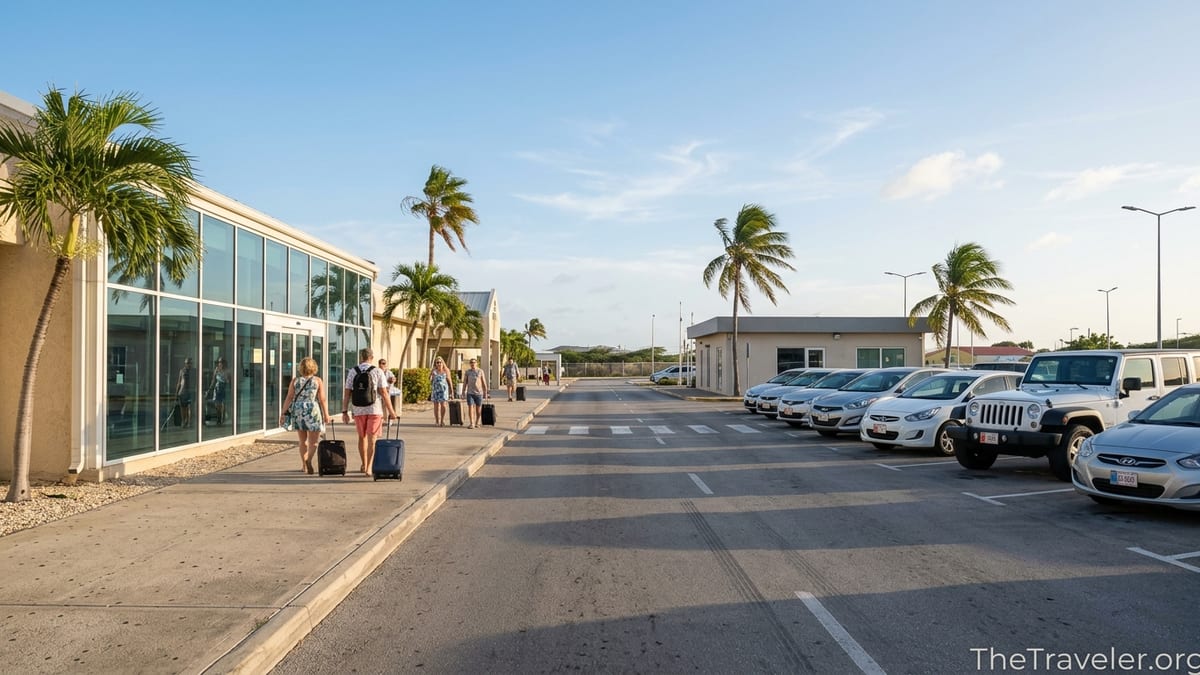
How Car Rental Works at Queen Beatrix International Airport
Queen Beatrix International Airport (AUA) sits just outside Oranjestad and is Aruba’s main gateway for international visitors. There are no rental counters directly inside the arrivals hall. Instead, the major companies are located on airport grounds across the street, or a few minutes away with a free shuttle. From the baggage claim exit, you walk outside, cross the small access road in front of the terminal, and you will see signs and kiosks for familiar brands such as Budget, Avis, Alamo, Enterprise and Sixt, along with local companies like Top Drive and Carvenience. Most travelers are walking with luggage for only two or three minutes before reaching their counter.
Reservations with the big international brands usually include on-airport pickup. For example, Budget and Avis operate from lots directly opposite the terminal, while Enterprise and Alamo provide vehicles on airport grounds with short walks from the counters. Local firms sometimes meet you curbside with your car or run a shuttle that leaves every 10 to 15 minutes. It is common for staff to hold a sign with your name at the exit and then walk you to the car or shuttle.
Once at the lot, the check-out routine is similar to North America or Europe. You present your passport, driver’s license and a credit card, confirm your insurance and fuel options, sign the contract and do a quick walk-around inspection. Most rentals use a full-to-full fuel policy. Staff typically point out some key driving rules and show you on a map how to get from the airport toward your hotel areas around Eagle Beach, Palm Beach or further north.
On-Airport vs Off-Site Rental Companies
Beyond the airport brands, Aruba has a growing number of off-site agencies that target visitors who are comfortable booking online in advance. Companies such as Flex Rentals Aruba, Mitoo Car Rental, Atlantic Car Rental and Elixir Car Rental operate from offices two to five minutes from the terminal. They do not have counters across from arrivals, but instead include free airport pickup or delivery in their rates. You either meet a representative outside customs or catch a small shuttle van to their nearby office.
Off-site operators compete on price and flexibility. For instance, a local company might advertise a weeklong compact car in low season from around 275 to 300 US dollars, compared with a higher base rate from a major brand once you add taxes and fees. Some local agencies bundle in extras such as an additional driver, beach chairs or a basic GPS app, while the international chains tend to charge separate daily fees for each add-on. Travelers who do not mind a brief shuttle ride can often save a noticeable amount over a seven to ten day rental.
On-airport brands are appealing if you want the simplest, most predictable process or expect to rely on loyalty benefits from programs like Avis Preferred or Enterprise Plus. They may also be easier to work with if you need to change or cancel your reservation through a global call center. Off-site firms are usually more hands-on and personal, but their office hours can be shorter, and very late-night arrivals sometimes require coordination by email or messaging in advance to confirm pickup.
Insurance in Aruba: CDW, Liability and What Your Card Covers
Understanding rental car insurance in Aruba is essential, because coverage rules can differ from what you are used to at home. Aruba requires basic third-party liability coverage, and most rental companies include a minimum amount of liability in the base rate. This is meant to cover damage or injury you cause to other people or property, not damage to your rental car. Travelers from the United States and Canada often assume their personal auto policy or credit card will cover everything, but those protections can be limited or excluded outside their home country, so it pays to double-check before you fly.
The main optional product you will be offered at the counter is collision damage waiver, usually called CDW. CDW is not technically insurance but a waiver that limits your financial responsibility if the rental car is damaged. A typical Aruba agency might offer a standard CDW with a deductible of around 500 US dollars for a small car. Some companies sell an upgraded CDW Plus with a zero deductible, costing a bit more per day but eliminating your out-of-pocket costs in most collision scenarios, as long as you respect the rental terms like no off-road driving and no driving under the influence.
Many premium travel credit cards include an auto rental collision damage waiver benefit when you pay for the rental in full with that card and decline the rental company’s CDW. However, fine print matters. Coverage may be secondary, may exclude certain vehicle types such as Jeeps or pickups, or may not apply in certain countries. Some international brands at Queen Beatrix require you to purchase CDW if you are renting a 4x4 vehicle, unless you can show written proof that your credit card covers collision and theft in Aruba specifically. Travelers planning to rent a Wrangler or other 4x4 to explore rougher areas should bring printed confirmation from their card issuer if they want to rely on card coverage.
Supplemental liability insurance, sometimes sold as SLI, may also be available to increase your liability limits beyond the local minimum. If you have significant assets or simply want extra peace of mind, you can ask about this at booking or at the counter. As with other destinations, it is smart to contact both your personal auto insurer and your credit card company before your trip, ask how their coverage works in Aruba, and then compare that with what the rental company offers. That way, you are not making a rushed insurance decision at the counter after a long flight.
Typical Deposits, Holds and Payment Methods
When you pick up your car at Queen Beatrix International Airport or an off-site office, the rental company will place a security hold on your credit card. The amount depends on the agency, vehicle class and insurance choices. For a basic economy or compact car with CDW accepted, it is common to see a hold in the range of 500 to 1,000 US dollars. For a 4x4 such as a Jeep or a larger SUV, or if you decline CDW and rely on external coverage, the hold can be higher to reflect the greater potential exposure.
Most Aruba agencies prefer a major credit card in the primary driver’s name. Some accept debit cards with a higher deposit and proof of onward travel, but this is less consistent than in large US markets. Cash deposits are rare, and when allowed they can be substantial. Always read the payment and deposit conditions on your confirmation email. For example, you might see a note that a 750 US dollar hold is required for renters who do not purchase the full protection package, or that local residents have different deposit rules than visitors.
The hold is usually released automatically when you return the car with no new damage and with the fuel level where it should be. On the island side, this often happens quickly, but your bank can take several days to show the funds as available again. If you return your car on a Friday and fly home the same day, it would not be unusual for the pending hold to linger on your card statement until midweek. If you are planning a trip with high overall expenses, such as paying for a resort stay on the same card, keep these temporary limits in mind so you do not accidentally run into your credit limit.
Driving in Aruba: Roads, Rules and Practical Tips
Aruba drives on the right-hand side of the road, with traffic signs that follow international symbols and local language. Speed limits are posted in kilometers per hour, and the island’s main roads are paved and generally in good condition. From Queen Beatrix Airport, it is a straightforward ten to fifteen minute drive along the coastal road toward the low-rise area around Eagle Beach and then further on to the high-rise hotels at Palm Beach. Cellular coverage is solid around the populated areas, and smartphone navigation apps work well, though you may want to download an offline map before arrival.
Driving styles in Aruba are relatively relaxed, but there are quirks. Roundabouts are common, and you yield to traffic already in the circle. Some residential streets can be narrow, and you may encounter speed bumps near schools and neighborhoods. In Oranjestad, one-way streets and local-only access zones can be confusing on your first day; driving slowly and watching for signs helps. Parking in town is usually metered in central areas, with signs indicating hours of enforcement and whether you need a paper ticket from a nearby machine.
Outside of town and the hotel strip, lighting can be limited at night, especially on the way to more remote beaches or viewpoints. Many repeat visitors prefer to do their exploring in daylight and use taxis if they plan on drinking at bars or late dinners. If you are thinking of driving on rougher tracks near the northern coast or toward the national park, be aware that standard rental contracts for regular sedans and compact cars typically exclude off-road driving. Even some paved roads leading to popular sights can have potholes or unpaved sections, so slow speeds and careful driving are wise.
Beach Parking: Eagle Beach, Palm Beach, Arashi and Baby Beach
One of the key benefits of having a rental car in Aruba is how easy it makes visiting different beaches in a single day. Eagle Beach, north of Oranjestad, has wide stretches of sand with free parking along the road parallel to the beach. Visitors commonly park under low trees or in marked bays, then walk a few steps to the sand. It is wise to avoid blocking driveways or hotel entrances, and to keep valuables out of sight in the car. During peak holidays and late afternoons, spaces closest to popular palapas and beach bars can fill, but with some patience you can usually find a spot within a short walk.
Further up the coast, Palm Beach sits behind the high-rise hotel strip. Here, much of the immediate beachfront parking is tied to individual resorts, but there are public access points with small parking areas between properties and near shopping plazas. If you are staying elsewhere on the island, a car lets you stop at Palm Beach for an evening stroll, dinner or nightlife without waiting for a taxi. Just budget a few extra minutes to find public spaces and follow any posted signs regarding time limits.
At the northwestern tip, Arashi Beach has a dedicated parking lot adjacent to the sand, along with additional parking along the access road. Visitors often note that parking here is easy outside of the absolute busiest hours, and that they can leave the car within a very short walk of their chosen palapa or snorkeling spot. Basic facilities such as restrooms and a small beach bar make it a popular day-trip destination for people staying elsewhere on the island. Further away on the southeastern side, Baby Beach has its own parking areas near the sand, so you can comfortably drive down for a half or full day, especially if you are traveling with children and beach gear.
Across these main beaches, parking is generally free, which is a major plus compared with many coastal destinations. The trade-off is that popular sections can feel busy, and unmarked parking areas can be dusty or uneven. Honest common sense goes a long way: park where others are parked, avoid soft sand, do not leave valuables in view, and always lock the car. Travelers frequently report that even when they moved between multiple beaches in a day, they did not struggle to find parking, which underscores why so many consider a rental car the easiest way to enjoy Aruba’s coastline.
Is Renting a Car in Aruba Worth It?
Whether a rental is worth it comes down to your itinerary, budget and comfort behind the wheel. If you are staying for a week in a resort on Palm Beach and plan to spend most of your time on that single stretch of sand, with a couple of organized excursions, you might manage fine using taxis and occasional tours. For example, a couple staying at a high-rise hotel might spend their entire stay between the resort, a sunset sail, and one guided jeep tour to the national park without ever needing personal wheels.
On the other hand, if your idea of a good trip is visiting Eagle Beach one morning, Arashi the next, then driving to Baby Beach later in the week, stopping at off-the-beaten-path restaurants and supermarkets along the way, a rental car provides flexibility that taxis cannot match. A compact rental spread across seven days can compare favorably with the cost of multiple round-trip taxi rides, particularly for families or small groups. The freedom to leave a crowded beach and try another, or to head out early for sunrise or stay late for sunset without checking taxi availability, is a major intangible benefit.
Driving on the island is relatively straightforward for visitors used to right-side traffic, and parking at beaches and attractions is usually simple. Fuel costs and distances are moderate because the island is small, and many visitors report using less fuel than they expected. The main downsides are navigating insurance choices, tying up some credit limit in the security deposit, and taking responsibility for driving in an unfamiliar place. If you are anxious behind the wheel in new environments or dislike dealing with insurance and deposits, organized tours and taxis can be a more relaxing way to get around.
For many travelers, a hybrid approach works well. They might rent a car only for three or four days in the middle of a longer stay, timing it for beach-hopping and independent exploring, while relying on resort shuttles or taxis for airport transfers and the rest of the trip. This can reduce overall costs and the number of days you are paying for a car that is mostly sitting in a hotel lot, while still giving you the freedom to discover your favorite corners of the island.
Practical Booking Tips and Common Pitfalls
Booking ahead for Queen Beatrix International Airport is highly recommended, especially for peak periods such as Christmas, New Year and school holidays. On these dates, Jeeps and SUVs frequently sell out first, and walk-up prices at the counter can be significantly higher than prepaid reservations. Making a reservation directly with the rental company, or through a reputable aggregator, allows you to lock in an approximate total that includes taxes and mandatory fees. When comparing prices, make sure you are comparing similar insurance levels and cancellation terms.
Before confirming, read the fine print about mileage limits, cross-border restrictions and driver requirements. Most Aruba rentals include unlimited mileage and do not permit taking the car off the island. Minimum age requirements can vary. In many cases, drivers must be at least 23 or 25 years old, with a valid license held for at least one year, and young drivers sometimes pay a daily surcharge. An international driving permit is usually not required if your license uses Roman characters, but can be helpful if your license is in another script.
On pickup day, inspect the car thoroughly and take timestamped photos or a short video of all sides, the interior and the fuel gauge. Point out any pre-existing dents or scratches to the agent and make sure they are noted on the condition report. Confirm the fuel policy and where to refill near the airport; there is typically a gas station located within a short drive of the terminal on the main road. Keep a copy of the rental agreement in the glove box so you have the emergency contact number handy, along with any instructions on what to do in case of an accident.
When returning the car, allow a little extra time before your flight in case there is a line at the check-in lot. Returns at the airport agencies often involve a quick inspection and then a short walk back to the terminal. For off-site companies that shuttle you back, ask in advance how much time they recommend before your departure. Many visitors plan to arrive at the airport at least two to three hours before international flights, so handing back the car 15 to 30 minutes before that window begins usually works smoothly.
FAQ
Q1. Do I need a car to get from Queen Beatrix International Airport to my hotel?
You do not strictly need a car, because taxis and pre-arranged transfers are available outside the terminal, but having a rental waiting at the airport lets you leave on your own schedule and start exploring immediately, especially if your hotel is not on the main resort strip.
Q2. Is driving in Aruba difficult for visitors from the United States or Canada?
Most travelers from North America find driving in Aruba straightforward, since the island drives on the right and traffic is relatively calm, though you should be ready for roundabouts, some narrow residential streets and limited lighting on more remote roads at night.
Q3. Can I rely on my credit card for rental car insurance in Aruba?
Many travel credit cards include collision damage coverage, but you should confirm that Aruba is covered, check any exclusions for 4x4s or specialty vehicles, and bring written proof because some rental companies will require local CDW unless you can show that your card provides valid protection on the island.
Q4. How much is the typical security deposit for a rental car at Queen Beatrix Airport?
Security holds commonly range from about 500 to 1,000 US dollars for standard cars, with higher amounts possible for Jeeps or if you decline the rental company’s collision waiver, and the hold is usually released automatically within a few days after you return the car without new damage.
Q5. Is parking free at Aruba’s main beaches?
Parking at popular beaches such as Eagle Beach, Arashi and Baby Beach is generally free, with roadside spaces or small lots next to the sand, though you should avoid blocking driveways, stay off soft sand and keep valuables out of sight in your vehicle.
Q6. Do I need a 4x4 to explore Aruba?
You do not need a 4x4 to reach most resorts, main beaches and restaurants, but if you plan to spend significant time on rougher tracks or exploring more remote coastal areas, a 4x4 can be useful, provided you understand that off-road driving may be restricted by your rental contract and insurance.
Q7. Are there advantages to using an off-site rental company instead of an airport brand?
Off-site companies near the airport often offer lower rates, more personalized service and extras like free airport pickup or beach gear, while airport brands provide the familiarity of global networks and loyalty programs, so the better option depends on whether you prioritize price or convenience.
Q8. Is it safe to leave belongings in a rental car while I am at the beach?
It is safer not to leave valuables in the car at all, but if you must, keep items out of sight in the trunk, lock the doors, park where other cars are parked, and take passports, wallets and electronics with you to minimize risk.
Q9. What should I do if I have an accident with my rental car in Aruba?
Stay calm, make sure everyone is safe, do not move the vehicles unless instructed, contact the rental company using the emergency number on your contract, and follow their guidance, which may include waiting for the local traffic authorities to document the incident for insurance purposes.
Q10. Is renting a car in Aruba worth it for a short three- or four-day visit?
For a brief stay focused on one resort area, taxis and tours may be enough, but if you want to visit multiple beaches like Eagle, Palm, Arashi and Baby Beach or try local restaurants away from the hotel zone, even a three-day rental in the middle of your trip can add a lot of flexibility and value.