


Cartagena’s Rafael Núñez International Airport (CTG) sits only a few kilometers from the walled city and the beaches of Bocagrande, which makes the taxi ride into town quick and relatively inexpensive. Yet many first-time visitors still feel unsure when they step out of arrivals and are suddenly surrounded by offers of rides. This guide walks you through the taxi system at CTG in 2026, from the official booths and printed fare tickets to what a ride should cost, where to wait, and how to handle late-night arrivals safely.
Get the latest updates straight to your inbox!
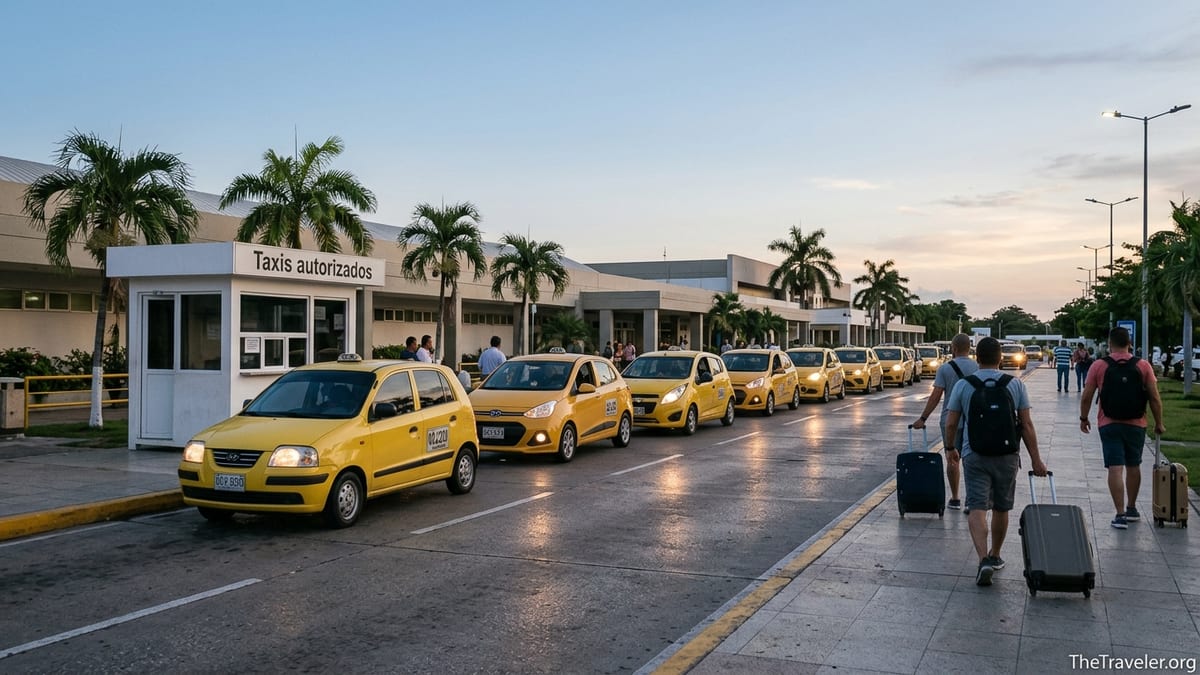
How the Taxi System Works at Rafael Núñez Airport
Unlike cities that use metered taxis, Cartagena runs a flat-zone fare system from Rafael Núñez International Airport. Official airport taxis charge fixed prices based on the neighborhood you are going to rather than distance or time in traffic. The airport, the city transport authority, and local taxi unions have agreed these tariffs in advance, and they are updated periodically by municipal decree. In practice this means that when you arrive, you should know roughly what your ride will cost to the walled city, Getsemaní, Bocagrande or La Boquilla before you ever get into a car.
To enforce these fixed prices, CTG has an official taxi dispatch system inside the terminal. Just past customs in the arrivals hall, before you exit to the street, you will find an authorized taxi desk or kiosk. The staff member asks for your destination, selects the appropriate zone on a small terminal or printed chart, and issues a ticket that lists the exact fare. You then take this ticket to the line of yellow taxis waiting outside the terminal; the driver is required to honor the printed price.
This system is designed to reduce haggling and protect visitors from surprise charges. It also helps keep the flow of taxis organized, particularly during busy periods such as long weekends, cruise ship days, and the December high season. For travelers arriving for the first time, especially those with limited Spanish, the most important rule is simple: get your taxi ticket inside the terminal and hand it to an official yellow cab outside.
Official Taxi Stations: National and International Arrivals
Rafael Núñez Airport is relatively compact, but it has clearly separated national and international arrival flows. Both sides feed into the same general arrivals level, and both have access to authorized taxi services. After clearing immigration and baggage claim from an international flight, you will walk into a public arrivals hall where banks, ATMs and small cafés are located. Look for signs indicating "Taxis autorizados" or ask uniformed airport staff for the official taxi counter before heading toward the exit doors.
On the domestic side, passengers arriving from cities like Bogotá, Medellín, Cali or San Andrés enter a similar arrivals area with ground transportation options. Here too there is an official taxi point for those connecting into town. Many Colombian travelers are already familiar with the zone-based fare system, so the domestic taxi line often moves quickly, but as a foreign visitor you should still insist on using the same official process: ticket from the desk, then taxi from the organized queue directly outside.
In front of the terminal, taxis wait in lines aligned with the exits. The vehicles that work directly with the airport operate under concession rules and must display proper taxi signage, yellow paint, license plates, and an airport permit. You will typically see airport marshals or security staff in high-visibility vests managing the line, especially at peak times. If a driver tries to pull you away from this line and suggests walking deeper into the parking lot to "save money" or "skip the queue," decline politely and stay within sight of the terminal doors and cameras.
Understanding 2026 Taxi Fares and Sample Costs
Because fares are set by municipal decree and by airport-specific tables, prices can change slightly from year to year. For 2025 and 2026, the city adjusted the general taxi minimum fare and night surcharge, while the airport continues to publish its own table of flat rates from CTG to different zones in and around Cartagena. The exact figures depend on the latest official document, but the structure has been stable for several years.
As a practical benchmark, recent airport taxi tables list Zone 1 destinations such as Marbella, Crespo, El Cabrero, Canapote and the Getsemaní area at an entry-level fare in the low twenty-thousands of Colombian pesos. That means a typical ride from the airport to the edge of the walled city or to a beachfront hotel in Marbella might cost somewhere around the price of a coffee and snack at a major international chain in North America. Zone 2, which covers areas like La Boquilla and Morros, is a little higher, while Zone 3, including Manga and residential neighborhoods slightly further inland, climbs another small step.
For many visitors, the most relevant comparison is the ride from CTG to Cartagena’s historic center and Bocagrande hotel strip. Expect the official airport fare to the walled city or Getsemaní to be in the same general range as other Zone 1 or Zone 2 trips, and slightly higher to Bocagrande and El Laguito because those require crossing the bayfront avenue and passing more traffic lights. Even with recent annual increases, the cost in US dollars usually falls between the price of a short rideshare trip in Miami and a mid-range taxi ride from a European airport to a nearby city district. If you are traveling with two or three people, sharing one taxi often works out far cheaper than any shuttle bus or private transfer.
At night, after about 9 p.m., Cartagena applies a modest night surcharge across the taxi system. This is built into the airport fare table, so the price printed on your ticket at 11:30 p.m. will already reflect the higher night rate. You do not need to calculate anything or tip extra to "cover" the night supplement. As long as your ticket lists the amount and the driver sticks to it, you are paying the correct official price for that date and time.
Fare Tickets, Payment and Luggage Handling
The taxi ticket you receive at the airport counter is your main protection against overcharging. It typically includes the zone number, a short description of the destination area, and the total fare in Colombian pesos. When you reach the vehicle, hand the ticket to the driver before closing the door and keep a quick photo of it on your phone. The driver will usually glance at the amount and start driving without further discussion. If anyone tries to negotiate a higher price than what appears on the ticket, step back toward the terminal and speak with a staff member or guard.
Payment is almost always in cash, in Colombian pesos. While some individual drivers may accept local payment apps, visitors should not count on card acceptance in standard yellow cabs. On arrival, use an ATM from a major Colombian bank in the terminal to withdraw a reasonable amount. Then, break large notes at a café or small store so that you can pay your taxi fare with smaller denominations. Many travelers aim to have a mix of 10,000 and 20,000 peso bills plus a few coins, which simplifies paying an airport fare without needing the driver to find significant change.
Official fares from Rafael Núñez include normal luggage. You will not generally be charged extra for having one checked suitcase and a carry-on or for placing bags in the trunk. The driver will typically help you load and unload your luggage, but tipping is flexible rather than mandatory. If the driver handles several heavy bags or provides useful local advice in English or clear Spanish, a small gratuity of a few thousand pesos is appreciated but not required. What you should avoid is agreeing to any additional "luggage fee" not printed on your ticket; for standard passengers this is not part of the official scheme.
For families or groups with bulky items such as surfboards, musical instruments or multiple large suitcases, it is worth mentioning this at the taxi desk. Staff can direct you to a vehicle with a larger trunk or a hatchback rather than a sedan with a small boot. In rare cases, they may suggest two taxis if your party and luggage physically do not fit in one car; when this happens, each taxi will have its own printed fare ticket for the same destination zone.
Late-Night Arrivals and Safety Considerations
Rafael Núñez International Airport operates well into the night, and flights arriving after midnight are common, especially from Bogotá and other domestic hubs that feed late connections. Official taxis are available 24 hours a day, although the line can be shorter and the terminal quieter after the last big bank of evening arrivals. For solo travelers touching down at 1 a.m., the safest option remains the same: walk directly from baggage claim to the official taxi desk, get your printed fare ticket, and proceed to the closest organized taxi queue under the eye of airport staff and security cameras.
At night, a few additional habits help. Stay inside the terminal building until you are ready to leave, keep your phone and valuables out of sight while in line, and avoid stepping into the darker parts of the parking lot with strangers offering "better" prices. If someone with a laminated badge or reflective vest approaches you inside and urges you to skip the desk and walk straight to a waiting car, you can politely decline and indicate that you want the printed ticket. Legitimate airport staff will understand the request; persistent pressure is a warning sign that the person is working independently of the official system.
Once in the taxi, close the doors properly and keep your bag on the floor or seat rather than on your lap facing an open window at traffic lights. Many travelers choose to send a quick message with the taxi license plate to a friend or family member; you can photograph the plate from the rear of the car or note the number from the door sticker. Windows are often left slightly open in Cartagena’s humidity, but you can ask the driver to close them more if you feel exposed when passing through busier junctions or nightlife districts.
For travelers who feel especially anxious about arriving late, an alternative is to pre-arrange a hotel pickup. Many mid-range and higher-end hotels in the walled city and Bocagrande will book an airport taxi or private car on your behalf and send you the driver’s name and vehicle details in advance. This typically costs more than the standard airport taxi fare but offers extra reassurance for those landing in the very early hours or traveling with young children.
Avoiding Informal Taxi Offers and Common Scams
Most taxi journeys in Cartagena end without incident, but like many popular beach cities, there is a small minority of drivers and touts who look for opportunities to overcharge or take advantage of confused visitors. The most common issue at Rafael Núñez is not violent crime but inflated fares and pressure from informal drivers operating outside the official system. The simplest way to protect yourself is to use only the authorized taxi station and printed tickets and to ignore unsolicited offers once you step outside.
One frequent scenario involves a person waiting just beyond the customs exit who approaches with a friendly "Taxi, my friend?" and suggests guiding you to a car. They may wear a polo shirt with a logo or even a vest that looks official, but instead of taking you to the formal taxi line, they lead you to a vehicle parked off to the side or deeper in the lot. Once your luggage is inside and the car is moving, you may find that the price is much higher than expected, sometimes several times the official rate for the same journey. If at any point the person guiding you does not stop at the taxi desk or does not produce an official printed fare ticket, you can simply say that you need to go back to the terminal to use the official counter and turn around.
Another pattern reported by visitors is the "meter myth." Cartagena airport taxis do not use meters for city trips, yet some opportunistic drivers tell passengers that the fare will be "according to the meter" and then quote a large sum on arrival. If a driver mentions a meter at CTG, treat it as a sign that you are not using the correct fixed-rate system. Step out of the queue and verify your ticket or ask the dispatcher for clarification before leaving.
Overcharging can also occur at the end of the ride, especially at busy curbsides in front of major hotels in the walled city or Bocagrande. A driver might claim that traffic was "very heavy" or that there was an extra charge for a detour, toll, luggage or air conditioning. In almost all standard routes from the airport into town there are no tolls and no legitimate extra surcharges beyond the fixed fare. Having your original ticket gives you a clear reference point; you can calmly repeat the listed price, offer that amount, and, if pressed, mention that you are happy to contact the hotel front desk or local tourist police to clarify.
Finally, be cautious of anyone outside the airport pitching highly discounted long-distance rides or full-day tours right as you exit the terminal. While Colombia does have reputable private drivers and tour operators, the arrivals curb is not where serious companies usually recruit clients. If you want a private transfer to destinations such as Playa Blanca or the Rosario Islands, book through your accommodation, a recognized agency in the historic center, or a vetted online provider rather than improvising with a stranger who approaches you next to the baggage trolleys.
Using Ride-Hailing Apps and Alternatives to Yellow Taxis
In addition to traditional yellow taxis, Cartagena is served by app-based ride-hailing platforms, including global brands and local competitors. Regulations for these services in Colombia are complex and can change, and enforcement is stricter in some cities than others. At Rafael Núñez, ride-hailing cars do operate, but they are not part of the official taxi line in front of arrivals. Travelers who prefer using an app for price transparency and GPS tracking often wait until they are outside the terminal and then request a car to a pickup point slightly away from the main taxi stand.
Using an app has advantages and trade-offs. On the plus side, you see an estimated fare before confirming, can pay by card in many cases, and have trip records and driver details inside the application. Some visitors feel safer knowing that the route is tracked and that they can share it with friends. On the minus side, an app driver might ask you to be discreet about the pickup in front of the airport due to local tensions with taxi unions, and at times of heavy traffic or late-night demand, surge pricing can make an app ride more expensive than an official taxi with a fixed fare.
For those traveling light and on a budget, there is also a public transport option. Cartagena’s bus rapid transit system connects areas near the airport with the city, and local buses run along the coastal corridor. However, these services require familiarity with routes, are slower, and may be crowded, especially during peak hours. With luggage or after a long flight, most visitors find that the modest cost of an official airport taxi is well worth the comfort and simplicity compared with managing a bus and multiple stops.
Walking from Rafael Núñez to nearby neighborhoods such as Crespo or Marbella is technically possible due to the short distance, but is not recommended with luggage or after dark. Sidewalks are uneven in places, the climate is hot and humid, and traffic at the airport roundabouts can be intense. If you have booked accommodation very close to the airport, a short taxi ride still offers a more controlled and secure start to your stay.
The Takeaway
For most travelers, getting from Rafael Núñez International Airport into Cartagena is quick, straightforward and reasonably priced when you follow the official system. The core steps are consistent whether you arrive from New York, Bogotá or Madrid: ignore informal offers, walk to the taxi desk inside the terminal, obtain a printed fare ticket for your destination, and then proceed to the organized line of yellow cabs immediately outside. This process anchors the fare, gives you a paper record and places you under the visible umbrella of airport security.
By understanding the zone-based fare structure, arriving with small-denomination pesos, and keeping an eye out for the most common overcharging tactics, you can turn what might feel like a stressful moment in a new country into a simple, predictable transaction. From the arrival curb at CTG, the colonial walls of Cartagena and the bayfront skyline of Bocagrande are only minutes away. Starting your trip with a calm, well-managed taxi ride sets the tone for exploring the city’s plazas, beaches and nightlife with more confidence over the days that follow.
FAQ
Q1. Where exactly do I find the official taxi desk at Rafael Núñez Airport?
The official taxi desk is located inside the arrivals hall, just after you exit customs and baggage claim. Look for signs indicating authorized taxis or ask airport staff before you walk out to the street.
Q2. How much should a taxi from the airport to the walled city or Getsemaní cost?
The fare is set by the airport’s zone table and printed on your ticket. It is typically in the lower range of Cartagena’s fixed airport fares, reflecting the short distance of a few kilometers.
Q3. Can I pay my airport taxi fare by credit card?
Most standard yellow taxis from Rafael Núñez are cash only. Plan to withdraw Colombian pesos at an ATM in the terminal and pay with small bills.
Q4. Is it safe to take a taxi from the airport late at night?
Yes, as long as you use the official taxi desk and the organized taxi queue right outside the terminal. Avoid following unofficial guides into dark parts of the parking lot.
Q5. Do airport taxis charge extra for luggage?
No, typical checked bags and carry-ons are included in the official fare. You should not accept any additional luggage fee that is not printed on your taxi ticket.
Q6. What if a driver refuses to accept the price printed on my ticket?
Stay calm, show the ticket again, and if the driver insists, step back toward the terminal and speak with the dispatcher or security staff to resolve the issue.
Q7. Are ride-hailing apps allowed to pick up at Rafael Núñez Airport?
Ride-hailing cars do operate in Cartagena, but they are not part of the official taxi line. If you use an app, expect to meet your driver in a location slightly away from the main taxi stand.
Q8. How do I tip taxi drivers at the airport?
Tipping is optional and modest. Many travelers round up the fare or add a small amount if the driver is particularly helpful with bags or advice, but there is no fixed percentage.
Q9. Can I book an airport taxi in advance through my hotel?
Yes. Many hotels in the walled city and Bocagrande will arrange a pickup using an airport taxi or private car, often at a slightly higher price but with added convenience and reassurance.
Q10. Is it safe to walk from the airport to nearby neighborhoods?
The distance to areas like Crespo or Marbella is short, but walking with luggage is not recommended due to heat, uneven sidewalks and traffic. A brief taxi ride is safer and more comfortable.