


Landing at Rafael Núñez International Airport in Cartagena and picking up a rental car can be a smart way to explore Colombia’s Caribbean coast at your own pace. It can also be confusing if you are not familiar with local insurance rules, security deposits, parking options near the walled city, or what it is really like to drive to popular beaches such as La Boquilla or Playa Blanca. This guide walks you step by step through renting at the airport, navigating Cartagena’s streets, and deciding if a car is genuinely worth it for your trip.
Get the latest updates straight to your inbox!
Where to Find Car Rental Desks at Rafael Núñez Airport
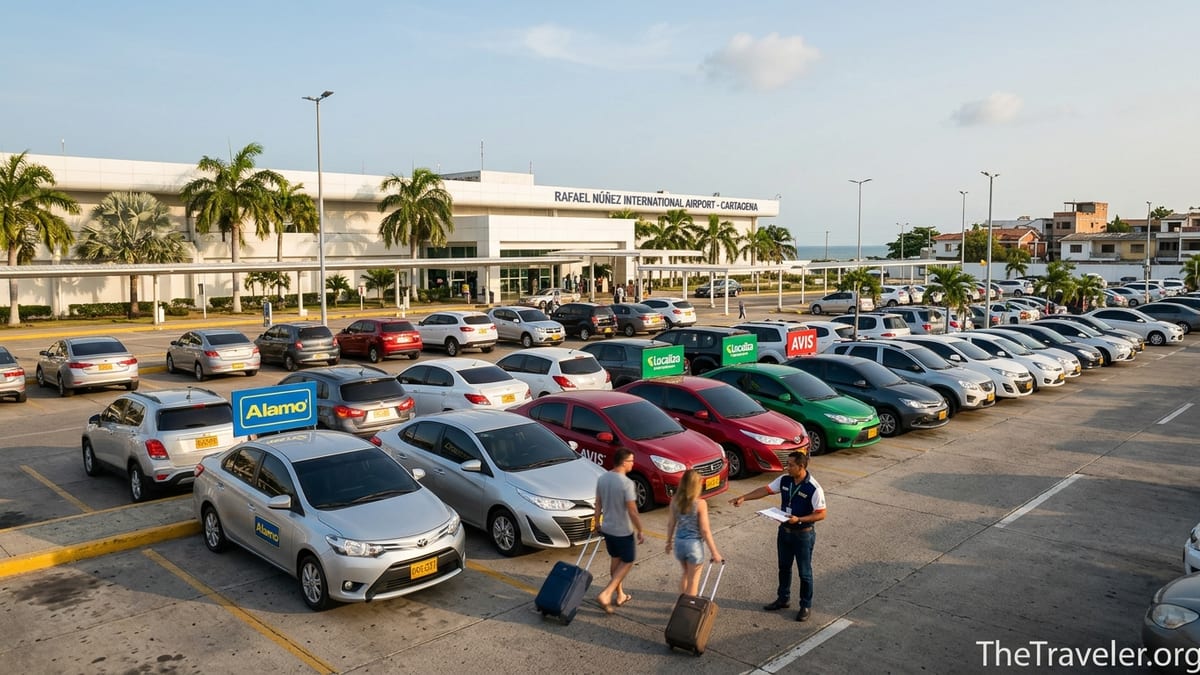
Rafael Núñez International Airport (CTG) sits in the Crespo neighborhood, roughly a 10 minute drive from Cartagena’s historic center in light traffic. Inside the single passenger terminal, the main car rental desks are clustered in the public arrivals area. After you clear immigration and customs and walk into the public hall, look for signs in Spanish and English pointing to “Alquiler de Vehículos” and “Car Rental.” Counters for large brands such as Alamo, Avis, Budget, Localiza, Hertz and others are typically lined up along the wall facing the exit toward the taxi rank and parking lot.
Some companies operate directly from those arrival hall counters and walk you to their vehicles in the main parking lot directly outside the terminal doors. Others keep only a small desk inside and then shuttle you a short distance to an off terminal lot north of the airport. In practice, the walk from desk to car is usually under five minutes, and even off site shuttles tend to take less than ten minutes because of the airport’s compact size.
Opening hours vary by provider, but major brands usually align with flight schedules rather than strict office hours. For example, Alamo and Localiza tend to open around 6:00 a.m. and stay staffed through the evening to cover late arrivals. If you land after midnight or very early in the morning, it is important to check the exact hours during booking and add your flight number so a staff member knows to wait for you.
Walk up rentals are possible, especially outside peak holiday seasons, but availability and pricing are unpredictable. Around Christmas, New Year, Easter, and long Colombian holiday weekends, counters frequently run out of cars. Travelers who booked online in advance through brand websites or aggregator platforms usually get priority at the desk, so securing a reservation ahead of time is strongly recommended.
Vehicle Types, Prices, and Pickup Experience
The majority of rental cars available at Rafael Núñez Airport fall into compact and economy categories with manual transmission, which are popular with Colombian travelers and more affordable on daily rates. Think of small sedans and hatchbacks similar to a Chevrolet Onix, Renault Logan, or Kia Picanto. These simple models are fine if you will mainly drive between the airport, Bocagrande, the walled city, and nearby beaches like La Boquilla or Manzanillo del Mar.
Automatic transmission vehicles are available from most international brands but in more limited numbers and at higher prices. For example, a compact automatic from a mainstream company such as Budget or Hertz might start around the equivalent of 40 to 55 US dollars per day outside peak dates, while a manual of the same size could be closer to 30 to 40 dollars per day. SUV models, which many visitors prefer for comfort on bumpy access roads to beach areas outside the city, often run 20 to 40 dollars more per day than a compact sedan.
At pickup, staff will inspect the car with you and mark existing scratches or dents on a paper or digital form. It is worth walking slowly around the entire car, taking time-stamped photos or a quick video of each side, the bumpers, and the interior. If you notice any damage that is not clearly marked on the form, ask them to add it before you drive away. This practice is especially useful in Cartagena because small cosmetic damage from tight street parking and potholes is common.
Companies at Rafael Núñez increasingly provide newer air conditioned vehicles, which is essential in Cartagena’s hot and humid climate. When comparing prices online, factor in that very low headline rates sometimes correspond to older fleets or local agencies with minimal English spoken at the desk. International brands like Alamo, Avis, and Localiza generally charge slightly more but offer a more predictable pickup process, standardized contracts, and better support if something goes wrong on the road.
Understanding Insurance, Deposits, and Payment Holds
Car rental insurance in Colombia can feel complex because several layers of protection may appear in your quote. At a minimum, rentals must be covered by mandatory liability insurance similar to the local SOAT policy that every Colombian vehicle carries. This covers bodily injury to third parties, but it is limited and does not pay for damage to your rental car. To cover the car itself, rental agencies typically offer a collision damage waiver, sometimes called LDW or CDW, and theft protection. These may be bundled or sold separately.
If you decline the company’s full protection because your credit card includes rental coverage, you should expect a much higher security deposit. It is common for agencies at Rafael Núñez to preauthorize or hold the equivalent of 1,500 to 2,500 US dollars on your card when you rely on your own card insurance, compared with a deposit closer to 500 to 1,000 dollars when you buy their complete package. For instance, a traveler renting a compact automatic for five days and accepting the agency’s main protection might see a deposit hold near 800 dollars, while another driver in the same car who refuses that coverage could face a 2,000 dollar hold.
Most rental desks will want a major credit card in the primary driver’s name. Some local brands will accept debit cards but often with higher deposits and extra requirements, such as showing a return airline ticket or proof of Colombian residency. If you plan to rely on a premium travel credit card’s collision coverage, bring printed or digital proof of that benefit and confirm in advance that Colombia is included and that coverage applies to rentals from local agencies, not only in your home country.
Deductibles on Colombian rental insurance are usually expressed as a percentage of the vehicle’s value or a fixed cap rather than a simple flat fee. For example, a policy might state that you are responsible for 10 percent of the damage up to a maximum of the car’s commercial value. In practical terms, that could still be several hundred dollars for even minor repairs. Theft coverage also typically requires you to file a police report and follow local procedures. Reading the contract at the counter takes time but will help you understand your real exposure if the car is damaged, stolen, or involved in an accident.
Parking in Cartagena: Old City, Bocagrande, and the Airport
Parking is one of the biggest surprises for visitors who rent a car in Cartagena. Around Rafael Núñez Airport itself, parking is straightforward. There is a main paid parking lot directly in front of the terminal where rental agencies keep many of their vehicles, and visitors can also leave a car there for short or medium stays. This lot is handy if you are dropping off friends or returning the vehicle early and want to walk a few minutes to check in.
In the historic center and the neighboring barrio of Getsemaní, on street parking is limited and tightly regulated. Several streets near the city walls and around plazas have no parking rules, often indicated by signs or painted curbs. The city has worked in recent years to restrict private vehicle parking in sensitive areas like the Parque de la Marina corridor to improve pedestrian flow and reduce congestion. That means you cannot simply leave a rental car in front of the walls and expect it to stay there all day without risk of fines or towing.
Instead, visitors with cars generally rely on paid parking lots at the edges of the old city or in Getsemaní. An example is a 24 hour surface lot near the Convention Center or multi level garages a short walk from the Torre del Reloj. Rates are usually charged by the hour, with daily totals that can add up if you are spending long days wandering Cartagena on foot. In practice, many travelers find it easier to park once at a garage near the historic center, then explore by walking or using taxis rather than moving the car repeatedly.
Bocagrande, Laguito, and Castillogrande, the main modern beachfront districts southwest of the walled city, offer a mix of on street parking and small paid lots attached to hotels and shopping centers. If you are staying at a midrange or upscale hotel there, check whether guest parking is included. Some beachfront properties charge an extra nightly parking fee, while others include one space per room. Leaving a car overnight in a supervised hotel garage or lot is generally safer than on the street, even in relatively calm neighborhoods.
Driving to Beaches: La Boquilla, Manzanillo, Playa Blanca and Beyond
One of the main reasons travelers consider renting a car in Cartagena is the freedom to explore beaches along the coast. From Rafael Núñez Airport, you can reach La Boquilla in roughly 10 to 15 minutes by following the coastal road north. This stretch is mostly flat and straightforward, with a single main route passing hotels and residential buildings in the Crespo and La Boquilla areas. Parking here is a mix of informal roadside spaces and small attended lots next to beach restaurants, where an attendant keeps an eye on vehicles in exchange for a modest fee that is often collected in cash.
Farther north, Manzanillo del Mar and newer developments along the highway toward Barranquilla are reachable in around 20 to 30 minutes, traffic permitting. The main highway is paved but can have heavy truck traffic, and access roads down to the beach can be uneven or potholed. A higher clearance vehicle, such as a small SUV, is more comfortable here, especially in the rainy season when standing water collects in low spots.
Driving to Playa Blanca and Barú is more involved. The road south from Cartagena crosses bridges and passes through industrial and rural areas before turning toward the island. Depending on traffic, the drive can take from one to two hours each way. The final approach to Playa Blanca is via a narrower road with speed bumps and occasional congestion caused by tour buses and informal parking. Once you arrive, parking is usually in dirt lots run by local operators who direct you to a spot and charge a fee on entry. While thousands of visitors make this trip every week, drivers should be patient, especially on weekends and holidays when congestion peaks.
In all these beach areas, avoid leaving visible valuables in the car. Use common sense by locking doors, taking phones and cameras with you, and paying the small extra cost for a watched lot where possible. Navigation apps on your phone work reasonably well around Cartagena, but it is wise to download offline maps beforehand in case of patchy mobile data coverage outside the city.
Local Driving Conditions, Rules, and Safety Considerations
Cartagena’s traffic is intense at certain hours, but it is not usually as chaotic as larger Colombian cities like Bogotá. Still, driving here differs from the structured lane discipline many visitors know from North America or Europe. Motorcycles weave between cars, buses stop frequently without much warning, and lane markings are sometimes faded or ignored. Around the airport and the Crespo neighborhood, traffic is generally manageable, but the roads closer to the walled city can become congested during rush hours and on cruise ship days.
Foreign visitors can usually drive with a valid driver’s license from their home country for short stays, as long as their passport and entry stamp are in order. Seat belts are mandatory for all occupants, and using a mobile phone while driving is prohibited unless you have a hands free device. Random police checkpoints are common on roads leading to and from the city and on routes to beach areas. Officers may ask for your license, rental agreement, and proof that the vehicle’s mandatory insurance is in force.
Cartagena, like many Colombian cities, operates a vehicle restriction system known as “pico y placa” on certain weekdays, limiting when cars with specific license plate numbers can circulate in parts of the city. Although rental cars are sometimes exempt or subject to different rules, you should ask the rental desk for up to date information. They can tell you which days and hours you need to watch for and which zones are affected, so you do not inadvertently drive into a restricted area and receive a fine monitored by cameras.
Driving at night on rural or less populated roads outside Cartagena requires extra caution. Street lighting can be patchy, pedestrians and animals may appear unexpectedly, and some drivers use high beams inappropriately. If you are not accustomed to these conditions, try to plan beach trips so that you return before nightfall. Within the city, late night driving is more about congestion and the risk of minor fender benders than serious crime, but it is still safer to keep windows up, doors locked, and valuables out of sight.
Is Renting a Car in Cartagena Really Worth It?
Whether renting at Rafael Núñez Airport is worth it depends largely on where you are staying and how you plan to spend your time. If your trip is focused on Cartagena’s old city, Getsemaní, and the immediate Bocagrande beaches, a car often becomes a burden rather than a benefit. Taxis and ride hailing services provide cheap and plentiful transport around these central areas, and many sights are best explored on foot. In this scenario, the daily cost of the rental, parking fees, and the stress of driving and finding legal spaces may outweigh any time savings.
On the other hand, if you are staying outside the core tourist zones or plan multiple day trips to beaches north and south of Cartagena, a rental can offer real flexibility. Families or small groups visiting La Boquilla one day, Manzanillo the next, and perhaps Playa Blanca or the nearby mangrove areas might find that the cost of hiring private drivers for each outing approaches or exceeds the price of an economy rental, especially when divided by four or five travelers.
Consider a five day itinerary where a group of friends lands at Rafael Núñez, stays at a condo in Morros near La Boquilla, and also wants to visit the historic center twice and spend a full day on Barú. With a compact rental car, they can drive from the airport to their lodging in about 15 minutes, park in the building’s garage, and use the car selectively for longer outings. Their main extra expenses will be gasoline, parking at the old city, and a parking fee at Playa Blanca. In this case, renting feels convenient and cost effective.
By contrast, a couple staying in a boutique hotel inside the walled city with no on site parking will quickly feel the downsides. They will have to park in a garage outside the walls, walk in with luggage on arrival, and pay daily parking fees even when the car sits unused while they explore on foot. For such travelers, a taxi from the airport and occasional rides to Bocagrande or La Boquilla often represent a simpler and cheaper solution than managing a rental car for the entire stay.
The Takeaway
Renting a car at Cartagena’s Rafael Núñez International Airport gives you immediate independence to explore beaches and neighborhoods along Colombia’s Caribbean coast. The process at the airport is generally straightforward, with several major international and regional rental brands operating desks right in the arrivals hall and cars parked only a short walk away. If you book ahead, understand the insurance and deposit conditions, and inspect the vehicle carefully at pickup, the experience can be smooth and predictable.
However, Cartagena’s reality on the ground means a rental is not automatically the best choice for every visitor. Limited and regulated parking in and around the walled city, local driving habits, and the convenience of low cost taxis can make a private car more of a liability if you plan to stay mostly in the historic center. Where a rental shines is for travelers based in beach districts or condos outside the core who want to make repeated trips up and down the coast, or for those who value the flexibility of setting their own schedule to reach La Boquilla, Manzanillo, Barú, and other shoreline escapes.
Before committing, take a few minutes to map your key activities, ask your accommodation about parking, and compare the total cost of a rental, including insurance and expected parking fees, with the price of taxis or private transfers. With clear expectations and a realistic sense of Cartagena’s roads and parking rules, you can decide whether picking up a set of keys at Rafael Núñez Airport will add freedom to your Caribbean adventure or simply another set of logistics to manage.
FAQ
Q1. Can I rent a car at Rafael Núñez Airport without a reservation?
It is sometimes possible to secure a walk up rental at the airport, but availability and prices are unpredictable, especially during holidays and weekends. Booking ahead online gives you a better chance of finding the vehicle type you want at a stable rate.
Q2. Do I need an international driving permit to rent a car in Cartagena?
Most visitors can rent and drive with a valid driver’s license from their home country, along with their passport and entry stamp. An international driving permit can be useful as a translation but is not usually required for short tourist stays.
Q3. How much is the typical security deposit for rentals at Rafael Núñez Airport?
The deposit or card hold often ranges from the equivalent of about 500 to 1,000 US dollars if you purchase the rental company’s main protection package, and up to roughly 1,500 to 2,500 dollars if you decline it and rely on your credit card insurance.
Q4. Is it safe to drive from Cartagena to Playa Blanca and Barú on my own?
Many visitors drive this route without problems, but the trip involves mixed urban and rural roads, congestion near the beach, and limited lighting at night. Daytime travel, cautious driving, and parking in watched lots improve safety and comfort.
Q5. What kind of car is best for visiting Cartagena’s beaches?
A compact sedan or hatchback is sufficient for city driving and close beaches like La Boquilla, while a small SUV with higher clearance is more comfortable for uneven access roads and longer trips to places like Playa Blanca or Manzanillo del Mar.
Q6. How difficult is parking near Cartagena’s walled city?
On street parking in and around the historic center is limited and tightly regulated, with some areas where private parking is prohibited. Most drivers use paid lots or garages at the edges of the old city and then continue on foot.
Q7. Are rental cars affected by Cartagena’s pico y placa restrictions?
Pico y placa rules can change, and rental cars may be subject to specific conditions. Ask the rental desk for the latest details on which days and hours apply and which zones you should avoid with your car.
Q8. Can I rely on my credit card’s rental car insurance in Colombia?
Many premium credit cards include collision coverage for international rentals, but terms vary. Confirm that Colombia is covered, understand exclusions, and bring proof of coverage, as rental agencies will still place a significant deposit hold if you decline their protection.
Q9. Is fuel easy to find around Cartagena and the beaches?
Gas stations are readily available in and around Cartagena’s urban area and along main highways to nearby beach towns. Fill up before driving to more remote stretches, and keep some cash or an accepted card ready for payment.
Q10. When is renting a car in Cartagena not worth it?
If you plan to stay mainly inside the walled city or Getsemaní and use the beach in Bocagrande occasionally, the combination of taxis, walking, and ride hailing is usually cheaper and less stressful than managing a rental car and paid parking every day.