


More news on this day
Freight traffic on a regional line in central Poland was disrupted after a Rail STM Newag Dragon 2 locomotive derailed near the town of Zagnańsk while hauling 14 wagons of aggregate, according to Polish media coverage and industry reports.
Get the latest news straight to your inbox!
Derailment Near Zagnańsk Involves Modern Dragon 2 Locomotive
Reports from Polish news outlets and railway industry platforms indicate that the incident occurred on a freight route in the Świętokrzyskie region, close to Zagnańsk, when a heavy-haul Dragon 2 electric locomotive operated by Rail STM left the tracks. The train was pulling 14 wagons loaded with construction aggregate at the time of the derailment.
Initial information from publicly available coverage suggests that only the locomotive derailed, with the loaded wagons remaining on the rails. There were no immediate reports of injuries to the train crew, and no hazardous materials were involved. The consist was reportedly carrying stone or gravel destined for infrastructure or construction use, a common type of freight on regional Polish lines.
The Dragon 2, manufactured by Newag, is one of the newer generations of high-power Polish freight locomotives, designed to haul heavy trains on both main lines and secondary routes. The use of such modern rolling stock underscores how even recently built equipment can be affected by local infrastructure conditions, track geometry, or operational factors.
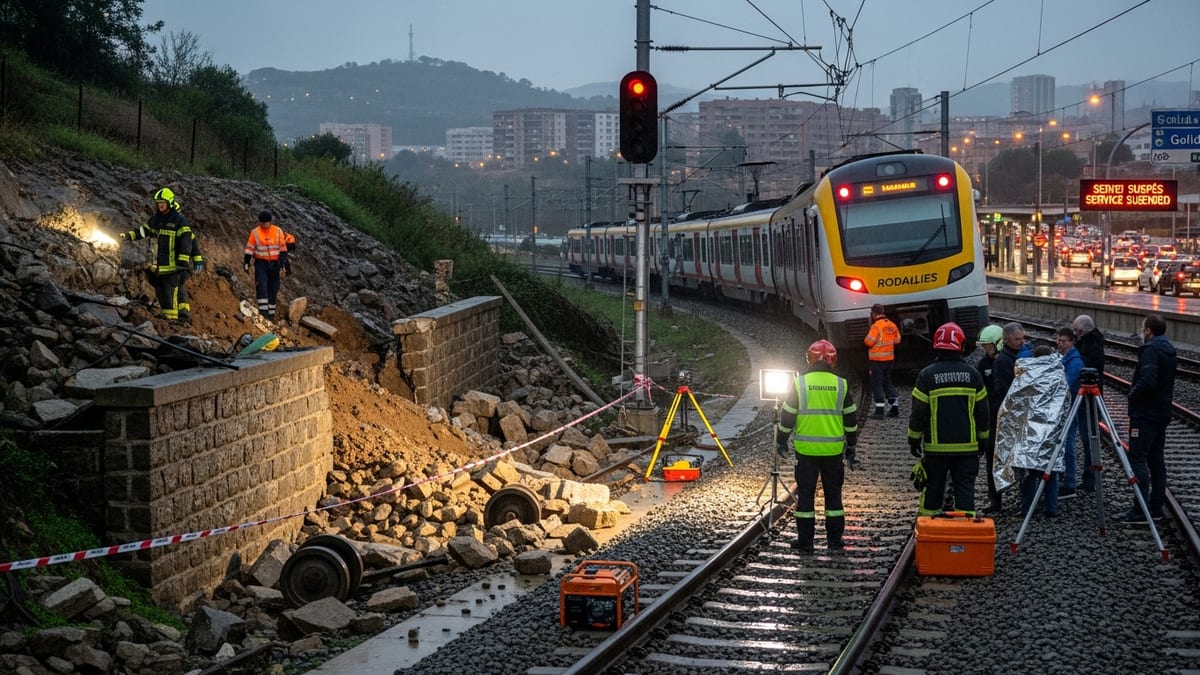
Images shared by regional media show the derailed locomotive leaning off the track formation near a turnout area, with emergency responders and railway maintenance teams present. The wagons appear to have remained upright and aligned, which limited the risk of significant cargo spillage.
Emergency Response and Line Disruption
Accounts from local coverage describe a rapid response by fire and rescue units from nearby Kielce and volunteer services from Zagnańsk, alongside railway maintenance crews. Their work focused on securing the scene, examining the locomotive’s position, and preventing any further movement that might endanger staff or damage infrastructure.
Rail infrastructure teams reportedly suspended traffic on the affected track section while inspections and recovery planning were carried out. Freight services on the line were either halted or rerouted where possible, while passenger operations on nearby routes were monitored for potential knock-on delays.
Public information indicates that the derailment did not generate a wider safety threat beyond the immediate area of track. The absence of fuel leaks or dangerous cargo reduced the environmental risk, allowing the focus to remain on technical recovery. Nevertheless, the incident added to a series of rail disruptions in Poland in recent months, which have included freight accidents and infrastructure faults in other regions.
Recovery operations for a derailed locomotive of this size typically involve specialized rail cranes and heavy engineering support. While full details of the lifting and rerailing process were not immediately shared, such work usually requires temporary strengthening of the track bed and the careful coordination of both infrastructure and operator teams.
Focus on Infrastructure, Speed and Operating Conditions
Early coverage has not attributed a definitive cause to the derailment, but publicly available commentary in the Polish rail sector frequently highlights the interplay between track condition, axle load, and operating speed on regional lines. Heavy freight locomotives such as the Dragon 2 exert considerable forces on the track, particularly on curves, junctions, and older infrastructure.
Recent incidents elsewhere in Poland involving freight derailments and infrastructure damage have already prompted discussion among rail commentators about the condition of some secondary routes, especially where heavy aggregate or bulk trains operate. The Zagnańsk derailment is likely to be examined in that broader context, including the quality of ballast, rail fastenings, and the state of turnouts.
National investigative procedures in Poland typically involve a technical inquiry into factors such as track geometry, wheel and bogie condition, signalling, and driver actions. While the formal findings have not yet been made public, industry observers will be watching for any recommendations affecting speed limits, maintenance regimes, or routing of heavy freight on particular corridors.
The incident also raises questions about how regional lines balance intensive freight use with available maintenance windows. Increased demand for aggregate for road and rail projects in Poland has generated more heavy trains on routes that were not always designed for sustained high-axle-load operations, making such derailments a matter of ongoing concern for planners.
Implications for Dragon 2 Operations and Rail STM
The Newag Dragon 2 family has become an important part of the modern Polish freight locomotive fleet, operated by several private and state-linked cargo companies. Industry platforms describe the type as a high-performance, six-axle locomotive capable of handling demanding freight tasks, including long aggregate trains and cross-border services.
Publicly available information on leasing and acquisition deals shows that the model is commonly used by private operators such as Rail STM, which deploys it across domestic corridors. A derailment involving such a flagship locomotive type is therefore likely to attract close technical scrutiny, even if the root cause ultimately lies with infrastructure factors rather than the vehicle itself.
Analysts tracking the market note that the overall safety record of modern electric freight locomotives in Poland remains strong when measured against traffic volumes. However, isolated incidents can still influence operator decisions about preferred routes, maximum loads, and speed margins on certain sections of track, particularly where maintenance backlogs are reported.
Depending on the outcome of the technical assessment, the Zagnańsk event may prompt temporary internal guidelines for Dragon 2 operations on specific lines, such as additional monitoring of wheel-rail interaction, tighter speed profiles through junctions, or reinforced driver briefings on known infrastructure constraints.
Broader Impact on Poland’s Freight Rail Reliability
The derailment arrives at a time when Poland’s rail network is playing a growing role in both domestic logistics and international freight flows. The country’s position as a key overland route for cargo between Western Europe, Central Europe, and Eastern markets has turned operational reliability into a strategic priority.
Recent weeks have already seen other freight disruptions reported in southern and central Poland, including wagons plunging into a river in Małopolska and infrastructure damage on mainline sections. While each case involves different circumstances, together they have drawn attention to the pressures on an aging but heavily used network undergoing phased upgrades.
For shippers of bulk materials such as aggregates, which rely on predictable train paths and high-capacity consists, even short-term closures can translate into construction delays, higher trucking costs, or the need for temporary storage. The Zagnańsk derailment illustrates how a single locomotive leaving the tracks on a regional line can ripple through wider supply chains, especially during peak building seasons.
Observers of the Polish rail sector suggest that the cumulative effect of such incidents may bolster arguments for accelerated investment in track renewals, turnout replacement, and improved monitoring technology on freight-heavy corridors. For operators like Rail STM, maintaining customer confidence will depend on transparent communication about disruptions and visible commitment to safety and reliability as investigations into the Dragon 2 derailment progress.