


More news on this day
Passengers on a busy commuter rail corridor are facing altered timetables, reduced frequencies and extended journey times after an electrical substation fire damaged power infrastructure and forced operators to rapidly redraw schedules.
Get the latest news straight to your inbox!
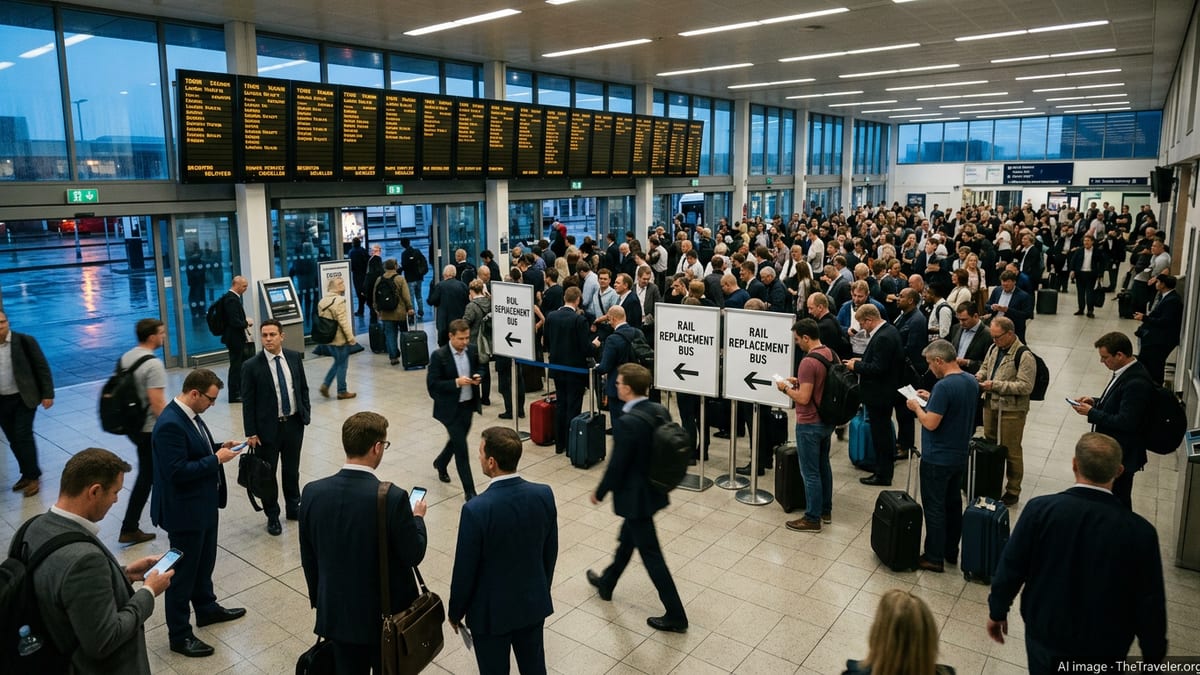
Power Failure Triggers Wide-Ranging Rail Disruption
According to publicly available incident summaries and rail operator updates, a fire at a traction power substation near a key main line triggered an automatic shutdown of electrical feeds to several track sections. The safety systems cut power to contain the fault, but the loss of supply left multiple trains stranded and halted services across the affected corridor at peak travel times.
Initial reports indicate that the blaze broke out close to tracks on a principal intercity and commuter route, disrupting movements in both directions as engineers assessed damage to cables, switchgear and signalling interfaces. Images shared via news outlets and social media showed smoke rising close to the railway, with emergency services attending alongside specialist rail response teams.
As power was progressively restored, operators shifted from outright cancellations to a reduced and simplified timetable. This transition is typical after major infrastructure failures, as damaged assets are isolated and trains are rerouted over alternative lines or constrained to a smaller number of platforms and paths while repairs continue.
Rail industry documents outlining timetable compliance and disruption management show that such incidents can affect planning cycles well beyond the initial emergency. Loss of a substation can temporarily cut available train paths, limit speeds, and reduce the capacity of busy junctions, compelling operators to rewrite working timetables and passenger-facing schedules for days or weeks.
Temporary Timetables, Diversions and Speed Restrictions
In the wake of the substation fire, operators on the affected route have moved to a short-term amended timetable that concentrates services on core flows and reduces stopping patterns. Publicly available journey planners and operator notices describe fewer trains per hour, with some intermediate stations seeing rail replacement buses or advice to use nearby alternative routes.
On long-distance services, some trains are being diverted over parallel lines that normally carry freight or secondary passenger flows. These diversions typically add journey time and may bypass certain usual stops, in part because signalling layouts and pathing constraints differ from the primary main line. Timetable summaries indicate that a number of late-evening and early-morning services have been withdrawn or combined to free up rolling stock and crew.
Infrastructure managers commonly impose temporary speed restrictions after major electrical or trackside incidents, particularly where equipment has been exposed to heat or where inspections are ongoing. Public information shows that slower line speeds are in force through the affected section, with operators warning of extended journey times even on trains that continue to run to their usual routes.
Rail planning guidance notes that any reduction in line speed or available tracks has a compounding impact on punctuality. Reduced margins make it harder to recover from minor delays, so operators often choose to formalise a slower, more reliable timetable rather than attempt to run the full pre-incident schedule and risk cascading disruption across the wider network.
Knock-On Effects for Commuters and Long-Distance Travelers
For regular commuters, the most immediate impact has been changes to departure times and the removal of certain direct services. Passengers are being advised through operator channels to check journey details on the day of travel, as rolling adjustments continue while infrastructure teams refine what the damaged corridor can reliably handle.
Some rail user groups report heavier crowding on surviving peak trains as travelers adjust to fewer options and altered patterns. With several services retimed by only a few minutes, there are also reports of passengers missing connections or finding that long-used fares no longer align neatly with off-peak thresholds when trains are moved earlier in the hour.
Long-distance travelers have seen particular disruption where intercity services share tracks with dense commuter flows. To manage limited power and track capacity, operators have in some cases prioritized trains covering the longest distances or those linking major hubs, while trimming back short-hop journeys that can be more easily replaced by local alternatives or bus links.
Industry data and previous case studies of major power incidents suggest that travel patterns can take time to stabilise after such shocks. Passengers may temporarily switch to road or coach options, while others adapt by traveling earlier or later, working remotely on certain days, or using alternative rail corridors that still have capacity.
How Rail Planners Rebuild the Timetable After a Fire
Timetable planning codes and rail industry handbooks describe a structured process for rebuilding services after a major infrastructure failure. In the first hours, the priority is to clear stranded trains, provide safe evacuation where required and create basic shuttle or bus services around the damaged area. Only once the extent of the damage is clear can planners start constructing a stable short-term timetable.
Working timetables are designed around the performance limits of infrastructure, including the capacity of power substations and overhead or third-rail systems. When a substation is taken out of service by fire, planners must recalculate how many trains per hour each section can support, taking into account altered power feeds, isolation zones, and any need to keep additional headway between trains while investigations proceed.
Academic research on disrupted rail networks indicates that optimising revised train paths is a complex mathematical problem, particularly in already saturated urban corridors. Planners use software tools, historical performance data and real-time feedback from control rooms to identify which services deliver the greatest benefit to the largest number of passengers within the reduced capacity envelope.
Because passenger-facing reliability is a key measure, operators often lock in a conservative interim timetable for several days, even if incremental improvements to infrastructure are made in the meantime. More ambitious service uplifts tend to be reserved for scheduled timetable change dates, when there is time to model knock-on effects across connecting routes and adjust crew and rolling stock diagrams accordingly.
What Travelers Should Expect in the Coming Days
Publicly available information from rail operators and infrastructure managers suggests that, while emergency repairs at the burned substation site are progressing, the full reinstatement of pre-incident timetables is likely to be gradual. Some trains may return ahead of others as individual tracks, platforms and power sections are signed back into use.
Passengers are being encouraged to allow extra time, especially when making tight connections or catching last services of the day. Journey planners may only be updated shortly before travel, and rail experts frequently advise checking again closer to departure, as live running information can diverge from printed or previously published schedules during recovery phases.
Travel industry observers note that incidents involving traction power substations, while relatively rare, are likely to remain a significant risk factor in dense electrified networks. Ageing equipment, rising demand, and the increasing complexity of modern signalling and power systems all place additional stress on infrastructure, which can magnify the impact of any single failure.
For now, the focus for operators and infrastructure managers along the affected corridor is to stabilise performance under the temporary timetable, restore passenger confidence, and then phase back additional services as soon as it is safe and operationally viable to do so.