


More news on this day
A rare midwinter medical evacuation from Antarctica, involving an American patient flown to hospital care via New Zealand with support from Australian aviation specialists, is casting new light on how the United States and partner nations coordinate high-risk rescue operations and what that means for the growing world of polar travel.
Get the latest news straight to your inbox!
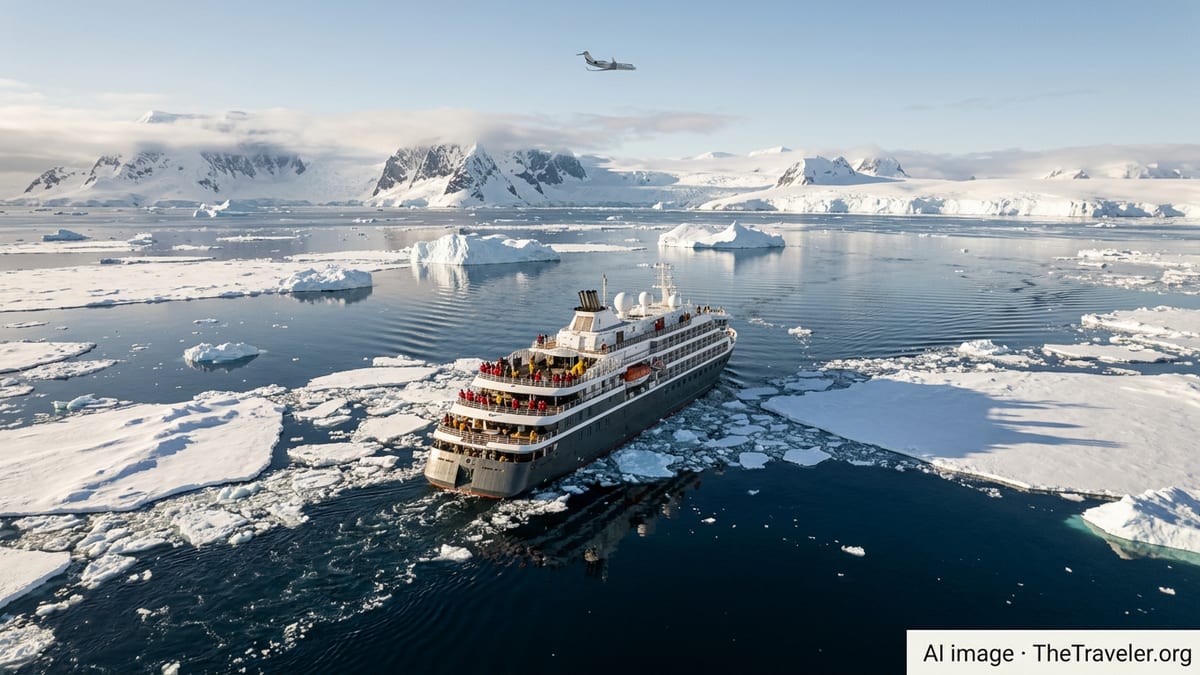
A High-Stakes Rescue in the Polar Night
Publicly available coverage from August 2026 describes a complex midwinter operation in which an American working at a U.S.-run Antarctic facility required urgent evacuation to advanced medical care. An Australian-operated jet was dispatched to McMurdo Station after an urgent request for assistance, with the patient ultimately transferred to Christchurch Hospital in New Zealand. Reports indicate the individual was in serious condition on arrival.
The flight took place during the austral winter, when Antarctica experiences continuous darkness, extreme cold and unstable weather. Aviation specialists describe midwinter landings on the continent as among the most difficult in the world, with crews facing frigid temperatures that challenge aircraft systems and very limited visual cues on snow and ice runways.
According to recent reporting and archival notices from the U.S. National Science Foundation, midwinter flights to McMurdo are only attempted when no other option is available for life-saving care. Routine logistics flights are largely suspended between February and late August, leaving research stations reliant on their own medical facilities and telemedicine unless partners can mount a special mission.
The 2026 operation followed a pattern seen in previous years, where New Zealand and, at times, Australian assets have supported the United States Antarctic Program with medical evacuations at the end of the summer season or during the winter dark. Each mission illustrates both the risks inherent in polar work and the depth of cooperation built up among nations that operate on the continent.
How the United States and New Zealand Work Together in Antarctica
Christchurch, on New Zealand’s South Island, functions as one of the principal gateways for U.S. activities in Antarctica. Official logistics guidance from the U.S. Antarctic Program notes that many personnel and cargo transit through Christchurch en route to McMurdo and onward to other bases. New Zealand’s own agency, Antarctica New Zealand, manages government-supported activities in the Ross Sea region and maintains its Scott Base near McMurdo.
Both countries are members of the Council of Managers of National Antarctic Programs, an international association that brings together 34 national programs responsible for nearly all scientific and logistical operations on the continent. Through this forum, members develop shared standards on aviation, safety, and emergency response, and coordinate assets such as aircraft and ice-strengthened vessels.
New Zealand Defence Force announcements over recent seasons highlight how closely integrated the cooperation has become. Royal New Zealand Air Force Hercules crews have conducted several long-range medical evacuations of U.S. personnel from McMurdo to Christchurch, including during periods of marginal light and closing weather windows. These flights have been described in public statements as part of a long-standing joint logistics pool with the United States.
For travelers, this partnership underpins much of the unseen safety net behind operations in the Ross Sea sector. While tourists typically arrive by cruise ship or charter flight from New Zealand or South America, the infrastructure, runways, weather forecasting and emergency protocols maintained for national programs also support search-and-rescue readiness in the broader region.
Why Midwinter Antarctic Flights Are So Rare
Medical guidance published by the U.S. National Science Foundation stresses that Antarctica’s isolation and limited medical facilities mean evacuation can be difficult even in summer and may be impossible between February and August. Winter on the continent combines near-total darkness with surface temperatures that can plunge far below minus 40 degrees, affecting airframes, hydraulics and fuel.
To reach McMurdo in winter, aircraft often must commit beyond a point of no return, where turning back is no longer feasible because of fuel constraints. Pilots must land on compacted snow or ice runways with minimal visual reference, relying heavily on instruments and local ground support. Any unexpected change in weather can complicate both the landing and the return to New Zealand or another safe airfield.
Public documentation from national Antarctic programs notes that winter-over personnel go through strict medical and psychological screening before deployment. The requirement acknowledges that, for months at a time, on-site medical staff and telemedicine support may be the only options. Only when a condition exceeds what can be managed on station do partners begin planning a risky midwinter flight.
These constraints have shaped some of the most dramatic episodes in Antarctic history, including earlier winter medical emergencies at South Pole and coastal stations. Each new case, such as the 2026 evacuation, reinforces how narrow the margin can be between the capabilities of a remote field clinic and the need for full hospital care thousands of kilometers away.
What Polar Travelers Should Know About Medical Risk and Rescue
While most visitors to Antarctica travel during the summer season and never approach the level of risk undertaken by wintering staff, the recent evacuation is a reminder that medical care across the polar regions is fundamentally different from that in more accessible destinations. U.S. policy documents for private Antarctic expeditions point out that commercial travelers may need specific evacuation insurance, as government programs prioritize safety of their own personnel and scientific missions.
Operators that follow best practice typically require detailed medical disclosures from guests and recommend conservative decisions about pre-existing conditions. Guidance from polar research bodies underscores the importance of being in good health before any Antarctic deployment and recognizing that even routine ailments can become complicated when evacuation is delayed by weather or distance.
For those booking cruises or expedition voyages, publicly available information suggests asking clear questions about medical staffing on board, availability of telemedicine, and the operator’s contingency plans for serious illness or injury. Travelers should also understand that diversions to the nearest port or airfield for evacuation can dramatically alter itineraries, particularly in the remote Southern Ocean.
The broader lesson from the McMurdo evacuation is that even with advanced aircraft and coordinated international support, reaching hospital-level care from Antarctica remains time-consuming and uncertain. Responsible polar travel planning treats evacuation as a last resort, emphasizing prevention, realistic self-assessment and careful choice of operator.
The Expanding Web of Polar Safety Cooperation
The 2026 midwinter mission unfolded against a backdrop of increasing international focus on polar safety. The Council of Managers of National Antarctic Programs regularly convenes search-and-rescue workshops, bringing together logistics experts, aviators and maritime agencies to refine joint responses to emergencies across the continent and the surrounding Southern Ocean.
New Zealand’s national search-and-rescue governance framework explicitly includes responsibilities for its vast Southern Ocean region, while other nations, including the United States, Chile, Argentina and Australia, provide overlapping capabilities. Together with COMNAP, they work to align procedures, share real-time information and, when necessary, dispatch assets across national lines to assist those in distress.
For the United States, participation in these structures forms part of a wider Antarctic strategy that combines scientific leadership with robust safety and environmental protections. Official reviews of the U.S. Antarctic Program emphasize the critical role of partnerships with gateway countries such as New Zealand, which host logistics hubs, search-and-rescue coordination centers and specialized aviation units.
As climate change and rising interest in polar tourism bring more people and vessels into high latitudes, experts in these forums are examining how to maintain adequate rescue capacity. The recent midwinter evacuation provides a vivid case study: a single patient’s urgent needs mobilized resources across three countries, requiring careful risk calculations at every step. For future travelers and operators, it is a reminder that the safety of polar journeys depends not just on individual ships or planes, but on a deeply interconnected international system built to respond when conditions are at their worst.