


More news on this day
A newly released investigation into a fatal train collision has found that the driver failed to activate a dedicated emergency system in the final seconds before impact, intensifying scrutiny of how rail operators are trained and how onboard safety technology is used in critical moments.
Get the latest news straight to your inbox!
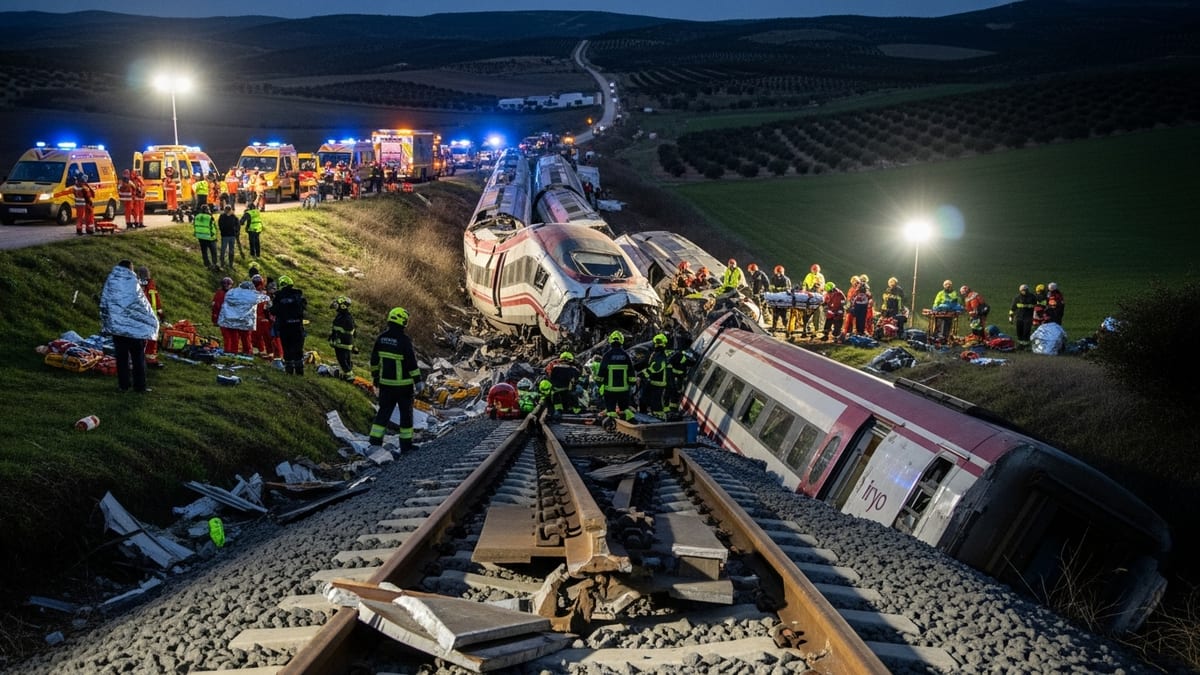
Findings Highlight Missed Use of Emergency Protection
According to published coverage of the report, investigators concluded that the train involved in the collision was equipped with an emergency braking or protection function that was not used by the driver as the crash became imminent. The system is designed to provide a rapid response in situations where a collision or serious derailment risk is detected or perceived, but the report indicates it remained inactive until the point of impact.
Publicly available information shows that the collision occurred at speed and that standard braking alone was insufficient to prevent fatalities and severe damage. Analysis in the report suggests that activating the emergency system could have provided additional deceleration or triggered protective measures that may have reduced the severity of the crash, even if it could not have fully prevented it.
The investigation notes that the driver did apply some level of braking but did not engage the dedicated emergency mode available in the cab. The report characterizes this as a missed opportunity, emphasizing that emergency systems are specifically intended for rare, high-risk scenarios in which every fraction of a second and every meter of stopping distance can affect survival outcomes.
The findings also draw attention to the interface design and location of the emergency controls, indicating that they were functional and accessible at the time of the crash. The report does not point to mechanical failure of the emergency hardware, which places the focus instead on human factors and operational decision making in the minutes and seconds leading up to the collision.
Human Factors, Training and Split-Second Decisions
The investigation places significant emphasis on human factors, including the driver’s workload, situational awareness and understanding of when and how to use the emergency system. Reports indicate that, in the moments before the collision, the driver was processing rapidly changing information and attempting to respond within a very short window of time.
Training materials and procedures reviewed by investigators are reported to describe emergency activation as a last-resort measure to be used when a collision or serious incident appears unavoidable. However, the report suggests that real-world decision making under stress can differ sharply from classroom expectations, particularly when drivers are uncertain about whether they still have time to stop using conventional braking alone.
Publicly available analysis in the report raises questions about whether current training sufficiently prepares drivers to make instant judgments on switching from normal braking to emergency modes. It also points to the risk that drivers may hesitate to use emergency systems because of concerns about potential damage to equipment, disruption to the network or perceived criticism if the situation later appears less serious than it seemed in the moment.
The findings underscore that, in a safety-critical environment, any cultural or procedural hesitation around using an emergency function can have fatal consequences. Investigators note that the driver’s failure to activate the emergency system must be viewed in the broader context of training, supervision and organizational expectations, rather than as an isolated individual error.
Technical Systems Under Review After Collision
The report also examines how the broader signaling and train protection systems performed during the incident. According to technical summaries referenced in coverage, the line was equipped with automated controls and alerts intended to warn drivers of danger and, in some cases, to intervene directly if signals are passed at danger or if a train approaches a conflict point at excessive speed.
Investigators assessed whether these automatic safeguards were configured to provide timely warnings and to apply brakes independently of the driver when necessary. The initial findings indicate that while some systems functioned as designed, the chain of protective layers did not fully prevent the collision, leaving the final line of defense to the driver and the manual emergency system in the cab.
The report notes that the failure to use the emergency function highlighted a gap between the theoretical safety envelope provided by layered technology and the practical reality of how those layers are used. Where systems depend on human activation at a critical moment, the absence of clear prompts or automatic triggers can mean that an available safety net remains unused.
Following the collision, infrastructure and rolling stock managers are reported to be reviewing the configuration of onboard emergency controls, as well as potential enhancements to automated train protection. Areas under consideration include more assertive automatic braking when conflicts are detected and clearer visual and audible cues to drivers when an emergency input is expected.
Regulatory and Industry Responses Focus on Safety Culture
Publicly available statements from rail regulators and industry bodies referenced in media reports indicate that the findings have prompted a broader examination of safety culture on the network. The failure to use the emergency system is being treated as a symptom of deeper structural issues in training, supervision and operational norms.
In response to the report, rail operators are reported to be considering revisions to driver training programs to emphasize that emergency systems should be used decisively whenever a serious collision risk is perceived, even if there is uncertainty about the ultimate outcome. Some organizations are also understood to be reviewing how simulator-based training scenarios can better replicate the pressure and ambiguity of real incidents.
The report’s conclusions are likely to influence upcoming regulatory discussions about how emergency systems are standardized across fleets, how frequently drivers must demonstrate proficiency, and how data from events is shared across the industry. Safety advocates argue that transparent sharing of lessons from serious collisions is crucial to preventing similar tragedies on other routes and in other countries.
For passengers, the findings may reinforce existing concerns about how technology and human judgment interact on modern railways. While automated systems have reduced many types of risk, the collision described in the report shows that lives can still depend on a single decision in the cab. How rail operators respond to the identified gaps in training, design and culture will be closely watched by regulators, unions and the traveling public alike.