


Riyadh’s King Khalid International Airport (RUH) sits around 35 kilometres north of the Saudi capital, so your first ride into the city is more than just a quick hop. Whether you are arriving for business, transit or Umrah, choosing the right taxi or ride-hailing option can mean the difference between a smooth arrival and an expensive headache. This guide walks you through official airport taxis, Uber and Careem, typical fares, hotel zones, luggage and family considerations, plus how to avoid hassle from informal drivers in the arrivals hall.
Get the latest updates straight to your inbox!
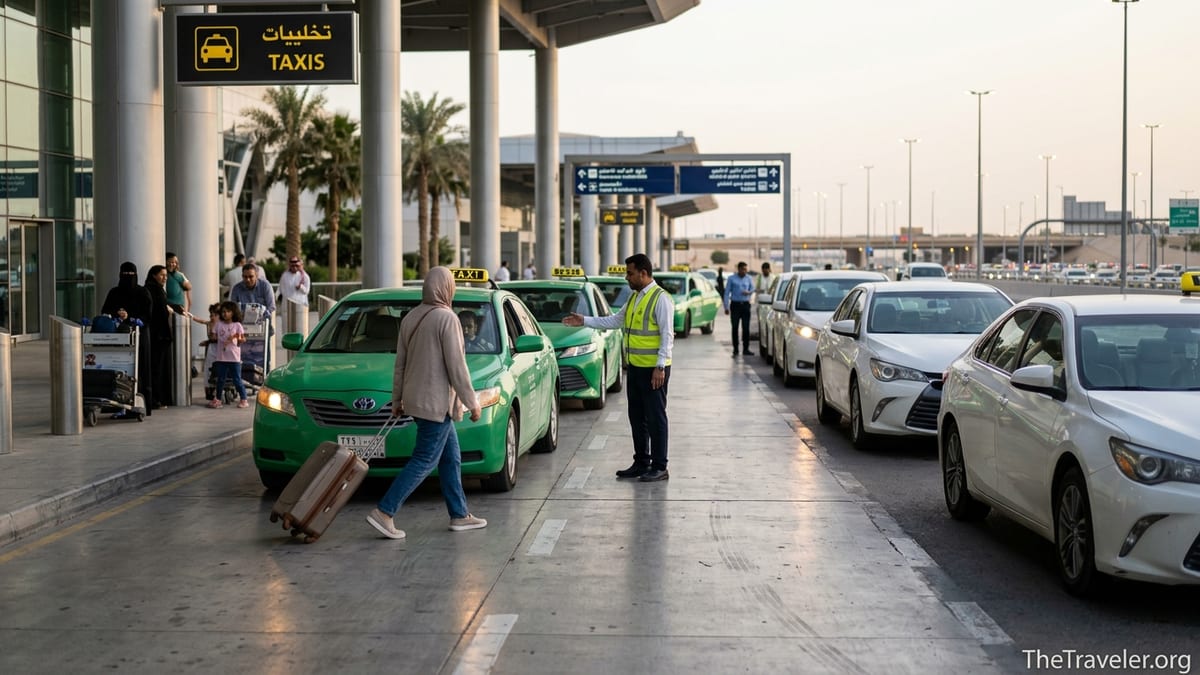
How Airport Taxis Work at Riyadh’s King Khalid International
King Khalid International Airport is spread across multiple passenger terminals, but the taxi system is broadly the same: after baggage claim you exit through customs, then follow signs for taxis or “Ground Transportation.” Official airport taxis line up outside on the arrivals level, typically beyond a barrier where only licensed vehicles are allowed to wait. You will also find counters for the official airport taxi operator just before you step outside.
As of mid-2026, airport taxis at RUH operate under a concession often referred to locally as SAFWA, described in recent airport transport guides as the sole authorized on-site taxi operator. In practice this means the vehicles waiting at the signed taxi rank immediately outside each terminal are regulated, with published tariffs and inspections by Saudi transport authorities. Drivers are required to display an ID, keep the car clean and use the approved fare structure.
Unlike some airports that use fixed fares per zone only, Riyadh’s airport taxis typically combine published point-to-point guide prices with meter-based or time-based charging inside the city. At the taxi counter, staff will quote an approximate price to your hotel district and may give you a printed slip. Once you are in the car, the driver should either run the meter or follow the agreed tariff. When in doubt, ask politely before you move: “Approximately how many riyals to Olaya?” or “To the Financial District?”
Most airport taxis today accept cash in Saudi riyals and a growing number also accept local card or contactless payments, but you should not rely on a foreign card working in every vehicle. For a late-night arrival, having at least 200 to 300 riyals in cash gives you a comfortable buffer for a ride into central Riyadh plus any short detours.
Typical Fares and Real-World Price Examples
Because official tariffs are updated periodically by regulators, exact numbers can shift, but recent public price lists and traveler reports give a realistic range. A standard official taxi from RUH to central Riyadh hotel areas such as Olaya, Al Murabba or Al Faisaliah often comes out in the region of 120 to 180 Saudi riyals in normal traffic. The same trip booked on UberX or Careem Economy usually ranges around 80 to 120 riyals, depending on demand and time of day.
To put that into concrete examples, travelers in 2025 and 2026 commonly report paying around 90 riyals on UberX for a 30 to 35 minute ride from the airport to the King Abdullah Financial District, while an official airport taxi for a similar route may be closer to 130 to 160 riyals. A ride from RUH to the Diplomatic Quarter on the far western side of the city can edge higher, often roughly 150 to 200 riyals for a taxi, while ride-hailing sometimes comes in around 110 to 150 riyals if surge pricing is not active.
Inside the city, hourly taxi rates published in past airport tariff sheets have hovered around the equivalent of 90 to 130 riyals per hour, before VAT, for standard vehicles. This hourly structure is mainly relevant if you ask the driver to wait while you run multiple errands, for example stopping at a mall for a quick purchase on the way to your hotel. For a straightforward hotel transfer, you will almost always pay a flat trip price or a normal metered fare instead of the hourly rate.
Because distances in Riyadh are long and traffic patterns vary, it is wise to think in broad bands. For most visitors, a realistic rule of thumb is that an official taxi into the main hotel zones will cost somewhere between 120 and 200 riyals, while Uber or Careem, when available, will usually be slightly cheaper, in the 80 to 150 riyal bracket. If someone in the arrivals hall offers you a private ride for “only 250 riyals cash, no meter,” you are likely looking at an unlicensed driver with an inflated price.
Uber, Careem and Other Ride-Hailing Options at RUH
Ride-hailing apps are widespread in Riyadh and are often the preferred option for residents. Uber and Careem operate citywide and can generally pick up and drop off at King Khalid International Airport, within the rules enforced by airport authorities at the time of travel. In the apps you will often see “Riyadh Airport (RUH)” as a preset location, with dedicated pickup points marked by pillar numbers or signage outside each terminal.
When you land, you can connect to airport Wi-Fi or use an eSIM to request a car online. Recent Uber pages for RUH show average fares around 90 riyals for a 30-plus minute airport ride, which matches many traveler reports. Careem’s Economy or GO options are usually very similar in price to UberX, while larger SUVs or “Max” vehicles cost more but are a popular choice for families with multiple suitcases.
One practical point many newcomers miss: at some Saudi airports, including Riyadh, ride-hailing drivers are expected to use specific pickup lanes and are not supposed to cruise directly in front of the taxi rank. To avoid friction with airport marshals and taxi drivers, some Uber or Careem drivers may message you asking you to meet them one level up at Departures or at a side entrance. This is not inherently unsafe, but you should always check that the car, plate number and driver name in the app match exactly before you get in.
Late-night and early-morning availability is generally good in Riyadh, but wait times can increase after 1 or 2 a.m., especially on weekdays. If you have a 3 a.m. arrival or are traveling with small children, consider using the “Reserve” or pre-booking options some apps and premium services offer, or arrange a car through your hotel, even if it costs a bit more than on-demand ride-hailing.
Riyadh Hotel Zones and What Your Taxi Should Cost
Understanding the main hotel zones in Riyadh can help you judge whether the fare you are quoted is reasonable. Many international visitors stay in a few well-known districts. Olaya and Al Faisaliah form a central business and shopping corridor anchored by iconic towers like Kingdom Centre and Al Faisaliah. Al Murabba and the area around the National Museum host several mid-range hotels and government offices. The King Abdullah Financial District to the north has grown into a major business hub with new five-star properties, while the Diplomatic Quarter to the west houses embassies and upscale hotels.
From the airport, Olaya and Al Murabba are among the closest large hotel zones in practice, even though Riyadh’s sprawl means “close” still often means a 30 to 40 minute drive. For these areas, if you walk up to the official taxi rank, expect something in the 120 to 170 riyal range in normal conditions. If the counter or driver quotes you 250 or 300 riyals for Olaya without any clear explanation, that should raise questions and you are within your rights to ask to see the official tariff or choose another cab.
For more distant zones like the Diplomatic Quarter or the expanding northwestern suburbs, a taxi fare creeping toward 180 to 220 riyals may be justifiable, especially at peak rush hour. However, you can always quickly compare by checking Uber or Careem on your phone before committing. If the app says an UberX to your hotel is 110 riyals and an informal driver in the arrivals hall is urging you into a private car for 260 riyals “because of traffic,” there is no reason to accept the higher price.
Some premium hotels in Riyadh, particularly in the Diplomatic Quarter and Financial District, offer their own chauffeured airport transfers, often in black SUVs. These are almost always more expensive than taxis or ride-hailing, easily running 250 to 400 riyals per car each way, but they can be good value if you are arriving very late, carrying sensitive equipment or traveling on a corporate account that prioritizes meet-and-greet convenience over price.
Luggage, Families and Accessibility in Riyadh Airport Taxis
Riyadh’s airport taxis range from compact sedans to larger sedans and SUVs, but the cars queuing at the official rank tend to be standard four-door vehicles. A typical sedan will comfortably handle two large suitcases and one or two cabin bags. If you are a family of four with multiple large suitcases and a stroller, you may want to wait specifically for a larger car or, better yet, order an SUV category on Uber or Careem, which usually advertises space for four or more suitcases.
Families traveling with infants should be aware that car seats are not routinely provided in either taxis or ride-hailing cars in Saudi Arabia. Some parents arriving at RUH bring their own child seats and install them in the back of the taxi or Uber, which is the safest option if your child will be spending a lot of time in cars during your stay. If you prefer not to carry a seat, you will likely be buckling your child directly into the back seat, which is common locally but may not align with safety recommendations in your home country.
For travelers with reduced mobility, airport staff can assist with wheelchairs and escort services inside the terminal, but the situation outside is more variable. Official airport taxis are not usually wheelchair-adapted, and drivers may have limited English when it comes to discussing specific mobility needs. If you require a vehicle with a ramp or fixed wheelchair docking, arranging a private transfer through a specialist operator or through your hotel in advance is often necessary. In some cases, ride-hailing apps may list accessible options, but availability can be inconsistent.
If you are transporting bulky items such as ski bags, musical instruments or exhibition materials, take a moment at the rank to visually confirm the car’s trunk size before loading. Riyadh’s traffic police enforce seatbelt rules more actively than in the past, and taxis can be stopped for apparently unsafe loads. Keeping oversized bags laid flat in the trunk or in an SUV’s cargo area is better than trying to wedge them into the back seat on top of passengers.
How to Avoid Informal Drivers and Common Taxi Pitfalls
Saudi Arabia is generally safe and heavily policed, and violent crime involving visitors is rare, but airport transport remains one of the few areas where tourists can be overcharged or hassled. The first line of defense is simple: ignore any unsolicited offers of rides inside the terminal or just outside the doors. Unlicensed drivers often cluster near the exit from customs, calling out “Taxi, taxi” or even “Uber, Careem” while showing you a smartphone. Their prices are almost always higher than official taxis or app-based rides, and they operate outside the protections of the regulated system.
Transport authorities in the kingdom have reported hundreds of violations at airports in recent years for unauthorized passenger pickup, with fines and vehicle impoundment for offenders. For the passenger, the risk is more about cost and hassle than personal safety. An informal driver may claim the meter in his car is broken and then demand a much higher flat fare at the end of the trip, or take a long detour on unfamiliar roads to justify an inflated price. In a worst case, a traveler might leave belongings in such a car and have no clear way to trace or report the driver afterward.
To protect yourself, always choose one of three options: walk directly to the signed official taxi rank and take the next regulated cab in line, book Uber or Careem through the app and meet the driver at the specified pickup point, or use a pre-arranged hotel or private transfer with clear written confirmation of the fare. Before the car moves, confirm the approximate fare and ensure that either the meter is running or that you have agreed on a total price that aligns with what the taxi counter told you or what your app displays.
If a driver pressures you aggressively, refuses to turn on the meter, or quotes a number that feels wildly out of line with what you have seen in the app or at the counter, it is acceptable to step out of the vehicle while still inside the airport area, tell the driver you are not comfortable and return to the rank or ride-hailing pickup point. In Riyadh’s tightly monitored airport environment, it is better to be cautious and firm than to accept a ride that begins with confusion or discomfort.
Paying, Receipts and Safety Once You Are in the Car
Payment for official airport taxis in Riyadh is still dominated by cash. Keep small denominations such as 10, 20 and 50 riyal notes, since drivers may not have change for a 500 riyal bill at the end of a 130 riyal ride. Some taxis display point-of-sale terminals or QR codes for local card payments or national digital wallets, but international card acceptance can be patchy. If paying cash, wait until the car is fully stopped at your hotel entrance, confirm the final fare verbally, and count the notes as you hand them over.
One advantage of ride-hailing apps is that all payment flows through the app, with a digital receipt emailed or saved in your account. This not only simplifies expensing for business travelers but also provides a clear record if you need to dispute a charge or report an incident. If something goes wrong, such as a driver detouring unreasonably or an item left in the car, reporting through the app is often more effective than trying to track down an independent taxi later through the airport operator.
While in the car, basic precautions are the same as in any large city. Sit in the back seat, especially if traveling alone. Share your live location and trip details with a trusted contact via your phone. Keep your passport, wallet and phone in a zipped bag at your feet rather than loose on the seat. If you feel uncomfortable with the chosen route, you can politely ask the driver to stay on the main highways or suggest a direct route using a map app, bearing in mind that local drivers often know time-saving variations.
If you do encounter a serious issue, such as harassment, refusal to end the trip at your location, or outright fraud, take note of the car’s plate number, the driver’s displayed ID and any receipt details. For ride-hailing, file a report in the app immediately. For an official taxi, your hotel concierge can often help you contact the airport taxi desk or the local transport authority. Saudi regulators have tightened oversight of taxis and ride-hailing companies in recent years, and repeated violations can lead to drivers losing their license to operate.
The Takeaway
For most travelers arriving at Riyadh’s King Khalid International Airport, getting into the city by road is straightforward if you stick to official channels. The safest and most cost-effective options are the signed airport taxi rank, reputable ride-hailing apps like Uber and Careem, or a pre-booked hotel or private transfer. Typical fares to central hotel zones fall within a predictable band, and you can always cross-check a taxi quote against what your app shows for the same journey.
Informal drivers in the arrivals hall are the main pitfall to avoid. They rarely offer better prices than the regulated options and leave you without the safety net of clear tariffs, traceable bookings and complaint channels. By ignoring unsolicited offers, confirming your fare before departure, keeping an eye on the route and using digital receipts where possible, you can turn your first ride from RUH into a smooth, uneventful start to your time in the Saudi capital.
FAQ
Q1. How much does a taxi from Riyadh airport to the city center usually cost?
For most central areas such as Olaya or Al Murabba, recent reports suggest an official airport taxi typically costs around 120 to 170 Saudi riyals in normal traffic, while UberX or Careem Economy often fall in the 80 to 130 riyal range.
Q2. Are Uber and Careem allowed to pick up at King Khalid International Airport?
As of 2026, Uber and Careem operate widely in Riyadh and can generally pick up and drop off at RUH within airport rules, using designated pickup points or clearly marked areas outside the terminals, although exact procedures can change and are best checked in the app on arrival.
Q3. Where do I find the official taxi rank at Riyadh airport?
After baggage claim and customs, follow the signs for taxis or Ground Transportation to the arrivals level exit, where you will see a marked queue of licensed taxis behind barriers, often supported by a small taxi counter or staff in reflective vests directing passengers.
Q4. Is it safe to accept a ride from someone who approaches me inside the terminal?
It is strongly recommended that you decline unsolicited offers of rides inside the terminal or just outside the doors, as these are usually unlicensed drivers who charge inflated prices and operate outside the protections of the official taxi and ride-hailing systems.
Q5. Do Riyadh airport taxis accept credit cards?
Some official taxis have card machines or support local digital wallets, but cash in Saudi riyals remains the most reliable method, and foreign cards do not always process successfully, so carrying enough cash for your airport transfer is wise.
Q6. What is the best option for a family with a lot of luggage?
Families with multiple large suitcases or strollers often find it easiest to book an SUV category on Uber or Careem, or request a larger taxi at the official rank, ensuring the vehicle has enough trunk space before departure rather than squeezing bags into passenger seats.
Q7. How long does the drive from RUH to central Riyadh usually take?
In light to moderate traffic, the journey from King Khalid International Airport to central hotel districts typically takes around 30 to 40 minutes, but during weekday rush hours or major events it can stretch beyond 50 minutes, so build in extra time if you have appointments.
Q8. Can I pre-book a private transfer instead of using taxis or apps?
Yes, many hotels and specialist transport companies offer pre-booked airport transfers, often in black sedans or SUVs, which are more expensive than regular taxis or Uber but provide meet-and-greet service and can be a good choice for late arrivals or corporate travelers.
Q9. What should I do if a driver refuses to use the meter or demands a much higher fare?
If this happens while you are still in the airport area, you can calmly insist on the meter or a fare in line with the published tariffs, and if the driver refuses, step out of the car, return to the official taxi rank or use a ride-hailing app instead of continuing a journey that starts with disagreement.
Q10. Are car seats available in Riyadh airport taxis for young children?
Car seats are not typically provided by default in either airport taxis or ride-hailing vehicles in Riyadh, so parents who want their child securely restrained usually bring their own seat and install it in the back of the taxi or booked car after arrival.