


For business travelers heading into Riyadh, the journey from King Khalid International Airport (RUH) to King Abdullah Financial District (KAFD) is often the first real test of how well a trip has been planned. With a dedicated Yellow Line on the Riyadh Metro now linking the terminals directly to KAFD, and a well-established ecosystem of taxis, Uber and Careem, you have several credible options. Choosing the right one depends on your arrival time, luggage, schedule and where you are staying or meeting inside the financial district.
Get the latest updates straight to your inbox!
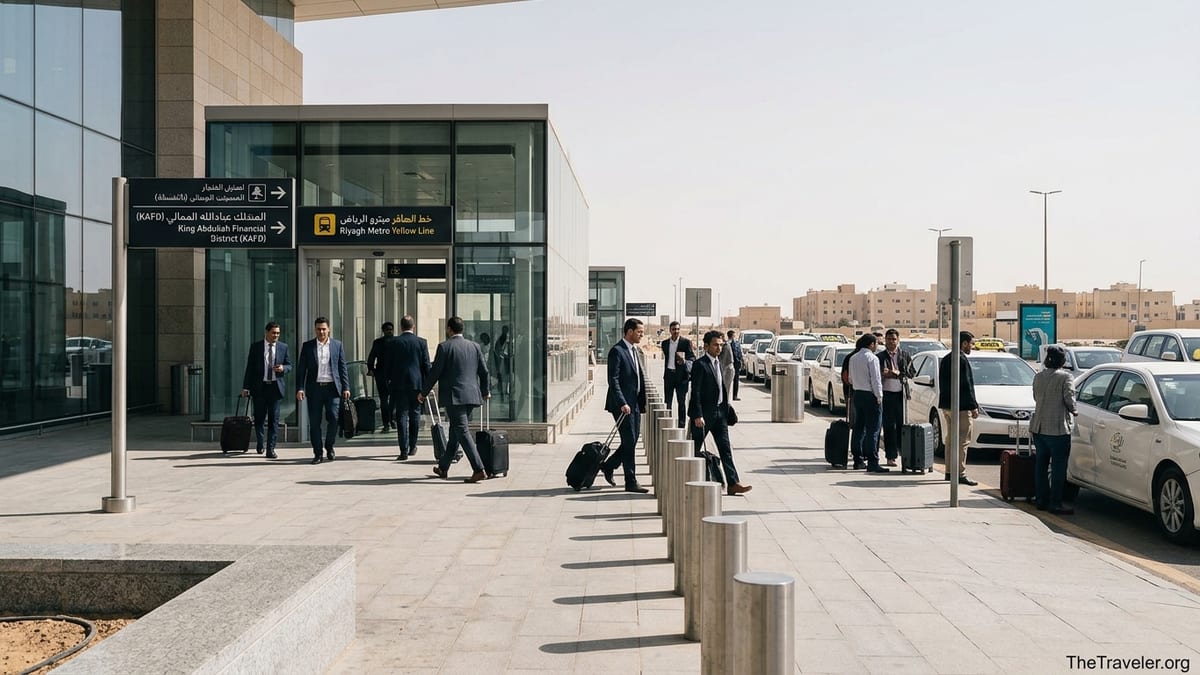
Understanding the Riyadh Airport to KAFD Corridor
King Khalid International Airport sits roughly 35 to 40 kilometers north of central Riyadh, with KAFD positioned on the northern edge of the city’s built-up core. Line 4 of the Riyadh Metro, widely referred to as the Yellow Line, was designed explicitly to connect the airport terminals to KAFD, turning what used to be a strictly road-based transfer into a simple point-to-point rail journey. The metro now runs between the airport’s main passenger terminals and KAFD Station, where it intersects with other lines that serve the wider city.
The Yellow Line alignment runs broadly southwest from the airport to KAFD, passing a limited number of intermediate stations before terminating inside the financial district. Public information indicates it spans close to 30 kilometers from KAFD to Airport Terminals 1–2, with travel time typically quoted at around 25 to 35 minutes in normal operations. That contrasts with road transfers, which can take anywhere from 25 minutes off-peak to more than 50 minutes during the heaviest evening or Sunday-morning traffic.
KAFD itself is a self-contained business district with its own metro interchange station serving the Yellow Line along with other lines in the Riyadh Metro network. For visiting executives, this matters because it means conference venues, corporate towers and nearby hotels are typically within a short ride or even a covered walk from KAFD Station. Many conference organizers in Riyadh now routinely recommend delegates land at RUH and follow the Yellow Line to KAFD as a default transfer option.
In practice, most business travelers end up choosing between three main routes from the airport to KAFD: the Yellow Line metro, an airport taxi from the official rank, or a ride-hailing service such as Uber or Careem. Each has its own sweet spot depending on whether you are traveling during rush hour, carrying several checked bags, or heading straight into a board meeting with no time margin.
Using the Yellow Line Metro: Fast and Predictable
For many business travelers, the Yellow Line metro is now the most predictable way to move between the airport and KAFD. Trains run on a set timetable, are not affected by road congestion, and avoid the variability of taxi queues or ride-hailing surge pricing. From the airport metro station, located in or adjacent to the main terminal complex, the line runs directly to KAFD Station with only a handful of stops, generally taking half an hour or less under normal conditions.
Operating hours can vary slightly by day and around religious holidays, but typical daytime service starts in the early morning and continues into the late evening. Frequencies often tighten around commuter peaks, making the metro particularly attractive for 8:00 to 9:00 arrivals or late-afternoon departures when the highways around Riyadh are busiest. Business travelers arriving on a morning flight from Dubai or London, for instance, can usually clear immigration, walk to the metro and be at KAFD before many colleagues driving in from northern suburbs.
The metro is built with luggage in mind. Trains have open gangways and dedicated standing areas near doors where rolling suitcases can be parked without blocking aisles. Elevators and escalators connect platforms and concourses, which makes the system workable even with a large checked bag and a carry-on. A common pattern is an executive landing with one cabin bag and one medium suitcase, rolling both directly from baggage claim onto the train and leaving the metro at KAFD Station just a few minutes’ walk from their hotel.
Tickets are generally purchased from vending machines at the station concourse using cards or cash, or via stored-value travel cards promoted by the operator. Fares for an airport-to-KAFD trip are typically modest compared with most major financial centers, often in the range of what you would pay for a short urban metro ride in European capitals. This makes the Yellow Line especially compelling for cost-sensitive corporate travel policies, junior team members traveling alone, or longer stays where repeated trips can add up.
Taxi, Uber and Careem: Door-to-Door Flexibility
Despite the convenience of the Yellow Line, many business travelers still prefer the flexibility of point-to-point road transport. Official airport taxis queue outside arrivals at each terminal and use a meter that charges by distance and time. Before the metro opened, guidance for visitors often quoted typical city-center fares from the airport at roughly 80 Saudi riyals or more, with journeys to more distant business districts like KAFD sometimes costing higher depending on traffic and exact destination. Today, with fuel costs and traffic variability, travelers should expect a similar or slightly higher range for airport-to-KAFD rides, especially in peak periods.
Ride-hailing services such as Uber and Careem are widely used in Riyadh and tend to be the preferred choice for regular visitors and residents. They allow you to order from your smartphone as soon as you exit customs, track your driver in real time and route directly to a specific tower entrance or hotel lobby in KAFD. In practice, fares to KAFD fluctuate based on time of day, demand and the vehicle class you choose. At off-peak times, some travelers report paying roughly comparable amounts to a metered taxi for a basic sedan; during high-demand windows around 5:00 to 7:00 in the evening, prices can climb, as they do in other major cities.
Door-to-door vehicles are particularly attractive if your KAFD destination is not immediately adjacent to the metro station. For example, if you are heading to a meeting in a tower on the outer edge of the district or to an event venue closer to the Northern Ring Road, a taxi or ride-hailing car can drop you at the exact entrance with minimal walking in Riyadh’s heat. This is also the most comfortable option when traveling with colleagues, bulky trade-show materials, or sensitive equipment that you prefer not to wheel through public spaces.
One subtle factor is language and local familiarity. Many airport taxi drivers are used to foreign passengers and recognize major hotel brands or corporate towers in and around KAFD. Uber and Careem drivers rely heavily on digital maps; you will want to verify that they select the correct KAFD entrance or hotel name to avoid time-consuming detours. Frequent travelers often save their regular KAFD meeting addresses in their ride-hailing profiles, which speeds up booking on future trips.
Travel Time, Rush Hour and Choosing the Right Mode
In choosing between metro, taxi and ride-hailing, the single most important factor is usually the time you are traveling. Riyadh experiences pronounced traffic peaks on workdays, particularly Sunday to Thursday mornings between roughly 7:30 and 9:30 and late afternoons from about 4:30 to 7:00, when office workers and government staff converge on or leave major corridors. Highways connecting the airport to the city and the Northern Ring Road around KAFD can slow significantly in these windows.
In light traffic, a direct taxi or Uber from the airport to KAFD might take as little as 25 to 30 minutes door-to-door, especially if your hotel or office is immediately off a main arterial road. In heavier conditions, the same journey can easily stretch to 45 or 50 minutes. During one recent conference season, for instance, visiting delegates reported taking nearly an hour by car from Terminal 1 to KAFD at around 5:30 in the evening, compared with barely half that time on the Yellow Line earlier in the day.
The metro, by contrast, tends to keep travel time in a narrower band. Once on board the Yellow Line, you can generally plan on around half an hour to KAFD, with minor variations for dwell times at stations. What you still need to budget for is the time to walk from your gate to immigration, clear formalities, collect bags and reach the metro hall. For a regional business traveler with only cabin baggage arriving on a Gulf flight in the middle of the day, it is realistic to move from aircraft door to KAFD hotel reception in 70 to 90 minutes in total.
If your arrival or departure times coincide with rush hour and your schedule is tight, the Yellow Line is typically the safer option. Conversely, if you are landing late at night when metro frequencies may be reduced or nearing closing, a taxi or ride-hailing service becomes more practical. When in doubt, many seasoned visitors check the latest metro operating hours on arrival and then decide between rail and road based on how quickly they clear the terminal.
Luggage, Business Gear and Mobility Considerations
How you are traveling physically can be just as influential as timing. The Riyadh Metro is designed to handle standard airline luggage, but there are still practical limits. One wheeled suitcase and a laptop backpack is straightforward on the Yellow Line, especially if you can lift your bag briefly over small gaps or escalator steps. Multiple large checked bags, hard-shell sample cases, or conference banners can become awkward in train aisles and on station escalators.
In such cases, a taxi, Uber or Careem often makes more sense, particularly for team travel. It is common to see project teams arrive with several hard cases of equipment for an installation or a trade show. Splitting that group across two or three ride-hailing vehicles directly from the airport curb can be significantly easier than maneuvering everything onto a train and through KAFD’s station concourse, even if the rail option is faster on paper.
Travelers with mobility issues should also think carefully about the transfer mode. Riyadh Metro stations provide elevators and step-free paths, but moving independently through a large terminal, across a concourse and into a train can still be tiring. For someone recovering from a leg injury or an older executive who prefers to minimize walking, arranging a car with close-up drop-off at the hotel entrance is often the best solution. Many business hotels near KAFD also coordinate with regular drivers who understand accessibility needs and can assist with bags.
For light-packers, on the other hand, the metro is very attractive. An executive on a two-day trip carrying only a cabin-size spinner and a slim briefcase can keep their total door-to-door time tightly under control by walking straight from arrivals to the Yellow Line, riding to KAFD and rolling into a hotel lobby without ever waiting at a taxi rank. This pattern is increasingly common among regional professionals flying in from Dubai, Doha or Manama for day-long meetings.
Where to Stay: Business Hotels Around KAFD
The growth of KAFD as Riyadh’s flagship business hub has been matched by a rapid expansion in nearby hotel capacity. Within the district itself and in adjacent neighborhoods such as Al Aqiq and along King Fahd Road, you will find a mix of international brands and local business hotels that cater to different budgets and trip profiles. Properties marketed specifically as being in or near King Abdullah Financial District often emphasize quick access to the metro station and short driving times to the airport.
For executives who want to be within a few minutes’ drive of their offices, hotels branded with global chains close to KAFD are a natural choice. Several mid- to upper-upscale properties in Al Aqiq and along the Northern Ring Road advertise themselves as a five- to ten-minute car ride from the heart of the district, traffic permitting. These usually feature strong business amenities such as dedicated meeting rooms, executive lounges, robust Wi-Fi and early breakfast service tailored to 8:00 a.m. starts.
There is also a growing inventory of serviced-apartment style accommodation near KAFD, which appeals to consultants and project teams on multi-week assignments. These properties offer larger living areas, kitchenettes and laundry facilities while still being reachable from KAFD by a short ride-hailing trip or even a couple of stops on connecting metro lines. A consultant working on a three-month banking implementation, for instance, might stay in a serviced residence along King Fahd Road to balance access to KAFD with occasional trips to other parts of Riyadh.
Within the district, the hospitality offering continues to evolve. New luxury hotels positioned directly in KAFD are being developed specifically for high-end business and conference travelers, with interiors, food and beverage concepts and meeting spaces aligned to the expectations of multinational corporations. As these open, they will make it increasingly realistic to land at RUH, ride the Yellow Line to KAFD, and walk under cover directly into a hotel that is effectively part of your meeting campus.
Planning for Meetings and Tight Schedules
For a typical short business trip, the tightest moments are often the first morning meeting and the return to the airport for your outbound flight. When landing in Riyadh for a 10:00 a.m. client meeting at KAFD, it is wise to work backward from your required arrival time, allowing not only for the transfer from the airport but also for immigration queues, baggage claim and a brief freshen-up at your hotel. Many seasoned visitors aim to land no later than three hours before their first scheduled appointment in the district.
Suppose you are flying in from Dubai on an early-morning service that lands around 7:30. If your meeting is at 10:00 in a tower near KAFD Station, the Yellow Line is likely your best option. Even if immigration takes 45 minutes and baggage claim another 15, you can reasonably be on the metro by around 8:45, reach KAFD by roughly 9:15, and still have time to walk to your building, clear security and compose yourself before walking into the room. Booking a taxi in this scenario leaves you more vulnerable to any spike in road traffic.
On departure, you should build in comfortable buffers. If your flight is at 20:30 and you are leaving from a KAFD office, a reasonable pattern is to finish meetings by 17:30, leave the district by around 18:00, and target arrival at the airport by 19:00 at the latest. In the early evening, the metro again offers a more predictable run time, while taxis and ride-hailing are more exposed to variable congestion. That said, if you are carrying several bags after checking out of your hotel, it may be worth accepting the risk of a slightly slower road journey in exchange for the ease of a curbside drop-off at departures.
Corporate travel policies can also play a role. Some companies now explicitly recommend the Yellow Line for solo travelers moving between RUH and KAFD during daylight hours, both for cost control and sustainability reasons, while allowing senior executives or teams with significant equipment to book road transfers. For important client dinners after dark, road vehicles remain the norm, as they can route from KAFD to restaurants in other districts of Riyadh that are not directly on the metro network.
Rush-Hour Strategies and Real-World Scenarios
If your trip coincides with Riyadh’s rush hours, a bit of strategic planning pays off. For early-morning arrivals on long-haul flights from Europe or Asia that reach RUH around 6:00 or 7:00, you will be approaching the downtown area just as commuters flood the arterial roads. In that window, many experienced travelers strongly favor the Yellow Line to KAFD, then transfer to a short taxi ride for any last-mile segment if their hotel or office is on the fringe of the district.
Consider an executive landing from London at 6:45 on a weekday, booked into a business hotel just outside KAFD along the Northern Ring Road. If they take a taxi directly from the terminal, they may find themselves in thick traffic just as the inbound rush peaks, with journey times becoming unpredictable. Instead, by taking the Yellow Line to KAFD Station and then ordering a ride-hailing car from the station exit to the hotel, they can split the journey into a fixed thirty-minute segment plus a ten-minute local hop, reducing the risk of major delay.
Evening peak requires similar thinking. After a full day of meetings in KAFD, outbound traffic to the airport can be congested, particularly on days when major conferences, sporting events or concerts overlap. Checking metro hours before leaving the office allows you to decide whether to walk to KAFD Station and ride the Yellow Line, or whether to pre-book a car to pick you up at a side entrance slightly ahead of the main post-work exodus. Some managers stagger team departures by a few minutes and allocate who will take the metro or a car based on baggage and flight times.
Weather is another consideration, especially in the hottest months. In high summer, midday temperatures in Riyadh can exceed what many travelers are used to, making even short outdoor walks uncomfortable. When meetings are scheduled around noon or mid-afternoon, it is often worth structuring your route to minimize surface exposure. That might mean choosing a hotel with a shaded or air-conditioned connection to KAFD Station, or using a short taxi ride from the metro rather than walking several blocks along sun-exposed streets.
FAQ
Q1. How long does it usually take to travel from Riyadh Airport to KAFD?
In light traffic, a direct taxi or ride-hailing car can take around 25 to 30 minutes, but this can extend toward 45 to 50 minutes in peak hours. The Yellow Line metro typically takes about half an hour between the airport and KAFD Station once you are on board.
Q2. Is the Riyadh Metro Yellow Line convenient if I have luggage?
Yes, the Yellow Line is designed to handle standard airline luggage, with open spaces near doors and elevators connecting platforms and concourses. One medium suitcase and a carry-on are easy to manage; multiple large cases may be more comfortable in a taxi or ride-hailing car.
Q3. Should I choose a taxi, Uber or Careem from the airport to KAFD?
Choose based on your priorities. Taxis are straightforward from the curb, while Uber and Careem let you route precisely to a specific hotel or office. If you value predictable timing during rush hour, the metro is often better; if you are carrying heavy bags or traveling late at night, a car is usually more practical.
Q4. How much should I expect to pay for a car from the airport to KAFD?
Exact fares vary by traffic, route and vehicle type, but travelers often report that metered taxis and basic ride-hailing options cost roughly what you would expect for a 30 to 40 kilometer airport transfer in a major Gulf city, with higher prices during peak demand. It is sensible to check fare estimates in your ride-hailing app on arrival.
Q5. Are there good business hotels close to KAFD?
Yes. The area in and around KAFD has a growing collection of business-focused hotels, including international chains and local brands in nearby neighborhoods such as Al Aqiq and along King Fahd Road. Many advertise five- to ten-minute transfers to KAFD and easy access to the metro.
Q6. If my first meeting is in KAFD at 10:00, what arrival time at the airport should I plan for?
Landing at least three hours before your meeting is a sensible rule of thumb. That window allows for immigration, baggage claim, walking to the Yellow Line or taxi rank, and travel to KAFD, plus a short buffer to check in at your hotel or freshen up before the meeting.
Q7. Is it safe to use ride-hailing services like Uber and Careem in Riyadh?
Ride-hailing services are widely used by residents and visitors in Riyadh. As with any major city, it is wise to verify the license plate and driver details in the app before getting in, sit in the back seat, and share your trip status with a colleague if you are arriving late at night.
Q8. What is the best option during weekday rush hours?
For solo travelers or those with light luggage, the Yellow Line metro is usually the most reliable option during peak road congestion, as it is not affected by traffic. If you are traveling as a group with equipment or prefer a door-to-door transfer, pre-booking a taxi or ride-hailing car and allowing extra time is advisable.
Q9. Can I rely on the metro for late evening or very early morning flights?
The metro’s early-morning and late-evening services depend on the timetable, which can vary slightly and may be adjusted during holidays. If your flight is very early or late, check the latest operating hours when you land or in advance; if there is any doubt, arrange a taxi or ride-hailing car as a backup.
Q10. How should I plan my return from KAFD to the airport for departure?
Work backward from your flight time, aiming to be at the airport about two hours before departure for regional flights and earlier for long-haul services. From KAFD, allow around an hour for the transit itself, whether by Yellow Line or car, plus extra margin for potential delays, especially in the late afternoon and evening.