


More news on this day
A confirmed missile strike that damaged Riyadh’s Public Investment Fund (PIF) Tower in November 2026, combined with renewed conflict-zone advisories for Saudi and Gulf airspace, is prompting airlines to extend suspensions of some Saudi routes, maintain diversions around sensitive corridors and warn travellers to expect short-notice changes into at least early 2027.
Get the latest news straight to your inbox!
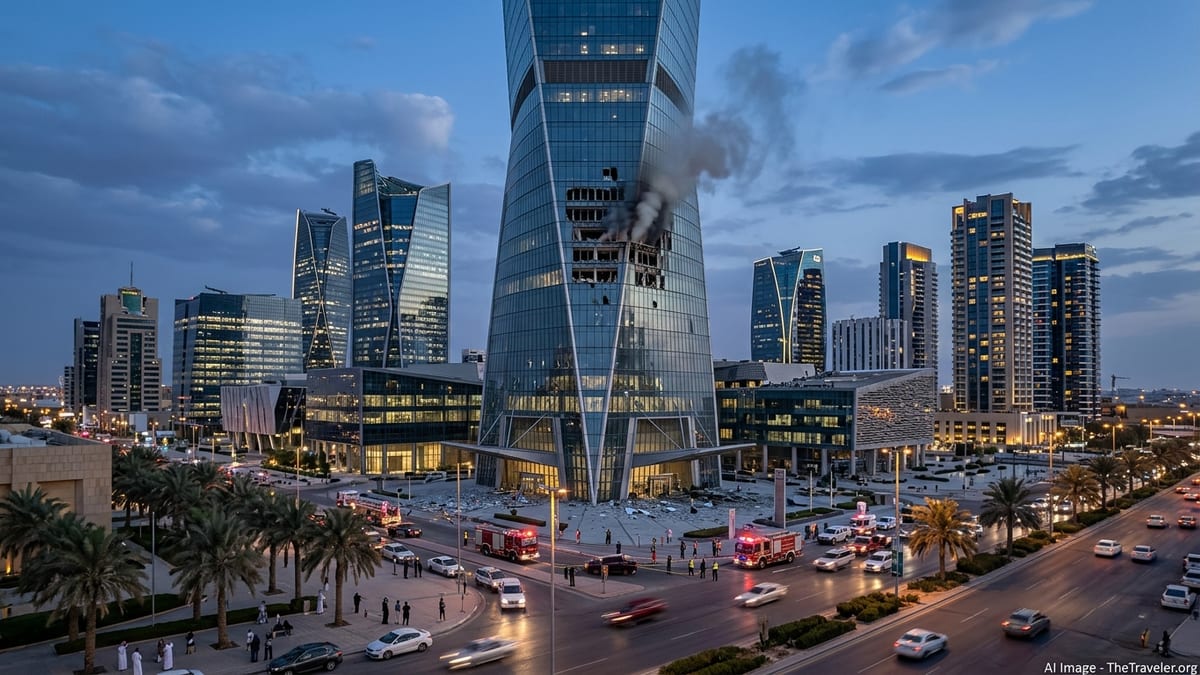
What is confirmed about the Riyadh financial district attacks
Saudi authorities and the Saudi-led coalition have confirmed that towers in Riyadh’s King Abdullah Financial District were hit in separate Houthi attacks in November 2026, including the landmark Public Investment Fund Tower. Public statements from the coalition and footage circulated by major news agencies show explosions partway up the glass-and-steel PIF Tower, with smoke and damaged facade panels on multiple upper floors, and debris visible at street level in the surrounding business district.
Open-source chronologies indicate that a first attack on the financial district on 8 November 2026 damaged the nearby Aramco Tower, while a second confirmed strike on 19 November 2026 hit the PIF Tower itself. International media reports and a publicly available reference timeline list the 19 November incident as a Houthi missile strike that shattered windows across several floors of the PIF Tower. A follow-on attack on 24 November is reported to have injured 11 people in the district, although it remains unclear whether that later incident affected the PIF Tower or a different building in the cluster.
In public statements, the Saudi-led coalition has labelled the financial-district attacks “terrorist” incidents and has attributed them to Yemen’s Houthi movement, which has claimed responsibility for a series of recent long-range drone and missile strikes on Saudi cities. A diplomatic communication to the United Nations in late November refers to repeated attacks during the month on Riyadh and other locations and notes a pattern of targeting civilian and economic infrastructure. As of 25 November 2026, available reporting points to at least 11 people injured in connection with the tower-area strikes; there are no widely cited, independently confirmed reports of fatalities specific to the PIF Tower impact itself, although casualty figures for some related incidents elsewhere in Riyadh are still being clarified.
The November strikes follow an increase in missile and drone activity affecting the Riyadh region since early autumn, including damage and debris incidents around King Khalid International Airport. Conflict-monitoring consultancies and specialist media have documented frequent interceptions of incoming weapons around the capital, with Saudi air defences destroying many drones and missiles before impact but with a limited number, including those that hit the financial district, breaching defences and causing visible damage. For aviation planners, the cluster of attacks close to Riyadh’s air approaches has sharpened concerns about risk exposure during low-altitude phases of flight where avoidance options are constrained.
Conflict-zone bulletins keep Saudi and Gulf routes under scrutiny
The clearest regulatory signal so far comes from updated conflict-zone advisories issued by the European Union Aviation Safety Agency. EASA’s Conflict Zone Information Bulletin for the airspace of the Persian Gulf and Gulf of Oman, designated CZIB-2026-07R4, was revised on 16 November 2026, with its validity formally extended until 31 January 2027. The bulletin, which remains listed as active, urges operators to exercise a high level of caution when planning or conducting flights over or near the waters of Bahrain, Kuwait, Qatar, Oman and the United Arab Emirates, as well as over parts of the Gulf of Oman.
A separate EASA bulletin covers airspace over Saudi Arabia. The current revision, dated 16 November 2026, explicitly cites the increased frequency and geographic spread of attacks by the Houthi movement against Saudi targets in recent months and extends the advisory’s validity to 31 January 2027. The text stops short of mandating a blanket ban on overflights but describes the operating environment as highly volatile and vulnerable to rapid deterioration, and it recommends that airlines conduct thorough risk assessments and consider alternative routings or higher cruising levels where practicable.
Within these parameters, airlines have some flexibility, and practices vary by carrier. Flight-tracking data for November 2026 show that a number of European and Asian airlines have already shifted long-haul routings to avoid the most sensitive segments of the Gulf and adjacent waters. Some Europe–Asia services that previously passed close to the Strait of Hormuz or central Gulf shipping lanes now track further south or inland, accepting modest increases in flight time and fuel burn. On routes that continue to cross the advised area, several operators appear to be maintaining higher en-route altitudes than before or adjusting departure timings in line with their internal security assessments. These measures are framed as precautionary and are subject to rapid adjustment if the assessed risk level changes.
National civil aviation authorities in Europe and beyond are also updating their own conflict-zone lists and advisories with reference to the EASA bulletins. Some authorities explicitly warn operators about the potential for misidentification of civil aircraft in areas with active military activity and advise airlines to review contingency procedures for sudden airspace closures. For travellers, this regulatory backdrop helps explain why a journey that still appears on sale through an airline or online agency may nonetheless be vulnerable to last-minute schedule changes, re-routings or aircraft swaps when security conditions tighten.
Saudi Arabia at the centre of extended airline suspensions
Commercial impact is most visible on direct air links with Saudi Arabia, particularly services to Riyadh and to eastern-Province cities such as Dammam. Abu Dhabi-based Etihad Airways has repeatedly extended what began as short-term cancellations into longer suspensions. As of mid to late November, public notices reported by regional media and industry trackers state that all passenger and cargo flights between Abu Dhabi and Riyadh, and between Abu Dhabi and Dammam, are cancelled through 30 November 2026. Etihad continues to serve other Saudi destinations, including Jeddah and Medina, but schedules on those routes have been adjusted several times since October and remain flagged as subject to change at short notice.
From Dubai, Emirates has retained some connectivity with Saudi cities, yet flight-status pages and schedule snapshots show a pattern of intermittent suspensions or sharply reduced operations to Riyadh and Dammam in particular. Reporting in mid and late November points to days when Emirates-listed services to Riyadh, Jeddah and Dammam were withdrawn from sale or cancelled, while Medina remained more consistently served. Low-cost carrier flydubai and Sharjah-based Air Arabia have reported similar disruption on a smaller scale, consolidating or temporarily suspending flights on certain Saudi routes while keeping others running. Carriers in neighbouring states, including Oman, have issued notices indicating that services to Riyadh and Dammam may be curtailed or paused when security warnings intensify.
The knock-on effects reach well beyond Gulf-based airlines. Specialist aviation publications and booking-system analyses in November 2026 show several European and Asian carriers either postponing planned resumptions of Saudi routes or extending existing suspensions. In some cases, airlines that had scheduled a winter 2026 relaunch of flights to Riyadh or Jeddah have shifted those plans into the northern summer 2027 season, explicitly citing security concerns and weaker advance demand. Other airlines that cautiously reinstated Riyadh or Jeddah earlier in 2026 have again removed these routes from near-term timetables, instead marketing Saudi destinations via partner-operated connections through third-country hubs where flights remain available.
The variety of responses is reflected in the different published “end dates” for suspensions. For example, recent industry summaries list Etihad’s current cut-off for Riyadh and Dammam as 30 November 2026, note that at least one major European carrier has cancelled Riyadh and Dammam services until late December 2026, and indicate that some Asian airlines have set even longer provisional suspensions into the first quarter of 2027. All of these dates are labeled as subject to review, and airlines continue to advise passengers to check flight status close to departure.
Gulf connecting hubs adapt as traffic patterns shift
Elsewhere in the Gulf, major transfer hubs remain open but are operating in a more constrained environment than before the latest escalation in attacks. Dubai International continues to handle significant long-haul traffic, with Emirates and a range of foreign carriers operating passenger and cargo services through the hub. Published winter 2026/27 schedules indicate that frequencies on some inbound routes, particularly from Europe, remain below levels achieved before the security situation worsened in early 2026, reflecting a mix of risk avoidance and softer demand for travel through the region.
British Airways has taken cautious steps back into the Gulf market after a period of suspensions linked to the wider Middle East situation. Guidance material prepared for UK-based corporate clients and airline documentation indicate that BA planned to resume passenger services between London Heathrow and Dubai in early November 2026, at a reduced daily frequency compared with the multiple daily rotations that operated before the conflict intensified. At the same time, BA continues to fly to Doha but has not yet reinstated services to Bahrain or Jeddah, and internal planning documents cited in public filings suggest that a return to Bahrain is unlikely before late March 2027. This leaves many UK-based travellers to and from Saudi Arabia relying on one-stop itineraries via Gulf or European partners rather than on nonstop BA-operated flights.
Doha’s Hamad International Airport and Abu Dhabi’s Zayed International Airport remain central nodes for connections between Europe, Africa, Asia and Australasia. Qatar Airways continues to operate an extensive network from Doha, but route-specific notices show that it has temporarily halted or reduced flights on some services where airspace restrictions or demand drops are most acute, including selected Saudi routes earlier in the autumn. In Abu Dhabi, Etihad still positions the airport as a long-haul transfer point, yet its continuing suspension of direct Riyadh and Dammam services, coupled with the need to reroute certain flights to avoid particular conflict-affected corridors, has altered the shape and timing of some connection waves.
Travellers transiting these hubs report that the published minimum connection times do not always reflect the heightened risk of operational delays in the current environment. With airlines fine-tuning routings and departure slots in response to rolling security assessments, even small disruptions can cascade into missed onward connections, particularly on itineraries involving Saudi destinations or routings that cross currently sensitive airspace segments. Agents and corporate travel managers are increasingly advising clients to allow longer layovers through Gulf hubs than might have been standard prior to 2026.
Travel advisories, sanctions and what passengers should verify next
Government travel advisories are shaping individual itineraries alongside airline decisions. As of late November 2026, the United Kingdom’s Foreign, Commonwealth & Development Office continues to advise against all but essential travel to specified areas of Saudi Arabia and against all travel within a set distance of the Yemeni border. The advisory highlights the risk of further missile and drone attacks on Riyadh and other major cities, and stresses that the security situation can deteriorate quickly with little warning. The United States maintains a region-wide alert urging its citizens in the Middle East to exercise increased caution, and several European governments have issued similar notices, in some cases recommending that travellers avoid particular transit points when practical alternatives exist.
Parallel US sanctions on Iran’s aviation and logistics sectors, expanded earlier in 2026, continue to limit certain flight options around the Gulf. In response, Gulf regulators have restricted or suspended some services by Iranian carriers to regional airports, which has reduced the number of direct flights between Iranian cities and hubs such as Dubai and Abu Dhabi compared with earlier in the decade. Passengers who previously relied on these links now face longer routings via third countries or must secure seats on non-Iranian airlines that still have permission to operate to both ends of their journey, frequently at higher fares or with fewer frequency choices.
Looking ahead to December 2026 and the first months of 2027, the outlook for travel through Saudi Arabia and neighbouring airspace will depend on several factors. These include the tempo and accuracy of any further attacks on Saudi territory, the performance and posture of air defences around Riyadh and other hubs, and the outcome of periodic reviews of conflict-zone bulletins and national travel advisories. Operators and regulators will also be monitoring how quickly damaged infrastructure in Riyadh’s financial district can be secured and repaired, although there is no indication so far that structural issues at the PIF Tower itself are directly limiting air operations at King Khalid International Airport.
For travellers considering flights to, from or through the Gulf in the coming months, detailed pre-trip checks are essential. Passengers should verify the latest government travel advisories for Saudi Arabia and nearby states shortly before booking and again just before departure, as changes in advice can affect both the availability of insurance cover and the flexibility airlines are willing to offer. It is also important to confirm the operating airline and flight number for every leg of an itinerary through the carrier’s own channels and to monitor reservations for time changes or aircraft substitutions. Many airlines are currently offering more flexible rebooking or refund policies for tickets that touch Saudi Arabia or other directly affected destinations, but these are generally limited to travel on specific dates or to flights that meet defined disruption thresholds.
Given the elevated risk of re-routings and delays, travellers who plan to use Gulf hubs as connection points may wish to allow more generous layover times than they would in a more stable environment and to think in advance about alternative routings should their primary plan be affected by an extended suspension or sudden airspace closure. Until there is clear and sustained improvement in the regional security picture and a relaxation of current conflict-zone advisories, airlines are likely to retain a cautious posture toward Saudi routes and Gulf overflights, and travellers should build that uncertainty into their planning.