


More news on this day
A Russian drone’s unauthorized entry into Moldovan airspace led to a temporary closure of the country’s skies and delayed Ukrainian President Volodymyr Zelensky’s flight from Chisinau to Oslo, highlighting growing aviation risks along Europe’s eastern flank.
Get the latest news straight to your inbox!
Airspace Closure Near Chisinau Triggers Presidential Flight Delay
Published coverage indicates that on September 8 a Russian drone crossed from Ukraine into Moldovan airspace, prompting Moldovan aviation authorities to temporarily close the country’s skies. As a result, a flight scheduled to carry Volodymyr Zelensky from Chisinau International Airport to Norway departed later than planned.
Reports from international and regional media describe the incident as a security precaution rather than an on-the-spot emergency at the airport. Publicly available information shows that the drone was detected while Zelensky’s aircraft was preparing to depart, leading to a pause in movements in and out of Chisinau until the situation could be clarified.
Moldovan government communications cited in news reports note that air traffic restrictions were lifted once it became clear that the incoming drone had either crashed within Moldova or exited toward neighboring Romania. Only then was clearance given for Zelensky’s aircraft and several commercial flights to resume operations.
Initial accounts in some outlets suggested the presidential plane had come close to being struck. Subsequent reporting from aviation and regional sources, however, emphasized that the danger stemmed from the broader airspace incursion and the uncertainty around the drone’s trajectory rather than verified near-collision data.
Drone Detonation Far From Airport but Regional Risk Persists
According to details carried by multiple outlets, the drone ultimately detonated at a considerable distance from Chisinau International Airport, with some reports indicating roughly 160 kilometers between the crash site and the capital. Despite the geographic separation, the event was serious enough to trigger Moldova’s air-defense alert procedures and a full, if temporary, shutdown of the country’s airspace.
Local and international coverage underscores that there is no public evidence the drone was specifically targeting Zelensky’s aircraft. Analysts cited in open reporting instead place the incident within a pattern of Russian drones straying over or attacking border regions adjacent to Ukraine, periodically spilling into the airspace of nearby states.
Even without confirmed targeting, the episode illustrates the operational challenges facing civil and government aviation in a region where long-range drones and missiles have become routine features of the conflict landscape. Flight planners and air-traffic managers in Moldova, Romania, and Ukraine continue to adjust routings and maintain contingency procedures in response to evolving airspace threats.
The distance between the drone’s fall site and the airport has prompted debate about how close the aircraft came to actual harm. Aviation-focused reports note that many early descriptions relied on cautionary language, while later reconstructions stress that the delay was primarily a risk-management response to an uncertain air picture.
Impact on Commercial Flights and Chisinau as a Transit Hub
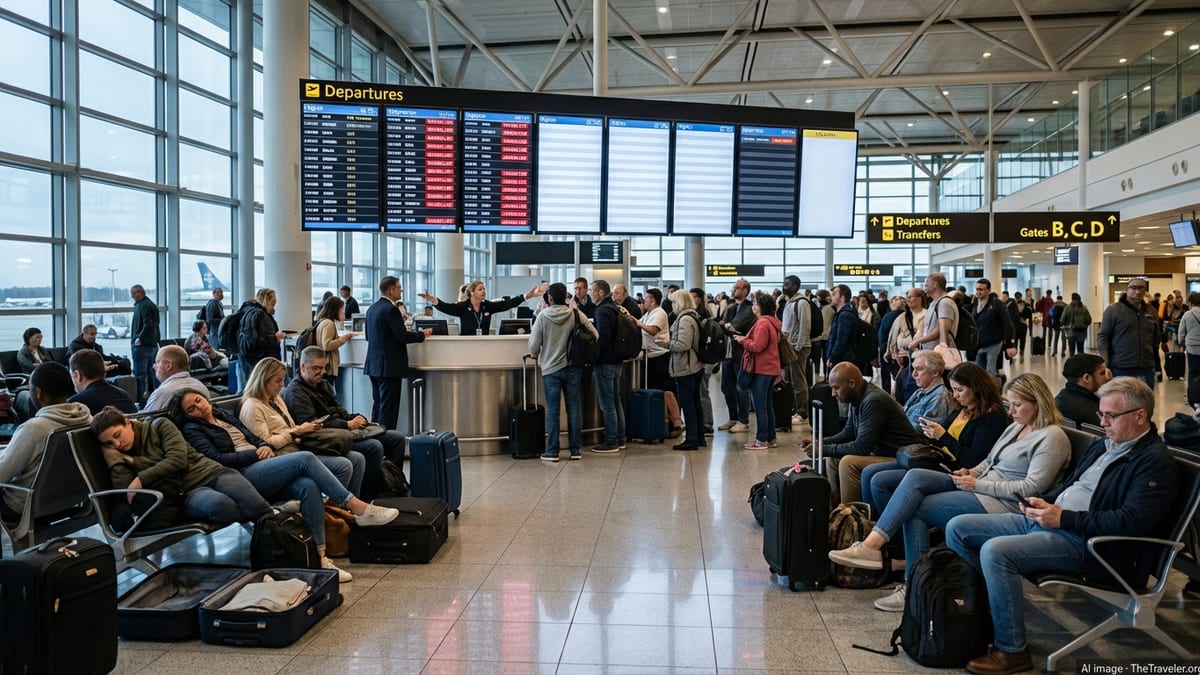
Beyond the Ukrainian delegation, the airspace closure disrupted regular passenger operations at Chisinau International Airport. Regional press accounts state that three outbound flights and four arrivals were delayed during the alert, temporarily stranding travelers and crew until the all-clear was given.
Chisinau has served as a key transit point for diplomatic and humanitarian traffic related to the war in neighboring Ukraine, and traffic flows have increased since 2022 as foreign delegations, aid organizations, and media teams move in and out of the region. The latest disruption underscores how quickly routine operations at the Moldovan capital’s airport can be affected by events along the nearby border.
Aviation observers note that while closures of this kind are disruptive, they reflect a conservative approach to risk when military drones or missiles are present anywhere near a flight corridor. Public information on the episode indicates that once authorities confirmed the drone had either crashed or exited Moldovan airspace, normal traffic gradually resumed.
For airlines and passengers, the incident serves as a reminder that regional itineraries remain vulnerable to abrupt security-related changes, including last-minute diversions, delays, or reroutings, especially for flights operating close to Ukrainian and Black Sea airspace.
Symbolic Backdrop: Zelensky’s Trip to Norway
The delayed departure occurred as Zelensky was traveling to Norway for a two-day visit on September 7 and 8, centered on the funeral of King Harald V and meetings with Norwegian leaders and defense industry representatives. According to published coverage, discussions in Oslo included European efforts to strengthen air and missile defense, including projects under the Freyja initiative.
The drone-related delay therefore unfolded against a symbolic backdrop of talks on how European states can better shield their territory and infrastructure from long-range aerial threats. Commentators in Ukrainian and European media have pointed to the incident as a real-time illustration of why such defense cooperation remains a priority for countries bordering or supporting Ukraine.
Norwegian and Ukrainian statements highlighted the strategic relevance of bolstering air defenses not only over Ukraine but also across NATO’s northern and eastern regions. The temporary grounding in Chisinau offered a tangible example of how conflict-driven drone activity can reverberate far beyond the immediate front lines.
For Moldova, which is not a member of NATO but maintains close ties with both the European Union and neighboring Romania, the event again underlined the importance of coordination with regional partners on air-surveillance and response mechanisms.
Growing Drone Activity Along Europe’s Eastern Frontier
Publicly available reporting from Moldova, Romania, and Ukraine shows that since Russia’s full-scale invasion of Ukraine in 2022, dozens of drones have crossed or fallen near their borders, sometimes causing damage or casualties on the territory of third countries. The latest incursion into Moldovan airspace fits within this broader pattern.
Experts cited across open sources note that Russia’s extensive use of one-way attack drones and reconnaissance platforms increases the probability of navigation errors, debris, or deliberate tests of regional air defenses spilling over into neighboring states. In response, those states are upgrading radar coverage, bolstering ground-based air defenses, and tightening civil-aviation procedures.
Travel and aviation analysts point out that airspace closures, reroutings, and heightened security checks have become part of the operational environment for carriers serving Eastern Europe. While major commercial routes are designed to avoid the highest-risk zones, the Moldovan incident shows how quickly conditions can change, even for government flights under close protection.
For travelers, the episode is a reminder that itineraries through the region may be subject to sudden disruption tied to military activity, even when flights themselves do not come under direct threat. Industry guidance increasingly encourages passengers to monitor airline alerts and local news closely when flying near active conflict areas.
Associated Press: Flight carrying Zelenskyy to Norway delayed in Moldova
European Pravda: Moldova comments on delay of Zelensky’s plane
India Today: Moldova airspace closure after drone incursion
Aviation24: Drone threat delays Zelenskyy’s flight from Chisinau
Radio Moldova: Russian drone disrupts air traffic in Moldova