


More news on this day
A new wave of air traffic control disruption across the United Kingdom has reignited frustration among passengers, as reports emerge of families left more than £1,000 out of pocket despite extensive delays, diversions and overnight stays triggered by system failures.
Get the latest news straight to your inbox!
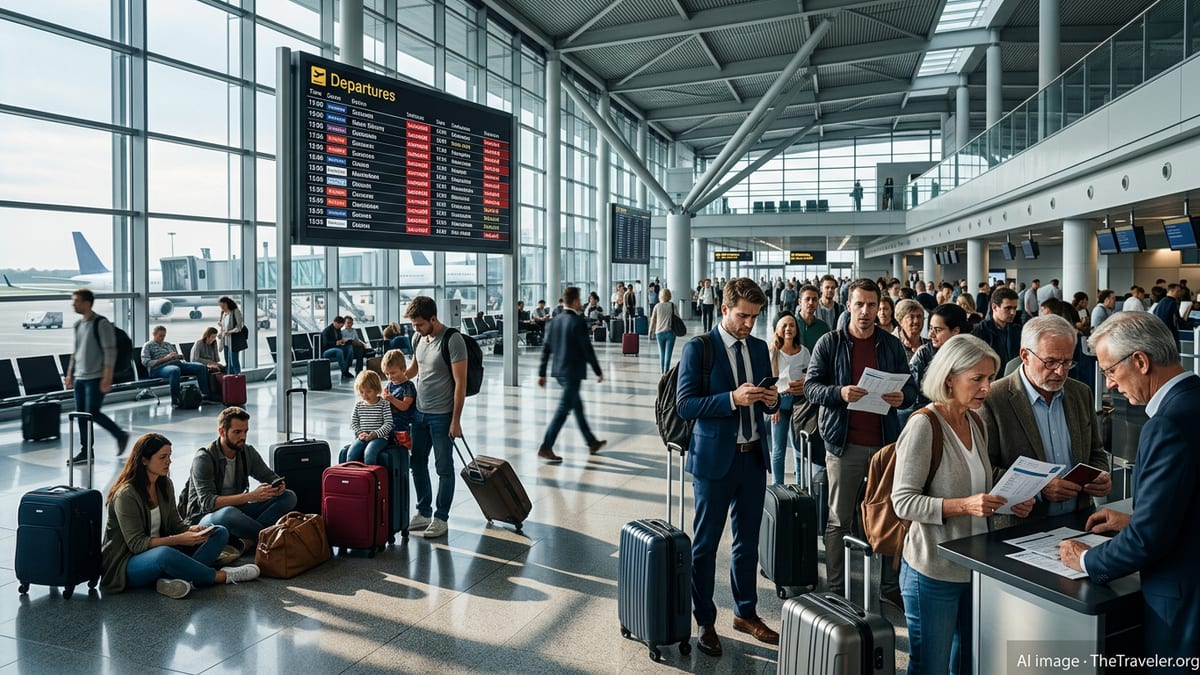
Technical failures trigger widespread air traffic disruption
Recent problems affecting the UK’s air traffic control infrastructure have led to the cancellation or severe delay of thousands of flights at major hubs including London Heathrow, Gatwick and other regional airports. According to flight-tracking data and published news coverage, more than 1,000 flights were canceled on the first day of the latest outage, with the knock-on impact carrying into subsequent days as airlines struggled to reposition aircraft and crew.
The disruption has drawn comparisons with the August 2023 failure of the National Air Traffic Services (NATS) flight planning system, when an independent review for the UK Civil Aviation Authority (CAA) later estimated that over 700,000 passengers were directly affected and that combined costs to airlines, airports and travelers likely ran to between £75 million and £100 million.
Industry groups have highlighted that even a short interruption to the central flight-data systems can trigger long-lasting operational challenges. Aircraft and crews going out of position, airport slots being missed and strict working-time limits for staff all contribute to multi-day backlogs, leaving passengers stranded far from their intended destinations.
With many travelers still making up trips postponed during the pandemic years and airports operating close to peak capacity, the timing of the latest outages has amplified their impact. Summer holidaymakers, school groups and business travelers have reported missed cruises, tours and events, with some forced to abandon travel plans altogether.
When air traffic chaos hits, who pays the bill?
The immediate financial shock of a sudden shutdown is usually borne by airlines, which must arrange care for stranded passengers. Publicly available guidance from the CAA and the UK government states that carriers are responsible for providing or reimbursing “right to care” assistance such as meals, refreshments, hotel accommodation where necessary, and transport between the airport and accommodation when flights are delayed or canceled.
In practice, however, many travelers report that they are initially told to arrange their own accommodation and onward travel, and then to claim costs back. The Aviation FAQs issued by the House of Commons Library underline that airlines often need to step in to buy tickets on rival carriers or arrange alternative routes, and that these obligations can continue until passengers reach their final destination.
Airlines and industry bodies have repeatedly argued that they shoulder an unfair share of the financial risk from failures outside their control. Previous parliamentary evidence and industry commentary indicate that the 2023 NATS outage alone may have forced airlines to absorb more than £100 million in refunds, rerouting costs and care for passengers, even though the underlying failure lay within the air traffic control system.
Air navigation service providers such as NATS operate under long-term licences and charge airlines for airspace management, but they are generally shielded from direct passenger compensation claims. Air transport associations have called for reform so that these providers contribute financially when system failures cause mass disruption.
Why many passengers receive no cash compensation
Despite the scale of recent disruption, many passengers are discovering that they are not entitled to fixed-sum compensation for delays or cancellations. Under UK passenger rights legislation, which is derived from retained EU Regulation 261, cash compensation is only payable where the delay is not caused by so-called extraordinary circumstances.
Guidance from the CAA and the UK government lists air traffic control failures and decisions as examples of events that are usually classified as extraordinary. In these situations airlines must still provide care and assistance, and must offer a choice between rerouting and a refund, but the additional lump-sum compensation of up to several hundred pounds per passenger is normally not due.
Consumer advice published by the CAA for recent air traffic incidents reiterates this distinction. Passengers impacted by the latest outage are encouraged to claim reasonable expenses, such as overnight accommodation or meals, but are warned that claims for statutory compensation are likely to be rejected if the airline can show that the primary cause was an external air traffic control failure.
This gap between reimbursable expenses and non-payable compensation is at the heart of many of the most painful individual losses. Families who have had to buy last-minute replacement tickets, pay for extra nights in hotels during peak season or book alternative transport at short notice report overall costs rising well above £1,000, only part of which may be recoverable from carriers.
Regulators and lawmakers weigh reform of passenger protections
The latest disruption has renewed attention on the findings of the independent review into the August 2023 NATS failure, which recommended strengthening consumer protections and considering additional powers for the CAA. The report highlighted that many passengers remained uncertain about their rights and that the complexity of current rules left room for disputes over what counted as reasonable care and assistance.
Government statements responding to that review signalled an intention to explore reforms that would provide air travellers with stronger protections. Proposals under discussion include mandating participation in alternative dispute resolution schemes for all airlines operating in the UK, clarifying the scope of extraordinary circumstances, and potentially shifting some financial responsibility for disruption away from airlines and towards infrastructure providers where appropriate.
Travel and consumer groups have also called for clearer communication at the time of disruption, including standardized notices at airports and via airline apps that spell out entitlement to meals, accommodation and refunds. Research carried out for the CAA after the 2023 outage suggested that many affected passengers were either unaware they could claim certain costs back or found the claims process difficult to navigate.
As the latest incident plays out, campaigners argue that any reform should not only address headline compensation rules but also simplify and speed up reimbursement for basic expenses. Some passengers affected by previous outages reported waiting several months for claims to be processed, adding financial stress to already disrupted journeys.
What delayed and stranded passengers can do now
For those caught up in the current round of air traffic chaos, regulators advise taking practical steps to protect their position while events unfold. Travelers are encouraged to keep all receipts for food, accommodation and alternative transport, to document delays with photographs or screenshots of airline messages, and to submit formal complaints via airline websites rather than relying solely on staff at the airport.
Guidance from the CAA and official travel advice resources stresses that passengers on UK or EU carriers, or departing from a UK airport, are covered by the UK’s passenger rights framework. This normally entitles them to a refund or rerouting in the event of a cancellation, as well as care and assistance while they wait. Different rules may apply to flights operated by non-UK or non-EU carriers on routes into the country.
Travel insurance can help to bridge some of the financial gaps where statutory compensation does not apply, particularly for consequential losses such as missed accommodation bookings or tours. Policy wording varies, but published consumer advice recommends contacting insurers promptly once disruption becomes clear, and checking whether missed departure, travel abandonment or schedule-change clauses can be invoked.
As inquiries continue into the root causes of the latest air traffic problems, the financial fallout for both airlines and passengers is still emerging. For many individual travellers, the critical question remains whether the system will evolve so that they are no longer left carrying four-figure bills every time a technical glitch brings UK airspace close to a standstill.
Sources: UK Civil Aviation Authority – independent review of August 2023 NATS failure; UK CAA – flight delays and cancellations guidance; UK government – Air passenger travel guide; Sky News – UK airports disruption coverage; Reuters – air traffic control issue disrupts flights at major UK airports