


More news on this day
U.S. air travelers faced another day of substantial disruption this week, with more than 984 flights delayed and at least 111 canceled nationwide as weather systems, congestion at major hubs and localized incidents converged to snarl early September schedules.
Get the latest news straight to your inbox!
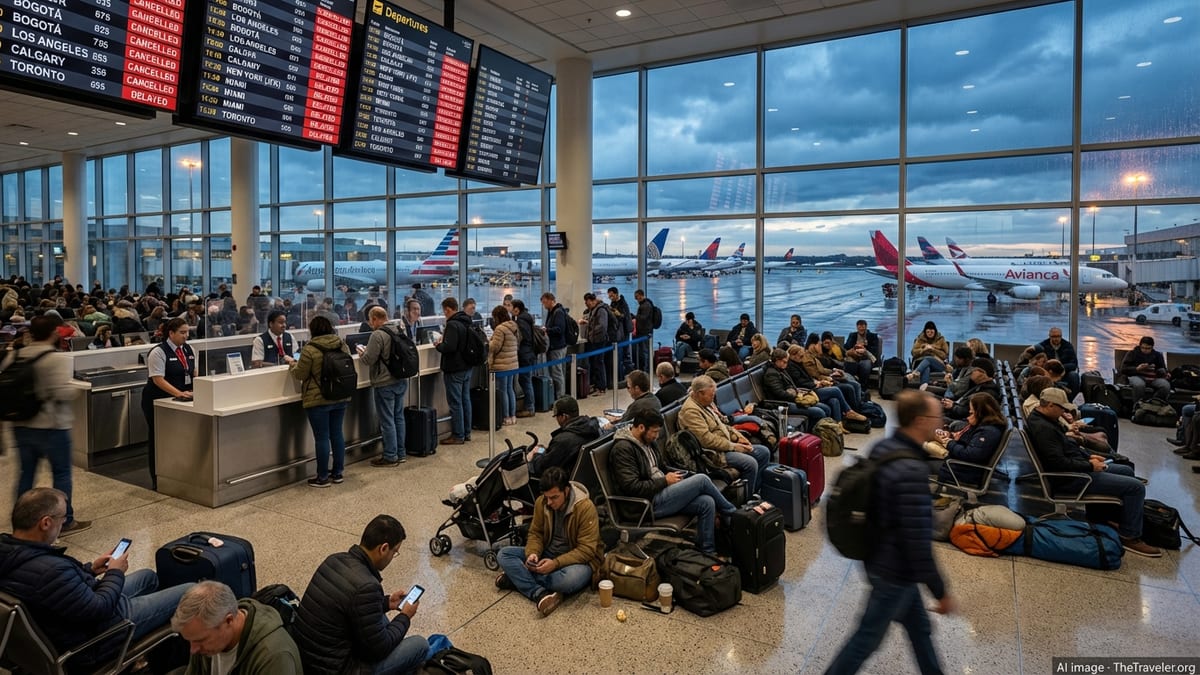
Early September flight disruptions ripple across major hubs
Real-time aviation tracking data for the first days of September indicate a sharp spike in late and canceled departures across the United States, with one recent tally citing more than 2,300 delays and nearly 150 cancellations over a two-day stretch. Disruption has been concentrated at some of the country’s busiest hubs, including New York, Boston, Chicago, Dallas Fort Worth, Los Angeles and several New England airports, where afternoon and evening peak periods have seen congestion build quickly.
Separate analyses of U.S. operations on individual days in early September describe hundreds of delayed flights and more than 100 cancellations nationwide, aligning with totals of roughly 900 to 1,100 affected departures and arrivals in a single day when storms and staffing constraints overlap. One assessment of a recent disruption wave cited close to 900 delays and around 200 cancellations within, into or out of U.S. airports, while another count put the total at nearly 900 delays and more than 120 cancellations, underscoring how quickly numbers escalate once major hubs slow down.
Traffic data compiled by passenger-rights platforms describe similar patterns. One report on early September disruptions highlights almost 900 delayed flights and about 200 cancellations across U.S. carriers in a single afternoon window, while another notes more than 1,000 combined delays and cancellations driven largely by thunderstorms, localized IT issues and crew-availability constraints at large connecting airports.
Industry-focused coverage stresses that even when the overall national cancellation rate remains below a few percent of scheduled flights, concentrated clusters of delays at big coastal and Midwest hubs can leave thousands of travelers stuck in terminals or missing connections. Once aircraft and crews fall out of position, late departures in one region can continue to ripple across the network through the evening.
Weather, congestion and local incidents combine to snarl schedules
Published coverage of the latest disruptions points to a familiar mix of causes: slow-moving thunderstorms across the Northeast and Midwest, airspace constraints near busy corridors, and ground delays as airports meter arrivals and departures for safety. In several recent cases, federal aviation advisories warned of potential delays or cancellations at airports in New York, Philadelphia, Washington, central and South Florida, Houston and New Orleans as convective storms formed along approach and departure paths.
Passenger-rights organizations report that severe late-summer thunderstorms can quickly force traffic managers to increase the spacing between aircraft, reducing runway capacity and triggering departure holds. One early September storm system affecting Boston, New York and Chicago was associated with more than 2,100 delays and over 300 cancellations across the affected hubs in a single day, according to one disruption summary, demonstrating how weather over a relatively small geographic area can have an outsized national impact.
Local incidents have added further strain. At Miami International Airport, for example, domestic arrivals and departures continued to experience knock-on disruption after an Amazon-operated cargo aircraft left the runway and crashed on a Sunday in early September. Flight-tracking data cited in local news coverage reported more than 120 delays and over 60 cancellations tied to follow-on operational constraints at the airport as investigators worked on site and some airfield capacity remained restricted.
These localized shocks layer on top of already tight schedules and staffing. Even when the immediate cause is weather or an isolated airport incident, publicly available federal data and independent analyses have repeatedly highlighted system-capacity limitations and late-arriving aircraft as recurring contributors to delay statistics, creating a fragile operating environment whenever conditions deteriorate.
Which airlines and airports have been hit hardest
Across the most recent disruption cycles, large network carriers and their primary hubs have featured prominently in delay tallies. Reports drawing on FlightAware data for individual days note that American Airlines has, at times, led U.S. carriers in delayed flights, while United Airlines has reported some of the highest single-day cancellation counts. JetBlue has also appeared among the most affected airlines in certain storm periods, reflecting its dense schedules at weather-sensitive East Coast airports.
Airport-level statistics paint a similar picture. On one recent disruptive day, Newark Liberty International Airport recorded more than 50 delays and 20 cancellations, while New York’s John F. Kennedy International Airport and LaGuardia Airport reported dozens of late departures and a high number of cancellations as thunderstorms moved through the region. Other analyses highlight serious congestion at Boston Logan and Chicago O’Hare, which together with the New York metro airports form a corridor where weather-driven ground stops can quickly influence flights across the country.
Farther south, Miami International’s operational challenges after the cargo incident led to triple-digit delay counts and several dozen cancellations in a single morning, affecting both inbound and outbound passengers. In the central United States, storm-related disruptions at Chicago and Florida airports on another early September day were associated with nearly 7,000 delays and close to 300 cancellations, according to one passenger-rights briefing, again underscoring how regional weather events can cascade through national schedules.
Even when some airports report relatively normal operations over a given 24-hour window, the interconnected nature of airline networks means that an aircraft delayed at one hub may arrive late at another, pushing subsequent departures behind schedule. As a result, travelers flying from airports with no local weather issues can still be caught in multi-hour waits or miss onward connections.
What passengers can do if their flight is affected
Consumer advocates and airline guidance converge on several practical steps for travelers facing delays or cancellations. Publicly available advice emphasizes starting with the airline’s mobile app or website, where same-day rebooking options often appear before they are made widely available at airport counters. Enabling push notifications can provide earlier warning of schedule changes, which is particularly useful when weather systems are moving through multiple hubs.
Travel analysis sites recommend that passengers monitor real-time flight status dashboards and airport delay maps offered by the Federal Aviation Administration and major flight-tracking platforms. These tools can help travelers understand whether a disruption is likely to be short-lived or part of a broader pattern of holds and cancellations, informing decisions about rebooking, connecting times or even choosing a different route.
For those facing long delays or overnight disruptions, passenger-rights organizations suggest documenting the timing and stated reasons for delays, keeping receipts for meals or accommodation, and reviewing both airline contracts of carriage and applicable consumer-protection rules. In some cases, particularly for flights touching regions covered by European regulations, travelers may have options to claim compensation in addition to refunds or rebooking.
Experts also note that when severe weather is forecast at key hubs, booking earlier departures in the day can reduce the risk of being affected by rolling delays that build up by afternoon. Allowing additional connection time, especially at airports with a history of congestion during storm seasons, can provide extra margin when operations begin to slow.
Disruptions highlight ongoing fragility in U.S. air travel
The latest wave of more than 984 delayed flights and more than 100 cancellations underscores how sensitive the U.S. air travel system remains to overlapping pressures. While federal statistics show that overall cancellation rates have, at times, been held near or below 2 percent of scheduled operations in recent months, large numbers of passengers can still be affected on days when storms, staffing gaps and unexpected incidents converge.
Policy documents and oversight reports from the U.S. Department of Transportation describe a system in which late-arriving aircraft, air-carrier-related factors and capacity constraints continue to play a substantial role in delay metrics, even as airlines adjust schedules and add buffer time. These structural issues mean that when a corridor such as the Northeast or upper Midwest is hit by severe weather, the resulting ground stops and reroutes can push banks of flights at multiple hubs behind schedule.
For travelers, the pattern translates into an uneven experience. Many days pass with relatively smooth operations, while others, like the early September disruption period, bring widespread delays and cancellations that can affect thousands of itineraries even if only a modest share of total flights is canceled. Analysts note that, heading into the rest of the shoulder season and toward the winter holidays, the combination of volatile weather and tight airline staffing will likely keep the system vulnerable to similar nationwide ripple effects.
Yahoo News: Over 896 flights delayed, 200 canceled amid widespread U.S. travel disruptions
Yahoo / SILive.com: Over 899 flights delayed, 126 canceled amid widespread U.S. travel disruptions
AirHelp: 1,096 U.S. flight delays and cancellations disruption overview
AirHelp: Storm disruptions affecting Boston, New York and Chicago
Local10: Delays, cancellations continue at Miami International Airport