


Few travel dilemmas feel as luxurious as choosing between Saint-Tropez and Cannes. Both are legendary names on the French Riviera, both promise sunshine, superyachts, and rosé by the sea, and both can deliver a holiday you talk about for years. Yet on the ground they feel very different. One is a former fishing village turned social playground, the other a compact city polished by the Cannes Film Festival and year-round events. Knowing which one leaves a bigger impression depends less on prestige and more on what you actually want your days and nights to look like.
Get the latest updates straight to your inbox!
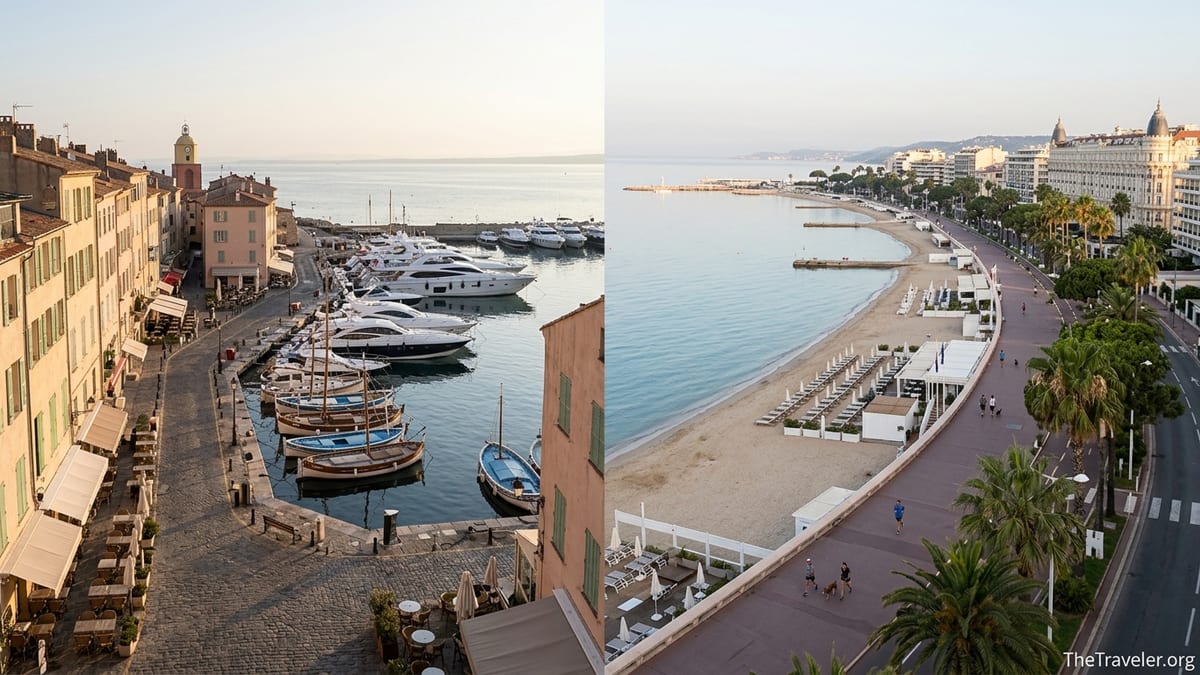
First Impressions: Village Glamour vs Festival City
Arriving in Saint-Tropez, the first surprise is its size. For all the mythology, the old town is still a small Provençal village spiraling up from the harbor, with lanes barely wide enough for a scooter, pastel facades, and laundry strung above cobblestones. The main port, however, feels like an open-air theater of wealth: mega-yachts stern-to, deck crews polishing stainless steel, and visitors strolling along the quay with ice cream or an evening pastis. It is intimate, almost like a movie set, but the energy in high season can be intense and very social.
Cannes, by contrast, immediately reads as a small city. La Croisette, its famous seafront boulevard, is lined with grand hotels, designer boutiques, and private beach clubs that spill onto the sand. The Palais des Festivals, home of the Cannes Film Festival, anchors one end, and even outside festival week you will often see red-carpet infrastructure and event signage. Behind the seafront, Cannes quickly becomes practical: apartment blocks, supermarkets, neighborhood brasseries, and residential streets. It feels lived-in and functional in a way Saint-Tropez does not, which many travelers find reassuring for a longer stay.
If you imagine your Riviera base as a glamorous village where the party comes to you, Saint-Tropez makes a strong first impression. If you prefer a compact, walkable city with a clear center, transport links, and easy services, Cannes is more likely to feel like the right scale.
Season also shapes those first impressions. Between late June and late August, Saint-Tropez’s harbor becomes a private world of reservations, guest lists, and traffic jams along the peninsula roads, while Cannes feels busy but more evenly paced thanks to a year-round events calendar and its larger hotel inventory that spreads visitors out.
Beaches and Beach Clubs: Pampelonne vs La Croisette
On paper, both destinations are about sun and sea, but their beach experiences diverge fast. Saint-Tropez’s headline stretch is Pampelonne Beach, roughly a 5-kilometer curve of pale sand east of the village, technically in the commune of Ramatuelle. Sections are divided between public areas and private beach clubs that rent loungers, serve long lunches, and often morph into afternoon parties. Iconic names like Club 55, Bagatelle, Verde, Shellona, and Jardin Tropezina have become destinations in their own right, where booking a pair of sunbeds in high season can run to several hundred euros for the day once food and drinks are included.
The upside is the natural setting. Pampelonne is wide and mostly sandy underfoot, with clear, shallow water and a sense of space that is hard to find closer to the big coastal cities. A practical example: a couple booking standard sunbeds at a mid-range Pampelonne club in July might expect to pay a moderate fee per bed, plus a similar amount for a simple lunch like grilled fish, salad, and a bottle of local rosé. Flagship clubs and front-row beds will be significantly more. For many visitors, the memory is not the bill but the feeling of lingering over lunch as the DJ slowly raises the tempo and the entire beach seems to stand up and dance.
Cannes beaches feel more urban. Along La Croisette, most of the sand is technically controlled by hotels and independent beach clubs that rent sunbeds by the half or full day. There are smaller public sections, but they fill quickly in July and August. The sand is groomed and pleasant, the water calm, and service efficient. Pricing is still premium, but in general sunbed rentals on La Croisette trend slightly lower than at the most famous Pampelonne clubs, especially outside festival periods and peak summer weekends. Many visitors choose a midrange club, pay for a pair of loungers and an umbrella, and treat it like a city beach day with waiter service.
Beyond the main strips, both destinations offer quieter alternatives. Around Saint-Tropez, smaller in-town beaches like La Ponche or Les Graniers appeal to travelers who want to swim without committing to a club scene, while the coastal path around the peninsula reveals coves that feel surprisingly wild given the celebrity status of the area. Near Cannes, public beaches toward Cannes La Bocca or on the nearby Île Sainte-Marguerite offer simpler, less curated days by the sea. If your idea of a big impression is a cinematic beach club scene, Saint-Tropez has the edge. If you want easy-to-access sand steps from your hotel lobby, Cannes is hard to beat.
Nightlife and Atmosphere After Dark
Both towns know how to stay up late, but their after-dark personalities are quite distinct. Saint-Tropez is the more concentrated and intense experience. Evenings typically begin with an aperitif around the harbor or on Place des Lices, the leafy square that hosts the famous Provençal market in the morning and pétanque games at dusk. Later, attention shifts either back to the beach clubs, which often host dinners with DJs and dancing, or to nightclubs in and around the center. Names like Les Caves du Roy, with its vintage disco-glam interior and champagne-fueled dance floor, have become part of the Saint-Tropez legend.
Because the village is small, nightlife energy can feel amplified. In July and early August, tables at popular restaurants are often booked weeks in advance, and nightclubs quickly become a tight social circuit of regulars, seasonal staff, and visitors. Dress codes skew glamorous, and it is common to see groups arrive by tender from nearby yachts. Travelers who thrive on high-energy, late-night scenes often describe their first Tropezian summer as unforgettable, while quieter visitors may feel overwhelmed or out of place, especially when menu prices and bottle service start to add up.
Cannes offers a broader spread of evening options, from relaxed to refined to full-on party. Along La Croisette and the streets behind it, you will find hotel bars with terrace seating, wine bars in side streets, casual bistros, live music venues, and a handful of nightclubs. During the Cannes Film Festival in May and other major events, pop-up bars and invite-only parties create a temporary layer of exclusivity, but outside those windows the scene is more accessible. It is entirely possible in Cannes to have an early dinner at a neighborhood restaurant, stroll along the seafront with a gelato, and be back at your hotel by 11, or to push on to late-night bars without feeling you are crashing someone else’s yacht party.
For travelers weighing which town will “wow” them after dark, the distinction is clear. If you want your trip defined by marquee nights, high-octane clubs, and waterfront table culture, Saint-Tropez will likely leave a stronger impression. If you prefer variety and the option to dial nightlife up or down from one night to the next, Cannes provides more flexibility.
Where Your Money Goes: Prices, Hotels, and Value
Both Saint-Tropez and Cannes are expensive by French standards, and prices fluctuate widely depending on dates and events. Still, patterns emerge. Saint-Tropez has fewer hotel rooms overall, and a large share of its inventory sits firmly in the luxury or ultra-luxury category, from historic addresses in the village itself to sprawling palace-style properties in the surrounding hills with private shuttles to their beach clubs. In peak months, even modest-looking rooms can command premium rates simply because demand so far outstrips supply.
For a concrete sense of how this feels, imagine traveling in late July. A stylish but not overly famous five-star hotel in or near Saint-Tropez might easily quote four-figure nightly rates for an entry-level room, especially over weekends, while small boutique hotels and guesthouses can sell out months ahead. Villas are a major part of the lodging market here, often aimed at groups or families who arrive for a week or more with private staff and drivers. Day-to-day spending also tends to creep up: cocktails at beach clubs, late-night taxis along dark peninsula roads, and impulse boutique purchases all come at Riviera prices.
Cannes has a broader range of accommodation and therefore more price layering. Top-end seafront hotels on La Croisette can rival or surpass Saint-Tropez rates during the festival and prime summer weeks, but the city also offers midrange and even relatively budget-friendly hotels a few blocks inland. Travelers willing to stay in the back streets behind the station or toward Cannes La Bocca can often find per-night rates noticeably lower than anything within walking distance of the Saint-Tropez harbor in the same period. Self-catering apartments are common and appeal to longer-stay guests who want to cook some meals at home.
When it comes to food and drink, both towns reward careful planning. In Saint-Tropez, a casual breakfast at a harbor café, a beach club lunch, and a proper dinner can quietly add up. Many repeat visitors balance splurge days with simpler meals at village bistros or takeaway from bakeries and rotisseries. In Cannes, visitors might splurge at a Croisette restaurant one night, then choose a fixed-price menu at a neighborhood brasserie the next. Overall, Cannes is more forgiving to different budgets, while Saint-Tropez leans toward travelers prepared for consistently high outlay. If your idea of a big impression is feeling you have entered a money-no-object world, Saint-Tropez supplies it. If impact comes from getting a Riviera experience without constantly wincing at the bill, Cannes is easier on the nerves.
Access, Logistics, and How Easy Each Place Feels
Logistics are where Cannes often decisively wins, especially for first-time visitors. The city sits directly on the main coastal rail line, with frequent trains linking it to Nice, Antibes, and even Italy in one direction, and Saint-Raphaël, Toulon, and Marseille in the other. Nice Côte d’Azur Airport is a straightforward transfer away by private car, taxi, or express bus, with travel times that can be under an hour outside traffic peaks. Once in town, most key areas are walkable, from the station to La Croisette, the old quarter of Le Suquet, and the harbor.
Reaching Saint-Tropez is more of an undertaking. There is no train station in town, and the nearest rail hubs are at Saint-Raphaël or Les Arcs, followed by a bus, taxi, or private transfer. In summer, road access along the peninsula regularly clogs with traffic, turning relatively short distances into long, slow crawls. Many visitors sidestep this by arriving by boat, either on scheduled ferries from nearby coastal towns or by private charter. While scenic, these options introduce their own constraints in terms of schedules, sea conditions, and luggage capacity. Once in Saint-Tropez, walking is easy within the village, but getting to Pampelonne without a car means relying on shuttles, taxis, or hotel transfers.
For day trips, Cannes again has the advantage. You can hop on a ferry to the Lérins Islands for a change of scenery, take a quick train to Antibes for its ramparts and Picasso Museum, or continue to Nice for an evening on the Promenade des Anglais. Organized excursions to Monaco and inland hilltop villages are common. From Saint-Tropez, nearby options such as Ramatuelle, Gassin, and the broader Gulf of Saint-Tropez are beautiful but require more planning, especially if you prefer not to drive narrow inland roads or hunt for parking in high season.
This difference in ease directly influences which town leaves a bigger impression. A stay in Cannes often feels smooth and connected, with spontaneous day trips and relatively predictable transfers. A stay in Saint-Tropez can feel like entering a more removed, curated bubble. For some, that isolation is precisely the point. For others, especially on short trips, the extra friction can make Cannes the more satisfying choice.
Culture, Character, and Who Each Destination Suits Best
Beyond beaches and nightlife, both places offer more nuanced cultural experiences, though they present them differently. Saint-Tropez has a long-standing artistic pedigree, from post-war painters to the Brigitte Bardot era that helped mythologize the town. Visitors today can climb to the Citadel museum for views over the Gulf of Saint-Tropez and exhibits on the town’s maritime history, wander through small galleries tucked into side streets, or time their visit with events such as yacht regattas that turn the harbor into a forest of masts. Local markets at Place des Lices give a taste of Provençal life, from olives and cheeses to linen dresses and straw baskets.
Cannes’s cultural identity is anchored in film and events. The city hosts an array of festivals and congresses year-round, which means that on any given week there may be a television festival, a property fair, or a music event bringing in visitors from around the world. The old quarter of Le Suquet offers a reminder of the town’s fishing-village roots, with narrow lanes leading up to a church and castle overlooking the bay. There are also modest museums, public art installations, and classical concerts, although most casual visitors experience Cannes culture more through cinemas, festival-related exhibits, and open-air performances along the waterfront.
In terms of traveler profiles, broad patterns emerge. Saint-Tropez tends to suit visitors who prioritize atmosphere over efficiency: fashion-conscious couples, groups of friends planning specific beach club days, yacht owners and charter guests, and repeat travelers who know the local rhythm and book well in advance. It can also work for families, especially those staying in villa-style properties with pools, but parents should be realistic about crowds, prices, and the strong emphasis on nightlife in peak season.
Cannes, with its better infrastructure and range of hotels, often appeals to conference attendees extending work trips, couples who want a mix of beach and day trips, and families seeking a straightforward base with supermarkets, pharmacies, and playgrounds within walking distance. It is entirely possible to have a low-key Riviera week in Cannes built around sandy mornings, gelato afternoons, and strolls to casual restaurants, something that can be harder to engineer in Saint-Tropez at the height of summer without serious planning.
The Takeaway
When travelers ask which destination “wins” between Saint-Tropez and Cannes, the honest answer is that they are built to impress in different ways. Saint-Tropez is the more concentrated fantasy: a small port wrapped in myth, where days flow from beach club to boutique to harbor bar to nightclub, and where the very inconvenience of getting there signals that you have crossed into a specific social world. The impression it leaves is visceral and often expensive, defined by specific moments: a late lunch at a famous beach club, the view from the Citadel at sunset, or a midnight walk along the harbor past yachts lit up like floating villas.
Cannes leaves its mark more through ease and breadth. It is a place where you can land, settle into a seafront or backstreet hotel, walk almost everywhere you need to go, and improvise a blend of beach time, short excursions, and unpretentious meals. The glamour is there in the form of grand hotels and red carpets, but it does not dominate every moment. For many travelers, especially on a first French Riviera trip or with limited time, that balance between prestige and practicality makes Cannes the destination they end up recommending to friends.
If your priority is high-energy nightlife, iconic beach clubs, and the feeling of stepping into a rarefied summer bubble, Saint-Tropez is likely to leave the bigger impression. If you want a base that combines Riviera atmosphere with realistic logistics, a range of price points, and the freedom to explore without a car, Cannes may quietly win your heart. The most rewarding strategy, budget and time permitting, is to experience both: a few days based in Cannes, with a carefully planned day or overnight in Saint-Tropez to taste its particular magic, then decide which world you want to return to next time.
FAQ
Q1: Which is better for a first-time French Riviera trip, Saint-Tropez or Cannes?
Cannes is usually more practical for a first visit thanks to its train connections, easier airport transfers, and wider range of hotels. You get a classic Riviera feel without needing a car or complex logistics, and you can still sample neighboring towns on day trips. Saint-Tropez is a fantastic experience, but its remoteness and higher costs make it better suited to travelers who are comfortable with more planning.
Q2: Is Saint-Tropez really that much more expensive than Cannes?
Both are pricey in peak season, but Saint-Tropez often feels more expensive day-to-day because of its smaller hotel stock and heavy focus on high-end beach clubs and nightlife. In Cannes you can still splurge on a Croisette hotel or fancy dinner, yet there are more midrange hotels and casual restaurants a few streets back from the seafront, which makes it easier to control your budget.
Q3: Can I visit Saint-Tropez as a day trip from Cannes?
Yes, many travelers base in Cannes and do a day trip to Saint-Tropez by boat or a combination of train and ferry. In summer, ferries are popular because they avoid road traffic and offer scenic views of the coast. A typical day might involve a morning departure, lunch at a harbor or beach club, a few hours exploring the village, and a return in the evening. Just be sure to book ahead in high season and keep an eye on last boat times.
Q4: Which destination has better beaches?
If “better” means wide, soft sand in a more natural setting, Pampelonne Beach near Saint-Tropez generally wins. It offers long stretches of sand, clear water, and a mix of public areas and private clubs. Cannes beaches are attractive and convenient, especially along La Croisette, but they are more urban and mostly divided into smaller sections operated by hotels and beach clubs. For travelers who value easy access over wild scenery, Cannes still works very well.
Q5: Is either town suitable for families with children?
Both can work for families, but Cannes is often the easier choice. You can walk from family-friendly hotels to the beach, find playgrounds and casual restaurants nearby, and take short train rides to other towns for variety. Saint-Tropez can be enjoyable with children, particularly if you choose a villa or hotel with a pool and plan quieter beach days, but the emphasis on nightlife and the logistics of reaching Pampelonne make it a bit more complicated.
Q6: How far in advance should I book for summer?
For July and August, it is wise to book accommodation several months in advance in both destinations, especially in Saint-Tropez, where the best-located hotels and villas fill up quickly. Beach clubs in Saint-Tropez often open reservations weeks ahead for prime dates, and popular restaurants in both towns appreciate advance bookings for weekend evenings. Outside peak season, you can be more spontaneous, particularly in Cannes.
Q7: Do I need a car in Saint-Tropez or Cannes?
In Cannes you can comfortably manage without a car, using trains, buses, and boats for most outings. In Saint-Tropez, a car offers more flexibility for reaching Pampelonne and exploring nearby villages, but it also brings parking challenges and summer traffic. Many visitors there rely instead on hotel shuttles, taxis, and scheduled boats, especially if they plan to enjoy nightlife and prefer not to drive.
Q8: Which is better outside the peak summer months?
Cannes has a more consistent year-round rhythm thanks to its events calendar and local population. Spring and autumn bring milder weather, fewer crowds, and often better hotel value while restaurants and shops remain open. Saint-Tropez can feel magical in late spring and early autumn, when the light is softer and the crowds thinner, but some beach clubs and seasonal venues operate on shorter schedules, so it is worth checking opening dates.
Q9: Is Cannes only interesting during the Film Festival?
No, although the Film Festival in May gives Cannes its global profile, the city hosts many other events and can be enjoyable even when nothing major is happening. Visitors come for the beaches, island excursions, shopping, and easy day trips. In fact, many leisure travelers prefer to avoid the festival period because hotel prices and crowds spike, and the atmosphere becomes more about industry business than holiday relaxation.
Q10: If I can only choose one, which destination leaves the bigger impression?
It depends on what impresses you most. If you are drawn to high-energy beach clubs, yacht culture, and the feeling of stepping into a secluded summer playground, Saint-Tropez usually feels more intense and memorable. If you value a mix of glamour and everyday life, with easier logistics and the freedom to explore without stress, Cannes may quietly become the place you remember most fondly. Matching the destination to your travel style is the surest way to leave with the right kind of impression.