


More news on this day
Passengers at San Antonio International Airport endured hours of delays and uncertainty after a nationwide Federal Aviation Administration ground stop halted departures, turning a routine travel day into an extended wait in terminals and on parked aircraft.
Get the latest news straight to your inbox!
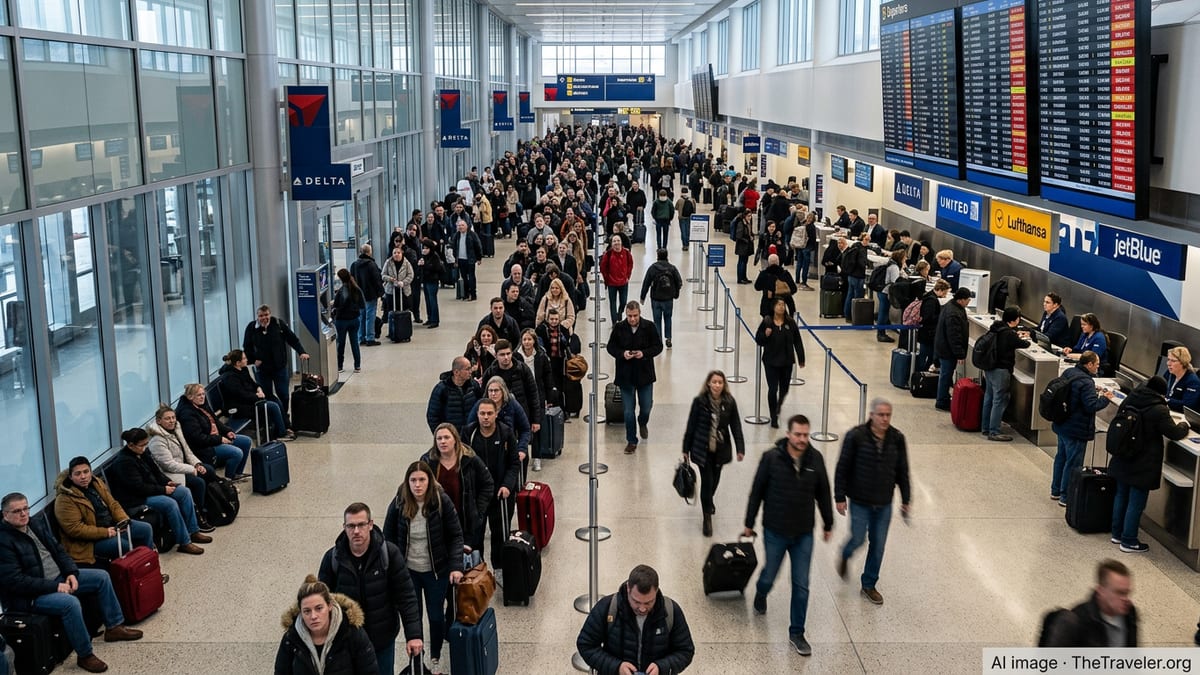
Nationwide order leaves San Antonio travelers in limbo
The Federal Aviation Administration ordered a rare nationwide ground stop after communication problems affected multiple air traffic control centers, pausing most U.S. departures for several hours. Publicly available information describes it as only the second sweeping halt to domestic flights since the Sept. 11, 2001 attacks, following an earlier pause tied to a Notice to Air Missions system failure in January 2023.
At San Antonio International Airport, the impact was immediate. Local coverage and airport advisories describe departure boards filling with red "delayed" and "canceled" notices while inbound flights already in the air were allowed to land. Travelers arriving at the terminal encountered dense security lines and crowded gate areas as airlines worked through the cascading schedule changes.
Airport social media feeds and public guidance urged passengers not to assume flights would depart on time, recommending that travelers verify status with their airline before leaving home. Those already at the airport were frequently directed to airline counters and mobile apps, as carriers rebuilt schedules once the FAA began gradually lifting restrictions.
Although the ground stop itself lasted only a portion of the morning peak, the disruption continued into the afternoon at San Antonio. Published reports from the 2023 outage show that delays there extended well after departures formally resumed, with some travelers waiting several extra hours for rebooked flights as aircraft and crews cycled back into position.
Scenes inside the terminal: lines, rebookings and uncertainty
Local news photographs from San Antonio document passengers queuing at ticket counters and self-service kiosks, phones in hand, as they searched for alternative flights. In some cases, travelers who had cleared security returned landside to speak with airline staff after learning of the halt from overhead announcements or smartphone alerts rather than from official briefings at the gate.
Check-in areas became early pressure points. Airlines needed to suspend many bag drops while system updates processed, leading to clusters of luggage and passengers around roped-off zones. Those with early-morning departures often learned that tight connections in Dallas, Houston, Denver or Atlanta were no longer viable, requiring full itinerary rewrites.
Once the FAA allowed departures to resume in stages, airport operations in San Antonio shifted to managing the backlog. Aircraft that had waited at gates for the national decision competed for limited departure slots, and crews approaching duty-time limits forced some flights to cancel even after the formal ground stop ended. Publicly available flight-tracking and airline data showed a pronounced spike in delays from mid-morning into early afternoon.
Travelers with flexible plans, including some leisure passengers highlighted in local coverage, chose to abandon same-day trips rather than navigate uncertain standby lists. Others accepted multi-stop routings or overnight stays to preserve onward international connections from larger hubs.
How San Antonio fits into a national disruption
San Antonio International is a medium-size facility with just two runways and a schedule built largely around connections through other U.S. hubs. That structure made the airport especially vulnerable to a network-wide halt. When the FAA pauses departures nationally, downline airports may reopen in phases, but connecting banks at major hubs can remain oversubscribed for hours.
During the 2023 ground stop linked to the federal NOTAM outage, flight operations across the country saw thousands of cancellations and delays. Contemporary accounts show San Antonio listed among airports advising passengers to contact airlines before traveling, reflecting how even airports far from the most congested hubs experienced significant knock-on effects.
Analyses by aviation groups and government researchers released after earlier disruptions note that airports of San Antonio’s scale tend to recover more slowly when they lack spare gates or additional late-night operating windows. Crews and aircraft are often tightly scheduled, so a multi-hour national pause can force widespread re-crewing and aircraft repositioning that continues into the following day.
In this latest event, the same dynamics were visible. Airlines serving San Antonio restructured schedules to prioritize previously stranded passengers and essential connections, leading to additional same-day cancellations of lower-demand flights so that aircraft could be redeployed on routes with heavy disruption.
Spotlight on aging aviation systems and modernization efforts
The nationwide grounding directed new attention to the technology behind U.S. air traffic control. Public reports on recent incidents, including the 2023 NOTAM outage and more recent communication failures near major hubs, describe a patchwork of aging systems that depend on legacy hardware and software.
Technical assessments published over the past year outline the FAA’s plan to introduce an Enterprise Information Display System at hundreds of facilities, replacing older data sources that in some cases still rely on removable media. The agency has set a goal of completing this modernization by the end of 2028, beginning with early deployments at airports such as Atlantic City, Nashville and Rochester, as well as regional data centers.
For travelers in San Antonio, these long-range efforts translate into an ongoing period of vulnerability in which rare but high-impact failures can still ripple through the national network. The fact that the latest halt followed earlier nationwide and regional outages has fueled broader discussion in aviation policy circles about funding, contractor oversight and the pace of technology upgrades.
Passenger advocates and aviation analysts, drawing on previous disruption data, emphasize that such failures consistently produce similar scenes: crowded concourses, long lines at customer service desks and frustration over communication gaps. The experience in San Antonio mirrored that pattern, underscoring how local passengers bear the immediate brunt of systemic problems far beyond their home airport.
What affected passengers can do next time
Although nationwide ground stops remain rare, the situation at San Antonio illustrates practical steps travelers can take. Public consumer guidance from the U.S. Department of Transportation notes that when a flight is canceled for any reason and a passenger chooses not to travel, airlines are generally required to provide a refund for the unused portion of the ticket, even for nonrefundable fares. Separate rules apply to delays, where policies vary by carrier and are described in each airline’s contract of carriage.
Travel advocates recommend checking flight status repeatedly in the 24 hours before departure, using both airline apps and airport information displays. In disruptions on the scale of a nationwide ground stop, rebooking options can disappear quickly. Passengers in San Antonio during previous outages who acted early were more likely to secure same-day alternatives or confirmed space on the first flights out after operations resumed.
Another lesson from the recent disruption is the importance of building extra time into itineraries that depend on tight connections at larger hubs. With limited spare capacity and increasingly full flights, a pause of even 90 minutes can topple plans that rely on minimum-connection-time links, particularly for international departures from coastal gateways.
For San Antonio-based travelers, the latest FAA ground stop served as a reminder that local conditions can change rapidly when national systems falter. While modernization projects aim to reduce the risk of similar events, airport scenes from the disruption show that individual preparation and awareness still play a significant role in how severely passengers feel the impact.