


More news on this day
Thousands of passengers across the United States faced cascading delays and cancellations after a rare nationwide ground stop ordered by the Federal Aviation Administration on November 13 abruptly halted most departing flights and upended travel plans heading into the weekend.
Get the latest news straight to your inbox!
A Rare Nationwide Halt Across the U.S. Air Network
The November 13 directive paused nearly all departures from U.S. airports after what federal aviation authorities described in public statements as a communications problem affecting multiple Air Route Traffic Control Centers. According to published coverage, the nationwide order followed earlier restrictions around Chicago O’Hare and Midway, where traffic management officials first began slowing and then stopping departures as the outage spread.
Publicly available information indicates that departures gradually resumed later in the day once systems were stabilized, but the backlog of delayed flights extended into the evening and into November 14 at some airports. Carriers’ online trackers showed waves of secondary delays as planes, crews and airport gates fell out of position, creating knock-on effects even after the formal stop was lifted.
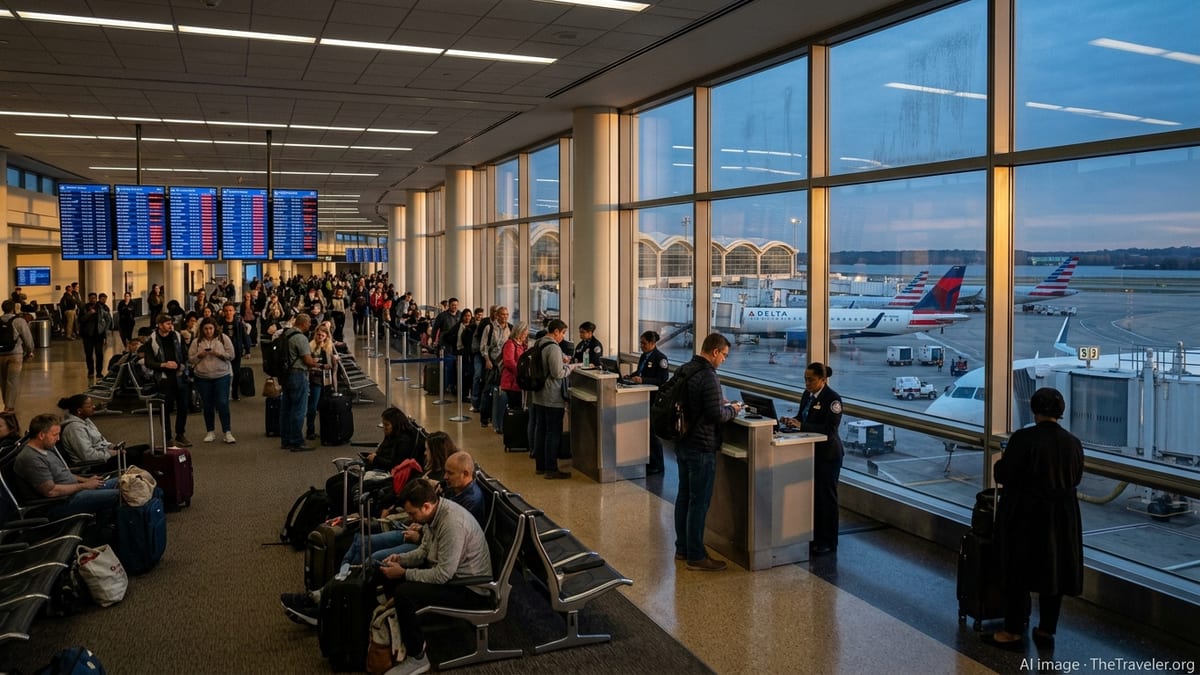
Reports from major hubs including Atlanta, Chicago, Dallas-Fort Worth, Los Angeles and New York described crowded concourses, long customer-service lines and departure boards dominated by red and yellow delay markers. At some airports, local media noted that arriving aircraft were held on taxiways because gates were occupied by planes that had not been able to depart on time, adding to passenger frustration inside cabins.
Industry and policy analysts quoted in national and regional coverage emphasized the rarity of a systemwide halt. Published accounts note that this was the first nationwide ground stop since January 2023, when a failure in the NOTAM safety-notice system paused departures, and only the second such disruption since the immediate aftermath of the September 11, 2001 attacks.
Disrupted Journeys and Strained Airport Operations
For travelers already on the move, the ground stop created a patchwork of experiences that depended heavily on where in the journey they were caught. Passengers who had cleared security but not yet boarded often found themselves clustered around gate podiums, watching departure times slide in 10- and 30-minute increments as airlines awaited clearance to push back and join departure queues.
At airports such as Los Angeles International, Chicago O’Hare and Boston Logan, regional reports describe aircraft waiting on ramps and taxiways because no gates were available, leaving passengers seated on planes as crews awaited instructions. In some cases, flights that had been scheduled to depart during the window of the ground stop were subsequently pushed back several hours or canceled entirely when it became clear that aircraft and crew duty-time limits would be exceeded.
Airport operators used public address systems and social media feeds to urge travelers to stay in contact with their airlines and to expect longer waits at concessions, restrooms and baggage carousels. Some airport authorities reported bringing in additional staff to manage crowds at security checkpoints and to answer questions from confused passengers trying to understand whether their flights would operate at all that day.
For those with onward connections through busy hubs, the uncertainty was particularly acute. Reports highlight that travelers bound for international departures or last flights of the evening often faced involuntary overnight stays when inbound segments arrived too late to make scheduled connections, leaving them dependent on limited hotel availability near major hubs.
Rebooking, Refunds and What Travelers Can Expect
The nationwide ground stop placed both airlines and passengers within an evolving regulatory and contractual framework. According to publicly available consumer guidance from the U.S. Department of Transportation, carriers are generally not required under federal law to provide hotel vouchers or meal compensation when disruptions are caused by factors categorized as outside their control, such as certain air traffic management issues. However, each airline maintains its own policies on rebooking, meal vouchers and accommodations, and those policies can differ significantly.
In the wake of the November 13 event, major U.S. airlines posted travel alerts outlining options for affected customers. These advisories typically allowed passengers ticketed to travel on the date of the ground stop, and in some cases over the following days, to change to alternate flights within a specified date range without change fees or fare differences, provided they maintained the same origin and destination. Some carriers also permitted rerouting through different hubs where seats were available, although premium cabin space and peak-time departures remained constrained.
Reports from consumer advocates stress the importance of distinguishing between delays and cancellations. When a flight is canceled and a traveler chooses not to fly, federal rules require airlines to provide a refund for the unused ticket, including many nonrefundable fares. For lengthy delays, compensation is less clear-cut and often depends on an airline’s internal policy and the cause of the disruption. After the ground stop, travelers were widely advised in media coverage to document their original itineraries, keep receipts for out-of-pocket expenses and monitor airline and credit card benefits that might offer limited reimbursement.
As rebooking continued into November 14, published flight-tracking data showed that certain routes with limited daily frequencies, such as smaller regional markets and late-evening departures, recovered more slowly. Travelers bound for holiday events, cruises or tightly timed tours faced difficult decisions about whether to persist with revised itineraries or abandon trips in favor of refunds.
System Resilience and Questions About Aviation Technology
Beyond the immediate disruption to itineraries, the ground stop has focused renewed attention on the resilience of the U.S. air traffic system and the technology that underpins it. According to open technical summaries and news analyses, the outage occurred days after the expansion of a new artificial intelligence driven traffic management platform known as the Strategic Management of Airspace, Routes and Trajectories, or SMART, which is intended to help optimize routing and capacity across the national airspace.
Officials and outside experts cited in published coverage have cautioned against drawing quick conclusions about any direct link between the SMART rollout and the November 13 communications problems. Early accounts from federal agencies and security officials indicate that there is no confirmed evidence of a cyberattack or malicious interference, although the precise technical cause of the failure remains under review. Investigations are expected to examine software changes, telecommunications infrastructure and redundancy protocols within the air traffic control network.
The United States has been gradually upgrading from legacy radar and voice-based systems to satellite navigation and digital data communications. Previous incidents, including the January 2023 NOTAM outage, have already prompted calls for greater investment in backup systems, failover capabilities and real-time monitoring tools that can flag emerging problems before they cascade into nationwide disruptions.
Industry analysts writing in aviation and business outlets argue that the November 13 event will likely intensify debates in Congress and within the aviation community about funding levels for air traffic modernization, staffing at air traffic control facilities and oversight of complex software deployments. For frequent travelers, the policy discussion may feel abstract, but its outcome could shape how quickly the system can detect and contain future glitches that threaten to strand passengers on a similar scale.
How Travelers Are Adapting in the Aftermath
As airlines and airports work through the backlog, travelers are adjusting both immediate plans and longer-term strategies. Social media posts and first-person accounts collected by news organizations show passengers rapidly turning to airline apps, third-party booking platforms and airport information screens to find any available seats to their destinations, sometimes opting for multi-stop routings or nearby alternate airports when nonstop options disappeared.
Travel advisors and consumer commentators have highlighted practical steps that can help mitigate disruption when events like the November 13 ground stop occur. These include keeping airline apps updated for real-time notifications, traveling with essential medications and a change of clothes in carry-on bags in case of unexpected overnights, and bookmarking customer-service phone numbers for quick access when airport queues become overwhelming.
Some travelers are also reassessing how they plan time-sensitive trips. Reports indicate that passengers heading to cruises, major events or international tours are increasingly encouraged to schedule arrivals at least a day in advance, recognizing that rare but high-impact events such as nationwide ground stops can ripple through the system for many hours after the initial problem is resolved.
While the November 13 ground stop has already prompted official reviews and technical investigations, its impact is perhaps most immediately measured in the missed family gatherings, delayed business meetings and abandoned weekend getaways it left in its wake. For travelers watching departures resume, the episode has underscored both the complexity of the national airspace system and the vulnerability of even the most routine flights to sudden, systemwide disruption.