


More news on this day
A video of passengers stuck on a packed aircraft during Friday’s rare nationwide Federal Aviation Administration ground stop has raced around social media, turning one stranded traveler’s frustration into a vivid symbol of how quickly the United States air travel system can seize up.
Get the latest news straight to your inbox!
A rare halt to departures across the United States
Publicly available information shows that the Federal Aviation Administration ordered a national ground stop for all departures at U.S. airports on Friday, November 13, 2026, citing “extraordinary circumstances” and a communications issue affecting air traffic control centers. The halt began in the late afternoon, pausing takeoffs at hundreds of commercial airports and cascading through both passenger and cargo operations.
Reports indicate that the disruption was linked to outages in communications and radar links between the country’s 22 regional air route traffic control centers, facilities that manage aircraft once they leave airport airspace. Aviation coverage notes that it was the first nationwide ground stop since January 2023 and only the second since the aftermath of the September 11, 2001 attacks, underscoring how unusual such a sweeping order is.
By early Saturday, November 14, the FAA had lifted the national order and shifted to more targeted restrictions, but the backlog of delayed and rerouted flights continued to ripple through the system. Live updates from major outlets tracked waves of cancellations and rolling delays at key hubs including Atlanta, Chicago O’Hare, Dallas Fort Worth, Denver, and the New York area airports.
While most flights already in the air continued to their destinations, the sudden halt on departures left terminals crowded and aircraft stacked up at gates and on taxiways, creating the conditions that set the stage for the stranded passenger video that has drawn so much public attention.
Viral video captures passengers trapped on board
One of the most widely shared clips shows passengers confined on board a narrowbody aircraft that had pushed back from the gate shortly before the ground stop took effect. In the video, travelers sit in dim cabin lighting as the pilot announces that a nationwide order has frozen all departures and that the flight has no clear estimate for takeoff.
According to coverage of the clip, recorded on November 13 and distributed by news agencies as licensable footage, the aircraft is parked away from the terminal with its engines shut down and no jet bridge connected. Passengers can be seen querying flight attendants in the aisle while phone screens glow with attempts to rebook or reach family members. The mood, captured in close-up shots, ranges from weary resignation to visible anger.
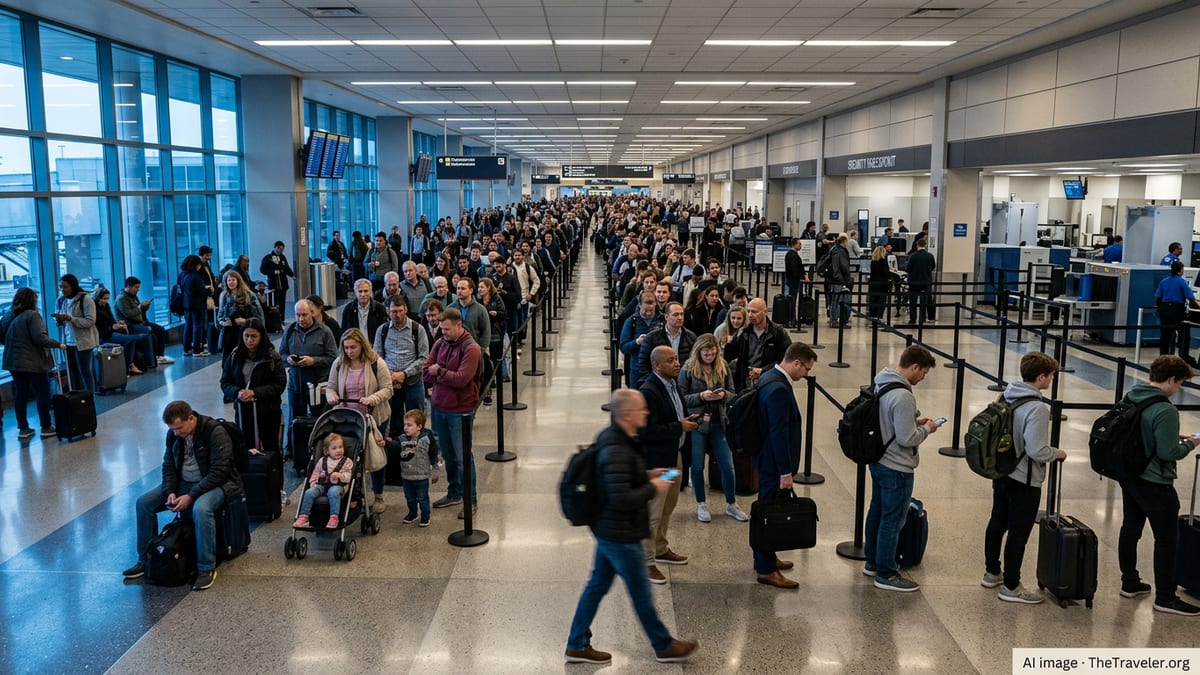
Other footage from the same period, including video from Reuters and U.S. television networks, shows similar scenes inside terminals at Chicago O’Hare, Las Vegas, San Francisco and New York, with long queues at customer service desks and crowds clustered around departure boards filled with red “delayed” notices. Together, the imagery has given the public an unusually immediate sense of what a systemwide aviation stoppage looks like from the passenger’s perspective.
One traveler interviewed at Las Vegas’ main airport, in a segment later shared online, described receiving little clear information and seeing multiple departure times slip away on the screens. That sense of uncertainty is a recurring theme in social media posts from the day of the outage, as travelers tried to reconcile official statements about a national technical issue with the often sparse updates arriving through airline apps and text alerts.
Technical fragility exposed by a single outage
The November 13 ground stop has intensified scrutiny on the resilience of U.S. air traffic control technology. In the days leading up to the incident, industry reporting highlighted the FAA’s ongoing effort to retire decades-old systems, including equipment that still relies on removable media, by 2028. Analysts point to a pattern of recent disruptions tied to communications links and data centers that suggests a network under strain from rising traffic and layered modernization projects.
Initial accounts of Friday’s disruption describe a breakdown in communications between multiple regional control centers, along with intermittent gaps in surveillance data. While a full technical timeline has not yet been published, aviation specialists interviewed in mainstream coverage emphasize that any uncertainty about the integrity of controller communications requires a conservative response, even if it means ordering a nationwide pause on departures.
The episode has revived comparisons to the January 2023 outage of the system that delivers safety notices to pilots, which also forced a brief nationwide halt. Policy commentary over the weekend notes that, three years later, a different part of the infrastructure has triggered a similar outcome, raising questions about how redundancy is being implemented and tested across the broader network.
For travelers, the technical nuances are less visible than the practical result: a system in which a fault at the infrastructure level can leave tens of thousands of people stranded, sometimes on board aircraft, with limited information about when operations will normalize.
Travelers face long delays and complex rebooking
Published flight data for Friday and early Saturday show thousands of delays and hundreds of cancellations across domestic carriers, with the heaviest disruption concentrated at major hubs that rely on tight connection banks. Airlines responded by issuing travel waivers allowing passengers scheduled to fly on November 13 and 14 to change dates without standard fees or fare differences on selected routes.
At the airport level, reports from local media in regions such as the San Francisco Bay Area and the New York suburbs describe crowded concourses, with some airports urging travelers to stay home unless their airline could confirm an updated departure time. In some cases, aircraft that had already boarded remained at the gate while crews waited for updated clearance; in others, passengers were asked to deplane and reboard hours later as schedules shifted.
The strain on customer service channels was immediate. Social media monitoring by travel analysts found that hold times for airline call centers stretched significantly, while online chat functions and mobile applications experienced slowdowns or timeouts. Travelers already in transit faced difficult choices about whether to remain airside and hope for a same-day departure or to exit, seek hotel rooms, or explore alternative ground transport.
Some airports saw knock-on effects into Saturday morning, with early departures delayed while aircraft and crew were repositioned. Analysts note that, for complex hub-and-spoke networks, a several-hour nationwide pause can take a full day or more to unwind, particularly at the start of a busy weekend travel period.
What the incident reveals about passenger protections
The stranded passenger video has also renewed debate about how much protection U.S. travelers have when flights are disrupted by events categorized as air traffic control or safety related. Department of Transportation guidance differentiates between delays caused by airlines and those attributed to government systems or weather, and compensation or hotel coverage is generally more limited in the latter scenarios.
Consumer advocates cited in weekend coverage argue that the distinction leaves passengers effectively unprotected during nationwide technical failures, even when they spend hours confined on parked aircraft. Current tarmac delay rules restrict how long passengers may be kept on board without the option to deplane, but the stranded video and similar clips posted from airports around the country suggest that policies can be difficult to apply in rapidly changing conditions.
The outage also highlights the information gap that often opens between system-level decision makers and individuals at the gate. Airlines and airports depend on real-time feeds from FAA systems to update their own operations, and when those feeds are compromised, frontline staff may have little more detail than the passengers in front of them. The resulting communication vacuum can fuel confusion, rumors and frustration, even when safety-focused decisions have strong technical justification.
As the FAA and transportation officials begin formal reviews of the November 13 incident, travelers and industry observers will be watching closely for concrete timelines and investments aimed at preventing a repeat. For many, however, the enduring image of this ground stop will be the crowded cabin in that viral clip, a reminder that behind every red line on an operations map are real journeys suddenly put on hold.