


Santiago’s Arturo Merino Benítez International Airport (SCL) is the main gateway to Chile and a major LATAM hub for South America. With a dedicated international terminal and a newer domestic terminal facing each other across a forecourt, most connections here are straightforward once you understand the sequence: immigration, bags, customs and a short walk between terminals. This guide breaks down each step with real-world examples so you can decide if your connection time is realistic and know exactly what will happen to you and your luggage.
Get the latest updates straight to your inbox!
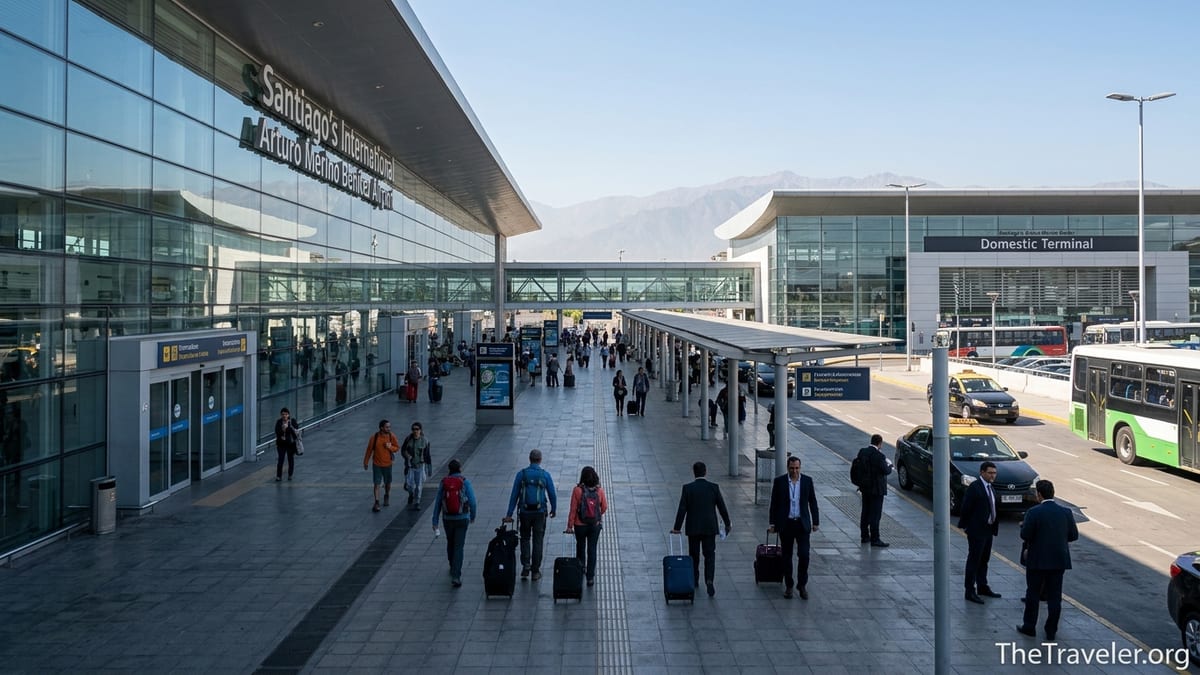
Understanding Santiago Airport’s Layout and Terminals
Santiago Airport has two main passenger terminals that now work as a pair: Terminal 2 for international flights and Terminal 1 for domestic flights. They sit opposite each other across a central plaza, connected by a covered pedestrian walkway. In practice, that means most domestic-to-international or international-to-domestic connections involve a short walk of around 10 to 15 minutes at a normal pace between terminal buildings, plus time for immigration, customs and security where required.
Terminal 2 handles almost all international traffic, including long-haul routes on LATAM, American Airlines, Delta, Iberia, Air France, KLM, Qantas and others. This is where you will arrive if you fly overnight from cities like New York, Madrid or Sydney. If you are connecting onward to Patagonia or the Atacama Desert, your next flight will almost always depart from Terminal 1 just across the way.
Terminal 1 is dedicated to domestic flights operated mainly by LATAM, Sky Airline and JetSMART. It has its own check-in areas, security checkpoints and boarding gates, plus a selection of cafes and convenience stores. From an arriving passenger’s perspective, the important thing to remember is that you cannot stay “airside” between the two terminals when you are changing from domestic to international or vice versa. At some point, you will exit into the public arrivals hall and then walk or be shuttled to the other terminal.
For many travelers, the compact size of the airport is a pleasant surprise. A typical real-world routing might look like Puerto Montt to Santiago on LATAM, connecting to Santiago to Los Angeles also on LATAM. In that case, all your domestic movements take place in Terminal 1 and your onward long-haul flight departs from Terminal 2, with the connection consisting of a short walk plus outbound immigration and security in the international building.
What Happens to Your Bags on Different Connection Types
What happens to your checked baggage in Santiago depends on two key variables: whether your flights are on one ticket or separate tickets, and whether your connection crosses the border between international and domestic segments. On a single ticket, LATAM and most partner airlines will usually tag your bags through to the final destination, but you may still be required to collect and re-check them in Santiago when entering Chile, because customs inspection occurs only once at your first point of entry.
Consider a common scenario: flying from New York to Santiago, then onward to Puerto Natales on a single LATAM ticket to reach Torres del Paine. At JFK your bag is tagged to Puerto Natales. On arrival at Santiago Terminal 2, you pass through immigration and then go to baggage claim where you must collect your checked luggage and take it through customs. After exiting into the public arrivals hall, you walk across to Terminal 1 and drop the bag at the domestic check-in or transfer counter before clearing security again. Although the tag shows Puerto Natales, that mid-journey handoff in Santiago is still required.
On the other hand, if you are transiting internationally through Santiago without entering Chile, your bag will normally stay checked through without your involvement. For example, flying from São Paulo to Los Angeles via Santiago on one LATAM ticket, you remain in the international terminal, follow “Connections” signage and head directly to security or your next gate. Your luggage is automatically moved between flights in the background while you never see it.
Separate tickets introduce much more risk because the second airline is not obliged to honor the first leg if there are delays. If you buy one ticket from Madrid to Santiago on Iberia and a separate ticket from Santiago to Calama on Sky Airline, your bag will usually be tagged only to Santiago. You must collect it, clear customs, exit the international terminal and then check in all over again for the domestic flight. In this case, a generously long layover of at least four to five hours is much safer than a tight connection.
Immigration, Customs and Security: Step-by-Step
Every passenger arriving on an international flight into Santiago must pass through Chilean immigration and customs at Terminal 2, even if continuing immediately to another destination within the country. After disembarking, you follow the “Arrivals” signage to passport control, where queues can vary from 15 minutes on a quiet evening to over an hour when several long-haul aircraft land together. Once your passport is stamped, you proceed to baggage claim to collect any checked luggage.
After retrieving your bags, you walk through customs, where Chilean officials are particularly strict about food, seeds and agricultural products. There are x-ray machines and occasional bag inspections, and fines for undeclared fresh items can be high, so it is wise to consume or discard fruit and similar snacks before reaching this point. Only once you have cleared customs can you exit into the public arrivals area on the ground floor of Terminal 2.
If you are continuing domestically, you then move between terminals and re-enter the secure area on the domestic side. That means checking your bag again if necessary and going through standard carry-on security, including liquids and electronics screening. If you are connecting from domestic to international, the sequence reverses: you arrive at Terminal 1, collect any checked baggage if you are on separate tickets, walk to Terminal 2, check in, pass through security and then complete Chilean exit immigration before accessing the international departure gates.
Travelers often underestimate the time consumed by these repeated steps. A realistic real-world breakdown for an early morning arrival might be 10 minutes to disembark, 20 to 40 minutes for immigration depending on lines, 10 to 20 minutes to receive checked bags, 5 to 10 minutes to clear customs, 10 to 15 minutes to walk between terminals and 10 to 20 minutes for domestic check-in and security. Even when everything runs smoothly, this can easily add up to 75 to 90 minutes before you are sitting at your next gate.
Domestic-to-International and International-to-Domestic Transfers
Santiago works well as a pure international hub, but domestic-to-international and international-to-domestic transfers demand more time and attention. When you step off a domestic flight in Terminal 1 with an onward international connection, you typically arrive directly into the public area if Santiago is your final domestic segment. If your flights are on one ticket with LATAM, you may not need to reclaim your bag, but you still must make your way to Terminal 2, check in or use a transfer counter, clear security and then pass through Chilean exit immigration.
Imagine you are flying from Puerto Montt to Santiago to Miami on a single LATAM ticket. In Puerto Montt, your bag is tagged to Miami. On arrival at Santiago, you follow signs toward the international terminal, walk 10 to 15 minutes across the forecourt and proceed to the appropriate LATAM check-in or connection area in Terminal 2. From there, you clear security and line up for passport control. With a healthy layover of three hours, this process is generally comfortable, leaving time for a coffee or quick meal before boarding.
The more stressful direction is often international-to-domestic, particularly for peak-season flights to Patagonia or the Atacama. A traveler arriving from London at 8:00 am and connecting to a 10:00 am LATAM flight to Punta Arenas has just two hours to clear immigration and customs, move to the domestic terminal, re-check baggage and clear security before boarding closes, typically 20 to 30 minutes before departure. If the long-haul flight is delayed or immigration queues are long, that margin can evaporate quickly, especially in January and February when holiday traffic is heavy.
Passengers on a single ticket enjoy some protection in this situation. If you booked London to Punta Arenas as one itinerary, LATAM is responsible for rebooking you if the inbound flight’s delay makes the connection impossible. In practice, that might mean being moved to a later flight the same day or, in the worst case, being accommodated overnight and flown the following morning. With separate tickets, by contrast, you would be treated as a no-show on the domestic segment and may have to buy a new ticket at walk-up prices.
LATAM-Style Connections and Partner Itineraries
As the dominant carrier at Santiago, LATAM has built its schedule and processes around common connection flows. Many North American and European travelers arrive overnight on LATAM or partner airlines and connect straight to domestic gateways such as Puerto Natales, Punta Arenas, Balmaceda, Puerto Montt or Calama for Torres del Paine, Carretera Austral, Lake District and Atacama trips. The airline’s morning bank of domestic departures is deliberately timed to receive these arrivals, but connection windows can be tight in high season.
On all-LATAM itineraries booked on a single ticket, bags for international-to-domestic connections are usually tagged to the final destination but must still be collected in Santiago for customs. Operationally, LATAM staff are accustomed to shepherding passengers with tight layovers. For example, travelers on a delayed overnight flight from Los Angeles might be met at the jet bridge by an agent holding a sign for passengers connecting to Punta Arenas. That agent may fast-track them through queues where possible and coordinate with ground staff to hold the onward flight for a short time if needed.
LATAM also cooperates with partners like Delta, American Airlines, Iberia, Air France and Qantas. If you buy a ticket from Atlanta to Puerto Natales operated partly by Delta and partly by LATAM, your baggage will typically be interlined between carriers on a single itinerary. However, you still go through the same steps in Santiago: immigration, baggage claim, customs, terminal change and domestic re-check. The fact that your bags are accepted at your origin airport merely reduces the number of check-in lines you face, not the number of border-control procedures.
By contrast, low-cost domestic carriers such as Sky Airline and JetSMART do not routinely interline baggage with foreign airlines when tickets are bought separately. A traveler flying from Toronto to Santiago on Air Canada and then to Calama on a separate Sky Airline ticket should expect to collect luggage and fully re-check, even if the flights appear to line up neatly on third-party booking websites. In such cases, planning a long daytime layover or even an overnight stop in Santiago is the safest strategy.
How Much Time You Really Need: Minimum Connection Times
Official minimum connection times published in reservation systems can be as low as around 60 to 90 minutes for certain international-to-domestic or international-to-international connections in Santiago, especially on a single airline. Airlines will sometimes sell itineraries that compress connections to these limits. While they are technically legal and occasionally work perfectly, they leave very little room for late arrivals, long queues or slow baggage delivery.
For most travelers, a more conservative and realistic target is at least two hours for international-to-international connections and at least three hours for any connection that crosses the border between domestic and international. For example, a two-hour layover between a midnight arrival from São Paulo and a 2:00 am departure to Lima may be comfortable because the terminals are quiet and there are fewer simultaneous arrivals. The same two-hour layover between an 8:00 am arrival from Europe and a 10:00 am departure to Patagonia in January could feel uncomfortably tight due to peak traffic.
Real itineraries illustrate how this plays out. A traveler connecting from a 6:30 am LATAM arrival from Miami to a 9:30 am domestic departure to Puerto Montt effectively has about two and a half hours between gate arrival and boarding time. This is usually enough for immigration, bags, customs, terminal walk and security, with a slim margin for delays. By contrast, someone arriving at 8:00 am from Madrid and booked on a separate 9:45 am Sky Airline flight to Calama would have barely more than an hour to complete identical steps, which is not advisable.
If you have flexibility, building in a four to five-hour layover, especially when separate tickets or checked bags are involved, greatly lowers stress. It can also provide time for a shower in a lounge, a sit-down breakfast or even a short trip outside to see daylight before a long journey south. While it may feel inefficient on paper, that buffer is often the difference between a smooth start to a Patagonian trek and the frustration of buying last-minute replacement flights.
Moving Between Terminals and Making the Most of a Layover
The physical transfer between Terminal 1 and Terminal 2 in Santiago is relatively simple. Once you exit the secure area, you follow clear signage toward the other terminal, stepping into a covered pedestrian zone that runs across the central plaza. Walking at a normal pace with a wheeled suitcase, most travelers cover the distance in 10 to 15 minutes. For those with mobility limitations or heavy baggage, airport staff and some airlines can arrange assistance with wheelchairs or electric carts when requested in advance.
Short layovers leave little time for anything beyond the basic formalities, but longer ones can be made reasonably comfortable without leaving the airport. Both terminals offer cafes selling coffee, empanadas and sandwiches, as well as small shops with snacks, travel adapters and local SIM cards. International departure areas include duty-free stores and a handful of sit-down restaurants where you can try Chilean wine or a simple seafood dish between flights.
On connections of six hours or more, especially in daytime, some travelers choose to leave the airport for a taste of Santiago before returning for their onward flight. The city center is typically 30 to 40 minutes away by licensed taxi or airport bus under normal traffic conditions, although rush hour can extend that. A realistic half-day plan might involve dropping your checked bags at an airport luggage storage service, taking a taxi into a central neighborhood like Lastarria for coffee and a walk, and then returning to the airport at least two hours before your next departure.
If you prefer not to leave the terminal but need rest, there is an on-airport hotel connected to the complex, as well as several hotels a short ride away along the airport access road. Booking a day room can be worthwhile for travelers arriving on overnight long-haul flights who face an evening connection to Patagonia, allowing for a nap, shower and quiet work time before heading back into the terminal formalities.
The Takeaway
Connecting through Santiago’s Arturo Merino Benítez Airport is generally straightforward once you know that almost all international flights use Terminal 2, domestic flights use Terminal 1, and that you will leave the secure area when moving between them. For international-to-domestic connections into Chile, you always pass through immigration and customs in Santiago, and you usually handle your checked bags there even when they are tagged to a final domestic destination.
In practice, the key decisions are how your tickets are booked and how much time you allow. Single-ticket itineraries on LATAM and its partners provide the greatest protection, as the airline is responsible for rebooking you if a legal connection is missed due to delays. Separate tickets, especially between full-service and low-cost carriers, require much more conservative layovers and a willingness to absorb risk if things go wrong.
Most travelers are best served by planning at least three hours for any domestic-to-international or international-to-domestic connection and at least two hours for international-to-international transfers, adding extra padding during peak holiday months or when checked baggage is involved. With realistic expectations, a bit of margin and a clear sense of the sequence from plane door to next gate, Santiago can be an efficient and manageable gateway to the rest of Chile and beyond.
FAQ
Q1. Do I have to collect my bags in Santiago if I am connecting from an international flight to a domestic flight?
Yes. When you first enter Chile at Santiago, you must pass through immigration and customs, which requires collecting any checked bags before re-checking them for your domestic flight.
Q2. Is a 90-minute layover enough to connect from an international arrival to a domestic flight at SCL?
A 90-minute connection can work on a single ticket when flights are on time and queues are short, but it leaves little margin. Most travelers should aim for about three hours.
Q3. Can I stay airside when transferring between Terminal 1 and Terminal 2?
No. For domestic-to-international and international-to-domestic connections, you exit into the public area and walk between terminals before clearing security again.
Q4. What happens if my first flight is delayed and I miss my connection in Santiago?
If both flights are on one ticket, the operating airline is generally responsible for rebooking you on the next available flight. With separate tickets, you usually must buy a new ticket.
Q5. How long does it take to walk between the domestic and international terminals?
The walk between Terminal 1 and Terminal 2 typically takes about 10 to 15 minutes at a normal pace using the covered pedestrian route across the central plaza.
Q6. Are there lounges I can use during a long layover at SCL?
Yes. Both terminals have airline-operated and independent lounges that you can access through status, premium cabins or paid entry, offering Wi-Fi, food and showers.
Q7. Can I leave the airport during a long international layover in Santiago?
In most cases, yes, provided you meet Chile’s entry requirements. Plan at least six hours between flights if you want to go into the city and return with a safe buffer.
Q8. Do low-cost airlines in Chile interline baggage with international carriers at SCL?
Generally not. Airlines such as Sky Airline and JetSMART typically require you to collect and re-check baggage when connecting from or to separate international tickets.
Q9. How early should I arrive for an international departure from Santiago?
Airlines generally recommend arriving about three hours before scheduled departure for international flights and about two hours for domestic flights from Santiago.
Q10. Is Santiago Airport easy to navigate for non-Spanish speakers?
Yes. Signage is bilingual in Spanish and English, and most frontline airline and security staff can manage basic English, making wayfinding and simple questions manageable.