


More news on this day
Saudi Arabia is accelerating a nationwide tourism buildout as Riyadh, Jeddah and Mecca add thousands of hotel rooms, new cultural districts and major transport hubs, positioning the kingdom to convert Vision 2030’s global travel goals into on-the-ground capacity.
Get the latest news straight to your inbox!
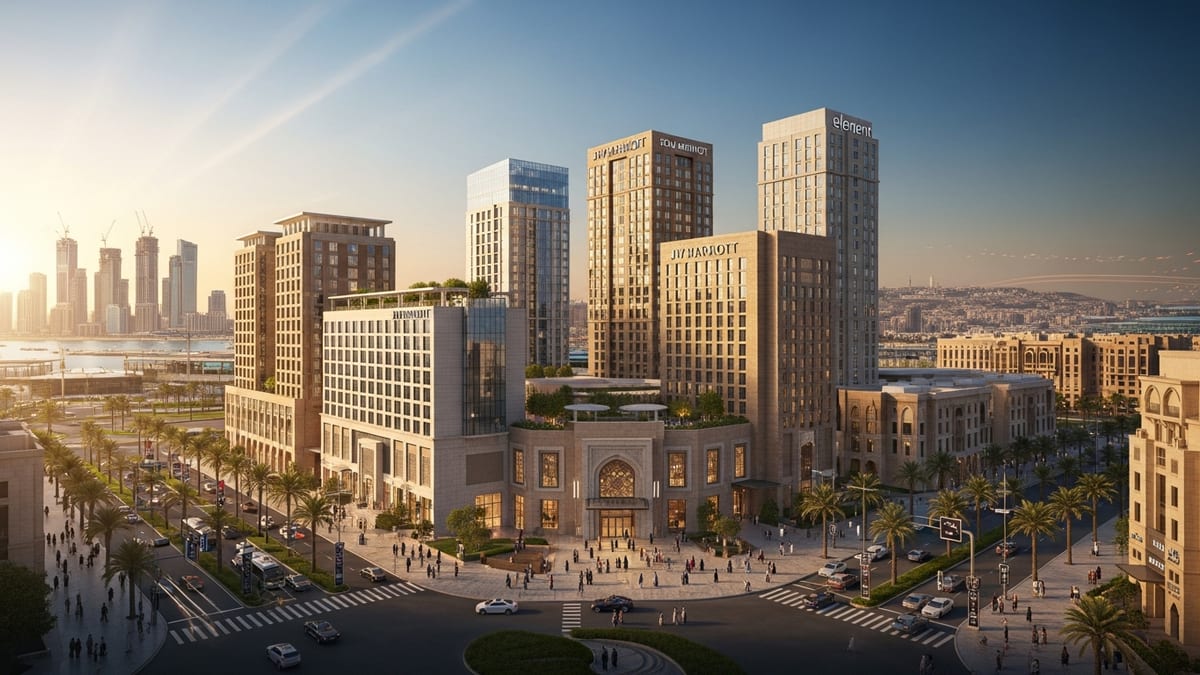
Hotel Capacity Surges As Kingdom Targets More Global Visitors
Publicly available industry data shows that by the end of 2025 Saudi Arabia had close to 6,000 hospitality units across the country, including nearly 2,850 hotels and just over 3,000 serviced apartments. Analysts report that developers are now working on a pipeline of roughly 83,000 to 94,500 additional rooms, heavily concentrated in the key urban markets of Riyadh and Jeddah, alongside religious hubs such as Mecca and Madinah. This expansion is framed as central to Vision 2030’s aim of attracting more international tourists while sustaining a fast-growing domestic travel market.
Tourism spending has been rising in parallel. Data compiled from UN World Tourism Organization sources indicates that international inbound tourism expenditure in Saudi Arabia reached more than 46 billion dollars in 2024, up around 13 percent on the previous year. In the domestic market, local travel media recently highlighted that spending in the first quarter of 2026 alone climbed by 8 percent year on year to about 34.7 billion riyals, supported by strong hotel occupancy levels in major destinations such as Jeddah and Madinah. These figures suggest that newly built capacity in core cities is already being tested by rising demand.
Government communications on Vision 2030 describe tourism as a key pillar of diversification away from oil, with targets to welcome over 100 million visitors annually and increase the sector’s contribution to gross domestic product. A growing number of projects in the country’s largest cities are explicitly branded as tourism and lifestyle destinations, blending residential districts with hotels, entertainment and retail. This integrated approach is becoming particularly visible in Riyadh’s western and northern corridors and along Jeddah’s waterfront.
Analysts note that the rapid pace of development also reflects Saudi Arabia’s efforts to host more international events, from investment conferences and sports tournaments to cultural festivals. These events require not only hotel rooms but also exhibition centers, arenas and upgraded transport links, helping to explain the scale and diversity of the current construction pipeline.
Riyadh Builds Mega-Districts Ahead of Expo 2030
Riyadh is emerging as a showcase for the next phase of Saudi tourism growth, with several multibillion-dollar districts under construction. Reports on the Diriyah project on the northwestern edge of the capital describe a 63 billion dollar heritage and lifestyle destination that includes dozens of hotels, museums, an arena and extensive public realm around the restored At Turaif UNESCO World Heritage Site. Recent project updates indicate that large parts of the development are under active construction, with visitor-focused components scheduled to open before 2030 to capture both leisure and cultural tourism.
Within the city’s core, the New Murabba development is being promoted as a new downtown for Riyadh, covering about 19 square kilometers. According to masterplan summaries, the district is set to include a major museum, immersive entertainment venues and more than 80 cultural and leisure attractions, anchored by the cube-shaped Mukaab structure and supported by hotels and serviced apartments. The project is positioned to coincide with Riyadh’s preparations to host Expo 2030, reinforcing the capital’s role as a gateway for international visitors.
Transport and sports infrastructure are also part of the tourism equation. Planning documents and specialist coverage describe the ongoing rollout of the Riyadh Metro, a multi-line rapid transit system designed to ease mobility across the city and connect emerging districts. In parallel, construction plans for the King Salman International Stadium on the outskirts of Riyadh outline a high-capacity venue with extensive hospitality suites, which is expected to underpin bids for major football and entertainment events and attract event-driven tourism.
Private and sovereign wealth fund investment is flowing into hotel developments across the capital, supported by long-term forecasts of rising demand from both business and leisure travelers. Commentary from sector analysts emphasizes that Riyadh’s growth is no longer limited to corporate travel; instead, the city is being repositioned as a destination in its own right, with museums, festivals and sports events intended to lengthen visitor stays and increase spending.
Jeddah Reinvents Its Waterfront As a Red Sea Gateway
On the west coast, Jeddah is undergoing a transformation aimed at consolidating its role as a Red Sea tourism and cruise hub. The Jeddah Central project, valued at tens of billions of dollars, is designed to remake a large stretch of the city’s waterfront into a mixed-use district with beaches, marinas, hotels and entertainment venues. Investor presentations and regional reports describe the scheme as a new urban core that will add thousands of hotel rooms and branded residences, giving Jeddah a modern seaside skyline oriented around tourism and leisure.
Hotel performance metrics suggest that Jeddah is already benefiting from the broader boom in Saudi travel. Recent industry coverage cited average hotel occupancy in the city at close to 60 percent in early 2026, supported by both domestic tourists and regional visitors using the city as a gateway to coastal retreats and inland destinations. New properties announced by international and regional hotel groups in and around Jeddah indicate confidence that demand will continue to grow as more entertainment and cultural offerings come online.
Jeddah is also being positioned as a key maritime entry point for cruise tourism in the Red Sea, complementing new resort destinations further north. Port and terminal improvements, combined with marketing campaigns targeting European and Asian cruise operators, are intended to attract more ships to base in or call at the city. This strategy aligns with the wider development of regenerative tourism projects along the Red Sea coast, where high-end resorts and nature-focused experiences are being developed with a strong emphasis on environmental standards.
In the historic heart of the city, restoration and cultural initiatives are turning Jeddah’s traditional architecture into a draw for heritage tourism. Museum projects and adaptive reuse of old buildings into boutique hotels and galleries are expected to diversify the visitor offer beyond beaches and shopping malls, reinforcing the city’s positioning as both a modern and historic destination.
Mecca Expands Pilgrim Infrastructure Into Year-Round Tourism
Mecca remains the spiritual center of Saudi tourism, but current development trends indicate a shift toward more comprehensive urban and visitor infrastructure. The Masar Destination project, running through the city, is a major mixed-use corridor that includes hotels, residential blocks, retail and transport solutions. Project descriptions emphasize that Masar is designed to help increase the capacity to host pilgrims to around 30 million annually by 2030, while enhancing urban services and public spaces for residents.
Market analyses focused on Mecca and nearby Madinah highlight a sharp rise in demand for quality accommodation close to holy sites, with a particular uptick in luxury and upper-midscale properties. Reports from hospitality consultancies point to growing interest from international hotel brands in expanding their presence in these cities, encouraged by long-term forecasts for Hajj and Umrah pilgrim numbers and government efforts to streamline visa procedures.
Large-scale infrastructure projects are being prioritised to manage peak seasons more efficiently, including upgraded road networks, enhanced crowd management systems and new public transport links. These investments are framed as essential to maintaining safety and comfort during the Hajj period while also supporting a gradual extension of visitor flows across the year through religious tourism, conferences and faith-oriented cultural events.
Observers note that Mecca’s evolution into a more diversified religious tourism city is being carefully balanced with sensitivities around heritage and religious sanctity. Urban planning documents describe an emphasis on integrating modern high-rise hospitality towers with existing urban fabric, aiming to increase capacity without undermining the character of the holy sites that attract millions of visitors annually.
Beyond the Big Three: Secondary Cities and Giga-Projects Round Out the Map
While Riyadh, Jeddah and Mecca anchor the current tourism surge, a growing number of projects in secondary cities and remote regions are broadening the country’s appeal. In Madinah, the Rua Al Madinah project is reshaping large areas near the Prophet’s Mosque, with published plans for over 1.5 million square meters of hotels, transport tunnels and visitor amenities intended to serve up to 30 million visitors a year. Regional development authorities have highlighted the project as a way to support both religious tourism and cultural experiences that encourage longer stays.
Further afield, mountain destinations such as Soudah Peaks in the Asir region and heritage landscapes like AlUla are being promoted as cooler-climate escapes and cultural tourism sites. These projects typically combine boutique resorts, outdoor activities and archaeological attractions, offering an alternative to the urban experiences found in Riyadh and Jeddah. They also reflect a broader policy push to distribute tourism benefits to less-developed regions of the kingdom.
On the Red Sea coast, flagship regenerative tourism initiatives are gradually moving from concept to partial operation, with several resorts reported as open and more under construction. Coverage from regional business outlets notes that these destinations are being powered by renewable energy and designed with strict environmental criteria, positioning them as test cases for low-impact luxury tourism that still contributes meaningfully to national revenue targets.
Sector analysts argue that the combination of giga-projects and city-level hotel and infrastructure expansion is central to Saudi Arabia’s bid to establish itself as a leading global tourism player by 2030. With hotel pipelines swelling, transport networks expanding and major international events on the horizon, Riyadh, Jeddah and Mecca are emerging as the primary stages where Vision 2030’s tourism ambitions are most visible, while a growing constellation of secondary destinations ensures that visitors have reasons to travel well beyond the country’s three biggest draws.