


More news on this day
Severe summer storms sweeping across key Canadian hubs have triggered 114 flight cancellations and 702 delays, disrupting operations at Air Canada and WestJet and leaving passengers across the country facing missed connections, overnight airport stays, and rapidly changing itineraries.
Get the latest news straight to your inbox!
Storm Systems Collide With Peak Summer Travel
Publicly available flight-tracking data and aviation disruption trackers for late June 2026 indicate that a series of fast-moving storm fronts over central and western Canada coincided with one of the busiest travel periods of the season, amplifying the impact of every cancellation and delay.
Weather alerts issued in recent days across parts of Ontario, Quebec, Saskatchewan, and Alberta described conditions favorable for severe thunderstorms, strong wind gusts, and heavy rainfall. These patterns created ripple effects for major airports serving Air Canada and WestJet, particularly Toronto Pearson, Montreal Trudeau, Calgary, Edmonton, Vancouver, and Winnipeg.
Operational summaries from disruption-monitoring platforms show that as storms intensified, both airlines increased the number of preemptive cancellations and extended ground holds, a tactic commonly used to keep aircraft and crew out of the worst of the weather but one that can significantly increase same-day delays.
The final tally across the most affected 24-hour window points to 114 cancelled flights and 702 delayed departures and arrivals on Canadian routes, a volume consistent with a full-day weather-related event across multiple hubs rather than a localized storm affecting a single airport.
Air Canada and WestJet Bear the Brunt
Publicly accessible airline-status dashboards and airport boards show that Air Canada absorbed the largest share of disruptions, in part because of its extensive domestic and transcontinental network. The carrier’s flights through Toronto, Montreal, and Vancouver experienced substantial knock-on delays as aircraft arriving late from weather-hit regions could not be turned around on schedule.
WestJet, which relies heavily on Western Canadian hubs, faced its own cascade of schedule problems as storms and associated air-traffic-control restrictions slowed operations in and out of Calgary, Edmonton, and Vancouver. The airline’s point-to-point model, which is typically designed to simplify connections, was challenged when multiple departures from the same region were simultaneously affected by lightning, low visibility, and wind.
Comparable incidents earlier in June, involving dozens of cancellations and several hundred delays for the same carriers, have already drawn attention to how quickly Canada’s relatively concentrated aviation network can seize up when a few storm cells hit major hubs at the wrong time of day.
Industry data published over recent months also show that both airlines have been managing broader operational headwinds, including jet fuel cost volatility and tighter capacity planning, leaving less slack in the system when severe weather strikes and recovery windows are short.
Passengers Face Long Lines, Tight Connections, and Limited Options
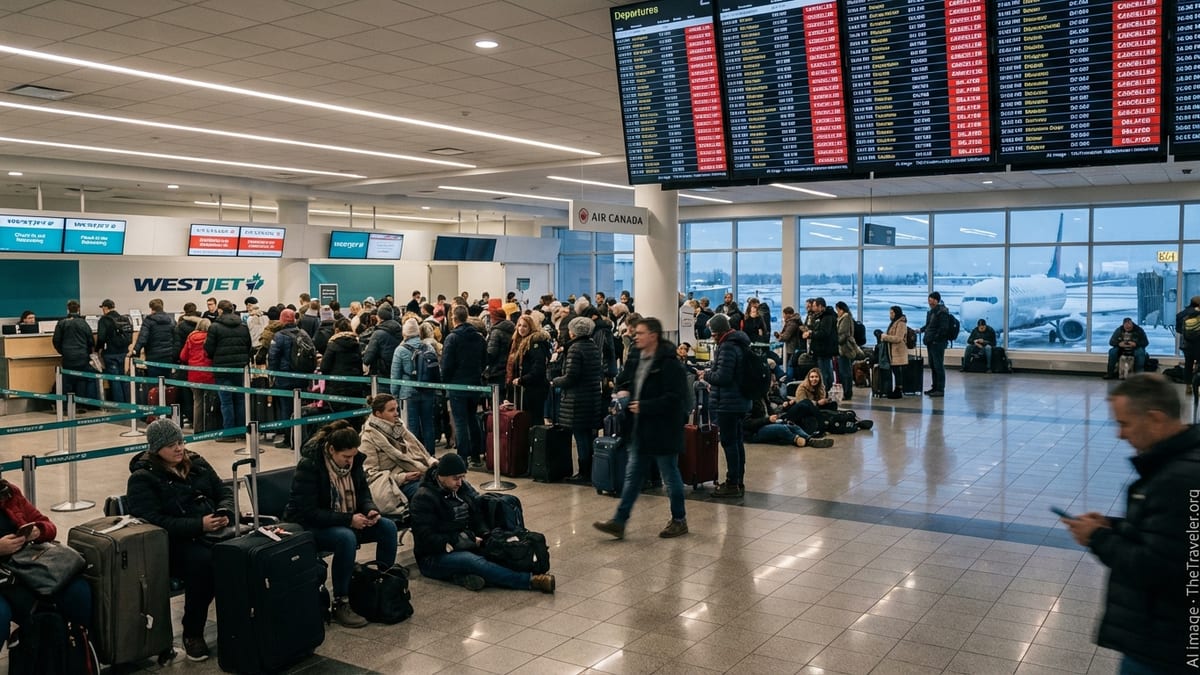
Across social media platforms and traveler forums, passengers shared images and accounts of packed terminals, hour-long check-in lines, and customer-service queues snaking through concourses as the disruptions unfolded. Many reported multiple rolling delay notifications before flights ultimately departed, while others described abrupt cancellations just as boarding times approached.
Travelers connecting through Toronto, Montreal, Calgary, and Vancouver appeared to be among the hardest hit, particularly those with international onward flights. When weather causes widespread delays, missed connections become difficult to re-accommodate because spare seats on later departures are scarce, especially in peak summer periods.
Reports from major Canadian airports indicated that some travelers chose to accept rebookings a day or more later, while others scrambled to secure seats on competing airlines or alternative routings through the United States and Europe. Hotel availability near key hubs tightened quickly as evening cancellations accumulated, with some passengers opting to stay overnight in terminal seating rather than search for scarce rooms.
For those whose flights did operate, onboard delays were also a factor. Taxiway congestion, de-icing in regions where colder upper-level air clashed with surface temperatures, and air-traffic-control spacing requirements meant departure queues often stretched well beyond scheduled pushback times.
Regulatory Rules and Passenger Rights in Focus
The latest disruption has renewed attention on Canada’s Air Passenger Protection Regulations, which set out minimum standards of treatment, rebooking obligations, and potential compensation for travelers facing cancellations and long delays. The rules distinguish between situations within an airline’s control, such as some mechanical or staffing issues, and those outside its control, such as severe weather and air-traffic-control restrictions.
According to publicly available guidance from both major carriers and the Canadian Transportation Agency, passengers affected by weather-related cancellations are generally entitled to rebooking on the next available flight or a refund if the trip no longer serves its purpose, but direct financial compensation for delay is typically not provided in these circumstances.
Consumer advocates note that large, weather-driven events often expose how complex it can be for individual travelers to determine the specific reason coded for their disruption. A single operational day can involve overlapping weather, crew-duty-time limits, maintenance, and airport-capacity constraints, each of which may be categorized differently under compensation frameworks.
Increased public scrutiny in recent months, including high-profile complaints about inconsistent explanations for delays, has prompted growing calls for clearer reporting, standardized disruption notifications, and faster resolution of compensation claims. Episodes of mass cancellations and delays, such as the latest 114-flight and 702-delay event, are likely to add new momentum to those discussions.
What Travelers Can Do During Widespread Disruptions
Travel advisors and aviation analysts routinely emphasize preparation and flexibility when severe weather is forecast along Canadian flight corridors. Monitoring weather alerts for both departure and arrival regions, as well as checking flight status frequently in the 24 hours before travel, can provide early warning that schedules may be at risk.
During large-scale events, publicly available guidance suggests prioritizing self-service tools such as airline mobile apps, websites, and automated kiosks, which can sometimes process same-day changes faster than in-person customer-service counters overwhelmed by long lines. Passengers who booked through travel agencies or corporate travel programs may also have access to dedicated support channels that can search alternative routings.
Experts caution that rebooking windows may narrow quickly once widespread delays take hold. For travelers with essential onward connections, some recommend proactively requesting earlier departures on the same route when storms are forecast for the original departure time, or considering indirect routings through less affected hubs.
While the latest bout of Canadian travel chaos is largely rooted in severe summer storms, the scale of 114 cancellations and 702 delays underscores how intertwined weather, airline scheduling choices, and infrastructure constraints have become, and how even a single day of adverse conditions can ripple through the travel plans of thousands of passengers.