


Landing at Seychelles International Airport on Mahé and trying to reach a ferry for Praslin or La Digue the same day can feel stressful. Distances are short, but tight schedules, luggage, and limited daily ferries mean you need a clear plan. This guide walks you through every realistic option from airport to ferry, how the Cat Cocos and Praslin–La Digue connections work, and what to do if things go wrong.
Get the latest updates straight to your inbox!
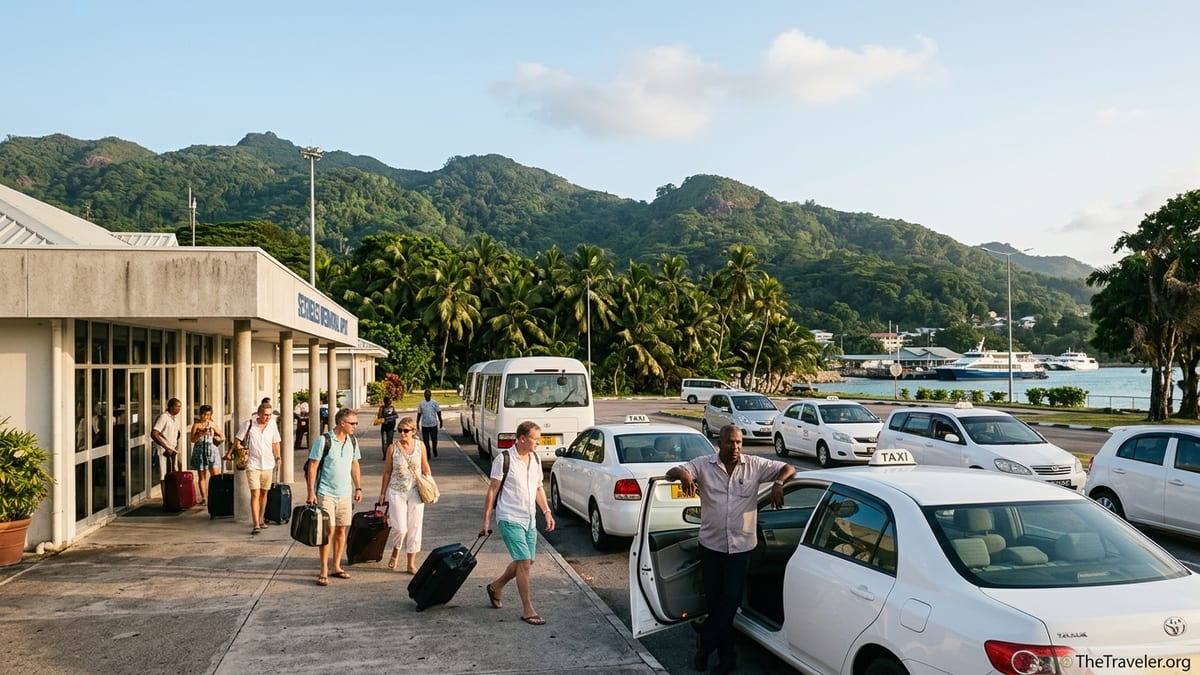
Airport to Ferry Terminal: Distances, Layout and First Decisions
Seychelles International Airport (SEZ) sits on the east coast of Mahé at Pointe Larue, about 10 kilometers from Victoria’s Inter Island Quay, where the Cat Cocos ferries to Praslin and La Digue depart. In light traffic, a taxi or private transfer usually takes around 15 minutes, though at peak times it can be closer to 25 minutes as you approach central Victoria.
The airport itself is compact. After immigration and customs you exit directly into the arrivals hall, where you will see a taxi rank outside and counters for local travel agencies and tour operators who can arrange transfers. There is no dedicated train or airport express; your choice is essentially between taxi, prebooked private transfer, or the public bus for getting to the ferry terminal.
The Cat Cocos ferries do not leave from the airport area. All inter-island ferries to Praslin and direct services to La Digue depart from the Inter Island Quay at the New Port in Victoria, a few minutes’ walk from the main bus terminal in town. Understanding that you must first get from SEZ to this quay is the key starting point for planning any same-day island connection.
Most travelers with checked luggage and a prebooked Cat Cocos ticket choose a taxi or private transfer from the airport to the quay. The bus is technically possible and cheap, but the reality with luggage and tight ferry schedules is more complicated, which we will cover in detail below.
Taxi vs Private Transfer vs Bus: What Actually Works
For most visitors heading straight to Praslin or La Digue, a standard airport taxi is the most practical option. Recent fare tables and local transfer aggregators quote around SCR 300 for the 10-kilometer run from Seychelles International Airport to the Inter Island Quay, which is roughly 20 to 25 US dollars for the vehicle, not per person. The ride is meterless, but fares between the airport and the quay are fairly standardized, and you will see approximate prices displayed on boards or brochures at the terminal.
Taxis are available around the clock when flights arrive, and a typical car can comfortably take three passengers with large suitcases, or four with lighter luggage. If you are arriving as a family with several big bags, request a larger vehicle at the stand or pre-arrange an MPV-style transfer with your hotel or a local agency. Realistically, a taxi remains the best balance of speed, comfort, and cost for most people aiming to make a specific Cat Cocos departure.
Private transfers, often arranged through hotels or services advertised as “ferry shuttles,” provide a driver waiting in arrivals with your name sign and a direct drive to the quay. Prices are typically similar to or slightly above standard taxis. For example, some transfer platforms quote airport to Inter Island Quay runs in the range of 25 to 40 euros per vehicle depending on time of day and vehicle size. The value here is reliability: if your inbound flight is delayed, the driver usually monitors it and adjusts pickup, and you avoid queueing at the taxi rank.
The public bus, operated by Seychelles Public Transport Corporation, passes near the airport on the main road and runs frequently into Victoria for a very low fare, often quoted by recent travelers at around SCR 8 per person. However, buses are not designed for heavy luggage, can be crowded during local commuting times, and do not stop directly at the ferry quay. You would typically ride to the Victoria bus terminal, then walk roughly 10 minutes on city pavements with your bags to the Inter Island Quay. Travelers who tried this with a full suitcase often report it as physically awkward rather than impossible. With a tight ferry cutoff or in heavy rain, this option is best avoided unless you have only a small backpack and time to spare.
Understanding Cat Cocos: Schedules, Check-in and Luggage Reality
Cat Cocos is the main high-speed catamaran operator linking Mahé with Praslin and La Digue. The standard journey between Mahé and Praslin is about 1 hour 10 minutes on a direct run, and up to around 1 hour 45 minutes if the service also calls at La Digue. Recent price sheets from booking agents quote economy class fares from Mahé to Praslin at roughly 60 euros one way, with higher prices for upper deck and business class. A through ticket Mahé to La Digue is usually more, in the range of a little over 70 euros in economy, reflecting the longer route and second leg.
Schedules vary by day and season, but a typical pattern includes a morning sailing around 8:00 or 8:30, a late morning or midday departure, and an afternoon departure around 16:30 from Mahé to Praslin, with some of these extending to La Digue. There are fewer crossings on certain days, so travelers should always check exact times before finalizing flights. Crucially, you should treat the ferry schedule as fixed and plan your arrival at SEZ with at least a few hours of buffer if you want to connect the same day.
Check-in for Cat Cocos is more like an airport than a casual island shuttle. Official guidance often recommends arriving 60 minutes before departure for baggage drop and boarding formalities. Bags are tagged, weighed, and loaded into the hold, and you receive a hand-luggage allowance for items you keep with you in the cabin. Some recent booking documents mention a free checked baggage allowance in economy of around 25 kilograms plus additional allowance for sports gear, with extra weight charged per kilogram. There are no strict security queues like a large airport, but the check-in desk can be busy before popular sailings, especially those timed for large hotel check-outs.
In practice, travelers with confirmed tickets who arrived 30 to 40 minutes before departure usually made the boat, but this leaves no buffer if there is a queue at the desk or a delay with bag handling. If you are connecting directly from a long-haul flight to a Cat Cocos departure, target being at the quay 60 minutes ahead, which usually means landing at least three hours before the ferry time once you include immigration, luggage claim, and the taxi transfer.
Praslin and La Digue Connections: Ferry vs Domestic Flight
To reach Praslin, your choices are the Cat Cocos ferry from Mahé or a short domestic flight from the airport to Praslin Island Airport. Travelers continuing to La Digue can either book a through Cat Cocos ticket Mahé to La Digue via Praslin, or combine the Mahé–Praslin domestic flight with a local Praslin–La Digue ferry operated by Cat Rose or another inter-island service.
The domestic flight option is attractive for those prone to seasickness or arriving during the rougher southeast trade-wind months. Flights themselves take about 15 minutes, plus time for check-in and transfers. They frequently connect with international arrivals, and the domestic terminal is adjacent to the international one at SEZ. However, seats are limited, prices can be significantly higher than the ferry, and there are baggage weight restrictions closer to airline norms, which matter if you are carrying dive gear or heavy camera equipment.
On Praslin, the main ferry terminal at Baie Sainte Anne handles crossings to La Digue. Cat Rose operates fast catamaran services with a typical crossing time of about 15 minutes. Even though the distance is short, there is still a check-in process and usually a requested arrival of 30 minutes before departure. Many Mahé–Praslin Cat Cocos sailings are timed to connect with these Praslin–La Digue ferries, and some booking sites allow you to purchase the full Mahé–Praslin–La Digue route on one ticket, simplifying the logistics.
For example, a visitor landing on Mahé in the morning might take an 11:00 Cat Cocos to Praslin, arrive around 12:15, then board a connecting Praslin–La Digue service at around 13:00. Their bags would be offloaded and reloaded between boats, and they would reach La Digue by early afternoon. This chain works smoothly when everything is on time, but any delay on the first leg can cause a missed connection, so always understand what your ticket provider or hotel will do if that happens.
Realistic Timing From Landing to Island: Sample Same-Day Scenarios
To judge whether a same-day island transfer is sensible, it helps to walk through real-time examples. Imagine an Emirates or Qatar Airways long-haul flight scheduled to land at 7:30 in the morning. If everything runs on time, you might clear immigration and collect bags by around 8:15, walk out of arrivals, and find a taxi by 8:25. With normal traffic, you could be at the Inter Island Quay by around 8:45. In this scenario, a Cat Cocos sailing at 10:30 would be realistic, giving you over 90 minutes for check-in and a coffee at the quay.
Now consider a flight landing at 15:00 with the last ferry to Praslin around 16:30. Travelers who have reported this combination often say they did not make the ferry, even with hand luggage only. Delays at immigration, a slow luggage belt, or a queue at the taxi rank can quickly erode your buffer. If you walk out of arrivals at 15:45, drive 20 minutes to Victoria in afternoon traffic, and reach the quay at 16:10, the check-in desks may already be closed or close to closing. It only takes a minor delay to turn this into an impossible connection.
For La Digue, same-day arrival is even more sensitive. A common pattern is to book a Mahé–Praslin Cat Cocos that connects to a Praslin–La Digue ferry leaving 30 to 45 minutes after arrival. If the Mahé boat is late due to sea conditions, or luggage offloading runs slowly, that window disappears. Some travelers mitigate this by booking an overnight on Mahé or Praslin and continuing to La Digue the next morning. Others accept the risk but avoid the last connection of the day, so that if they miss it there is at least a later Praslin–La Digue crossing they might still catch.
Working backwards is a useful strategy. Decide when you realistically want to set foot on La Digue or Praslin, then pick the ferry that arrives around that time, and only then look for an inbound flight that lands at least three to four hours before that ferry, especially if you are checking bags. Adding a night on Mahé after a very late or very early long-haul arrival can dramatically reduce stress and virtually eliminate missed-ferry scenarios.
Bus Reality: When Public Transport Makes Sense and When It Does Not
For budget travelers, the SPTC public buses are tempting. They serve the main road by the airport and run to Victoria’s central bus terminal at regular intervals from early morning until evening. The cost is only a few rupees per ride, which is a fraction of a taxi fare. On paper, one could exit the airport, walk a few minutes to the main road, flag a bus to Victoria, then walk to the Inter Island Quay and board a ferry having spent less than one US dollar on transport.
The practical reality is less straightforward. Buses can be crowded, especially during local commuting hours, and there is limited space for large luggage. Several recent visitors have described being asked or expected to keep their suitcases out of the aisle, which can be difficult on a full bus. Drivers do sometimes accept luggage, but it is at their discretion and can draw frustration from local passengers if the bus is busy. In the middle of the day, with an almost empty bus and only one suitcase, travelers have reported the journey as manageable, but they still needed to wrestle the bag on and off the bus and across Victoria.
Timing is another issue. Buses are subject to traffic and frequent stops, so while the taxi takes around 15 minutes, a bus might take 30 minutes or more to reach Victoria. Add waiting time at the stop, possible confusion about routes, and the walk from the bus terminal to the quay, and your total transfer time easily stretches toward an hour. With a ferry that expects you to check in 60 minutes before departure, the bus becomes a risky option on the same day as a long-haul flight or for any late-afternoon Cat Cocos connection.
Where the bus does make sense is for travelers staying a night or two on Mahé before heading to the islands, carrying only backpacks or light soft bags, and with flexible schedules. In that case, using the bus to explore Victoria and then walk to the quay for a midday ferry can be part of the experience. But for anyone with tight ferry timing, heavy suitcases, or a once-a-day connection, the bus should be treated as a backup or local-experience outing, not the backbone of your island-transfer plan.
Luggage, Seasickness and Comfort: Choosing the Right Setup
Luggage is often the deciding factor between the domestic flight and the ferry. Cat Cocos offers a generous free baggage allowance compared with small inter-island aircraft and is more forgiving if your suitcase creeps above typical airline limits. Large wheeled bags, dive gear, and camera cases are routinely checked into the ferry’s hold. On the Mahé–Praslin and Praslin–La Digue legs, staff handle the bags from quay to boat and back, so you are not lugging them up narrow gangways.
By contrast, domestic flights between Mahé and Praslin usually have stricter weight limits and smaller overhead bins, which can trigger excess baggage fees for travelers with multiple large cases. For a couple on a multi-week honeymoon carrying formal clothes, snorkel gear, and photography equipment, the difference between paying several kilos of excess on each domestic flight and checking the same bags onto the ferry for free can be substantial.
Seasickness is the flip side. The Cat Cocos route crosses open water where conditions can be choppy, particularly from around May to September in the southeast trade-wind season. Those prone to motion sickness should avoid the rear of the boat and lower deck seats near the engines where motion and fumes are more noticeable. Booking an upper deck seat, taking medication like meclizine or another motion sickness remedy before boarding, and focusing on the horizon can make the crossing more comfortable. In very rough weather, the smaller Praslin–La Digue boats can feel particularly lively, so sensitive travelers sometimes prefer to overnight on Praslin and take an early morning crossing when winds are lighter.
A useful real-world compromise is to take the ferry from Mahé to Praslin in the calmer transition months, such as April or November, and consider the domestic flight if you are traveling in the height of the trade winds and know that you suffer from motion sickness. If your overall itinerary allows, building in flexibility around the windiest weeks and avoiding the tightest ferry connections helps reduce the odds of an uncomfortable or delayed crossing.
Missed-Ferry Risks and Recovery Strategies
Despite careful planning, missed ferries do happen. The most common causes are delayed flights into Mahé, slow lines at immigration, or underestimating the time needed to get from the airport to the quay. Travelers on forums have described landing at 15:00 for a 16:30 Cat Cocos to Praslin, clearing the airport barely in time, then hitting traffic into Victoria and arriving after the check-in desks had closed. With no later ferry that day, they were forced to spend an unplanned night on Mahé.
The first line of defense is to avoid planning around the very last ferry of the day unless you are already on Mahé and confident about your timing. If you must connect to a final departure, consider arriving at least one full night earlier and using the day to recover from your flight. Booking flexibly cancellable accommodation on Mahé near the airport or in Victoria can serve as an emergency backstop if something goes wrong with your inbound leg.
If you do miss a Cat Cocos sailing, your options depend on how you booked. Travelers who bought tickets directly sometimes report being offered a switch to the next available departure, subject to space and any fare differences, but this is not guaranteed and can involve change fees. Those who booked through third-party sites or packages may need to negotiate through the agent instead of directly with the ferry company. In all cases, heading straight to the Cat Cocos desk at the quay or calling the local office from the airport as soon as you realize you will be late gives you the best chance of a sympathetic solution.
For missed Praslin–La Digue connections, the stakes are slightly lower because there are usually multiple short crossings each day. If you miss an immediate connection after arriving from Mahé, you can often catch a later Praslin–La Digue boat, even if you have to wait an hour or two at Baie Sainte Anne. Many hotels on La Digue are familiar with delays and will simply adjust your check-in time. In contrast, missing the final return from La Digue or Praslin to Mahé on the day of an international departure can be more severe, potentially leading to rebooking your long-haul flight at high cost. For that reason, many experienced visitors plan to be back on Mahé at least one full night before flying out.
The Takeaway
Transferring from Seychelles International Airport to the ferry terminal for Praslin and La Digue is straightforward when you respect the islands’ slower pace and limited schedules. The core of a stress-free transfer is to avoid stacking a tight long-haul arrival directly against the day’s last Cat Cocos departure. Build in buffer time, or a buffer night on Mahé, and you transform a frantic race into a relaxed introduction to the country.
In practical terms, most travelers should plan to take a taxi or prebooked transfer from the airport to Victoria’s Inter Island Quay, arrive at the ferry one hour before departure, and choose between Cat Cocos and the domestic flight based on a realistic assessment of baggage, budget, and seasickness. Once on Praslin, short ferries make La Digue easily accessible, but the same principles apply: keep your connections conservative and your expectations flexible.
By grounding your plan in real-world timings rather than best-case scenarios, you greatly reduce the chances of missed boats and frantic taxi rides. The reward is starting your time on Praslin’s beaches or La Digue’s bicycle paths in the right frame of mind: unhurried, already on island time, and ready to enjoy the Seychelles for what it does best.
FAQ
Q1. How long does it take to get from Seychelles International Airport to the ferry terminal?
In light traffic, a taxi or private transfer from the airport to the Inter Island Quay in Victoria usually takes about 15 minutes, but you should allow up to 25 minutes at busy times.
Q2. How much does a taxi cost from the airport to the Cat Cocos ferry?
Recent fare guides put the airport to Inter Island Quay taxi ride at around SCR 300 for the vehicle, roughly 20 to 25 US dollars depending on exchange rates.
Q3. Can I take the public bus from the airport to catch the ferry to Praslin?
Yes, you can take the SPTC public bus from near the airport to Victoria, then walk to the ferry, but it is slow, often crowded, and awkward with large luggage or tight ferry connections.
Q4. How early should I arrive at the Cat Cocos terminal before departure?
Plan to be at the Cat Cocos terminal at least 60 minutes before departure to allow time for ticket checks, baggage drop, and boarding, especially on busy sailings.
Q5. What is the ferry crossing time from Mahé to Praslin and La Digue?
The Cat Cocos crossing from Mahé to Praslin is usually about 1 hour 10 minutes, and services that continue to La Digue take around 1 hour 30 minutes to 1 hour 45 minutes in total.
Q6. Is it realistic to land in the afternoon and reach La Digue the same day?
It can be, but it is risky. If your flight lands after early afternoon, even a small delay can cause you to miss the last practical ferry connections to La Digue.
Q7. Should I book my Cat Cocos and Praslin–La Digue ferries in advance?
Booking in advance is strongly recommended, especially in peak seasons, as some departures and popular times do sell out or leave limited seating class options.
Q8. What are my options if I miss my booked Cat Cocos ferry?
If you miss a sailing, speak immediately with the Cat Cocos or ticket-desk staff. They may be able to move you to a later departure, subject to availability and possible change fees.
Q9. Is it better to fly or take the ferry if I get seasick?
If you are very prone to seasickness, the 15-minute domestic flight to Praslin can be more comfortable, though it is usually more expensive and has stricter baggage limits than the ferry.
Q10. How much buffer time should I allow between returning from the islands and my international flight?
Many experienced travelers aim to be back on Mahé at least one full night before their international departure to avoid any risk from delayed ferries or bad weather on the day of their flight.