


United Club lounges promise a calmer, more comfortable airport experience than the main terminal. For many United flyers, the big question is not how to get in, but whether relying on United Club as your primary lounge solution is actually a good bet. With changing access rules, rising prices and busier clubs, it pays to look closely before you commit.
Get the latest updates straight to your inbox!
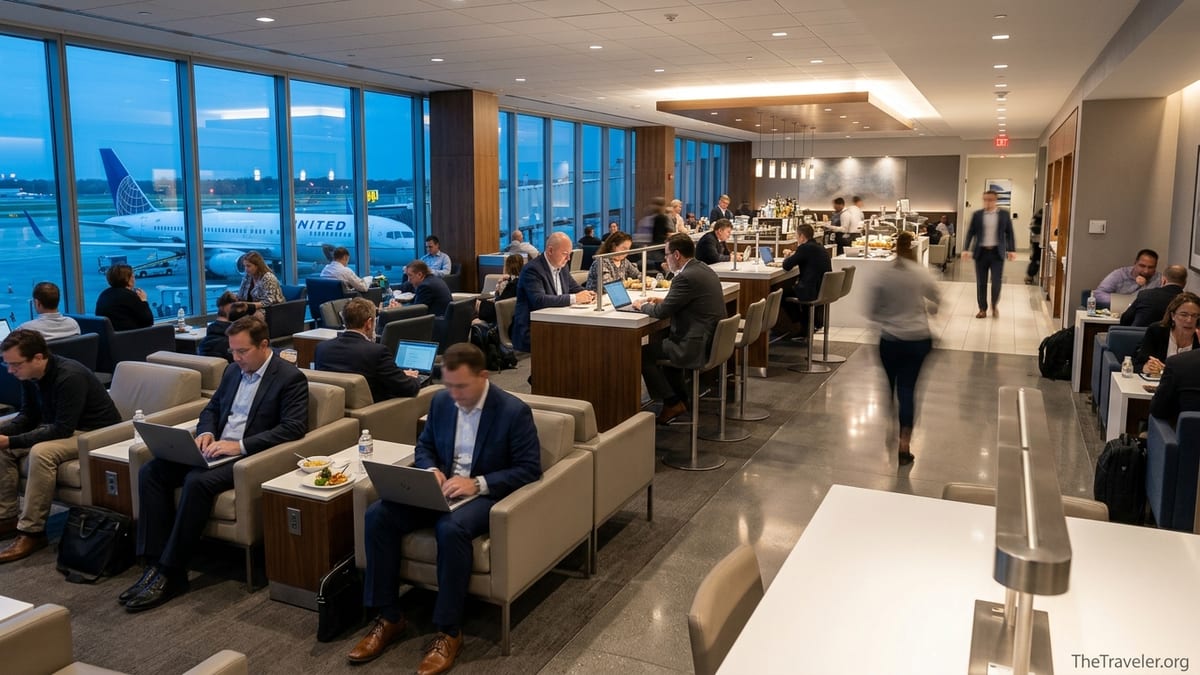
What United Club Really Offers Today
United operates more than 50 United Club lounges worldwide, mostly at its major hubs like Chicago O’Hare, Newark, Denver, Houston, San Francisco and Washington Dulles, along with a handful of international outposts such as London Heathrow. These lounges are designed as business-travel style spaces: work-friendly seating, quiet corners compared with the gate area, and a consistent baseline of amenities that you will recognize from one airport to the next.
A typical United Club offers comfortable chairs and work tables, Wi-Fi, power outlets, soft drinks, coffee machines, draft or bottled beer, house wine and basic spirits at no extra charge. There will usually be light buffet-style food such as soups, salads, snacks and a few hot items that vary by time of day. Some of the newer or renovated clubs, such as those at Newark Terminal C or Chicago O’Hare Terminal 1, also feature barista-made coffee and slightly upgraded food presentations, but you should still think of the experience as solid and functional rather than luxury.
Most locations have staffed customer-service desks that can help you with same-day flight changes and irregular operations. When Newark has a summer thunderstorm or Denver hits a winter blizzard, being able to rebook at a United Club desk instead of waiting in a long line in the concourse can be a significant practical advantage. That customer service element is one reason frequent business travelers still see value in memberships even when food and seating are not a major upgrade.
At the same time, United has been clear that its premium Polaris Lounges are where it focuses its highest-end offering. Recent changes have tightened Polaris access for many Star Alliance partner passengers and pushed more travelers back into standard United Clubs instead. That shift underscores the reality: United Club is positioned as a mid-tier, business-travel product, not a top-shelf flagship lounge.
How Much Does United Club Access Really Cost?
If you want to rely on United Club for regular access, cost is central to the trust question. As of 2026, a standalone annual United Club membership typically runs in the high hundreds of dollars, with exact pricing varying by your MileagePlus status level and whether you pay in cash or miles. Travelers without elite status generally pay more, while Premier Platinum or 1K members may see somewhat reduced rates, but the price is still a substantial recurring expense for anyone who only flies a few times a year.
Many United flyers instead look at co-branded credit cards that bundle lounge access. The United Club Infinite Card, which carries an annual fee over five hundred dollars, includes a United Club membership as its core benefit. In practice, that means unlimited access when you are traveling on a same-day United or Star Alliance flight, plus the ability to bring in at least one guest or children under a certain age subject to United’s current policies. By comparison, the lower-fee United Explorer Card provides two single-use United Club passes each cardmember year rather than full membership, a structure that suits occasional travelers who might use a lounge only on a couple of long-haul trips.
There are also one-time United Club passes sold directly in some channels, often priced just under sixty dollars for a single visit. Those may be offered within the United app when you check in, or through corporate travel programs. When you calculate roughly sixty dollars for one visit with basic buffet food and house drinks, the value proposition looks very different than an annual membership you expect to use twenty or more times. For example, a Chicago-based consultant flying United twice a week could amortize a membership fee over fifty or sixty lounge visits a year, while a casual vacationer would be paying the same price for just a few uses.
Finally, there is the value of getting access indirectly. Star Alliance Gold status with another airline such as Air Canada, Lufthansa or ANA can give you United Club access when flying United in economy class on international itineraries. Military personnel traveling on United or United Express can be admitted with the right documentation. In all cases, the real cost is not only the fee you pay, but how many times you realistically use the lounges each year.
Access Rules, Fine Print and Common Surprises
The biggest source of frustration for travelers who “trust” United Club is not the food or seating, but the rules. United has tightened and revised its lounge access policies several times in recent years, especially around guesting, credit card benefits and eligible flights. Travelers who remember a more relaxed era can be caught off guard if they rely on old information or word of mouth.
One recurring surprise is the requirement for a same-day boarding pass on United, United Express, a Star Alliance partner or an approved partner airline. A traveler connecting through Newark from a low-cost carrier to a separate United ticket might assume a club membership alone gets them in. In reality, the lounge agent will usually require that your boarding pass show a qualifying flight operated that day, and some one-time passes limit entry to the three hours before departure. A printed pass that looks valid is not enough if the timing or carrier does not meet current criteria.
Another common point of confusion concerns the United Explorer Card’s two annual United Club passes. In the past, these were often treated like fully transferable vouchers that cardmembers could give to friends or even resell. More recent terms tie them more clearly to the cardholder or authorized users and specify that passes are valid only for standard United Club locations, not smaller concepts like United Club Fly. Some travelers have arrived at a busy hub such as Denver or San Francisco only to discover that the lounge was not accepting one-time passes at peak hours because of capacity constraints.
Guest policies have also shifted. For example, United Club Infinite cardmembers and paid United Club members can generally bring in a guest and their children under a certain age, but details around how many adults, whether dependents up to age 18 or 21 are covered, and which rules apply in a transition period after policy changes can be confusing. An all-access member traveling through Houston may be allowed to bring a spouse and two teenagers without extra cost, while a traveler relying on a one-time pass may need two separate passes for themselves and a partner in the same situation.
Reliability on the Day: Crowding, Capacity and Service
Trust in a lounge product is ultimately measured at the door. Over the last couple of years, United has seen record passenger volumes and, according to its own reporting, increased sales of memberships and day passes. The result is that many United Clubs at major hubs now experience regular crowding, especially Monday mornings, Thursday evenings and peak holiday periods. Walk into the Newark United Club near the C concourse at 7 a.m. on a Monday and you may find a line at the reception desk and a “limited seating” announcement over the public address system.
Capacity controls mean that holding a pass, membership or qualifying credit card does not always guarantee immediate entry. Some United Club locations use a virtual queue during peak times, texting travelers when space opens up. For example, at Denver, it is not unusual to be told to wait ten or fifteen minutes in the terminal during busy afternoon banks of flights. Travelers relying on an Explorer Card’s two annual passes for a once-a-year family trip can feel understandably frustrated if the promised oasis requires an extra wait with children and carry-on bags in tow.
Service consistency is another factor. United has invested in renovating some flagship lounges, but not all locations are equal. The San Francisco United Club near the G gates, for instance, may offer more modern decor and better food choices than an older outstation lounge at a smaller airport. Staffing levels also matter. When weather disrupts operations, lines at the customer-service desk can be longer than lines at the bar, which affects how much practical benefit you get from your lounge access compared with working from a nearby cafe in the concourse.
To decide whether you should trust United Club as your main lounge solution, you need to be realistic about how flexible you are. If you fly at off-peak times, are comfortable with the occasional delay getting in, and primarily want Wi-Fi and a chair, United Club is generally reliable. If you expect guaranteed peace and quiet at every visit during the busiest departure banks, you are more likely to be disappointed.
Comparing United Club With Other Lounge Options
United Club does not exist in a vacuum. At large U.S. hubs, it often competes indirectly with airline lounges from Delta and American, as well as independent networks like Priority Pass, Plaza Premium and bank-operated spaces such as Amex Centurion Lounges or Capital One Lounges. Each comes with its own access model, quality level and reliability, which influences how much you should lean on United Club in your personal strategy.
For example, a frequent flyer based in Newark who carries a premium travel credit card might have access to an Amex Centurion Lounge plus the United Clubs in Terminal C. In practice, they may choose the Centurion Lounge for longer layovers thanks to more substantial hot food and craft cocktails, while using United Club when they only have thirty minutes between regional flights and want the closest space to their gate. In that scenario, United Club is reliable as a secondary option but not something the traveler counts on for their best experience.
At some international airports, partner or contract lounges outshine United Clubs. A traveler flying United economy from London Heathrow with Star Alliance Gold status, for instance, might have the choice between a United Club and another Star Alliance carrier’s lounge in the same terminal. Depending on current agreements and personal preference, they may trust the partner lounge more for shower availability or quieter seating before a long overnight flight. In contrast, at a domestic hub like Houston, where United’s presence dominates and independent lounges are limited, United Club becomes the default choice and its reliability is more important.
Price comparisons also matter. Paying nearly sixty dollars for a single United Club visit at a smaller airport with minimal buffet food looks less attractive when a Priority Pass card gets you into a contract lounge across the hall that serves similar fare, or when an airline upgrades you to a premium cabin on an international flight that includes better lounge access. Before buying a standalone United Club membership, it is worth auditing which other cards, statuses or tickets you already hold that could deliver equal or better access across your full travel pattern.
When United Club Access Is Worth Relying On
Despite the caveats, there are clear situations where trusting United Club for airport lounge access makes sense. Frequent United flyers based at a hub who travel mostly during business hours are the core audience. A Houston-based consultant who flies United to Chicago and Denver every week, for example, might easily visit a lounge 80 or more times a year. For them, even a high membership fee or the annual cost of a United Club Infinite Card can translate into a modest per-visit cost when you factor in food, drinks and productive working time.
United Club also shines during irregular operations if you are flying United. When a snowstorm snarls Chicago O’Hare and hundreds of passengers rush to rebook, members who can step into a United Club and work directly with an agent at the lounge desk often report significantly faster rerouting and better seat assignments than those who wait at gate podiums. For road warriors, that behind-the-scenes problem-solving is a form of insurance that justifies trusting the brand even if the snacks are not memorable.
Occasional travelers can also benefit when they time their access correctly. A family from Florida connecting through Newark on a once-a-year trip to Europe might use the two passes from a United Explorer Card to access the United Club near their departure gate. Arriving ninety minutes before boarding, they can feed their children, charge devices and decompress away from the main terminal. Used strategically in this way, the passes can effectively turn a stressful layover into a manageable break without paying for a full membership.
Travelers who value predictability above all else may find United Club a better long-term bet than random contract lounges. Even when quality varies, the brand standards, hours and staffing model are more consistent than one-off lounges that can change operators or close unexpectedly. If your work requires you to be online and reachable from the airport several times a week, that baseline consistency is worth considering.
Situations Where You Should Think Twice
On the other hand, there are clear cases where you should hesitate before trusting United Club as your primary lounge solution. If most of your flying is outside the United network, such as low-cost carriers or non-Star Alliance airlines, a paid United Club membership might deliver very little value. You will be paying for theoretical access you rarely have an opportunity to use.
Even dedicated United flyers should be careful if they mainly travel at peak times through the busiest hubs. A New York-based family that primarily flies to Florida on Friday evenings and back on Sunday afternoons through Newark, for example, is likely to see crowded clubs with limited seating, especially during school holidays and long weekends. For them, sixty dollars per visit for one-time passes is a questionable use of money compared with eating at a decent restaurant in the terminal or simply sitting by the gate.
Travelers who prioritize food and drink quality may also be better served by other products. United has improved offerings at some key hubs, but buffets typically remain a few notches below the level of Amex Centurion Lounges or premium international carrier lounges. If you view airport lounges primarily as dining experiences and you hold cards or tickets that grant access to higher-tier spaces, relying on United Club could feel like settling for less.
Finally, anyone who dislikes dealing with shifting rules should be cautious. Over the last several years, United has raised membership prices, adjusted guest allowances and refined credit card benefits. The direction of travel has generally been toward more restrictions, not fewer. Travelers who do not want to monitor policy updates or risk a surprise at check-in might be happier basing their lounge strategy around products with simpler, more stable access terms.
The Takeaway
So should you trust United Airlines United Club for airport lounge access? For many travelers, the honest answer is “yes, with eyes open.” United Club is a reliable, mid-tier lounge product that delivers consistent basics: a quieter space, Wi-Fi, power outlets, light food, drinks and access to dedicated customer-service staff. Used regularly by frequent United flyers, especially those based at major hubs, it can absolutely justify the cost of a membership or a premium United credit card.
At the same time, United Club is not a guarantee of peace and comfort at any price. Crowding, capacity controls and evolving rules mean that holding a card or pass is not the same as having a reserved seat. Occasional travelers, peak-time vacationers and those with access to superior lounges through other cards or airlines should think carefully before making United Club their primary solution.
The most sensible approach is to view United Club as one tool in a broader airport strategy. Combine it with priority security lanes, flexible flight times and alternative lounge options where available. Know the current access rules for your membership or card, build in a little extra time in case of queues at the door, and keep your expectations anchored at “solid business lounge” rather than “five-star hotel.” Under those conditions, you can trust United Club to add real value to your travel experience without expecting more than it is designed to deliver.
FAQ
Q1. Does a United Club membership guarantee me entry every time?
No. A membership or qualifying credit card gives you eligibility, but entry is still subject to capacity limits, local rules and same-day flight requirements.
Q2. Are the two United Club passes from the United Explorer Card enough for most travelers?
They can be for occasional travelers who fly United only once or twice a year, but frequent flyers will usually want full membership or a premium card instead.
Q3. Can I use a United Club pass if I am flying another airline the same day?
Generally you need a same-day boarding pass on United, United Express, a Star Alliance carrier or an approved partner. Separate tickets on unrelated airlines may not qualify.
Q4. How crowded are United Clubs during peak travel times?
At major hubs like Newark, Denver and Houston, lounges can be very busy on Monday mornings, Thursday evenings and holidays, sometimes triggering entry queues or waits.
Q5. Is United Club food good enough to replace a meal in the terminal?
In many lounges the buffet is sufficient for a light meal, but it usually will not match a sit-down restaurant or top-tier premium lounge in quality or variety.
Q6. Do United Club Infinite Card holders get the same access as paid members?
Yes, the card effectively includes a United Club membership with similar access rules and guest privileges, subject to the airline’s latest terms and conditions.
Q7. Is it better to buy one-time passes or an annual membership?
If you visit lounges only a few times a year, one-time passes or Explorer Card benefits may suffice. Once you exceed roughly a dozen visits a year, membership becomes more compelling.
Q8. Can families with children rely on United Clubs during long connections?
Yes, many families find United Clubs helpful for charging devices and getting snacks, but they should expect crowding at peak times and bring backup entertainment for kids.
Q9. How does United Club compare with independent lounges like Priority Pass?
United Clubs usually offer more consistent hours and airline support, while some independent lounges may provide better food or quieter spaces depending on the airport.
Q10. Are United Clubs improving or getting more restrictive over time?
United has invested in renovations and some upgraded amenities, but it has also raised prices and tightened access rules, so travelers should monitor changes before committing.