


Landing at the new Siem Reap Angkor International Airport can feel disorienting. The terminal is modern and spacious, but the city is around 50 kilometers away, and there is no metro, train, or public bus into town. Knowing in advance how taxis, private cars, and the official transport desk work will save you money and stress, especially if you arrive late at night or are carrying heavy luggage.
Get the latest updates straight to your inbox!
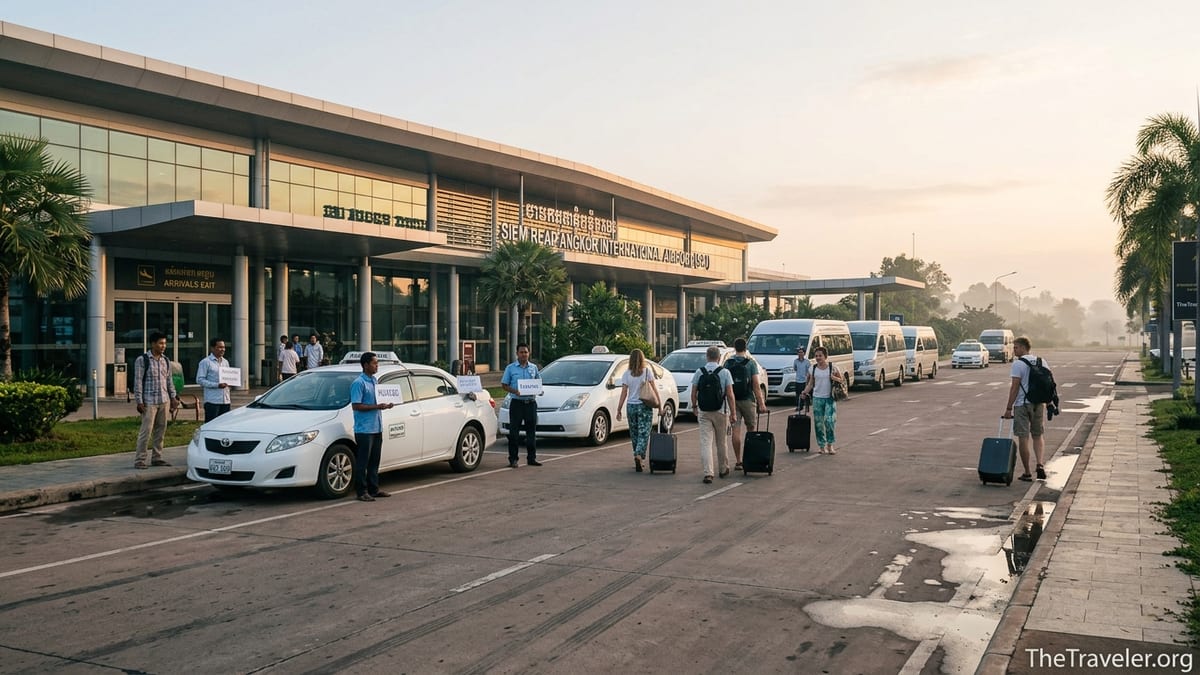
Understanding the New Siem Reap Angkor Airport Layout
The Siem Reap Angkor International Airport (IATA code SAI) opened in October 2023 and fully replaced the old in-town airport. It sits roughly 50 kilometers from central Siem Reap, close to National Road 6, with a transfer time of about 45 to 75 minutes depending on traffic and weather. This distance is the single biggest change visitors notice, because what used to be a quick 15-minute hop is now a genuine intercity-style transfer.
Arrivals are straightforward. After immigration and baggage claim, you walk into a public arrivals hall with ATMs, currency exchange counters, a small selection of cafés, and the official transport and tour desks near the main exit. The hall is compact enough that you can see most services at a glance, but it can still feel busy when several international flights arrive within a short window.
Outside the sliding doors you will find two main zones. Immediately in front of the terminal is a short-stay pick-up area where pre-booked hotel cars and private drivers wait with signs. A little further out is the general vehicle parking and taxi area. Walking distance is not excessive, but it is far enough that pulling heavy suitcases in Cambodia’s heat can be uncomfortable, so it is worth knowing where you are going before you step outside.
There is currently no rail link or city bus line that runs directly between the airport and Siem Reap. A few long-distance buses between provinces may stop near the airport highway junction, but they are not designed for new arrivals with luggage. In practice, almost all travelers use either an airport taxi, a pre-booked private car, or a transfer arranged by their hotel.
Airport Taxi Prices and How Much You Should Expect to Pay
Because the airport is about an hour from town, taxi prices are higher than what many travelers remember from the old airport. For a standard sedan taxi booked on arrival, most recent travelers report paying roughly 25 to 30 US dollars for the one-way trip into central Siem Reap. Prices vary slightly depending on where in town you are staying and the time of day, but anything in that band is considered normal and fair.
If you are heading to a popular area such as Pub Street, Sok San Road, or the Old Market district, expect drivers to quote a flat price rather than using a meter. For example, a family of three arriving on an evening flight might be quoted 28 dollars at the airport for a direct transfer to a mid-range hotel on Wat Bo Road, with no extra charge for luggage. The same ride pre-booked with a local transfer company could cost around 22 to 25 dollars, agreed in advance by email or messaging app.
Larger vehicles cost more. If you are a group of four to six people with checked luggage and need a van or SUV, prices often range from about 30 to 40 dollars for the whole vehicle. One common scenario is two couples with four large suitcases landing on the same flight and sharing a van for 35 dollars, which works out to less than 9 dollars per person for a door-to-door transfer that takes about an hour.
On the budget end, some travelers try to negotiate with independent drivers just outside the terminal building, aiming for 20 to 23 dollars for a standard car. This may be possible at quieter times, especially for midday flights when drivers know they can pick up a return fare back to the airport. However, arriving after 10 pm or during peak tourist months, you should be prepared for less flexibility and slightly higher quotes.
The Official Transport Desk: How It Works and When to Use It
Inside the arrivals hall, close to the main exit, you will find an official transport or tourist assistance desk operated in coordination with local transport providers. Staff speak basic English and can arrange a car or van directly from the airport at fixed rates, which are displayed on a printed board or laminated sheet. These rates are typically aligned with the going market price, often around 25 to 30 dollars for a standard car into central Siem Reap.
Using the desk is straightforward. You tell the staff your hotel name and approximate area, confirm the quoted price, pay in cash or sometimes by card, and receive a slip or ticket. A uniformed staff member then escorts you outside to match you with a driver. For solo travelers or first-time visitors landing at night, this can feel much safer and more organized than negotiating outside on your own.
The main advantage of the desk is transparency. You avoid the possibility of a driver changing the price mid-journey or adding sudden “luggage fees.” For example, a solo traveler arriving from Bangkok at 9 pm might simply walk to the desk, pay 27 dollars, and be in a taxi within 10 minutes, with no haggling. For someone who has just endured a long-haul connection, that simplicity is often worth a few extra dollars.
The drawback is that the fixed rates leave little room for bargaining. If you are traveling as a group and comfortable negotiating, you may be able to secure a slightly better deal by speaking directly with drivers in the parking area, especially in shoulder seasons when there is more competition for fares. Even then, many visitors still choose the desk for peace of mind and a clear paper record of the price and vehicle type.
Pre-booked Private Cars, Hotel Pickups and Ride Apps
Pre-booking a private transfer has become the preferred option for many travelers, particularly those arriving late at night, with children, or with bulky luggage such as camera gear or sports equipment. Numerous local companies and guesthouses now offer airport pickups at published rates, usually in the 22 to 30 dollar range for a standard car. In these cases, you typically pay online in advance or settle with your hotel at check-out.
A common real-world example is a boutique hotel along the riverside that advertises “airport pickup 25 USD per car.” Guests email their flight details, receive a confirmation, and on arrival find a driver at the exit holding a sign with their name. The journey takes about an hour, and the cost is simply added to the room bill. For visitors unfamiliar with Cambodia or traveling with elderly parents, the added comfort of a known driver and vehicle is frequently worth the small premium.
Some app-based services and regional ride-hailing platforms operate in Siem Reap itself, but their coverage to and from the new airport remains limited and inconsistent. Because the airport is far from town, few app drivers are willing to wait there for long periods, especially at off-peak times. You may find that opening a ride-hailing app at the terminal shows no available cars, or only very long estimated waits. Even when cars do appear, quoted prices can be similar to or higher than local taxis because of the long distance.
For that reason, relying solely on an app at SAI is risky, especially for late arrivals. You can consider using a ride-hailing app once you are in town for shorter journeys, such as traveling from your hotel to Angkor ticket office or to outlying cafés and restaurants. For the airport run itself, pre-booked cars, hotel transfers, or the official transport desk remain the most practical and predictable choices.
What to Expect if You Land Late at Night
Many international flights into Siem Reap arrive in the evening, and some land close to or after midnight. The airport stays operational around flight schedules, but services in the arrivals hall naturally thin out as the night progresses. A few cafés and shops may close early, and the number of available taxis and drivers waiting outside usually decreases after the last major wave of flights.
If you are scheduled to land after 10 pm, it is wise to organize your transport before you fly. That could mean booking a private car with a local company, confirming an airport pickup with your hotel, or at least planning to use the official transport desk as your default option. A typical late-night scenario is a couple arriving from Seoul around 11 pm who emerge into a quieter arrivals hall, quickly spot their hotel driver with a sign, and are on the road within 15 minutes, bypassing any uncertainty outside.
Travelers who arrive late without a plan may still find taxis available, but they have less room to compare prices or vehicle types. A lone backpacker landing at 12:30 am might walk out to the taxi area and find only a small group of drivers, most quoting around 30 dollars. At that hour, trying to bargain down to 22 or 23 dollars is often unproductive, and it can feel uncomfortable to negotiate when you are tired and the airport is quiet.
One practical precaution for late arrivals is to make sure your phone can connect to mobile data or airport Wi-Fi so that you can contact your hotel if your flight is delayed. Hotels and drivers are used to schedule changes, but they need a way to reach you. Screenshots of your hotel address, in both English and Khmer if possible, can also be useful if you end up using an ad-hoc taxi who is not familiar with smaller guesthouses.
Choosing the Best Drop-off Area for Your Hotel
Siem Reap’s hotels and guesthouses are spread across several main areas, and where you stay affects both travel time and how easy it is for drivers to find your accommodation. The most popular zone is around Pub Street and the Old Market, where you will find everything from budget hostels to stylish boutique hotels. For addresses in this area, drivers are very familiar with the streets and can usually drop you right at the door without difficulty.
Wat Bo Road and the riverside area, on the opposite bank from Pub Street, have many mid-range hotels and quieter guesthouses. A typical example is a small riverside hotel that offers its own 25 dollar pickup but is also easily reached by standard taxi. Drivers know Wat Bo Road well, and even if they are not familiar with your specific property, a printed booking confirmation or map on your phone usually solves any confusion.
Further out, larger resorts and family-friendly hotels cluster along National Road 6 and the roads leading toward the Angkor ticket office. These properties often have their own shuttle vans and are used to guests arriving from the new airport. If you are staying in one of these outlying resorts, it is particularly helpful to pre-book pickup, as the hotel’s chauffeur will know the most direct route from SAI and how to navigate any construction or detours.
If your driver seems unsure of your location, giving a well-known landmark near your hotel helps. You can say, for instance, “near Pub Street,” “close to the Old Market,” or “on the river, south of the bridge.” This is especially useful for smaller homestays and new guesthouses that may not yet appear clearly on in-car navigation systems. Most drivers are keen to provide good service in the hope of future referrals or additional touring work.
Handling Luggage, Families, and Special Situations
Siem Reap Angkor Airport was built with modern baggage systems and spacious carousels, and handling luggage is generally straightforward. The main consideration is how much space you will need in your transfer vehicle. A standard sedan will comfortably fit two people with two large checked bags and two carry-ons. Once you add a third large suitcase or bulky items like tripods or musical instruments, space becomes tight and upgrading to a larger car or van is more comfortable.
Families with small children should plan a bit more carefully. Most airport taxis and private cars are not equipped with child safety seats by default, and seat belts in the back seats may vary in quality. If a car seat is important for you, arrange this with a private transfer company or your hotel well in advance and confirm it in writing. Some higher-end hotels can provide a child seat for an extra fee or as part of their premium transfer service.
Travelers with oversized luggage, such as bicycles in hard cases or large camera equipment, should indicate these items when booking. A cycling group, for example, might reserve a van in advance for around 35 to 40 dollars to ensure room for both passengers and bikes. Turning up unannounced with bulky gear and expecting a small taxi to accommodate everything often leads to last-minute rearrangements and extra waiting time in the parking area.
For those with mobility concerns, such as wheelchair users or travelers recovering from surgery, the new airport’s flat surfaces and elevators make it easier to navigate than many older regional terminals. However, accessible vehicles are still limited. If you need a car with extra space, minimal steps, or the ability to stow a wheelchair without dismantling it, coordinate with your hotel or a specialized transfer provider well ahead of your arrival date.
Staying Safe and Avoiding Confusion or Scams After Landing
Overall, Siem Reap is a friendly and welcoming destination, and most visitors travel between the airport and town without any problems. Nevertheless, a few simple habits will help you avoid confusion and small-scale scams. The first is to always confirm the total price before you get into any vehicle, and to clarify whether the quote is per car or per person. Airport taxis and reputable private transfers quote per vehicle, but misunderstandings can happen in the rush of arrival.
It is also wise to ask whether the quoted price includes any tolls or parking fees, even though these are usually bundled into airport transfer prices. One common trick in some destinations is for a driver to add an unexpected “airport fee” at the end of the ride. While this is not a widespread issue in Siem Reap, a quick question at the start, such as “30 dollars total, all included, to my hotel?” makes it harder for surprise charges to appear later.
Another way to reduce confusion is to verify the driver and vehicle if you are using a pre-booked service. When you book through your hotel or a transfer company, they will usually give you the driver’s name, the car’s color, and sometimes the license plate number. When you walk out into the arrivals area and see several drivers holding signs, double-check these details before following anyone. This is especially important for solo travelers or those arriving very late at night.
Finally, keep some small denomination US dollar bills handy, such as 1s and 5s. Cambodia widely accepts US currency, and paying the exact agreed amount avoids tense moments while making change in the dark outside a hotel gate. Tipping is not mandatory, but rounding up a dollar or two for a safe, comfortable trip is appreciated, particularly if your driver helps with heavy bags or patiently waits while you check in.
The Takeaway
Arriving at the new Siem Reap Angkor International Airport is a very different experience from landing at the old in-town terminal, mainly because of the longer distance into the city. With transfers taking up to an hour and prices typically between 25 and 30 dollars for a standard car, being prepared matters more than it once did. The good news is that you have several reliable options, from the official transport desk to pre-booked private cars and hotel pickups.
If you are arriving during the day with light luggage, you can comfortably decide on the spot whether to use the desk or negotiate directly with drivers. For late-night arrivals, families, or travelers with special requirements, arranging a transfer in advance is well worth the extra effort. In all cases, confirming the price, keeping your hotel address handy, and choosing a vehicle that fits both your group and your bags will ensure a smooth start to your time in Siem Reap.
Once you are settled at your hotel near Pub Street, by the river, or in one of the larger resorts on National Road 6, the temples and night markets are just a short ride away. With the logistics of airport transport handled in advance, you can focus on what really matters: sunrise at Angkor Wat, wandering through root-covered temples, and exploring the food and culture that make Siem Reap such a rewarding place to visit.
FAQ
Q1. How much does a taxi from Siem Reap Angkor Airport to the city cost?
The typical price for a standard car into central Siem Reap is around 25 to 30 US dollars per vehicle, depending on time of day and exact hotel location.
Q2. How long does the transfer from the airport to Siem Reap take?
The drive usually takes between 45 minutes and 1 hour 15 minutes, with most travelers reaching hotels near Pub Street in about an hour under normal traffic conditions.
Q3. Is there an official transport desk at Siem Reap Angkor Airport?
Yes. In the arrivals hall you will find an official transport or tourist assistance desk that offers fixed-rate cars and vans to hotels in and around Siem Reap.
Q4. Can I use ride-hailing apps from the new airport?
Coverage from the airport is limited and inconsistent. You may not always find available cars, so it is safer to rely on taxis, private transfers, or hotel pickups for the airport journey.
Q5. Should I pre-book a transfer if my flight arrives late at night?
Pre-booking is strongly recommended for arrivals after about 10 pm, as there are fewer taxis waiting and you will have less flexibility to compare prices or vehicle types.
Q6. Do hotels in Siem Reap offer airport pickup services?
Many hotels and guesthouses offer paid airport pickups, typically in the 22 to 30 US dollar range for a standard car. The cost is often added to your room bill.
Q7. Is it safe to take a taxi from the airport?
Yes, most travelers report that airport taxis are safe and straightforward. Agree the full price before departure and, if possible, use the official desk or a pre-booked driver.
Q8. Are child seats available in airport taxis?
Child seats are not standard in most taxis. If you need one, arrange it in advance with a private transfer company or a hotel that can provide a suitable vehicle.
Q9. How much luggage can a standard taxi handle?
A typical sedan comfortably fits two passengers with two large checked bags and hand luggage. For three or more big suitcases or bulky gear, it is better to book a larger car or van.
Q10. Can I pay for my airport transfer by card?
Some hotels and private transfer companies allow card payment, especially if you pre-book. Most independent taxis expect cash, usually in US dollars, so carry small bills just in case.