


More news on this day
A SkyWest-operated United Express flight from Green Bay to Chicago made a brief departure from its scheduled route before turning back to Green Bay shortly after takeoff, according to live flight-tracking data and publicly available operational information.
Get the latest news straight to your inbox!
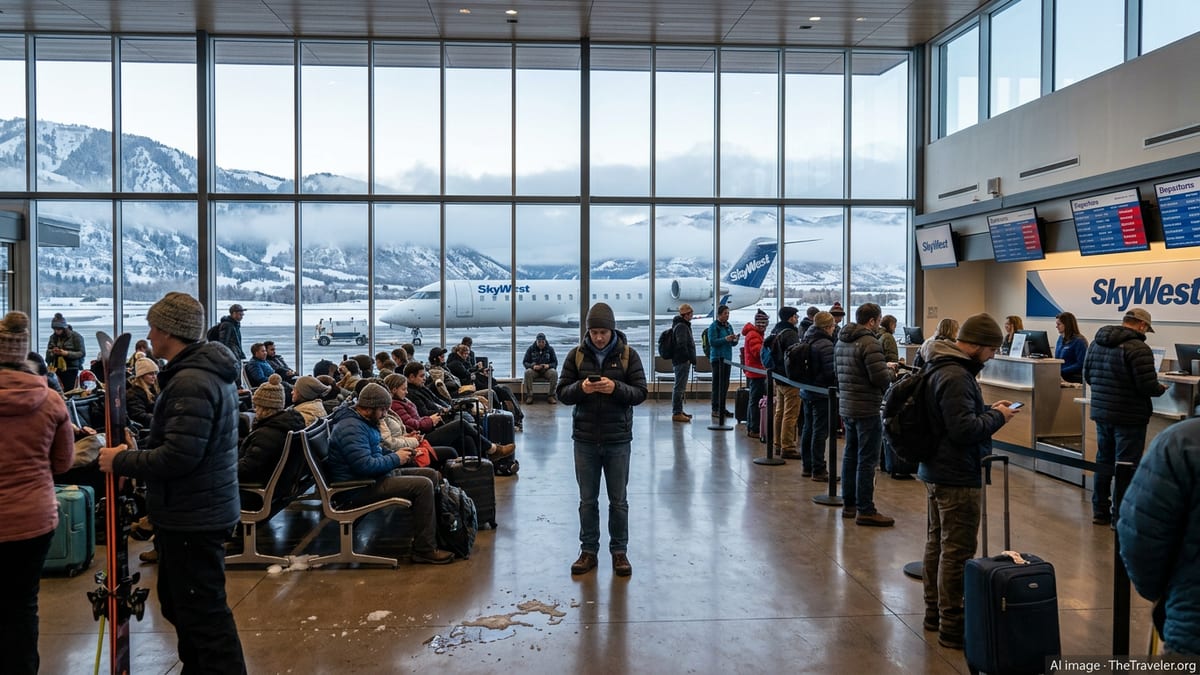
Short Green Bay to Chicago Hop Disrupted Midroute
The SkyWest Airlines flight, operating under the United Express brand as SKW5194 and using a Mitsubishi CRJ-200LR regional jet, had been scheduled on the familiar short-haul corridor between Green Bay Austin Straubel International Airport and Chicago O’Hare International Airport. The sector typically covers less than an hour of flying time, with regional jets like the CRJ-200LR commonly used to shuttle passengers to United’s major hub in Chicago.
On this occasion, departure from Green Bay appeared routine based on standard scheduling and aircraft type information published for the route. The CRJ-200LR, part of the long-range variant of the CRJ200 family now supported by Mitsubishi Heavy Industries’ MHI RJ Aviation, is widely used in North American regional operations for its ability to serve thinner markets with frequent connections.
Shortly after climbing out and tracking toward Chicago, however, SKW5194 did not continue on its usual path to O’Hare. Instead, flight-tracking data indicated a turn away from the planned routing and a return toward Green Bay, effectively transforming the outbound leg into a rapid U-turn back to the airport of origin.
The turnaround meant passengers expecting a quick connection into United’s Chicago network saw their plans disrupted on a route that is often marketed as a reliable shuttle for business and leisure travelers across Wisconsin and northern Illinois.
Flight-Tracking Data Points to Swift Decision in the Climb
Publicly accessible flight-tracking platforms show the aircraft departing Green Bay, initiating the standard climb toward cruise altitude, and then adjusting course well before reaching the halfway mark to Chicago. The plotted path reflects a relatively tight arc rather than an extended diversion to an alternate airport, which suggests the decision to return was made early in the flight profile.
While exact altitudes and time stamps may vary slightly among tracking providers, the pattern indicates that SKW5194 did not level off for a sustained cruise segment. Instead, the jet appears to have begun maneuvering back toward Green Bay within a short window after departure, consistent with a precautionary or operationally driven return rather than a prolonged airborne holding pattern.
Operational data for the Green Bay to Chicago corridor highlights how quickly conditions can change on regional flights. With scheduled gate-to-gate times often under an hour, crew members have limited time to troubleshoot irregularities aloft before confronting fuel, weather, and sequencing considerations near a major hub like O’Hare. Turning back to the departure airport can in some cases simplify handling, maintenance access, and onward passenger accommodation.
Reports from similar regional events in the upper Midwest, including diversions into and out of Chicago during periods of unsettled weather or traffic management initiatives, illustrate how quickly a normally routine flight can be rerouted when flight crews and dispatchers judge it prudent to alter plans.
Context: Busy Midwest Airspace and Weather Sensitivities
The Green Bay to Chicago route sits within one of the most complex air traffic environments in the United States. Chicago O’Hare routinely ranks among the nation’s busiest airports, and the broader Midwest airspace often experiences congestion linked to convective weather, low ceilings, and tight bank structures that funnel regional jets into narrow scheduling windows.
Recent Federal Aviation Administration planning updates for the Chicago region have noted the potential for delays and reroutes around periods of thunderstorms and gusty winds. When such conditions coincide with high traffic levels at O’Hare, regional flights are frequently among the first affected by flow-control measures, ground delay programs, or spacing requirements that can change a flight’s operational calculus shortly after takeoff.
Although specific causation for SKW5194’s return to Green Bay has not been formally detailed, publicly available operational patterns suggest a range of possibilities that are familiar in regional flying. These scenarios can include minor technical issues that are more easily addressed at the origin station, shifting weather thresholds along the arrival corridor, or revised traffic management instructions that make a short-hop continuation less practical.
In such cases, returning to the departure field can give both passengers and airline operations teams clearer options than pressing on to a hub that may already be under strain from weather or congestion, particularly when the alternate airport is only a brief flight away.
Impact on Passengers and Regional Connectivity
For travelers, the abrupt U-turn of SKW5194 likely meant missed connections, rebooked itineraries, and additional time on the ground in Green Bay. The route is commonly used as a feeder into United’s extensive domestic and international network at O’Hare, and even short disruptions can cascade into longer delays for those bridging to onward flights.
Regional passengers who rely on small-jet links to larger hubs often have limited same-day alternatives when a flight returns to its origin. Options may include being rebooked on later departures to Chicago, rerouted through other Midwest airports, or in some cases shifted to ground transportation if schedules and distance make that feasible. The relatively short stage length between Green Bay and Chicago means that aircraft swaps or schedule adjustments can sometimes restore capacity later in the day, but peak-bank disruptions are not always easy to absorb.
At the same time, airline safety and reliability frameworks are structured to prioritize precautionary decisions even when they inconvenience passengers in the short term. When flight crews elect to return to the departure point, they typically do so within a system that allows for conservative judgment about technical anomalies, cockpit indications, or external factors such as weather and runway conditions along the intended route.
Regional operators like SkyWest, which fly under capacity-purchase agreements for major carriers, play a critical role in preserving connectivity for smaller communities. Events such as the SKW5194 U-turn underline the operational complexity behind what appears to be a simple short hop, and highlight how regional aviation remains sensitive to even minor irregularities in a tightly scheduled network.
Spotlight on the Mitsubishi CRJ-200LR in U.S. Regional Fleets
The aircraft type involved, the CRJ-200LR, traces its roots to the original Bombardier CRJ200 program and is now associated with Mitsubishi’s MHI RJ Aviation following the transfer of the CRJ program several years ago. The long-range LR version has been a workhorse in North American regional service, enabling carriers to operate thinner routes and high-frequency shuttles linking smaller cities to major hubs.
Across the Midwest and other U.S. regions, the CRJ-200 family continues to appear on schedules for short sectors similar to Green Bay to Chicago, often under the banners of major carriers through regional partners like SkyWest. Published fleet and route data show that these jets remain particularly common on early-morning and late-evening rotations that connect local markets with banks of departures at large hubs.
Although the industry trend has gradually shifted toward larger regional jets and small mainline aircraft, the CRJ-200LR still fills a niche on routes where demand is steady but does not yet justify bigger airframes. Events such as the SKW5194 return serve as a reminder of the type’s ongoing presence in U.S. skies, and of the operational decisions that shape how regional fleets are deployed on any given day.
For travelers planning itineraries through smaller airports like Green Bay, understanding that regional jets and short hops can be more sensitive to day-to-day operational shifts may help set expectations. While most flights operate without incident, the SKW5194 U-turn illustrates how quickly an otherwise routine connection can be altered in a tightly choreographed regional network.