


More news on this day
A routine United Express flight operated by SkyWest between Chicago O’Hare and South Bend attracted attention from aviation watchers when it diverted from its planned route and returned to Chicago instead of continuing to northern Indiana, raising fresh questions about how regional carriers manage potential technical issues on some of the United States’ shortest commercial sectors.
Get the latest news straight to your inbox!
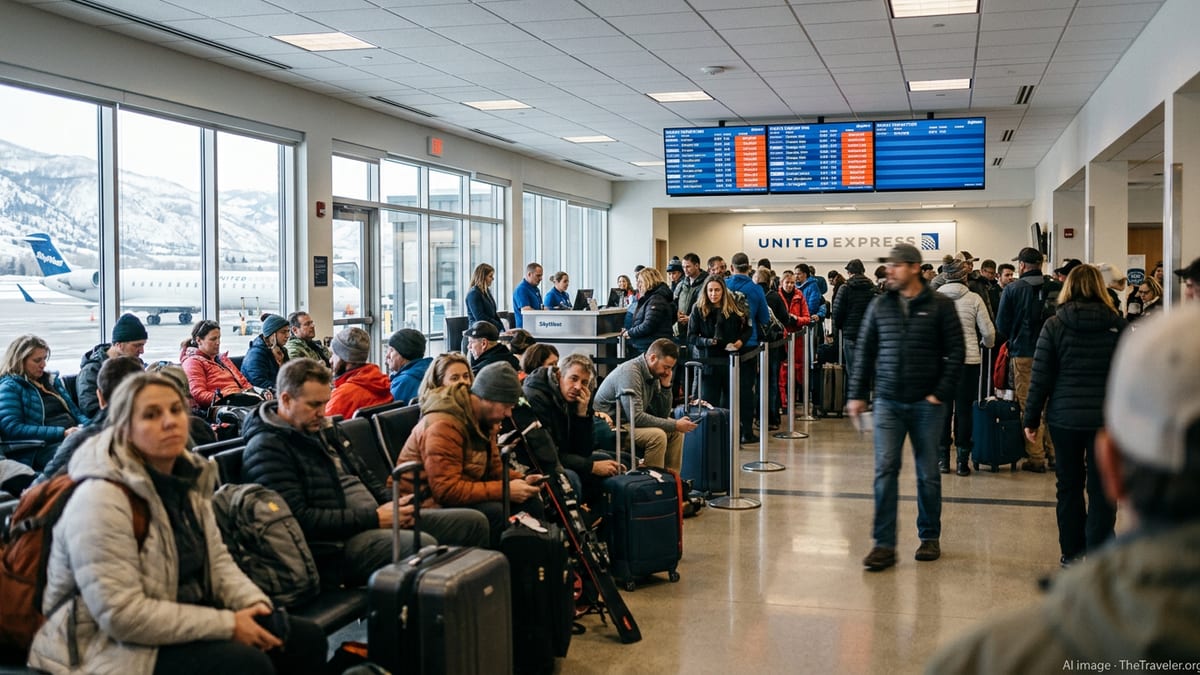
Short-Hop Flight Turns Back Toward O’Hare
The flight, listed as SkyWest SKW5499 and operating as United Express with a Mitsubishi CRJ-200LR regional jet, was scheduled to link Chicago O’Hare International Airport and South Bend International Airport. The route covers barely 84 miles of air distance, a sector that typically takes around 25 minutes of airborne time and serves primarily as a feeder connection into United’s Chicago hub.
Tracking data reviewed after the incident indicates that the aircraft departed O’Hare as planned and initially proceeded on the standard routing toward Indiana before leveling off and turning back toward Chicago. Instead of continuing across Lake Michigan’s southern shoreline toward South Bend, the jet re-entered the Chicago arrival stream and landed back at O’Hare.
No abnormal weather was reported along the route at the time, and there were no concurrent reports of airspace closures or traffic-management initiatives that would have required a return. The pattern of the diversion has led aviation observers to focus on the likelihood of a suspected technical or operational issue on board, prompting the captain to cut short the brief flight.
In line with typical regional operations, the service was marketed under the United Airlines code while being flown by SkyWest crew on SkyWest-operated equipment, part of the broader United Express network that connects smaller Midwest cities to Chicago for onward connections.
Suspected Technical Issue on a Workhorse Regional Jet
Although the exact trigger for the diversion has not been publicly detailed, the sequence of events is consistent with standard responses to a caution light, minor system discrepancy or maintenance-related concern on a regional jet. On short sectors such as Chicago to South Bend, crews have limited time in cruise to troubleshoot, increasing the likelihood that any unresolved alert will result in a return to the hub rather than a continuation to the outstation.
The Mitsubishi (Bombardier) CRJ-200LR involved is part of a long-serving family of 50-seat regional jets that have formed the backbone of North American feeder operations for decades. Industry data shows that SkyWest continues to operate a fleet of CRJ-200s for United Express on thinner routes where passenger volumes do not support larger aircraft but reliable schedule frequency is still required.
Aviation analysts note that aging regional jets can be more susceptible to minor technical snags that, while rarely serious, demand a conservative operating posture. In such cases, company procedures typically favor returning to a major maintenance base like Chicago, where spare parts, technicians and replacement aircraft are readily available, rather than pressing on to a smaller destination with more limited support infrastructure.
Publicly available flight information for United Express and SkyWest operations around O’Hare shows a pattern of occasional turn-backs and swaps on CRJ and Embraer regional fleets, reflecting the operational reality of high-frequency, short-haul flying in a complex hub environment.
Passenger Disruption on One of America’s Shortest Routes
For passengers, the decision to return to Chicago transformed what is often barely a half-hour hop into a more protracted travel day. Instead of a quick arrival in South Bend, customers were brought back to the origin airport and faced rebooking or onward ground transportation for the remaining distance, which is roughly a two-hour drive by car.
United’s published schedules show multiple daily frequencies between Chicago and South Bend operated by United Express partners, giving airline staff several options for re-accommodating affected travelers. On hub-and-spoke networks, passengers connecting onward from South Bend often have flexibility to be rebooked on later itineraries via Chicago or other hubs, depending on availability.
Industry practice on such disruptions usually involves a combination of same-day rebooking, meal vouchers where applicable and, in some cases, surface transport arrangements when the remaining distance is relatively short. On ultra-short routes such as Chicago to South Bend, bus or car transfers can sometimes deliver travelers more quickly than waiting for a replacement flight, particularly if aircraft and crew positioning are constrained.
Travelers on regional flights are also affected by the limited number of backup aircraft at smaller stations. By returning to the Chicago hub, the airline can more easily swap in a substitute jet or reassign passengers across the day’s schedule of departures to minimize overall delay.
Spotlight on Regional Safety Procedures and Conservative Operations
The SKW5499 event underscores how conservative decision-making remains a central feature of regional airline operations in the United States. Even in the absence of any reported emergency, a deviation from the planned route and a return to a major hub often signal that flight crews are applying a “safety first” approach in line with their training and company manuals.
Regional jets such as the CRJ-200LR operate high cycle counts, with multiple takeoffs and landings per day on short segments. This pattern of use places particular emphasis on fatigue monitoring of components, repetitive inspections and prompt resolution of cockpit alerts. Industry reporting on similar incidents in recent years points to a range of causes for mid-flight returns, from minor pressurization concerns to caution indications on engine or hydraulic systems that, while not immediately hazardous, demand further inspection on the ground.
Aviation safety specialists frequently highlight that flight crews are encouraged to err on the side of caution whenever they have doubts about the continued airworthiness of the aircraft. Returning to a primary maintenance hub gives technicians the opportunity to complete detailed checks, clear any fault messages and, when necessary, remove the aircraft from service until repairs are completed and test flights are performed.
The visibility of such events has increased with the widespread use of flight-tracking platforms and social media, which enable the public and aviation enthusiasts to follow diversions and returns in real time. This added transparency has, in turn, drawn attention to the operational robustness of regional networks and the layers of safety built into day-to-day flying.
What the Incident Means for Travelers on United Express
For travelers who rely on United Express services operated by SkyWest, the diversion of flight SKW5499 serves as a reminder that disruptions can occur even on the shortest domestic sectors. While frustrating in the moment, these decisions typically reflect a cautious mindset intended to prevent relatively minor technical issues from escalating.
Demand for feeder traffic into Chicago and other hubs is expected to remain strong, with regional partners like SkyWest continuing to operate a mix of 50-seat and larger regional jets on routes to smaller cities including South Bend. Industry trends point to a gradual fleet shift toward newer aircraft types, but many CRJ-200s remain active on thinner routes where their size and performance characteristics are still well matched to local demand.
For passengers planning itineraries through Chicago, awareness of the nature of these short flights can help set expectations. On sectors of less than 100 miles, gate-to-gate times are more heavily influenced by ground operations, air traffic flows and maintenance logistics than by airborne flying time alone. When irregular operations do occur, travelers who build additional connection buffers into their schedules are often better positioned to absorb delays.
As United and SkyWest continue to refine their regional networks, events such as the SKW5499 return illustrate how closely watched these operations have become in the age of real-time tracking, and how the industry’s conservative approach to safety continues to shape decision-making even on the briefest of journeys.