


The night I slept at LeConte Lodge, the Great Smoky Mountains felt less like a national park and more like a remote mountain outpost from another century. No cars, no humming generators, no glow of cabin televisions bleeding into the trees. Just the soft hiss of kerosene lanterns, the murmur of tired hikers sharing trail stories, and the wind pushing clouds past the summit of Mount Le Conte far below a sky full of stars. I had stayed at plenty of mountain inns before, but nothing prepared me for how different, how delightfully stripped down, a night at LeConte Lodge would be.
Get the latest updates straight to your inbox!
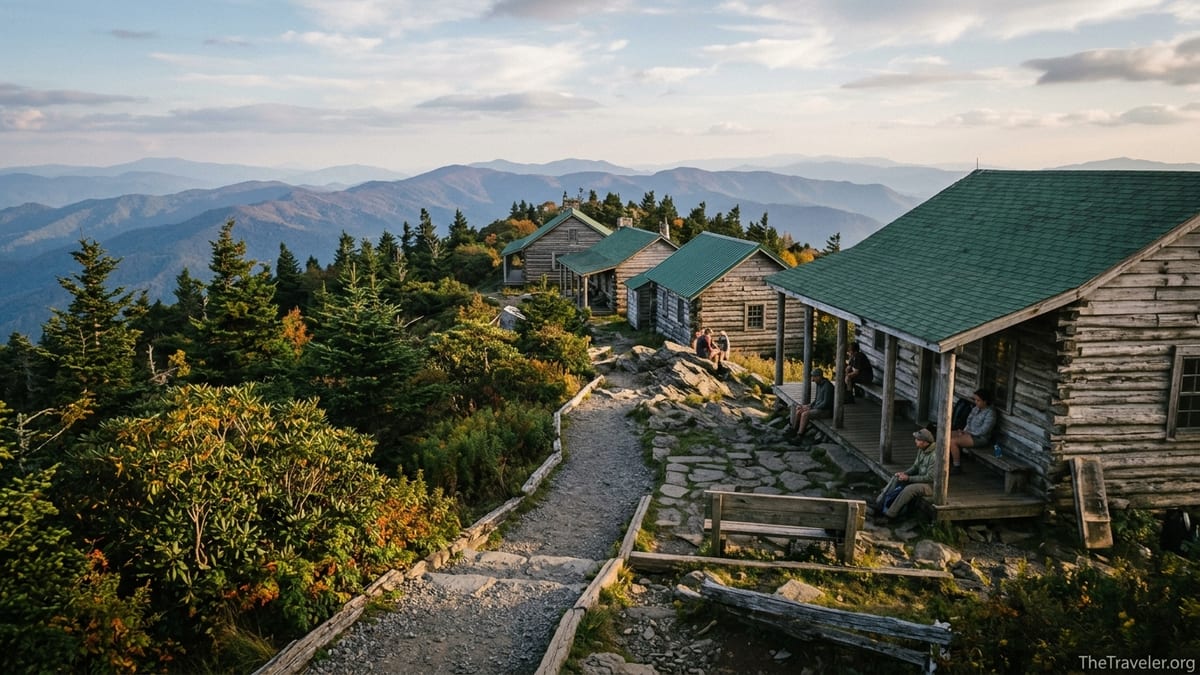
A Lodge You Can Only Reach On Foot
LeConte Lodge sits just shy of the 6,593-foot summit of Mount Le Conte in Great Smoky Mountains National Park, and the first surprise hits you long before you ever see a cabin roof: there is no road. The only way to bed here is by hiking one of five demanding trails, from the steep but wildly scenic Alum Cave Trail at about 10 miles round trip to the longer Trillium Gap and Boulevard routes. Even the easiest options involve more than 2,500 feet of elevation gain and several hours of steady uphill walking, which immediately sets this stay apart from drive-up mountaintop hotels in places like North Carolina’s Blue Ridge Parkway or New Hampshire’s Mount Washington.
On my visit, I chose the Alum Cave route from the Newfound Gap Road. It felt like a pilgrimage. The trail wound through old-growth forest, then squeezed through the narrow stone arch of Arch Rock, climbed to the views from Inspiration Point, and finally passed under the sweeping overhang of Alum Cave Bluffs. After that, the path grew steeper and rockier, with cable handrails bolted to exposed cliffs. Every step upward made the idea of a hot meal and a cabin bed more precious. When the first rough-hewn cabins of LeConte Lodge appeared out of the spruce-fir forest, they looked less like a resort and more like a tiny Appalachian village you were lucky to have reached before dark.
Knowing that every guest has walked in the hard way changes the tone of the place entirely. There are no casual drop-ins, no bus tours, no motorcoaches disgorging crowds for sunset. The crowd around you at check-in has earned the same sweat-streaked, calf-burning approach. That shared effort becomes the unspoken bond that shapes the atmosphere for the rest of the stay.
It also frames the logistics in a very real way. When the staff reminds you at check-in that everything from the propane to the pancake mix traveled up here on the backs of llamas and crew members, waste and excess suddenly feel different. Ordering one more cup of hot cocoa or leaving food on your plate comes with an awareness of that long climb from the valley.
Cabins That Trade Luxury For Atmosphere
Step inside a LeConte Lodge cabin and any image of a traditional mountain hotel instantly drops away. There is no electricity and no running water in the cabins. Light comes from kerosene lanterns hung from wooden beams. Heat, on colder nights, comes from a small propane heater. Beds are piled with thick, old-fashioned wool blankets instead of designer duvets. Windows are simple, wood-framed panes that rattle slightly when the wind picks up. Compared with more polished mountaintop lodges, such as those at ski resorts in Colorado or high-end inns along the Blue Ridge, this is a deliberate throwback.
My cabin held a row of twin beds with simple mattresses and clean sheets, a wooden chair, a few hooks for damp jackets, and a pitcher and basin for washing. No minibar, no television, not even an outlet to sneak-charge a phone. Yet that simplicity was exactly the appeal. The thick log walls muffled the wind, the lantern light painted everything in warm gold, and the wool blankets felt like they had been keeping hikers warm since the lodge opened in the 1920s.
The lodge offers a mix of private cabins and multi-room lodge accommodations, but all share the same rustic template. You will find a toilet block and a wash house, but not individual ensuite bathrooms. Drinking water is available from communal spigots. For travelers used to Western mountain lodges with spa tubs and high-thread-count sheets, it can feel spartan at first. Then the coziness settles in. You realize that everything you truly need is here: shelter, warmth, a comfortable bed, and a safe place to dry out your boots.
In many ways, it feels closer to a European mountain hut system than an American hotel. Think of the basic but beloved rifugi in the Italian Dolomites or the classic huts along Austria’s long-distance trails, where charm comes from creaking floorboards, shared spaces, and weathered timber, not from polished chrome or mood lighting. LeConte Lodge belongs squarely in that tradition, transplanted to the Southern Appalachians.
Meals That Taste Better Because You Earned Them
Because everything at LeConte Lodge has to be packed up the mountain, meals are served on a set schedule and menu, and they are included in your overnight rate. That means no browsing through an à la carte menu and no ordering a late-night burger. Instead, you gather in the communal dining hall for family-style dinner and breakfast, served by a small, efficient crew that feels more like an expedition team than a hotel staff.
On my stay, dinner began with steaming vegetable soup in simple stoneware bowls. Platters of roast meat, mashed potatoes, green beans, and warm bread followed, passed down long wooden tables where strangers quickly became tablemates. Dessert was straightforward and comforting, the sort of thing you might find at a church potluck in nearby Gatlinburg. There was nothing fussy or Instagram-ready about the spread, but after the long hike up, every bite tasted elevated.
Breakfast the next morning was equally hearty: pancakes with syrup, scrambled eggs, ham or bacon, biscuits, and preserves, along with endless coffee refills. In a world where many hotels charge extra for a basic continental spread, sitting down to a full hot breakfast at 6,300 feet, already included in your stay, feels generous. It also anchors your schedule. You eat when the bell rings, not whenever you happen to wake up, and that creates a daily rhythm that is very different from a resort stay.
For those not spending the night, the lodge usually sells simple items to day hikers, such as hot chocolate or bag lunches, depending on the season and supply levels. Prices reflect the logistical effort to get supplies to the mountaintop, so a cup of coffee or a candy bar will cost more than in town, but not absurdly so considering the setting. It is similar to what you might pay at a remote backcountry hut in the Rockies or at a mountaintop restaurant reached only by cable car in the Alps. The difference here is that the kitchen runs on propane instead of a power grid, and almost everything you see on the table has either been hauled up on a llama pack train or lugged in on a staff member’s back.
The Strange Luxury of Being Unplugged
One of the most jarring parts of checking into LeConte Lodge is realizing that your phone has become dead weight. There is no Wi-Fi, and cell service is spotty to nonexistent. The small solar power systems that support lodge operations are not there for guest device charging. After making one last attempt to send a text from a high spot near Cliff Top, I gave up and slipped my phone into my pack. What replaced it was a kind of quiet I rarely feel at any other lodging, even in national parks.
Evenings at LeConte revolve around simple pleasures because there are not many distractions. Hikers sip hot drinks on the porch, write postcards at lantern-lit tables, or swap trail tips about the best way down in the morning. Some read paperback novels pulled from the communal shelf. Others simply sit in silence, watching clouds drift below the lodge like a slow river. Without screens, conversations with fellow travelers unfold differently. A couple from Ohio shared that this was their fifth visit, booked a year in advance, and compared this annual pilgrimage to the sort of ritual ski week some people spend at Rocky Mountain resorts, only quieter and more grounded.
This forced disconnection is increasingly rare. Even lodges that market themselves as remote often have at least a lobby Wi-Fi signal. At ski resorts in Utah, for example, I am used to checking snow reports on my phone from bed and scrolling through photos before dinner. At LeConte, I found myself going to bed early instead, lulled by the wind and the stillness, unconcerned about missed emails or notifications that could not reach me anyway.
There is a subtle mental shift that comes with knowing you will not see a news alert until you hike back to the trailhead the next day. Problems from the valley feel physically lower and farther away. By the time the lanterns were turned down for the night, I realized I had not thought about the time once since watching the sun slip behind the ridge.
Sunsets, Sunrises, and Summit Wanderings
What might be the greatest privilege of sleeping at LeConte Lodge is not the bed, but the extra hours it buys you on the mountain. Day hikers who tackle Mount Le Conte via Alum Cave or Rainbow Falls often time their turn-around to avoid descending in the dark. Overnight guests, on the other hand, can linger on the high points long after most visitors are already back in Gatlinburg deciding where to go for dinner.
From the lodge, a short path leads to Cliff Top, a rocky outcrop that has become one of the classic sunset spots in Great Smoky Mountains National Park. The evening I arrived, a low bank of clouds sat in the valley while the higher peaks floated above it, catching the last orange and pink light. A loose semicircle of hikers watched in near silence, some wrapped in lodge wool blankets, others clutching enamel mugs. No one rushed to get the perfect photo because there was nowhere else we had to be. Slowly, people drifted back to the cabins in the blue afterglow.
At dawn, another trail cuts across the summit area to Myrtle Point, a favorite sunrise vantage where the first light fans out across wave after wave of blue ridges. Waking up in a cabin just a short walk away meant I did not need a pre-dawn start from town. I rolled out of bed, pulled on a jacket, and was standing on the rocks in time to watch the horizon glow. It reminded me of staying in backcountry huts in Colorado or New Hampshire, where the best high-country views are reserved for those willing to sleep up high instead of driving in for the day.
In between, the lodge area invites quieter exploration. Short paths link the cabins, the dining hall, the backcountry shelter, and viewpoints. In mist and rain, the place feels wrapped in a cloud, the cabins fading in and out of view as if the mountain is breathing. On clear days, distant ridges line the horizon and you can trace your route up from treetops to cliffs. It is an environment that rewards unhurried wandering, something a single out-and-back day hike rarely allows.
Planning, Prices, and the Reality of Getting a Bed
LeConte Lodge is not the kind of place you decide to visit on a whim. Advance reservations are required, and demand often outstrips supply for much of the operating season, which typically runs from late March through late November, depending on conditions. Bookings open well ahead of each season and many dates, especially weekends in peak fall foliage, are snapped up quickly, similar to coveted spots in popular mountain huts in national parks out West.
Rates are structured on an American Plan basis, which means your lodging includes dinner and breakfast. Recent schedules list per-person cabin and lodge room rates for the season, with Tennessee sales tax of 9.75 percent added on top. While prices change periodically, it is fair to say that a night here costs noticeably more than a basic motel room in nearby Sevier County, but less than luxury resorts in Gatlinburg or Pigeon Forge. When you factor in that two substantial meals and a uniquely remote setting are built into the rate, the value becomes clearer, especially compared with booking both a hotel room and restaurant meals in town.
Reservations can be requested by phone or through a form process, and there is often a lottery-like feel to securing specific dates. Many returning guests plan a year or more in advance, timing their stays around annual family hikes or fall color windows. Cancellations do occur, particularly for midweek dates in shoulder seasons, but snagging a last-minute opening still requires flexibility and a bit of luck. If LeConte is near the top of your bucket list, it is worth thinking about seasons in advance rather than trying to add it spontaneously to a weekend Smokies getaway.
It is also important to balance cost with the physical effort involved. Reaching the lodge is a real hike, not a stroll, and the trails can be wet, icy, or crowded depending on the time of year. Before committing several hundred dollars for a multi-person booking, anyone in your group who is new to mountain hiking should honestly consider whether they are ready for a full day on their feet with a pack, steady elevation gain, and limited bailout options once you are on the trail.
What First-Timers Need To Know Before They Go
For all its romance, LeConte Lodge is not the right fit for every traveler, especially if your idea of a mountain stay involves a spa robe and room service. First-timers should arrive with realistic expectations about comfort and effort. You will carry everything you need for the night up a steep mountain trail, sleep in a rustic cabin without electricity, share bathrooms, and live on the lodge’s meal schedule. If that feels more like an inconvenience than an adventure, there are plenty of other ways to experience the Smokies from valley hotels and roadside overlooks.
Packing smart makes a huge difference. Because supplies are limited and weight matters, the lodge encourages guests to travel light. A 30 to 40-liter backpack is usually enough for most hikers, holding a warm layer, rain jacket, headlamp, sleepwear, toiletries, water, and a few snacks. The lodge provides blankets, so there is no need to carry a sleeping bag. I found trekking poles indispensable on the steeper stretches and especially helpful on the descent the next day. Trail runners or hiking boots with good grip are essential, particularly if you expect wet rock or, early and late in the season, icy patches.
Weather on Mount Le Conte can be dramatically different from Gatlinburg below. A warm afternoon in town can translate to chilly, fogbound conditions at 6,000 feet, and shoulder seasons bring the risk of cold rain or snow. On my visit in late spring, the temperature at the trailhead hovered in the 70s Fahrenheit, but by the time I reached the lodge late in the afternoon, a chill wind had me pulling on a fleece and hat. As with any serious mountain hike, it pays to check the latest park advisories and be prepared for rapid changes.
There are also some welcome creature comforts available at the top, including hot beverages, simple snacks, and souvenir items such as logo mugs, patches, and T-shirts. Prices reflect the logistical challenge of stocking a remote mountaintop shop, but they are in line with what you might pay at other hard-to-access park concessions. Just remember that any extra items you buy will have to be carried back down in your pack the next day.
The Takeaway
Sleeping at LeConte Lodge felt far removed from every other mountain stay I had known, not because of over-the-top amenities, but because of what it does not have. No road, no power lines, no neon bar signs or thumping music from a nearby lounge. Instead, it offers the rare combination of a real bed, hot meals, and deep, enveloping quiet at more than 6,000 feet in one of America’s most visited national parks.
If your idea of a perfect mountain night involves clean sheets, the smell of spruce on a cold wind, shared stories over a simple dinner, and the knowledge that you and everyone around you earned your spot with every step of a long climb, LeConte Lodge will likely feel unforgettable. It is not comfort in the conventional sense, but something older and more elemental: shelter and community at the edge of the wild.
That is why, long after my legs forgot the burn of Alum Cave’s stair-steep sections, I still remember the muted glow of the lanterns, the sound of boots on wooden porches, and the feeling of waking in the dark to find the world spread out below the mountain, waiting for me to hike back down into it.
FAQ
Q1. How difficult is the hike to LeConte Lodge?
The hike is strenuous by most casual-hiker standards. Even the shortest route, Alum Cave, is roughly 10 miles round trip with significant elevation gain, uneven terrain, and some exposed sections with cable handrails. Anyone attempting it should be comfortable with several hours of steady uphill walking and a similar descent the next day.
Q2. Which trail is best for first-time visitors to LeConte Lodge?
Alum Cave is often recommended for first-timers because it combines dramatic scenery with the shortest distance, while Rainbow Falls and Trillium Gap offer longer but slightly more gradual ascents. The best choice depends on your fitness, comfort with exposure, and current trail conditions. Checking recent park updates and speaking with rangers can help you choose wisely.
Q3. What is included in the nightly rate at LeConte Lodge?
The standard rate typically includes your cabin or lodge room plus a family-style dinner and breakfast. Coffee, tea, and water are provided with meals. Additional snacks, hot drinks, and souvenirs are available for purchase. Taxes are added to the base rate, and gratuities for staff are customary but optional.
Q4. Do the cabins have electricity or heat?
The cabins do not have electricity, and there are no standard power outlets for guests. Lighting comes from kerosene lanterns, and heat on cool nights is provided by small propane heaters. The lodge supplies warm blankets, but guests should bring appropriate clothing layers for potentially chilly conditions.
Q5. Are private bathrooms available at LeConte Lodge?
No, cabins and lodge rooms do not have private bathrooms. Guests use shared restroom facilities and wash houses with cold water. It is more comfortable than true backcountry camping, but less private and less fully equipped than a modern hotel room.
Q6. Can I visit LeConte Lodge without staying overnight?
Yes. Day hikers are welcome to visit the lodge area during operating season. Depending on supplies and policies at the time, they may be able to purchase simple items such as hot drinks, snacks, or bag lunches. Overnight facilities, however, are reserved for guests with confirmed bookings.
Q7. How far in advance should I book a stay at LeConte Lodge?
Because space is limited and demand is high, it is common to plan at least many months in advance, especially for peak fall weekends. Some guests treat it as an annual tradition and submit requests for the following season as soon as reservations open. Flexible travelers may occasionally find last-minute openings due to cancellations.
Q8. What should I pack for a night at LeConte Lodge?
Plan on a comfortable hiking pack with weather-appropriate clothing layers, rain gear, a headlamp, basic toiletries, any personal medications, and a small amount of extra food or snacks. The lodge provides bedding, dinner, and breakfast, so you do not need a sleeping bag or cooking gear. Trekking poles and sturdy footwear are strongly recommended.
Q9. Is LeConte Lodge suitable for children or older hikers?
Many families and older adults successfully hike to LeConte Lodge, but it depends on individual fitness, experience, and health. The trails are long and steep, and there are no shortcuts or vehicle access if someone becomes too tired. Parents and older travelers should assess the abilities of everyone in their group honestly and speak with park staff if unsure.
Q10. What happens if the weather is bad on my reservation date?
The lodge operates in a wide range of conditions, including rain, fog, and cold temperatures. Reservations generally proceed as scheduled unless severe weather or park closures create safety issues. Guests are expected to come prepared for changing conditions and should monitor park advisories leading up to their trip, adjusting plans only if the park or lodge advises against travel.