


More news on this day
Private Swedish operator Snälltåget has decided not to bid for the planned Stockholm–Brussels night train contract, a move that underscores growing debate over how publicly supported international sleeper services in northern Europe should be structured and financed.
Get the latest news straight to your inbox!
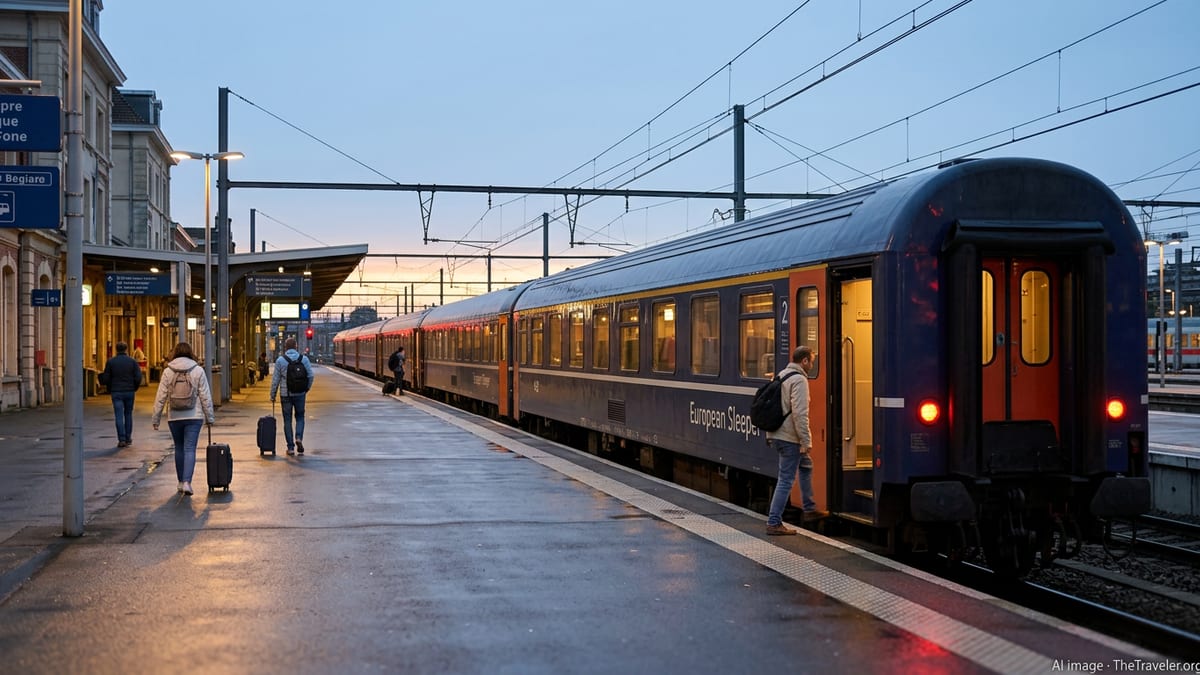
A planned link between Nordic and EU capitals
The proposed Stockholm–Brussels night train has been promoted in recent years as a flagship connection between the Nordic region and the European Union’s political centre. The service is intended to provide a low-carbon alternative to short-haul flights, while improving overnight rail connectivity for both business and leisure travellers between Sweden, Denmark, Germany and Belgium.
Publicly available information indicates that the Swedish Transport Administration, Trafikverket, has been exploring contractual options for an international night train under a public service obligation framework. Under this model, an operator receives financial support to run a socially desirable but commercially challenging service, in return for meeting specified timetable and quality requirements.
The Stockholm–Brussels link would build on Sweden’s broader night train strategy, which already includes publicly supported services from Stockholm to northern Sweden and a subsidised Stockholm–Hamburg route operated by state-owned SJ. However, the Brussels corridor presents additional complexity, crossing several national networks and requiring cooperation with multiple infrastructure managers and partner operators.
Against this backdrop, the decision by Snälltåget not to seek the contract marks a significant moment in the evolving landscape of Scandinavian and continental night train services.
Snälltåget prioritises commercial freedom over subsidy model
Snälltåget is an open-access, commercially driven operator that has built its business on running night trains without direct operating subsidies, relying instead on ticket revenue and seasonal demand. The company already links Stockholm and Malmö with Hamburg and Berlin on a market-based basis, and has expanded its offer to routes such as Malmö to the Austrian Alps and new connections via Malmö to Oslo.
According to company information and industry coverage, Snälltåget typically seeks flexibility over timetables, capacity and product design, adjusting operations in line with passenger demand and infrastructure constraints. This approach contrasts with public service obligation contracts, which often stipulate detailed service patterns over several years, with limited scope to vary operations without approval.
Reports on previous Swedish tenders suggest that some open-access operators perceive these contracts as highly prescriptive, with complex risk-sharing mechanisms and tight financial frameworks. For a small operator that already runs long-distance international night trains on a commercial basis, committing rolling stock and staff to a multi-year subsidised contract can be seen as reducing the ability to respond quickly to market opportunities elsewhere.
Observers note that Snälltåget’s choice not to bid for the Stockholm–Brussels contract appears consistent with its earlier decision not to participate in tendering for publicly supported Sweden–Germany night trains, even as it continued to expand its own commercial overnight services on similar corridors.
Market and policy tensions in the European night train revival
The withdrawal of interest from a specialised operator such as Snälltåget highlights wider tensions in Europe’s night train revival. On one hand, governments and the European Union are encouraging modal shift from air to rail, especially on cross-border routes that fit neatly into climate and connectivity goals. On the other, the economics of overnight services remain challenging, with high fixed costs and limited ability to fill berths year-round at fares that cover all expenses.
To bridge this gap, public authorities often use subsidised contracts, but these can inadvertently narrow the field of bidders. Industry analysis of Swedish tenders has pointed to cases where financial and technical conditions were seen as unattractive or overly rigid, resulting in a lack of competition or even failed procurements.
The Stockholm–Brussels corridor illustrates these pressures. The route must compete with a dense network of daytime high-speed trains and a significant volume of short-haul flights, while threading through capacity-constrained sections of track in Denmark and Germany. Any operator taking on such a service is likely to seek clarity over access charges, rolling stock compatibility and border procedures, alongside a subsidy level that reflects the commercial risk.
Snälltåget’s decision not to pursue the contract may therefore be interpreted by analysts as a signal that, in its view, the balance of risk and reward offered by the tender did not align with its business model, even if the route itself has symbolic and strategic importance.
Implications for SJ and the competitive landscape
The absence of Snälltåget from the bidding process effectively leaves more space for state-owned SJ and potentially other European operators to shape the future of the Stockholm–Brussels night train. SJ already operates the publicly supported Stockholm–Hamburg overnight service and has been expanding its experience in cross-border night operations in northern Europe.
Specialist media note that SJ has secured several recent contracts for Swedish night trains, including services to northern Sweden under Trafikverket’s procurement rounds. This suggests that the company is increasingly central to the country’s publicly supported overnight network, even as open-access operators like Snälltåget continue to run competing or complementary commercial services on some corridors.
For passengers, the competitive dynamic can cut both ways. A strong incumbent with public backing may offer stability, integrated ticketing and easier connections within the national rail system. At the same time, the absence of alternative bidders can limit diversity of onboard products, pricing strategies and service innovations that smaller challengers sometimes introduce.
In the case of the Stockholm–Brussels project, analysts will be watching whether SJ or any other major operator chooses to take on the route, and on what terms, given the mixed record of previous tenders for international night trains to and from Sweden.
Future prospects for cross-border sleeper services
Although Snälltåget will not compete for the Stockholm–Brussels contract, its existing and planned services indicate continued confidence in demand for overnight travel between Sweden and continental Europe. The company’s commercial night trains between Stockholm, Malmö and Berlin, as well as seasonal routes to the Alps and new connections via Malmö toward Norway, point to a market that is evolving through both public policy and private initiative.
At the policy level, discussions around the Stockholm–Brussels link are likely to feed into broader debates on how to design cross-border night train contracts that attract a wider range of bidders. Issues such as rolling stock ownership, risk allocation, timetable flexibility and coordination between infrastructure managers may all come under renewed scrutiny.
For travellers and climate advocates, the key question is whether a regular, reliable Stockholm–Brussels night train will materialise and endure beyond initial political enthusiasm. Snälltåget’s decision not to seek the contract does not preclude the route from going ahead under another operator, but it does underscore the delicate balance required to make international sleeper services both operationally viable and financially sustainable.
As governments and operators across Europe experiment with different models for supporting night trains, the Swedish experience with tenders to Hamburg, Brussels and northern Sweden is likely to remain a closely watched case study in how to revive long-distance rail travel across borders.