


Few night-sky images are as striking as the Milky Way arcing over the pale pumice plains of Minas de San José in Teide National Park. High on Tenerife, above much of the island’s cloud and light pollution, this Mars-like landscape offers dark skies, crisp air and sculpted lava forms that have become icons of European astrophotography. At the same time, Teide is a strictly protected national park with evolving access rules, and its high-altitude environment can be unforgiving after dark. Planning a night here now demands careful attention to regulations, safety and realistic conditions on the ground.
Get the latest updates straight to your inbox!
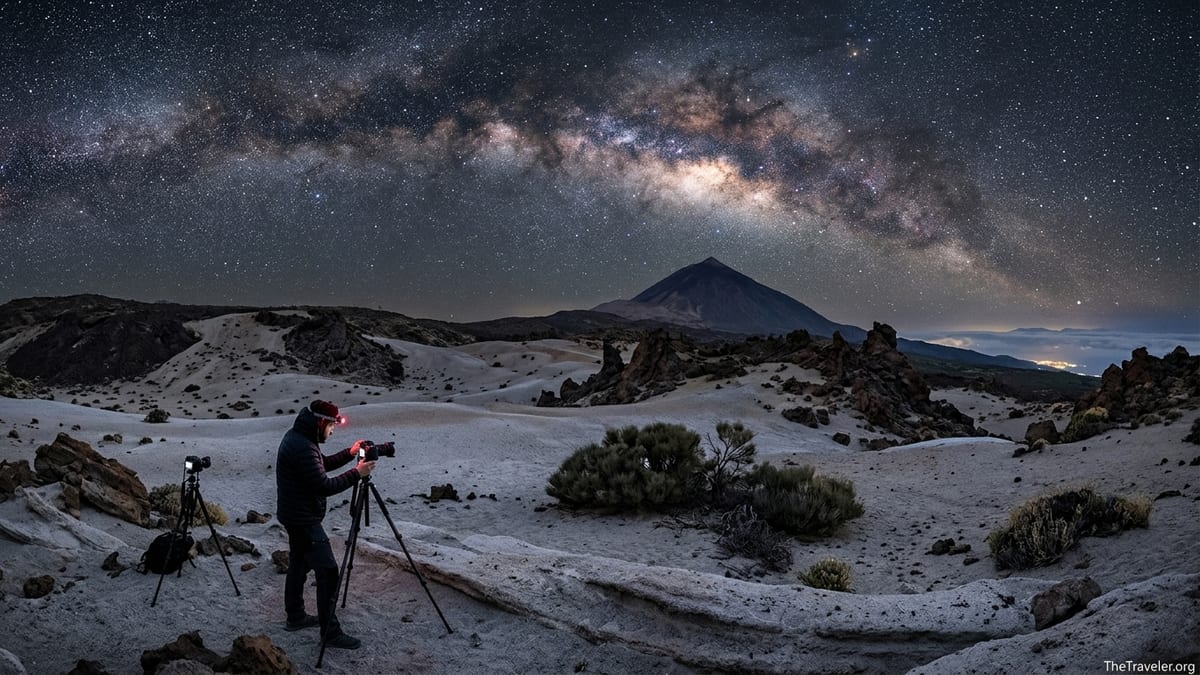
Why Minas de San José draws stargazers
Teide National Park sits well above 2,000 metres, with Minas de San José located along the TF-21 road on the eastern side of the caldera. At this altitude, the site often rises above the “sea of clouds” that blankets the coasts, giving observers dry, stable air and generally low light pollution. The surrounding summits shield much of the stray glow from metropolitan Santa Cruz and the tourist resorts, so on moonless nights the sky can be remarkably dark by European standards.
What makes Minas de San José especially attractive to astrophotographers is the combination of open horizons and distinctive foregrounds. The old pumice quarries and eroded lava formations form pale, undulating flats and scattered outcrops that read almost as a lunar or Martian surface in long exposures. Many published Milky Way panoramas, time-lapse videos and night-sky reels from Tenerife have been shot here, often with Teide’s cone rising in the background or jagged rocks framing the galactic core.
The scientific value of the area reinforces its appeal. The park’s volcanic plains, including Minas de San José, have been used by the European Space Agency and other programs to test planetary rover technology and instruments in terrain that resembles Mars in texture and colour. That role underlines both the site’s uniqueness and its fragility: thin, easily eroded pumice crusts and sparse high-altitude vegetation are highly vulnerable to trampling, off-track driving and uncontrolled crowds.
For visitors, the key message is that Minas de San José is not a casual roadside stop but part of a carefully managed national park. Night-time stargazing and photography remain possible for individuals, but they must be approached with the same respect for conservation and safety as daytime hiking, and with a clear understanding that rules have tightened in recent years and continue to evolve.
Understanding Teide’s night-time rules and restrictions
Teide is a Spanish national park, and its use is governed by a detailed management plan and specific visitation rules issued by the Canary Islands government. These regulations make clear that activities are allowed only insofar as they are compatible with the park’s conservation objectives. Free camping is prohibited throughout the park, as is bivouacking outside designated refuges, and visitors are expected to remain on established paths or in clearly delimited public access areas.
The current management plan confirms that motor vehicle access on the main park roads TF-21, TF-24 and TF-38 is generally free for private vehicles, subject to normal traffic law and any temporary controls imposed by the island’s authorities. That means there is no blanket curfew on driving through the park at night. However, this does not translate into a right to stay indefinitely in any roadside car park. Overnight stays in vehicles with a camping character are prohibited, and parking areas are intended primarily for day visitors, hikers and short stops rather than prolonged occupation.
Recent seasons have shown that authorities may impose extra restrictions during major astronomical events. For example, local media have reported that during busy Perseid meteor showers and eclipses, access to Teide has occasionally been restricted to special public transport services, with private vehicles barred from key approaches in order to prevent gridlock and overcrowding. Similar temporary measures are likely in future when large crowds are expected, and the exact rules can vary from year to year depending on forecasts and safety assessments.
Importantly for night-sky enthusiasts, there is currently no explicit rule that forbids being physically present in accessible public areas of the park after dark merely to stand, walk carefully or observe the sky. Individual accounts from visitors indicate that rangers sometimes ask people to move on from certain car parks or lay-bys at night if they suspect overnight stays, unsafe behaviour or activities that could disturb wildlife or other users. In such cases, the park administration and on-duty staff are the final authority. If a ranger instructs you to leave a specific spot, you should comply immediately, even if you believe your interpretation of the rules would allow you to stay.
Ecotax, reservations and the new management framework
In January 2026, the island council introduced an ecotax and time-slot system for access to some of Teide’s most heavily used summit-area trails. Current reports indicate that non-resident visitors must pay a fee and book specific time bands to use certain high-impact routes, most notably the main summit approaches, while residents benefit from different terms. The intention is to cap daily numbers, reduce erosion and fund conservation. These controls focus on walking trails, not on all roadside viewpoints, but they mark a broader shift toward tighter visitor management.
Alongside the ecotax, the new management plan for Teide sets the stage for progressive regulation of parking and traffic flows. Recent guidance aimed at tourists notes that visitor controls at busy viewpoints such as Minas de San José and Roques de García are expected to expand, including the possibility of pre-booked parking quotas and stricter time limits in the busiest seasons. Authorities have also announced plans to roll out more comprehensive access controls at the main road entrances to the park and, in the longer term, a shuttle-bus network from several coastal towns to reduce private car use.
At the time of writing, the details of how these measures will affect night-time stargazing and astrophotography specifically are still evolving. It is not yet clear whether evening and pre-dawn parking along TF-21 will be subject to the same slot bookings, or whether certain car parks will close at fixed times year-round. Because of this uncertainty, any writer or traveler planning an after-dark visit should, shortly before their trip, verify the latest information from official park and island websites or visitor information services, paying particular attention to whether new ecotax, reservation or time-slot schemes explicitly cover night hours and roadside miradors.
Until those details are fully implemented, travelers should assume that staying within clearly signposted parking durations, avoiding any suggestion of overnighting in vehicles, and moving on promptly if an area appears to be closing or filling with ranger vehicles will remain best practice. It is safer to treat Teide’s car parks as short-use facilities and to keep your night sessions focused and efficient rather than treating Minas de San José as a free overnight base.
What is and is not allowed at night in the park
The park’s general visitation rules apply around the clock. That means that wild camping, pitching tents, using awnings or setting up any kind of structure that suggests a temporary camp is not permitted at any time. Sleeping outside marked refuges, including sleeping in vehicles in a way that resembles camping, can be considered illegal pernocta and may attract fines. Lighting fires and using barbecues or gas stoves outside designated areas are also prohibited, which effectively rules out cooking in the open at night in places such as Minas de San José.
Commercial activities face an even stricter framework. The park explicitly subjects professional photography, cinematography, television, video and advertising work to prior authorization. Organized tours, workshops and any event that charges clients for services in the park generally require permits that specify group size, routes, timing and environmental conditions. Individual hobbyist astrophotographers working alone or with a friend for non-commercial purposes are usually not considered commercial users, but as soon as you run a paid workshop or shoot material for a commercial campaign, you enter the realm of regulated activity and should seek written authorization well in advance.
Several recent visitor accounts highlight a grey zone around night-time presence that does not involve camping yet can be misunderstood as such. Photographers who set up tripods for hours in a small car park, particularly if they use campervans or vehicles with mattresses inside, report occasionally being told to move on by rangers who interpret extended presence as overnighting. In one published case, the visitor later wrote to a regional outdoor access service for clarification and was advised that purely photographic use without sleeping or camping should be distinguished from pernocta, yet that on-the-ground enforcement may still be cautious.
In practice, anyone planning night-sky work in Teide should structure their sessions to minimise ambiguity. Stay in normal passenger cars rather than camper-style setups if possible, avoid laying out bedding, chairs or cooking gear, and be prepared to explain politely that you are there for a limited astrophotography session, not to sleep. Above all, accept that even if the written rules do not explicitly forbid your presence, staff may ask you to relocate in order to manage safety, congestion or environmental impact.
Minas de San José at night: layout, pros and cons
Minas de San José is a roadside mirador on TF-21 between El Portillo and the Teide cable car. The official mirador layout consists of a small parking area on either side of the road, a low wall and interpretive panel, and open pumice flats extending gently away from the tarmac. There are no toilets, no artificial lighting and no staffed facilities. Once car headlights have passed, the area is very dark, and the only illumination will be from the sky and any lights you bring.
From a photographer’s perspective, the site has several strengths. Access is easy: you step out of your car and, within a short walk, reach broad, relatively even pumice fields that give clear views of the southern sky and Teide’s cone. The pale ground reflects enough starlight to separate foreground from sky in a single exposure, and the scattered lava outcrops provide ready-made silhouettes and leading lines. For time-lapse or panorama sequences, the lack of nearby streetlights means minimal flare or colour casts from artificial sources compared with lower, more developed viewpoints.
The same qualities bring limitations. The pumice crust can be loose and irregular, with hidden holes and small drops that are hard to see by headlamp. In some directions the terrain falls away into steeper gullies and old quarry cuts. At night, particularly under new moon conditions, it is easy to stray toward unstable slopes or trample fragile patches of pioneer vegetation. The area also sits relatively close to the road, so you must constantly manage the risk from passing traffic and headlight glare on long exposures.
To stay safe and respectful, remain close to obvious, well-trodden paths and the flattest parts of the pumice plain. Avoid walking onto steeper slopes or climbing on delicate formations for the sake of a composition. Remember that rover tests and scientific fieldwork have taken place here; footprints and ruts can damage surfaces that take a long time to recover. Keeping your gear compact and your movements thoughtful not only protects the environment but also reduces the chance that rangers will perceive your presence as intrusive or risky.
How Minas de San José compares to other Teide stargazing spots
Minas de San José is one of several accessible stargazing points in the park, each with different characteristics. Roques de García, near the Parador hotel, offers dramatic rock towers and classic views of Teide, but it lies next to one of the busiest car parks and trailheads. Its popularity and the presence of nearby accommodation mean more headlamps, vehicle movements and potential crowds, even late in the evening during high season. For photographers seeking solitude and long, uninterrupted exposures, this can be a disadvantage compared to the relatively quieter Minas de San José.
Llano de Ucanca, further along TF-21, is another expansive plain with a dedicated parking area and sweeping views toward Teide. Its broader horizon and distance from the highest summit can make it slightly less dominated by the mountain itself, which some astrophotographers prefer for wide-field Milky Way arches. The terrain there can feel more open and less sculpted than the pumice formations of Minas de San José, so it suits those who want simple foregrounds and easier walking in the dark.
Mirador de la Tarta, on TF-24 between La Laguna and the park, sits on the caldera rim rather than the floor. It is famous for its layered lava cliffs and often looks out over a sea of clouds, with views toward the north and west. For stargazing, its elevation and distance from the resort belts provide excellent transparency, but the viewpoint itself is narrow, close to the road and lined with protective barriers. That makes tripod placement and movement more constrained, and vehicle lights can be more intrusive than on the broader plains of Minas de San José or Llano de Ucanca.
For many self-driving visitors, a practical strategy is to combine locations: watch sunset from a high rim viewpoint such as Mirador de la Tarta or another nearby mirador, then descend into the caldera once darkness has fully fallen and traffic has quietened, choosing Minas de San José or Llano de Ucanca for Milky Way shots. Whatever the combination, always keep within legal parking areas, respect any new time limits or booking requirements, and be ready with a backup location in case your first-choice car park is closed or saturated.
Timing, weather and high-altitude safety
From Tenerife’s latitude, the bright core of the Milky Way is typically best seen from late spring through early autumn, with the core highest in the sky around local midnight in the middle of that period and appearing earlier or later at the season’s edges. Exact rise and set times shift from year to year and depend on your date and horizon, so any writer preparing a trip guide should consult up-to-date astronomical apps or ephemeris data rather than relying on static times. The phase and brightness of the Moon are equally important: for revealing the Milky Way core and fainter nebulae, aim for nights around new moon or when the Moon is below the horizon for your key shooting hours.
Weather is a decisive factor at Minas de San José. Although Tenerife boasts many clear nights, conditions at over 2,000 metres can be severe and change rapidly. Even in midsummer, night-time temperatures on the caldera floor can feel near freezing when combined with windchill, and in shoulder seasons they can drop well below that. From autumn through spring, snow, ice and dense fog are not uncommon, and storms may force road closures at short notice. Local news outlets regularly report on episodes of snowfall on Teide and associated weather warnings that affect road access.
Visitors should treat any night session here as a true mountain outing. Wear multiple warm layers, including a thermal base, insulating mid-layer, windproof and preferably waterproof outer shell, hat and gloves. Sturdy footwear is essential; trainers that feel adequate by day can become dangerously cold and slippery on icy surfaces. Bring more food and hot drinks than you think you will need, packed in insulated bottles, and avoid alcohol, which worsens cold sensitivity and altitude symptoms.
Altitude itself can be as challenging as the cold. At over 2,000 metres, some people experience shortness of breath, headaches, light-headedness or mild nausea, particularly after a fast drive up from sea level. Those with cardiovascular or respiratory conditions should seek medical advice before planning a night visit. It is unwise to go alone if you have no prior experience at altitude; a companion can assist if you feel unwell, while solo visitors may find help far away on quiet nights when traffic is sparse and mobile reception patchy or absent in certain sectors.
Gear, light etiquette and protecting the night environment
For astrophotography at Minas de San José, the usual night-sky kit applies: a camera body with good high-ISO performance, a fast wide-angle lens, a sturdy tripod and, if desired, a star tracker for longer exposures. At this altitude and in cold conditions, battery life drops quickly, so always carry fully charged spares close to your body to keep them warm. Condensation can form on lenses and filters when moist breath meets cold glass, so lens cloths and simple dew mitigation techniques are useful on longer sessions.
Lighting is a critical consideration, both for your own safety and for preserving the dark-adapted vision and exposures of others. Use headlamps or torches with a red-light mode, and keep them on the lowest brightness that still allows you to move safely. Angle beams downward, cup them with your hand when passing close to other groups, and avoid shining lights toward the sky. Inside your vehicle, disable or cover courtesy lights that come on when doors open, and park so that when you leave later you do not have to swing full-beam headlights across the main shooting area for others.
Noise discipline matters too. Sound carries far in the thin, still air of the caldera, and excited conversations or music can disrupt the sense of solitude that many visitors seek at night. Keep voices low, avoid playing audio on speakers and respect the presence of organized stargazing groups who may be giving quiet explanations of constellations to participants. Remember that Teide’s wildlife, though not abundant at these altitudes, is also sensitive to disturbance; staying on marked paths and avoiding sudden light flashes into rocky crevices helps reduce impact.
Finally, pack out everything you bring in. This includes not only obvious litter but also cigarette butts, which are now explicitly banned due to both fire risk and environmental impact. The park has reinforced its stance against smoking in open areas, including miradors and car parks, so treating Minas de San José as a smoke-free environment is both legally and ethically necessary. Leaving the pumice plains exactly as you found them is the best contribution you can make to their continued availability for future stargazers.
Permits, commercial use and when to choose a guided tour
Teide’s regulations make a clear distinction between personal, non-commercial visits and activities that have a professional or commercial character. Commercial filming, advertising campaigns, photo shoots for products or brands, television work and organized tours or workshops that charge clients all fall under categories that usually require prior written authorization from the park administration. These permits can specify precise locations, time windows, group sizes and mitigation measures, and may involve fees or insurance requirements.
For small astrophotography workshops, where a professional photographer leads paying participants to sites like Minas de San José to teach techniques, it is prudent to assume a permit will be needed even if the group is small and the gear modest. Organizers should consult the latest official guidance, submit detailed descriptions of their planned routes, schedules and group sizes, and allow sufficient lead time for approvals. By contrast, individual hobbyists shooting for personal enjoyment, personal social media or non-monetized portfolios typically do not need permits, provided they comply with general park rules and do not use the park’s name or image in ways that imply endorsement.
Travelers who prefer a structured, lower-stress experience may opt for licensed stargazing tours run by local operators. Many of these tours use Minas de San José or similar roadside miradors as meeting points, bringing telescopes, binoculars and guides who are familiar with the sky and the regulations. Others operate in areas near the observatory or in different sectors of the park where parking and group logistics are clearer. Choosing a reputable, authorized operator transfers the burden of permits, access rules and night driving to professionals while still giving you the chance to enjoy the dark skies.
If you are writing or updating an article on this topic, explicitly instruct readers to confirm with official sources whether any new permit categories, ecotax extensions or group-size limits apply to night photography or informal gatherings. As management intensifies, rules that were once focused on daytime hiking may be expanded to cover after-dark use at busy viewpoints, and only current official documents can provide definitive guidance.
Putting it together: realistic night-sky scenarios
A realistic self-drive astrophotography plan might begin with an afternoon ascent via TF-24, stopping at a high mirador for sunset above the cloud layer. After dusk, you could drive into the caldera, pausing at Llano de Ucanca to assess conditions and then continuing to Minas de San José if parking is available and clearly open. There, you would spend a few focused hours capturing the Milky Way rising above the pumice flats, staying close to the car park and obvious paths, keeping lights discreet and being ready to leave if rangers request it or if weather deteriorates.
Another scenario could combine a guided tour with solo shooting. You might join an early evening stargazing trip that provides telescopes and sky interpretation at an authorized viewpoint, then, after returning to your vehicle and ensuring you are rested and confident about night driving, head independently to a second location for a shorter, carefully planned photography session. This hybrid approach lets you benefit from professional safety margins and local knowledge while still achieving your own compositions at Minas de San José or another quiet mirador.
For visitors who are unsure about altitude, mountain roads or the nuances of Spanish protected-area regulations, fully guided experiences may be the most sensible choice. Licensed operators work within agreed frameworks, monitor weather and road closures, and can adapt plans quickly if authorities impose last-minute restrictions, such as closing particular car parks or requiring shuttle use during major sky events. In such contexts, Minas de San José often functions more as a daytime or early-evening stop, while other zones with clearer rules for groups host the main night-sky activities.
Whatever scenario you choose, the non-negotiables are the same: check same-day information on road and trail closures, pay attention to any advisories about increased volcanic or seismic monitoring even when authorities state that short-term eruption risk is low, and confirm whether new ecotax or reservation systems affect the specific hours and places you plan to use. Treat access to Minas de San José at night as a privilege that depends on collective good behaviour. With thoughtful planning, respect for the rules and a realistic appreciation of the environment, you can still experience one of Europe’s most memorable night skies in a way that keeps it accessible for future generations.