


More news on this day
Severe thunderstorms moving across the Atlanta metro area on Friday prompted a ground stop at Hartsfield-Jackson Atlanta International Airport, slowing departures and arrivals at one of the nation’s busiest hubs and creating ripple-effect delays across the U.S. air travel system.
Get the latest news straight to your inbox!
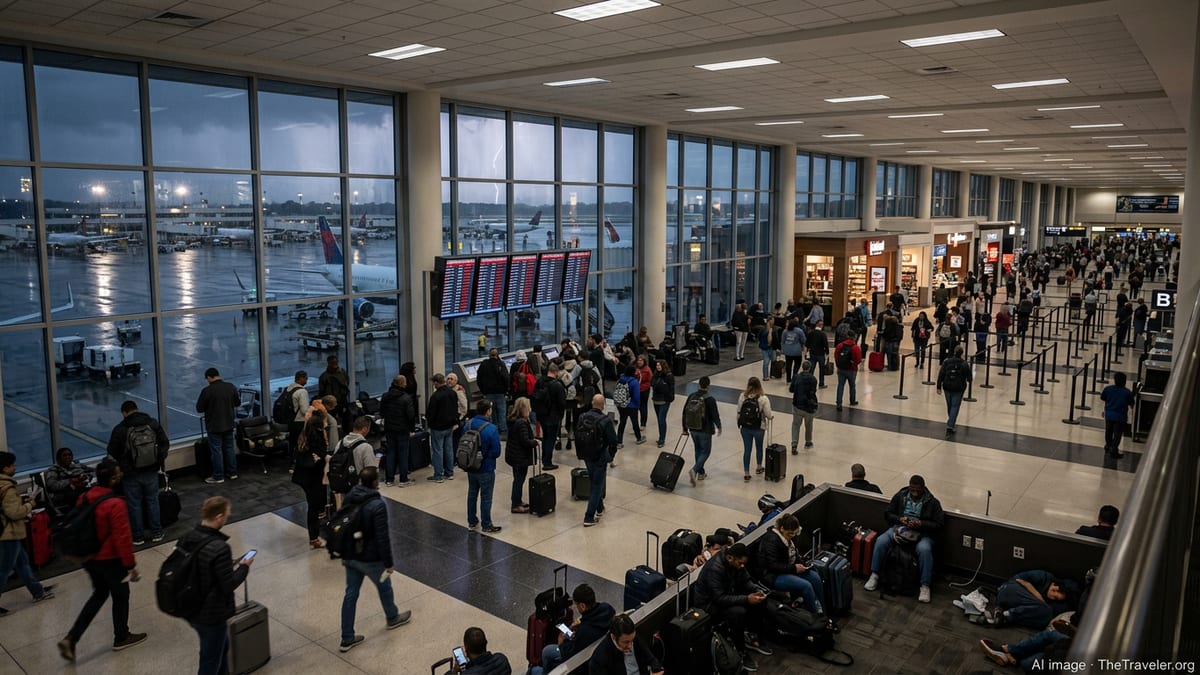
Thunderstorms Disrupt Operations at Key U.S. Hub
According to real-time airport status information published by the Federal Aviation Administration (FAA), flights at Hartsfield-Jackson Atlanta International Airport were affected on Friday as storm cells tracked directly across departure and arrival corridors. The FAA’s air traffic management updates showed constraints on operations at Atlanta, including ground delays and periods in which flights were held at origin airports until weather conditions improved in the region.
Atlanta regularly ranks among the world’s busiest airports by passenger volume, so even short-lived disruptions can quickly translate into widespread delays. When a ground stop is in effect, flights destined for the affected airport are kept on the ground at their departure points, a measure designed to prevent airborne holding and excessive congestion in the skies around the facility.
Recent advisories from the FAA’s Air Traffic Control System Command Center have highlighted how convective weather around Atlanta can rapidly force changes to the airport’s operating plan. Late August notices referenced thunderstorms leading to arrival delays of up to 30 minutes and diversion-recovery measures to manage aircraft that could not land as scheduled, illustrating the sensitivity of the hub to fast-developing storm systems.
Ground Stops and Delays Ripple Across Airline Networks
The FAA’s daily air traffic reports describe ground stops and ground delay programs as tools used to balance demand with available capacity when weather, runway configurations or other factors temporarily reduce an airport’s throughput. For a hub on the scale of Atlanta, those tools can affect flights across dozens of domestic and international routes within a matter of hours.
Publicly available data show that when thunderstorms limit arrival and departure rates at Atlanta, airlines often face a cascade of schedule adjustments. Flights inbound from nearby regional airports may be held at the gate, while longer-haul services are assigned new departure times to avoid extended holding patterns. Once aircraft and crews arrive late in Atlanta, subsequent legs on their rotations can also depart behind schedule, expanding the impact beyond the immediate storm window.
Operational planning advisories posted by the FAA in recent weeks have underscored how summer and early autumn storm activity can strain the system. National operations plans have cited the potential for losing access to key airports for short periods because of lightning, low visibility or heavy precipitation, resulting in targeted ground stops at individual hubs and temporary route restrictions in busy corridors.
Travelers Face Longer Journeys and Missed Connections
For passengers, a ground stop at Atlanta typically translates into longer travel days and a higher risk of missed connections, particularly for those relying on tight layovers through the hub. Even when individual flight delays are measured in minutes rather than hours, the compounding effect of weather-related holds and re-sequenced departures can push itineraries past their planned arrival times.
Online flight-status boards and airline updates on Friday reflected a mix of delayed departures and revised arrival estimates for Atlanta-bound services. Travelers were encouraged through carrier communications and airport advisories to monitor their flight details frequently, as estimated departure and arrival times can change multiple times during a dynamic weather event.
Recent FAA guidance emphasizes that ground stops are intended to enhance safety and reduce the risk of airborne congestion in constrained airspace. By metering the flow of traffic into an airport facing adverse weather, controllers can limit go-arounds, diversions and extended holding, even though the short-term effect for travelers is additional waiting at the gate or on the tarmac.
Recent Pattern of Weather-Driven Constraints at ATL
Advisories issued in late August and early September point to a recurring pattern of weather-driven constraints at Atlanta during the peak thunderstorm season. Command Center notices from August 27 referenced arrival delays into Atlanta of up to half an hour due to thunderstorms, while separate diversion-recovery advisories have been used to manage inbound aircraft that could not land during earlier storm cells.
These notices are part of a broader set of air traffic management tools used nationwide. The FAA’s Command Center routinely publishes advisories covering arrival delays, departure route restrictions and ground delay programs at major airports when capacity is reduced. For Atlanta, summer and early autumn storms remain a primary trigger, although construction and traffic surges can also play a role in constraining operations.
Airport planning documents and performance analyses released over the past year note that Atlanta’s high volume of connecting traffic adds complexity when schedules are disrupted. As flights arrive late, banks of outbound departures may need to be retimed to preserve key connections, while some itineraries are rebooked through alternate hubs to relieve pressure on the system.
What Passengers Can Do During Weather Ground Stops
While ground stops are outside the control of travelers and airlines alike, publicly available guidance suggests a few practical steps for navigating disruptions. Airlines generally advise customers to check their flight status repeatedly on official websites or mobile apps, sign up for text or email alerts, and consider adjusting connections if storms are forecast in hub cities such as Atlanta.
During prolonged weather events, some carriers publish flexible travel policies allowing affected passengers to change to alternative flights without additional fees, subject to specific date and route conditions. These waivers are typically detailed on airline travel advisory pages and updated as operational assessments evolve.
For those already at the airport, terminal displays and public announcements provide the latest gate and timing information. Travelers with critical same-day commitments are often encouraged in consumer travel guidance to build additional buffer time into their itineraries during peak storm seasons, particularly when routing through busy hubs that are prone to convective weather impacts.
As the current round of storms around Atlanta demonstrates, even brief interruptions at a major hub can quickly influence traffic patterns far beyond the Southeast. With thunderstorms still a fixture in regional forecasts at this time of year, intermittent delays linked to air traffic management programs at key airports remain a possibility for U.S. travelers.
FAA real-time status for Hartsfield-Jackson Atlanta International Airport