


More news on this day
A shaky smartphone video filmed by a stranded airline passenger has become one of the defining images of the nationwide US ground stop, capturing a tense cabin announcement, confused travelers and the moment hundreds of people learned at once that flights across the country had been ordered to a halt.
Get the latest news straight to your inbox!
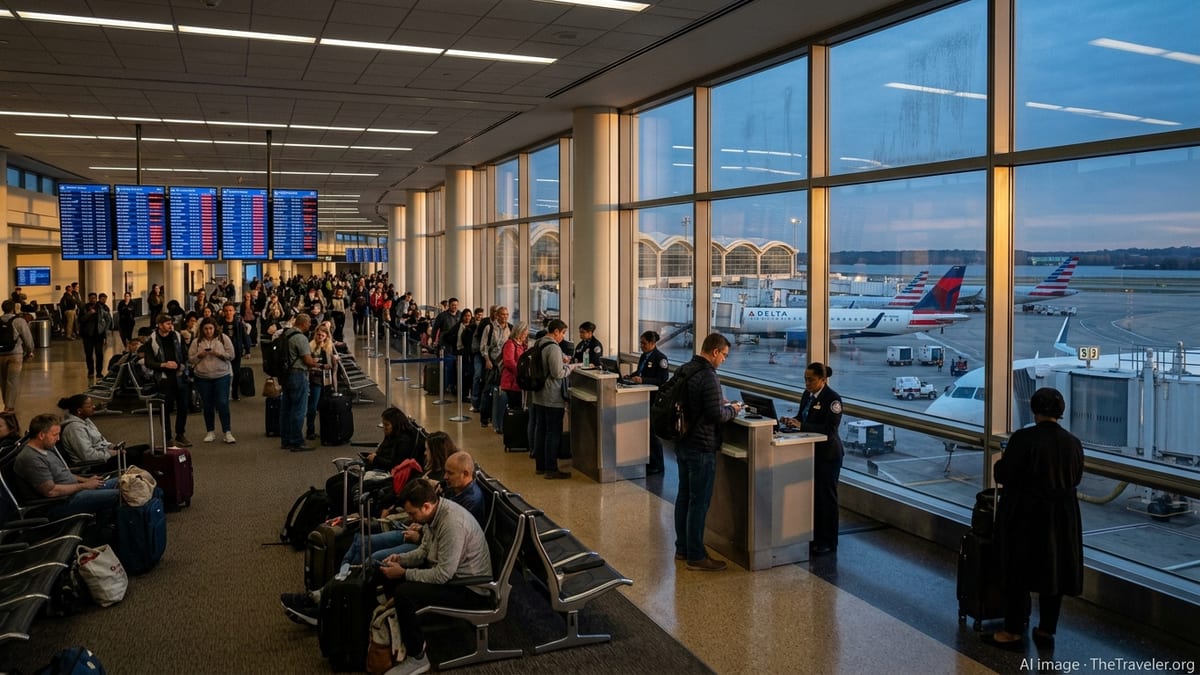
A rare nationwide halt to US air travel
The Federal Aviation Administration ordered a nationwide ground stop for departing flights across the United States on Friday, November 13, 2026, after what public statements described as a communications problem affecting multiple air traffic control centers. The order, which began around midafternoon on the East Coast, brought one of the world’s busiest air networks to a standstill for more than four hours before departures were gradually allowed to resume in the evening.
Analyses of flight-tracking data published by several outlets indicate that at the peak of the disruption roughly 4,000 commercial flights were either prevented from taking off or forced into extended delays while already at the gate or on the taxiway. Airlines then canceled thousands more flights into Saturday as crews and aircraft ended up in the wrong cities and overnight schedules had to be rebuilt with little warning.
Commentary in national media compared the scope of the stoppage to only two previous episodes in recent history: the shutdown of US airspace on September 11, 2001, and a shorter nationwide halt in January 2023 that followed a critical computer outage in the FAA’s systems. Travel reporters noted that while large local ground stops are not unusual during severe storms, an order that touches every major airport in the country remains extremely rare.
The impact was visible on departure boards from Boston to Los Angeles, where screens filled with red “delayed” and “canceled” notices in the late afternoon and early evening. Airport social media feeds showed long lines at customer-service desks, crowded concourses and baggage halls where travelers waited for luggage that could no longer be loaded onto outbound flights.
Viral cabin video captures the moment passengers learned
The video that has drawn particular global attention was recorded aboard a domestic flight that had just pushed back from the gate at Chicago O’Hare International Airport. Shared first to social media and later carried by broadcasters, it shows a flight attendant relaying a cockpit announcement that a nationwide ground stop has been issued and that the aircraft is required to wait on the tarmac until further notice.
In the clip, cabin lighting is dim and window shades are partly down, indicating a late-afternoon or early-evening departure. As the announcement mentions a “nationwide” halt, a murmur runs through the cabin. Some passengers look up sharply from phones and headphones, while others lean into the aisle to catch the details. The recording captures snippets of follow-up explanations about a communications failure affecting air traffic control centers and instructions for travelers to remain seated with seat belts fastened while the crew awaits updates.
Additional footage from the same passenger, carried by several news outlets, shows people scrolling through their phones to check airline apps and news alerts. A few appear to be relaying information to family and colleagues via messaging apps and video calls. Overhead bins remain closed, but passengers are visibly restless, shifting in their seats and asking questions of nearby crew members as the minutes tick by without movement.
Similar scenes appeared in video licensed through major news agencies from airports across the country, including clips of passengers stuck onboard in Denver and Los Angeles and crowded gate areas in Atlanta and Phoenix. Taken together, the images offer an unusually intimate view of how a system-wide aviation disruption unfolds in real time from a traveler’s perspective, rather than only from control towers and airline operations centers.
Inside the airports: long lines, missed connections and creative coping
On the ground, the halt rippled through major hubs almost immediately. Local coverage from Hartsfield–Jackson Atlanta International Airport described security checkpoints where travelers learned of the ground stop only after clearing screening and glancing up at departure boards filled with delays. In Phoenix, regional television reports showed passengers queueing at ticket counters in the early evening, hoping to be rebooked or to recover checked baggage from flights that would not depart that night.
In several cities, passengers recounted waiting on parked aircraft for multiple hours while crews sought updated departure times or permission to return to the gate. Some travelers chose to abandon air itineraries entirely, seeking last-minute rental cars, intercity bus tickets or rooms at airport hotels as it became clear that onward flights would not operate until the following day.
Not all scenes were tense. Human-interest segments highlighted small acts of improvisation, from impromptu games in waiting areas to musicians playing instruments to lighten the mood at Seattle–Tacoma International Airport and other hubs. Social media posts from airports in Kentucky and Arizona showed travelers organizing informal tournaments and sharing snacks, attempting to turn unexpected layovers into makeshift community gatherings.
Still, the practical consequences were serious for many. With a large share of Friday’s departures disrupted, Saturday’s schedules opened with a backlog of displaced travelers and aircraft. Data published by flight-tracking services on Saturday morning indicated several thousand additional cancellations, particularly on routes that depend on tight aircraft rotations and overnight positioning flights.
Cause, timeline and what travelers are being told
According to public statements and advisory documents released after the incident, the ground stop began at approximately 3:54 p.m. Eastern time on Friday and applied to most departures from US airports, while flights already in the air were allowed to continue under positive control. A communications issue affecting air route traffic control centers was cited as the reason for the precautionary halt, with some officials using the term “extraordinary circumstances” to describe the scale of the disruption.
The order was gradually relaxed over the course of the evening as backup systems and alternate procedures were brought online, and by late Friday night most airports were once again permitting departures. However, the complex nature of airline scheduling meant that the effects extended well beyond the formal lifting of the ground stop, as aircraft and crews had to be repositioned and mandatory rest requirements observed.
Travel insurers and consumer advocates issued advisories reminding passengers that policies and airline contracts of carriage handle such incidents differently, especially when the underlying cause is framed as a safety or air traffic control issue rather than a problem internal to a specific carrier. Some guidance suggested that travelers focus first on securing confirmed space on a new itinerary before seeking reimbursement or credits for out-of-pocket expenses like hotel stays or meals.
Published statements also urged passengers with upcoming travel in the days following the ground stop to monitor airline apps and text alerts closely, since residual delays can cascade through the system even after official operations are described as normalizing. Several carriers posted systemwide waivers allowing customers booked on affected days to change their flights without standard change fees or fare differences, subject to specific date and routing limits.
Lessons for future flyers watching the chaos unfold
The widespread sharing of passenger-shot video from cabins, gate areas and baggage halls has prompted renewed discussion among travel experts about how best to prepare for rare system-wide disruptions. Commentators noted that while events of this magnitude are unusual, the images from this latest ground stop underline the value of arriving with essential medications and chargers in carry-on bags, keeping airline apps updated and loaded with current contact details, and having a backup plan for overnight delays.
Observers also pointed out that real-time social media posts, while invaluable for capturing the atmosphere of an event, can sometimes circulate ahead of verified information about causes and timelines. During the first hours of the ground stop, speculation about cyberattacks and broader technical failures spread quickly online before more measured explanations linked the halt to communications problems within air traffic control facilities.
For many travelers whose videos circulated globally, the incident became an unplanned case study in how a highly interconnected transportation system responds when a central link falters. From the quiet anxiety in cabins like the one recorded at Chicago O’Hare to the crowded concourses in Atlanta, Las Vegas and Phoenix, the scenes preserved on phones across the country now serve as a visual record of one of the most extensive interruptions to US air travel in decades.
As airlines work through the backlog and schedules gradually return to normal, those same recordings are likely to remain a reference point in future debates over aviation resilience, infrastructure investment and how to balance safety-first decisions with the cascading impact that a few hours on the ground can have on millions of journeys.