


More news on this day
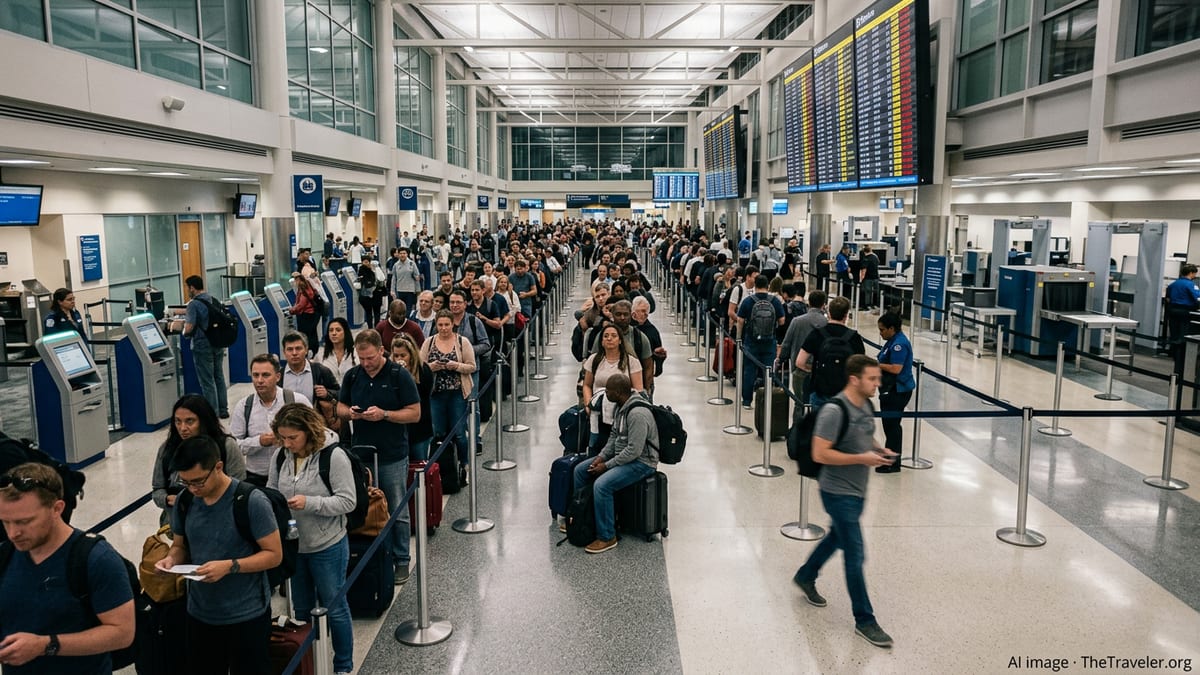
For thousands of airline passengers across the United States on Friday, what began as a routine travel day turned into hours of uncertainty, as a nationwide Federal Aviation Administration ground stop halted departures, filled airport terminals and left many travelers describing a mood of sheer confusion.
Get the latest news straight to your inbox!
A Routine Travel Day Turns Into a Tarmac Ordeal
The nationwide halt to U.S. departures, introduced during a telecommunications outage affecting Federal Aviation Administration systems on November 13, quickly rippled through some of the country’s busiest hubs. Publicly available data from flight-tracking services indicates that more than 11,000 flights were scheduled to depart U.S. airports after 4 p.m. Eastern, with delays and cancellations mounting as the stoppage stretched into the evening.
At major hubs such as Chicago O’Hare, New York’s LaGuardia and Atlanta, departure boards flipped almost in unison from “on time” to long delays. Reports from passengers on social media described aircraft being held short of gates or parked at remote stands while crews waited for word on available parking positions.
One domestic flight into Austin was among those stuck without a gate. According to published coverage, the pilot told passengers there had been “a little issue with the FAA,” and that no one was taking off, leaving arriving aircraft with nowhere to park until existing departures could be cleared. The aircraft eventually reached a stand, but only after extended time on the tarmac.
Even after the FAA lifted the nationwide ground stop and said arrival and departure rates were returning toward normal, network data showed that congestion at key hubs continued for hours. Aircraft were allowed to land, but many passengers with connections discovered that onward flights had already been canceled or significantly delayed, forcing them to rebook or seek alternatives.
‘Mostly the Vibe Is Confusion’ in Crowded Terminals
Inside terminals, the disruption translated into dense crowds and a lack of clear answers. Travelers interviewed in broadcast and online coverage across multiple outlets described learning of the ground stop not from gate agents, but from news alerts, airline apps and television screens in concourses.
On message boards and social platforms, one passenger who said they were onboard an aircraft during the stoppage characterized the atmosphere as “mostly the vibe is confusion,” with little information about when the plane would get a gate or whether connections would be protected. Others posting from airports spoke of standing in lengthy customer-service lines while simultaneously trying to rebook via airline apps.
Publicly available information from aviation analytics firms indicates that by early evening, thousands of passengers had effectively become stranded. With many late-night departures canceled and crews reaching duty-time limits, some travelers reported via local television segments that they were offered cots or thin blankets in gate areas instead of hotel rooms, while others said they received little more than meal vouchers that were difficult to use at concessions overwhelmed by demand.
Travelers with limited flexibility faced particular pressure. Commenters in online travel communities pointed out that for passengers without the means to absorb unexpected hotel, rideshare or rebooking costs, even a single night of disruption can carry serious financial consequences, especially at airports where nearby accommodation prices surge during major irregular operations.
What Caused the Ground Stop and How It Unfolded
According to publicly available statements and reporting, the November 13 disruption was linked to a telecommunications problem affecting FAA communication systems used to manage air traffic flows. The outage prompted the agency to order a temporary nationwide ground stop on most departures in order to maintain safety while the issue was investigated and resolved.
The episode drew immediate comparisons to a January 2023 failure of a key FAA safety database and to a series of more recent regional technology problems, including fiber-optic damage that affected air traffic communications in the U.S. Northeast and a high-profile air traffic control software failure in the United Kingdom earlier this year. In each case, relatively short technical issues cascaded into days of disruption as airlines worked through backlogs.
In this latest incident, publicly available flight statistics show that once the FAA began lifting restrictions, priority was given to aircraft already in the air and those operating into congested coastal hubs. Gates at many large airports remained full, forcing some arriving flights to hold or divert to secondary airports. Rail operators reported higher-than-normal interest on some corridors, suggesting that at least a portion of passengers chose to abandon air travel plans altogether once it became clear their trips would be significantly delayed.
Early official comments indicated that there was no immediate evidence of a cyberattack, though investigators were still working to determine the precise technical cause. The FAA has already been under pressure from lawmakers and industry groups to accelerate modernization of its communication and air traffic management systems, with Congress approving billions of dollars in funding for upgrades in the current budget cycle.
Stranded Passengers Navigate Costs, Rebookings and Limited Rights
The ground stop once again highlighted how much of the burden for major disruptions falls on individual travelers. Under current U.S. regulations, airlines are not automatically required to compensate passengers financially for delays that are attributed to air traffic control or other factors beyond the carrier’s control. Each airline publishes its own customer service commitments, and enforcement typically focuses on whether companies honor those published policies rather than on mandated payouts.
Publicly available information from consumer advocates and regulatory guidance shows that carriers are expected to provide refunds when flights are canceled and passengers choose not to travel. However, accommodation, meals and rebooking on other airlines are handled case by case. Passengers sharing experiences during the November 13 event reported a patchwork of responses: some said they received hotel vouchers and confirmed seats the following day, while others said they were told to seek reimbursement later or to contact their travel insurance providers.
For those attempting to salvage same-day arrivals, car rentals and intercity buses quickly became part of the equation. Social media posts from several airports indicated that one-way rental rates rose sharply as vehicles were snapped up, and that overnight intercity bus services saw a surge in demand on routes paralleling heavily affected air corridors.
Experts cited in recent analyses of similar disruptions have argued that clearer, standardized passenger protections could reduce uncertainty in moments like this, particularly when the trigger is a government-controlled system rather than an airline-specific failure. For now, though, passengers are often left to navigate complex terms and conditions while simultaneously trying to secure a way home.
Systemic Strains Behind Another Day of Chaos
Aviation specialists and policy analysts note that the November 13 ground stop did not occur in isolation. It follows a period marked by recurring technological issues, staffing shortages in air traffic control, and broader operational strain across airlines, particularly during peak travel periods.
Recent reporting on planned FAA technology upgrades notes that some critical systems still rely on decades-old infrastructure that is only gradually being phased out. Weather, radar and flight plan processing tools are in the midst of multiyear modernization programs, with completion dates stretching toward the end of the decade. In the meantime, the system remains vulnerable to outages when individual components fail.
Analysts also point to airline scheduling practices, which optimize aircraft and crew utilization to the minute under normal conditions but leave little slack when something goes wrong. When a nationwide constraint is introduced, as it was on November 13, aircraft and crews quickly end up out of position, and recovery can take days even after the original problem is resolved.
For the passengers who spent long hours in terminals, on parked aircraft or in unexpected hotel rooms, the technical explanations may offer limited comfort. What many described in accounts shared across news outlets and online forums was a day defined less by any single failure than by a pervasive sense of uncertainty, as they watched departure boards, refreshed apps and searched for answers to a simple question that often had no clear timeline: when, exactly, they would be able to go home.