


More news on this day
A nationwide aviation communications outage has stranded an estimated 1.5 million passengers across the United States, transforming airports into improvised waiting rooms where some travelers pulled out musical instruments, card decks and portable gaming consoles to pass the time.
Get the latest news straight to your inbox!
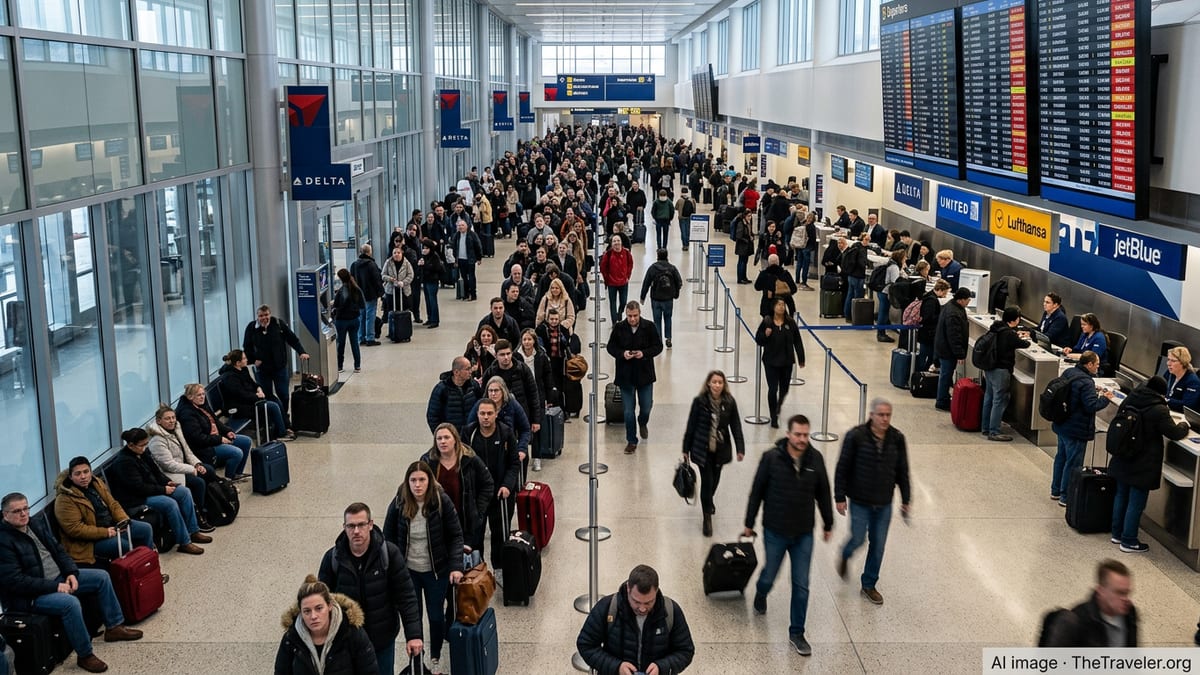
Ground stop halts thousands of flights across the country
Publicly available flight data and aviation analytics show that a communications failure affecting Federal Aviation Administration systems on Saturday led to a rare nationwide ground stop, temporarily preventing most departures from US airports. Domestic flights already in the air were generally allowed to continue, while arriving international services were assessed individually as they approached US airspace.
Airlines’ operations updates and industry tallies indicate that several thousand flights were canceled or significantly delayed over the course of the day, with knock-on disruption expected to continue into Sunday. One major data provider reported that more than 11,000 flights scheduled to depart after late afternoon were affected in some way, leaving aircraft and crews out of position across multiple hubs.
Based on typical US aircraft load factors, those cancellations and long delays translate into roughly 1.5 million disrupted journeys, with many travelers stuck in terminals far from home or forced to rebook days later. The scale of the interruption drew comparisons to past system failures and weather events, though the underlying cause this time centered on aviation communications rather than storms.
Airport notice boards at major hubs such as Atlanta, Chicago, Dallas and Denver showed long columns of red and amber status lines throughout the afternoon, as departure times slipped backward in 30 and 60 minute increments before many services were finally removed from the screens.
Scenes from terminals: harps, card games and improvised camps
Social media photos and videos from airports around the country captured travelers adapting to the long wait. At several large hubs, concourses filled with passengers stretched out on jackets and yoga mats, while others lined up at scarce power outlets to keep their phones charged.
In one widely shared clip from a Midwest airport, a passenger rolled a small harp case into a quiet corner near an unused gate and began to play, drawing a semi-circle of listeners sitting on the floor with carry-on bags as backrests. Elsewhere, images showed informal card tournaments forming around seating clusters, with decks of cards and travel-size board games pulled from backpacks.
Gaming handhelds and tablets were visible in many scenes, as travelers clustered in small groups to share screens and pass controllers. Parents described on public forums how they set up makeshift play areas using soft bags as boundaries, while airport public spaces became dotted with stacks of coloring books and toy figurines meant to keep children occupied during the uncertainty.
Despite the frustrations of missed connections and abandoned weekend plans, many of the images depicted attempts to create pockets of calm and even entertainment inside terminals more commonly associated with hurried boarding calls and quick meals.
Impact on hubs, crews and onward travel plans
The disruption hit hardest at major connecting hubs, where passengers often rely on tightly timed itineraries. Data from aviation analytics firms show that airports such as Hartsfield Jackson Atlanta International, Chicago O Hare, Dallas Fort Worth and Denver International each saw hundreds of delayed or canceled movements as the outage unfolded.
Because flight crews work under regulated duty-time limits, hours spent waiting on the ground eroded the schedules that airlines had built for the weekend. Industry observers noted that a number of flights that initially showed as delayed were later canceled once crew rosters could no longer legally support extended operations, compounding the backlog of stranded passengers.
Travelers with onward international connections or time-sensitive plans felt particular pressure. Reports from travel forums and news coverage described passengers missing cruises, tours and family events, while others scrambled to secure last-minute hotel rooms close to airports already experiencing high occupancy rates from convention traffic and regular weekend demand.
Some airlines encouraged customers not yet at the airport to delay leaving home until their flight status was clearly updated in mobile apps, citing the risk of crowding at check in and security for services that might not depart for many hours.
Sports teams and business travelers caught in the gridlock
The outage rippled through the broader travel ecosystem, affecting professional and collegiate sports teams scheduled to play weekend games in cities around the United States. Published reports indicated that basketball and hockey franchises, along with college squads and staff, were among those left in limbo as charter and commercial flights faced the same constraints as regular passengers.
Team travel departments, which often rely on narrow windows to move athletes between back to back games, were forced to consider contingency plans such as same day departures, modified lineups or altered tip off times. In some cases, journalists following the teams reported from departure gates rather than arenas as they waited for confirmation that aircraft could finally push back.
For business travelers, especially those connecting from international long haul flights, the timing of the outage proved challenging. Some arrived at US gateway airports after overnight journeys only to discover that their domestic legs onward to regional cities were canceled. Airline statements pointed to efforts to prioritize rebooking for travelers with limited options to reach smaller destinations.
Corporate travel managers monitoring the situation used company communication channels to advise staff to retain receipts for unexpected expenses and to stay flexible with meeting schedules early in the workweek, given the likelihood of residual delays as airlines reposition aircraft and crews.
What stranded passengers can do next
Consumer advocates and travel specialists offered a consistent set of practical suggestions for those caught up in the gridlock. Many recommend that passengers first confirm whether their itinerary is still active by checking airline apps and flight-status pages, which tend to update more quickly than departure boards in terminals.
Where flights have been canceled, publicly available airline policies outline options that can include free rebooking on the next available departure, travel credits or, in some circumstances, refunds to the original form of payment. Policies differ by carrier and by the specific cause of disruption, and travelers were urged in published guidance to review their airline’s customer commitment documents carefully.
Those holding separate tickets or complex multi airline itineraries face additional complications. Travel agents and online booking platforms advised that such passengers contact the company that issued their reservation, since that entity typically controls changes and refunds even when multiple airlines are involved.
Industry experts also highlighted the value of travel insurance for some passengers, particularly those with prepaid hotel stays, tours or cruises that may now be missed. However, they cautioned that coverage for system outages and knock on disruption varies widely, and that travelers should verify what their specific policy includes before assuming reimbursement.