


More news on this day
A rare nationwide ground stop that halted U.S. departures on November 13 has amplified traveler anxieties about aviation security and system resilience just as the holiday season approaches, after a telecommunications failure in the air traffic control network triggered cascading delays and cancellations across the country.
Get the latest news straight to your inbox!
Extraordinary Halt Comes at Start of Peak Travel Period
Publicly available information from the Federal Aviation Administration and major news outlets indicates that all U.S. departures were ordered to stop on Friday, November 13, after a communications issue affected multiple air route traffic control centers. The hold was described in public statements as an extraordinary safety measure, comparable in scale to the nationwide stoppage linked to a Notice to Air Missions system failure in January 2023.
Data compiled by flight-tracking services and cited in national coverage showed more than 1,900 flights canceled and over 10,000 delayed by early Friday evening, with disruptions concentrated at hubs such as Atlanta, Chicago O’Hare, Dallas–Fort Worth, and Denver. Airlines began progressively resuming departures later in the day once the ground stop was lifted, but rolling delays extended into the night as aircraft and crew schedules were reset.
The timing has intensified concern among travelers and industry analysts because the halt occurred just days before the busiest stretch of the U.S. holiday travel calendar, when the Transportation Security Administration typically screens well over 2.5 million passengers per day at peak. Some carriers have already extended travel waivers through at least November 20, allowing passengers to rebook without change fees on a limited set of dates and routes as they work through backlogs.
For many passengers en route to early family gatherings, sporting events, and international connections, the disruptions translated into missed holidays, additional hotel nights near airports, and lengthy customer-service waits. Consumer advocates note that the scale and timing of the event make it one of the most consequential pre-holiday aviation disruptions in recent years.
Telecommunications Outage Renews Cyber and Infrastructure Questions
According to published coverage drawing on Department of Homeland Security briefings, the stoppage was attributed to a telecommunications outage within the network that links the nation’s 22 air route traffic control centers. Transportation officials have publicly described inconsistencies in data moving through routers in the system, prompting a precautionary halt to departures while engineers worked to identify the affected equipment and restore stable communications.
Homeland security briefings summarized by multiple outlets emphasized that there was no indication of a cyberattack or other deliberate “nefarious” act behind the communications failure. At the same time, statements acknowledged that investigators were still examining whether a software update or other configuration change on the private communications network contributed to the failure.
The timing of the ground stop, coming less than 24 hours after a widespread Microsoft 365 outage that disrupted email and collaboration tools globally, has fueled public speculation about systemic digital vulnerabilities. Microsoft has stated in public updates that its incident was not the result of malicious activity and was unrelated to the aviation communications problems, but the back-to-back disruptions have sharpened debate about the resilience of critical digital infrastructure.
Aviation technology and cybersecurity specialists quoted in recent analyses point out that air traffic control networks are designed with multiple layers of redundancy, yet remain dependent on complex, aging systems that can be strained by large-scale software changes or equipment failures. The combination of growing traffic volumes, heightened security expectations, and intricate digital interdependencies is seen as a continuing challenge for agencies responsible for the national airspace system.
Traveler Confidence Tested After a String of High-Profile Outages
The latest nationwide grounding is only the second such halt since the September 11, 2001, terrorist attacks, aside from the 2023 stoppage tied to the Notice to Air Missions system. That rarity has made each event particularly visible, reinforcing public perceptions that aviation systems are vulnerable at moments when demand is highest and passengers are most reliant on dependable schedules.
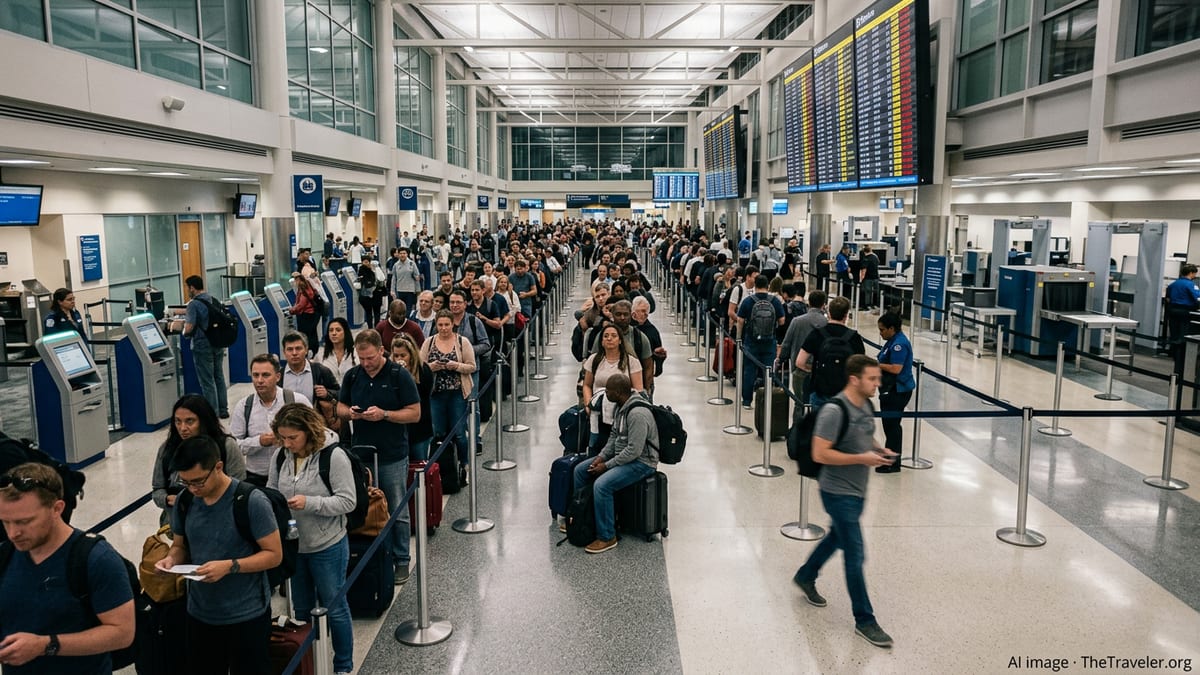
Consumer reports and social media posts in the wake of the November 13 stoppage describe crowded terminals, long security lines that led only to departure boards filled with red “delayed” notices, and passengers asked to disembark from aircraft already boarded. In many cases, travelers learned of the ground stop only after clearing security and discovering that departures nationwide had been frozen.
Publicly accessible data from airport dashboards and airline advisories show that some major carriers temporarily paused ticket sales for near-term departures from heavily affected hubs, hoping to stabilize operations for customers already in the system. Flexible-change policies introduced during the pandemic have given airlines more tools to shift travelers onto later flights, but industry analysts note that limited spare capacity during peak holiday periods makes full recovery from a nationwide disruption more difficult.
These experiences are adding to a steady accumulation of incidents in which technical failures, rather than weather or traditional security threats, become the primary cause of large-scale travel chaos. For passengers, distinguishing between safety-driven caution and underlying systemic fragility is increasingly difficult, which in turn can intensify anxiety about both security and reliability whenever a major outage hits.
Holiday Security Presence Expected to Increase at Major Hubs
While homeland security officials have publicly stated that there is no evidence the November 13 outage was caused by a hostile actor, the abruptness and scale of the ground stop are expected to influence how security is managed during the upcoming Thanksgiving and December holiday peaks. Industry observers anticipate visible increases in law enforcement presence at larger airports, particularly at checkpoints and boarding areas where delays can cause crowding.
Transportation and airport security agencies historically adjust staffing and screening protocols after high-profile incidents, even when those events are ultimately traced to technical faults rather than deliberate attacks. Analysts point to prior years in which additional canine units, more frequent random screening, and secondary identity checks were introduced following major cyber incidents or infrastructure failures that raised questions about system integrity.
Given the overlap between security and operations, airports are also likely to lean on more granular passenger-flow management, including the use of reservation-based security programs and expanded hours for pre-check lanes. Public-facing guidance already encourages travelers to arrive earlier than usual during busy holiday windows, and recent events may prompt airports and airlines to reiterate that advice more forcefully in the days ahead.
At the same time, experts caution that heightened visible security can be a double-edged sword for traveler confidence. For some passengers, more officers and additional screening can be reassuring; for others, it can signal that threats are increasing, even when agencies characterize incidents like the November 13 ground stop as precautionary responses to technical issues.
Policy Debate Grows Over Modernization and Redundancy
The ground stop has quickly fed into an ongoing policy debate in Washington over how aggressively to modernize the nation’s air traffic control infrastructure. Recent government accountability reports highlight the complexity and cost of replacing legacy systems with more resilient, software-driven platforms, while also warning that partial upgrades can introduce new failure points if not carefully managed.
Lawmakers on transportation and homeland security committees have previously pressed the FAA and related agencies to map single points of failure in networks that underpin both flight operations and security screening. The scale of Friday’s disruption, along with comparisons to the January 2023 outage, is expected to add urgency to calls for clearer timelines and funding plans to build in additional layers of redundancy, including backup communications paths and fail-safe procedures that do not require fully grounding departures.
For travelers, the policy discussion may feel distant, but the practical implications are tangible. Investments in more robust communications networks, expanded testing of software updates before nationwide deployment, and improved real-time information sharing between airlines, airports, and passengers could reduce the likelihood that a similar failure will disrupt future holiday seasons.
Until such changes are fully implemented, however, analysts suggest that major technical incidents will continue to test the balance between aviation security and operational continuity, especially during the high-stakes weeks when millions of travelers are relying on a smoothly functioning system to reach friends and family.